Ron pressed his thumb against the synthetic apple, watching the rubbery surface yield and immediately snap back.
Ron's thumb pressed into the synthetic skin of the apple. The material yielded with a squeak, rubbery and defiant, bouncing back to its perfectly spherical, unblemished shape the moment he lifted the pressure. The digital display beneath the plastic crate flickered, cycling through a glitched neon green animation of a smiling sun before abruptly settling on the price.
$40.00.
He blinked. The number remained rigid on the screen. A bead of sweat detached from his hairline, carving a clean, cold line through the grey extraction dust caked across his forehead. The dome's artificial summer protocols were currently trapped in a massive system feedback loop, blasting the Northern Outpost with relentless, humid heat. The climate control fans bolted to the ceiling above hummed a broken, jagged rhythm that rattled the metal shelving.
"Fuck this dystopian bullshit," Ron said.
He didn't whisper it. The words landed flat and heavy on the polished linoleum floor. A passing maintenance drone paused, its optical sensor whirring as the iris expanded. It recalibrated, assessing him as a potential behavioral hazard for exactly three seconds, then rotated on its treads and rolled away down the aisle.
Ron dropped the apple back into the crate. It clattered against the plastic grating like a billiard ball. He wiped his hands on his overalls, the thick industrial fabric stiff with dried slurry from his shift in Sector 4. The commissary was a cathedral of automated disappointment. Endless aisles of brightly packaged nutrient bars and dehydrated protein blocks stood illuminated by harsh, flickering white LEDs. The light cast sharp, unforgiving shadows across the empty checkout lanes.
He turned away from the produce section and walked toward the exit. The sliding glass doors hesitated, grinding violently on their unlubricated tracks before parting just enough for him to squeeze his broad shoulders through the gap. He navigated the subterranean transit corridors, the primary concrete arteries of the settlement. The walls here sweated condensation. Summer in the dome meant the subterranean levels felt like the inside of a malfunctioning terrarium.
He shoved his hands deep into his pockets. The metal shift-tokens rattled against his raw knuckles. Forty dollars. For a sphere of colored cellulose and artificial crunch.
The transit car arrived with a violent screech of metal on metal. Ron stepped inside the empty carriage. The seats were molded plastic, cracked at the edges and slick with the humidity. He sat down hard, staring at his boots. The toe caps were scuffed down to the bare steel. The train lurched forward, throwing him slightly against the scratched plexiglass window.
The screens mounted above the doors played a looping advertisement for the mega-corps' new line of hydration packets. A digitally rendered family smiled with aggressive, unnerving joy, clinking clear plastic pouches together. Ron watched their perfectly aligned, mathematically flawless teeth.
He exited at Level Minus-Three. The corridor leading to his family pod was narrow, lit by alternating amber strip lights. Half of the bulbs were dead, leaving pools of deep shadow between the apartment doors. He keyed his code into the keypad outside Pod 7B. The lock disengaged with a heavy, satisfying clunk.
The door slid open. The pod was cramped, a jigsaw puzzle of mismatched modular furniture and tangled charging cables running across the floorboards. The main ventilation shaft took up a quarter of the living space, a massive, ribbed metal tube that vibrated constantly against the far wall.
Sylvia sat at the cramped kitchenette table. She was massaging her temples with the hard heels of her hands. Her datapad lay flat on the chipped formica, displaying endless rows of patient files in stark white text. The local mental health clinic was chronically underfunded, serving as a dumping ground for the psychological wreckage of the mining sectors.
Jessie was slouched on the worn synthetic sofa. Three holographic screens floated around her head, casting a frantic, strobing blue light across her face. Her thumbs moved in a blur over a heavily modified controller.
Ron stood in the doorway. He looked at the humming metal of the ventilation shaft. He looked at the dust under his fingernails.
"I have a plan," Ron said.
Sylvia didn't look up from her datapad. "If it involves selling plasma again, the clinic already flagged your iron levels."
"No plasma," Ron said. He stepped inside and let the door seal shut behind him. The pod's internal temperature was a muggy eighty degrees. "I went to the commissary."
"Brave," Jessie said. She didn't look away from her game. "Did you buy the fifty-dollar synth-peach or the forty-dollar rubber apple?"
"I bought nothing," Ron said. He walked to the center of the room and tapped his knuckles against the cold steel of the ventilation shaft. "I'm going to grow tomatoes."
Sylvia stopped rubbing her temples. She lowered her hands and stared at him. The bags under her eyes were bruised purple in the harsh pod lighting.
"Tomatoes," Sylvia said.
"Real ones," Ron said. "In dirt."
"Ron, we can't even pay the hydro bill, and you want to be a goddamn dirt-farmer?" Sylvia stood up. Her metal chair scraped loudly against the floor. "Do you know what the penalty is for unauthorized agriculture?"
"I know what the penalty is for starving," Ron said. He crossed his arms. "Or dying of whatever the hell happens when you eat nothing but compressed soy for three years."
Jessie paused her game. The holograms froze mid-explosion. She leaned forward, resting her elbows on her knees. "Where are you getting dirt?"
"I'll figure it out," Ron said.
"Where are you putting them?" Sylvia asked, her voice rising in pitch. "We live in a shoebox, Ron. A hot, underground shoebox."
Ron patted the ventilation shaft. "In here. We open the access panel. We hollow out a section. The air flow is constant. It's warm. We hook up a UV lamp."
Sylvia stared at him for a long time. She looked at his stained overalls, the dirt on his forehead, the manic energy held tight in his shoulders.
"You've finally snapped," Sylvia said. "The extraction fumes finally ate your cortex."
"I saw the apple, Syl," Ron said. His voice dropped. The frantic energy vanished, leaving only a heavy, exhausted truth. "I poked it. It wasn't food. It was an insult. I'm not playing their game anymore."
Jessie tilted her head. The blue light from the frozen screens reflected in her eyes. "You want to steal resources from the corps to grow an illegal vegetable in our walls?"
"Fruit," Ron corrected. "Tomatoes are fruit."
"Whatever," Jessie said. A slow grin spread across her face, pulling at the corner of her mouth. "That is the most unhinged thing I've ever heard." She tapped a button on her controller. The holograms collapsed into a single point of light and vanished. "I'm in."
Sylvia looked from Jessie to Ron. She let out a long, ragged sigh and collapsed back into her chair.
"If we get evicted," Sylvia said, "I'm telling the arbiter this was entirely your idea."
"Noted," Ron said. "Now, we need fertilizer."
The mining facility sat on the edge of Sector 4, a sprawling brutalist structure of reinforced concrete and rusted scaffolding. The perimeter was monitored by automated security drones, their thermal optics sweeping the gravel yard in predictable, overlapping arcs. Ron lay flat on his stomach behind a rusted outloader, the sharp gravel digging into his ribs.
Jessie crouched next to him. She held a small, cobbled-together remote control. Wires spilled out of the plastic casing, taped together with silver adhesive.
"You realize the perimeter bots have thermal optics, right?" Jessie asked. Her fingers hovered over the toggles.
"I know," Ron said. He adjusted his grip on the heavy canvas duffel bag he had dragged from the pod. "That's why you built the decoy."
"It's a toaster duct-taped to a hover-board," Jessie said. "It's going to generate a heat signature, sure, but it moves like a drunk shopping cart."
"It just needs to distract them for sixty seconds," Ron said. He pointed toward a large, cylindrical vat near the loading dock. A thick black hose snaked from the vat into the main processing building. "The waste-paste valve is right there. The shift change is happening now. The dock is clear."
"Waste-paste," Jessie repeated. "We are stealing literal industrial runoff to feed our wall-fruit."
"It's nutrient-dense organic matter," Ron said. "The bi-product of the deep-core algae drills. It's perfect fertilizer."
"It looks like toxic sludge," Jessie said.
"Deploy the toaster," Ron said.
Jessie flipped a switch. Fifty yards away, from behind a stack of shipping containers, a small, boxy object shot out into the open yard. The heating coils inside the toaster glowed bright orange, radiating immense heat. The hover-board underneath it whined, spinning wildly as it hit a patch of uneven gravel. It careened to the left, hit a small rock, and spun in rapid circles.
Immediately, two security drones broke off from their patrol routes. Their optical sensors flashed from green to aggressive red. They glided swiftly toward the spinning, glowing toaster, their mechanical arms extending.
"Go," Jessie whispered.
Ron scrambled up from the gravel. He sprinted across the open yard, his boots pounding against the dirt. The heat from the dome's summer cycle made the air thick and hard to breathe. He reached the cylindrical vat and dropped the duffel bag.
He grabbed the heavy brass handle of the valve. It was stiff. He planted his boots, gritted his teeth, and pulled. The metal groaned, then gave way with a wet sucking sound.
Thick, dark sludge poured out of the nozzle. Ron shoved the open canvas bag underneath it. The paste was heavy, hitting the bottom of the bag with a dense, ugly thud. He watched the level rise, counting the seconds in his head.
Twenty seconds. Thirty seconds.
Across the yard, the drones had cornered the toaster. One of them deployed a suppression net. The net entangled the hover-board's rotors, causing the entire contraption to flip over and spark violently against the gravel.
Forty seconds.
Ron pushed the heavy brass valve back into place. It sealed with a sharp click. He grabbed the handles of the duffel bag. It weighed at least fifty pounds. The canvas strained under the wet, shifting mass inside.
"Dad!" Jessie hissed from her hiding spot. She was waving her arm frantically. One of the drones had turned away from the smoking toaster and was scanning the loading dock.
Ron hoisted the bag over his shoulder. The dampness of the sludge immediately soaked through the canvas, chilling his shoulder blade. He ran. He didn't look back. He sprinted toward the rusted outloader, throwing himself onto the ground beside Jessie just as the drone's thermal laser swept over the spot he had been standing.
The laser hit the metal of the vat, lingered for a moment, then shut off. The drone rotated and returned to its patrol route.
Ron lay in the gravel, his chest heaving. The heavy bag of sludge rested against his side. He looked at Jessie.
"The toaster performed admirably," Ron panted.
"It was a good toaster," Jessie said, staring at the distant, smoking remains of her creation. "Mom is going to be furious about that. She used it for her soy-bread."
"We will buy her a new toaster," Ron said. "With the money we save on groceries. Help me lift this."
They dragged the bag through the shadows, avoiding the main subterranean checkpoints by using the old maintenance tunnels. The tunnels were dark, littered with discarded wire and broken concrete. Every step sent a sharp echo bouncing off the curved walls.
When they finally reached Pod 7B, Sylvia was waiting by the door. She looked at the dripping canvas bag, then at Ron's shoulder, which was stained a deep, muddy brown.
"You're tracking that across my floor," Sylvia said.
"It's contained," Ron said, dragging the bag onto the linoleum. A small drop of sludge fell from the corner of the canvas and splattered on the floor. "Mostly."
Sylvia closed her eyes. "Open the vent. Let's get this over with."
Ron grabbed his toolkit from under the sofa. He unfastened the heavy bolts holding the access panel of the ventilation shaft in place. The metal plate came loose with a harsh scrape. Inside, the shaft was wide enough for a person to crawl through. A steady stream of warm air blew out into the room.
Sylvia handed him a heavy-duty plastic storage bin. "If this leaks into the lower levels, the arbiter will literally throw us into the surface-zone."
"It won't leak," Ron said. He shoved the plastic bin into the vent. He dragged the duffel bag over and began scooping the thick, dark paste into the bin. The texture was horrid, like wet cement mixed with gravel.
Jessie brought over a small, foil-wrapped packet. She tore the corner off. Inside were dozens of tiny, pale seeds. She had traded three fully charged power cells to a black-market botanist in Sector 9 for them.
Ron leveled the paste inside the bin. He wiped his hands on a rag. He looked at his wife and daughter.
"Plant them," Ron said.
Jessie leaned into the vent. She pressed the tiny seeds into the dark sludge, spacing them out meticulously. When she finished, she brushed the dirt off her fingertips.
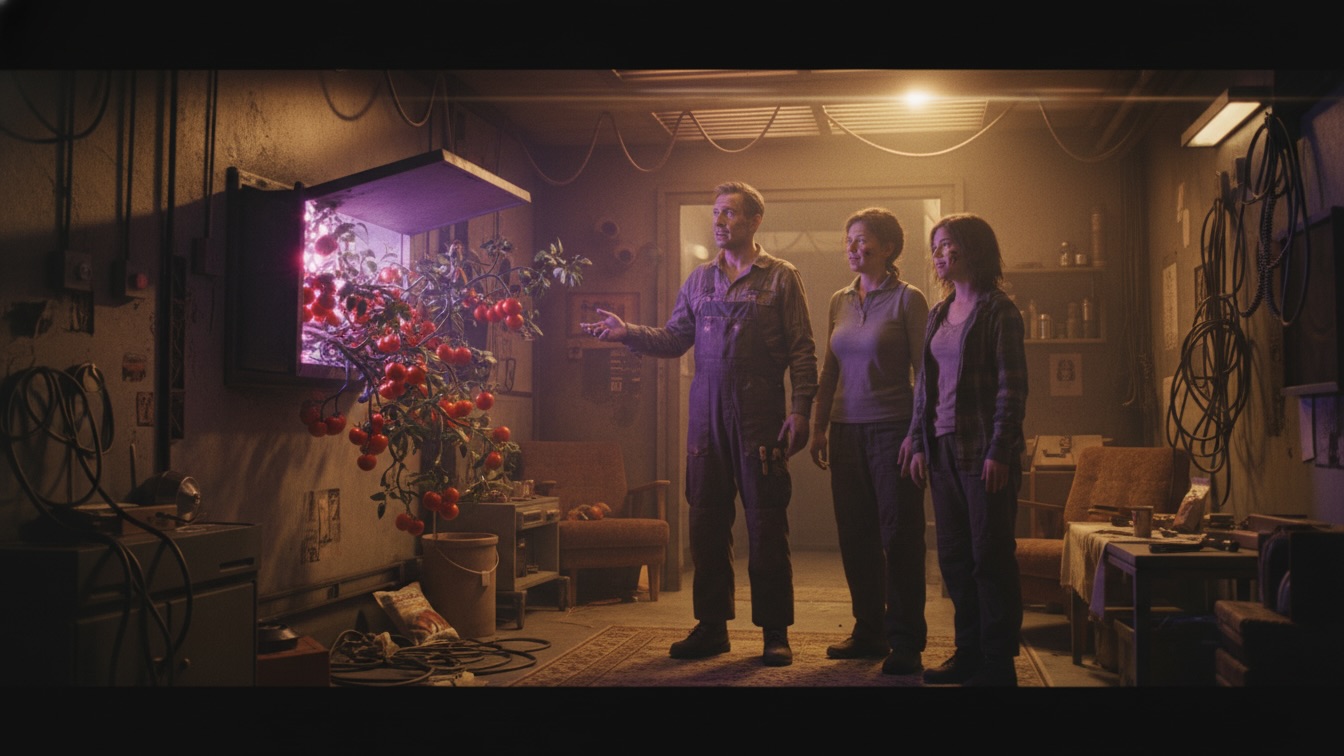
Ron reached into a cardboard box and pulled out a stolen industrial UV lamp. He mounted it to the top of the vent shaft, pointing the bulb directly down at the plastic bin. He plugged the cord into a modified battery pack.
He flipped the switch. A harsh, bright purple light flooded the inside of the metal tube, illuminating the dark soil.
"Now," Ron said, replacing the access panel but leaving a wide gap for the light and air. "We wait."
They sat on the floor of the pod, staring into the purple-lit gap in their wall. The hum of the vent sounded different now. It sounded like a machine with a purpose.
Seventeen days later, the first sprout appeared.
It happened during the third cycle of the artificial summer week. The dome's heat was oppressive, causing the walls of the pod to sweat a thin layer of moisture. Ron was sitting on the floor, his back against the sofa, staring into the gap in the ventilation panel. The purple UV light cast long, strange shadows across his face.
He leaned closer. His knee popped. There, pushing through the dark, crusty surface of the waste-paste, was a tiny hook of pale green.
Ron stopped breathing. He reached out, his thick, calloused finger hovering millimeters above the delicate curve of the plant. He didn't touch it. He just stared.
"Sylvia," Ron said. His voice was a rasp.
Sylvia walked out of the cramped bathroom, a towel around her neck. "The water pressure in the shower is basically a slow drip again. I think the sector valves are—"
"Look," Ron interrupted.
Sylvia walked over. She knelt beside him. She followed his gaze into the purple light.
"Oh," Sylvia breathed.
Jessie dropped out of her bunk bed, her bare feet slapping against the linoleum. She shoved past her parents and peered into the vent.
"It's doing a thing," Jessie said. "It's actually doing a thing."
The three of them sat there in the dim light of the pod, clustered around the metal opening. The frantic energy of their daily lives—the screaming datapad alerts, the flashing holograms, the constant hum of the dome's failing infrastructure—seemed to mute itself. They watched the tiny green hook as if expecting it to move. It was the only living, growing thing in their entirely synthetic world.
Over the next three weeks, the hook became a stem. The stem sprouted jagged, fuzzy leaves. Ron monitored the moisture levels obsessively, using a stolen medical dropper from Sylvia's clinic to administer precise amounts of water. He adjusted the UV lamp every twelve hours.
The plant grew tall, its vines reaching up toward the purple light, winding around the ribbed metal interior of the shaft. Little yellow flowers bloomed, startlingly bright against the industrial steel.
Then, the knocking started.
It was a sharp, authoritative rap on the pod door. Three quick strikes. A pause. Three more.
Ron froze. He was holding the medical dropper over the soil. Sylvia dropped her datapad onto the table. Jessie paused her game.
"Open the door, Sector Resident," a nasal voice called from the corridor. "Corporate Infrastructure Inspection."
"It's Michael," Sylvia whispered, her eyes wide. "The sector inspector. He comes to the clinic sometimes for panic attacks."
"Hide the lamp," Ron hissed at Jessie.
Jessie dove toward the vent. She reached inside and yanked the battery cord from the UV lamp. The purple light vanished, plunging the inside of the shaft into darkness. She grabbed the metal access panel and shoved it back into place, kicking the bottom edge to align the bolts.
Ron shoved the medical dropper into his pocket. He wiped his hands furiously on his pants. He walked to the door and hit the release button.
The door slid open. Michael stood in the corridor. He was a thin man in a sharply pressed grey corporate uniform. He held a large, bulky datapad. He had a severe nervous twitch in his left eyelid.
"Afternoon, Ron," Michael said. He didn't make eye contact. He stared at his datapad. "I'm tracking a localized hydro-anomaly. A massive water-usage spike in this specific corridor."
Ron leaned against the doorframe, blocking the view into the pod. "Water spike? Must be a leak in the main pipes. You know how the infrastructure is in Sector 7."
"My readings indicate the draw is coming directly from your pod's internal junction," Michael said. He tapped the screen. "I need to inspect your sink valves."
Michael stepped forward. Ron didn't move. Michael looked up, his eyelid twitching rapidly. "Ron. Step aside. It's corporate protocol."
"Michael!" Sylvia yelled from inside the pod.
She shoved past Ron, grabbing Michael by the shoulders and pulling him forcefully into the cramped apartment. She spun him around so his back was to the ventilation shaft. Ron stumbled out of the way, watching his wife with wide eyes.
"Sylvia?" Michael stammered, gripping his datapad tightly. "What are you doing?"
"Michael, you look exhausted," Sylvia said. She stepped deeply into his personal space, her voice dropping into a smooth, clinical cadence. "Look at your posture. Your shoulders are touching your ears. Are you internalizing the sector's infrastructure failures again?"
"I... I'm just looking for the water leak," Michael said, trying to look past her. Jessie was currently lying flat on the floor, using her foot to desperately slide the battery pack under the sofa.
"There is no leak, Michael. There is only the pressure you place upon yourself," Sylvia said. She grabbed his elbow and guided him toward the kitchenette table. "Sit down. Sit down right now. We talked about this at the clinic. The corporate hierarchy is a parent-substitute, and you are desperately seeking its approval by chasing ghost-anomalies."
Michael blinked. He sat down rigidly on the metal chair. "I'm seeking approval?"
"Obviously," Sylvia said. She pulled up a chair and sat directly in front of him, blocking his field of vision entirely. "Look at your eye. It's twitching. That's a somatic manifestation of your repressed anxiety. You are projecting a 'water spike' because you feel like you are drowning in your own life."
Behind Michael, Ron was frantically using a rag to wipe away a small puddle of water that had dripped from the medical dropper onto the linoleum. He scrubbed at the floor silently.
"I do feel like I'm drowning," Michael whispered. His grip on the datapad loosened. "The quotas this month... they raised them again. And the dome's summer heat is making everyone aggressive. I had a guy throw a synth-apple at my head yesterday."
Ron paused his scrubbing. He looked at the floor.
"That's trauma, Michael," Sylvia said gently. "You are experiencing occupational trauma. And instead of processing it, you are hunting for pipe leaks in residential pods."
"The datapad doesn't lie, Sylvia," Michael said weakly, but he set the device on the table.
"The datapad only tells you what the corporation wants you to see," Sylvia countered. She leaned forward. "Tell me about your mother. Does she still call you during your shift?"
Michael's shoulders slumped. "Every day. She complains about the ration blocks. She says they taste like dust."
Behind them, Jessie had successfully hidden the battery pack. She gave Ron a frantic thumbs-up. Ron kicked the rag under the counter.
"She's projecting her dissatisfaction with her life onto the food," Sylvia said. She patted Michael's hand. "Just like you are projecting your stress onto our water meter. I want you to go back to your office. I want you to take ten deep breaths. And I want you to close out this anomaly report as a 'system glitch.' Can you do that for your own mental health?"
Michael stared at her. He took a deep, shuddering breath. "A system glitch. Yes. The sensors are old. The heat makes them erratic."
"Exactly," Sylvia said. She stood up and pulled him to his feet. "Boundaries, Michael. You need to set boundaries with the corporation."
She guided him to the door. Michael stepped out into the corridor. He looked back at her, his expression entirely confused but strangely relieved.
"Thank you, Sylvia," Michael said.
"Drink some water, Michael," Sylvia said. She hit the button, and the door slid shut.
The pod was silent. The heavy thud of the door locking echoed in the small space. Sylvia leaned her forehead against the cool metal of the door.
Ron stood up from the floor. He looked at his wife.
"That," Ron said, "was terrifying."
"I am invoicing the clinic for an off-site emergency session," Sylvia muttered. She turned around. "Is the plant safe?"
Jessie walked over to the vent and carefully pulled the access panel away. She plugged the battery pack back in. The purple light flooded the shaft. The plant was entirely intact, its leaves vibrating slightly in the airflow.
"It's fine," Jessie said.
Ron walked over and looked down. Hidden beneath the broad, fuzzy green leaves, resting against the dark soil, were three small, hard green spheres.
"Look," Ron pointed. His finger shook slightly. "They're fruiting."
The tomatoes did not look like the holograms in the commissary. They were not perfectly spherical. They were deeply lobed, ribbed, and misshapen. One of them had a strange scar running down its side. As they ripened, turning from pale green to a deep, bruising red, they swelled unevenly, threatening to burst their own skins.
Ron harvested the first one on a Tuesday. The dome's lighting was simulating a dusky evening. He reached into the vent, his hand trembling, and twisted the heavy red fruit off the vine. It snapped with a crisp, wet sound.
He held it in his palm. It was heavy. It felt entirely different from the rubbery synth-apple. The skin was taut, fragile, and covered in a fine, almost invisible fuzz. He placed it carefully on the kitchenette table.
Sylvia and Jessie stood on either side of the table. No one spoke. The hum of the pod felt distant.
Ron pulled a kitchen knife from the drawer. The blade was dull, used mostly for prying open stubborn nutrient-paste tubes. He pressed the edge against the top of the tomato. The skin resisted for a fraction of a second, then split. A rush of clear juice spilled out onto the cutting board, carrying small, gel-covered seeds with it.
He sliced it into thick, messy wedges. The inside was a chaotic landscape of pulp and seed cavities, completely unlike the uniform, dense texture of corporate food.
He pushed a wedge toward Sylvia. He pushed one toward Jessie. He took one for himself.
"Okay," Ron said.
He picked up the wedge. The juice ran down his fingers, sticky and cold. He put it in his mouth and bit down.
The texture was a violent shock. It was soft, yielding instantly, exploding with liquid. The flavor was sharp, acidic, and wildly sweet. It was chaotic. It tasted like soil, like water, like the purple light, and like the dirty air of the vent. It tasted real.
Ron closed his eyes. He chewed slowly. The acidity bit at the sides of his tongue. He swallowed.
He opened his eyes. Sylvia was staring at the wall, her hand covering her mouth. A single tear tracked through the dust on her cheek. Jessie was chewing rapidly, looking at the remaining slices on the board with an intensity that bordered on feral.
"It's wet," Jessie said. Her voice was quiet. "I didn't know food was supposed to be this wet."
"It's real," Sylvia whispered. She wiped her mouth with the back of her hand. "My god, Ron. It's real."
They stood in the cramped, hot pod, eating the messy, lumpy slices of fruit. The juice stained the cutting board. It stained their fingers. It was a burst of whimsical, messy joy in the center of their bleak, neon-lit lives.
Two days later, they harvested the remaining tomatoes. There were five in total.
"We can't eat all of these before they go bad," Sylvia said, eyeing the red pile on the counter. "And we can't put them in the cooling unit. The power fluctuations will rot them."
"We aren't keeping them all," Ron said. He looked at the door. "Go get Greg and Brenda."
Ten minutes later, the neighbors from Pod 7C stood in the doorway. Greg was a towering man with a permanent slouch, his hands calloused from the hydro-farms. Brenda looked chronically exhausted, her hair tied up in frayed wire.
"Sylvia said there was an emergency," Greg said, looking around the pod nervously. "Did the arbiter find out about the spliced cable? Because I told you—"
"Come inside," Ron said. "Lock the door."
Greg and Brenda stepped in. The heavy door sealed. Ron led them to the kitchenette table. He had arranged the tomatoes on a clean white towel. He had sliced two of them.
Brenda stared at the red wedges. Her mouth opened, but no sound came out. She reached out slowly, her fingers hovering over the fruit just as Ron's had days ago.
"What is that?" Greg asked. His voice was a harsh whisper. "Is that contraband? Ron, are you insane?"
"Eat it," Ron said.
Brenda picked up a slice. She brought it to her mouth. She took a bite. Her eyes widened, snapping to Ron, then to Sylvia. She chewed, swallowed, and let out a sound that was half-laugh, half-sob.
"Greg," Brenda said, grabbing his arm. "Eat it."
Greg took a slice. He threw it into his mouth. He froze. His heavy jaw worked slowly. He looked down at the towel, then up at the ceiling.
"Where did you get this?" Greg asked. The fear in his voice was completely gone, replaced by a desperate, sharp hunger.
Ron walked over to the ventilation shaft. He pulled the access panel away. The purple light spilled out into the room, illuminating the thick green vines and the dark soil.
"I grew it," Ron said. "In the vent. With stolen paste and a UV light."
Greg walked over to the vent. He dropped to his knees, ignoring the dirt on the floor. He stared at the vines. He reached out and touched a leaf.
"The air flow is constant," Greg muttered, his mind working rapidly. "The temperature in the shafts is stable. Every pod in this sector is connected to the same ventilation network."
"Exactly," Jessie said from the sofa. She had her datapad out, pulling up a structural schematic of Sector 7. "There are over two hundred miles of ductwork in the residential zones. It's basically a massive, empty, climate-controlled tube."
Brenda looked at Sylvia. The exhaustion in her face had cracked, revealing something sharp and bright underneath. "If you can do it here, we can do it in 7C. The access panel is right behind our bed."
"We need more waste-paste," Ron said. He leaned against the counter. "And more seeds. And UV bulbs. But yes. We can do it in 7C. We can do it in 7D. We can line the entire network with dirt."
"The corps monitor the water," Greg said, standing up. "They'll see the spike."
"Sylvia handles the inspector," Ron said, grinning. "She therapy-bombs him. It's highly effective."
"We can bypass the main meters," Jessie said, tapping her screen. "I can splice the hydro-lines past the sensors. I did it with our power grid last month."
They stood around the table. The juice from the tomatoes had dried sticky on the wood. Ron looked at his wife, at his daughter, at his neighbors. They were broke, tired, and living in a crumbling subterranean box under a broken artificial sun. The systemic infrastructure around them was completely shattered.
But as Ron watched Greg sketch out ductwork diagrams on a napkin, he realized something profound. They had found a glitch in the concrete. They had found a weird, dirty, beautiful way to fight back together. The mega-corps owned the grocery aisles, they owned the transit lines, and they owned the sky.
But they didn't own the dirt in the vents.
“As Greg tapped the final schematic onto his datapad, the pod's main overhead light flickered, died, and was replaced by the ominous, pulsing red glow of a sector-wide security lockdown.”


