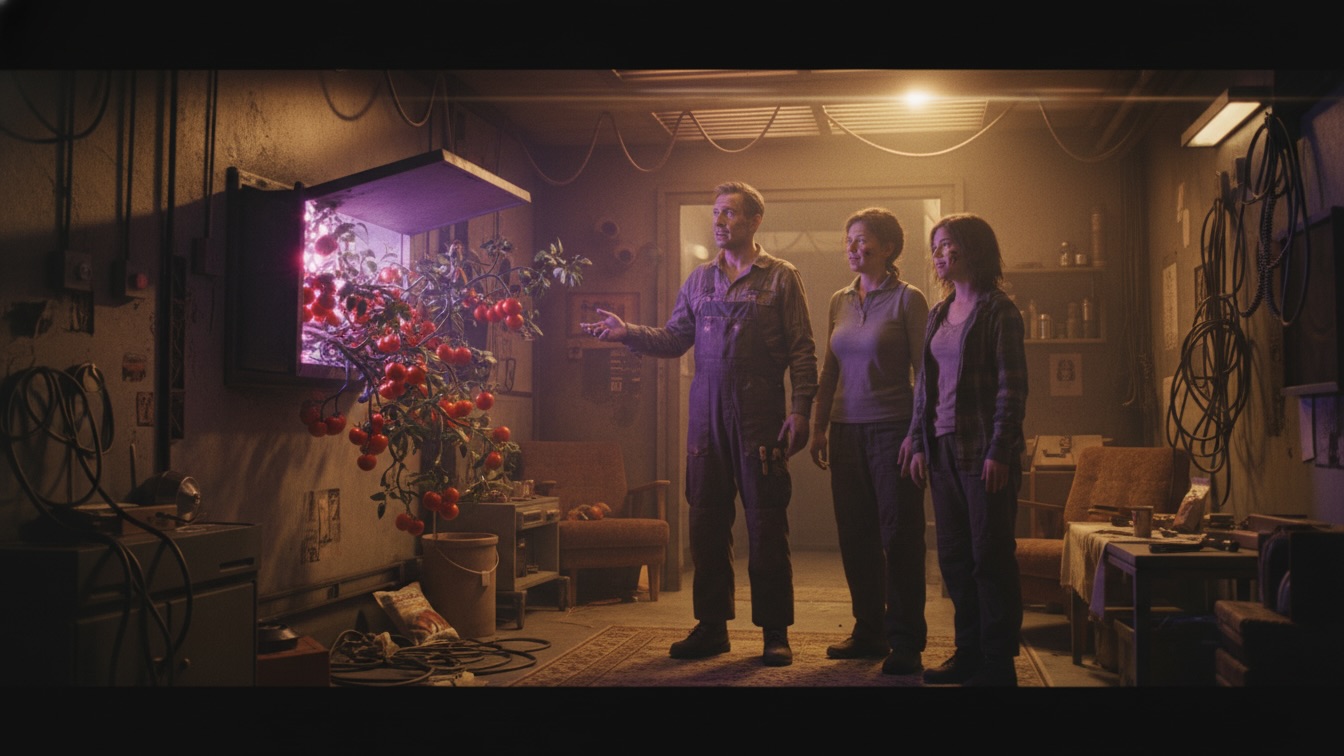
In a claustrophobic, corporate-controlled dome, Ron reaches a breaking point after encountering a forty-dollar synthetic apple that lacks any organic reality. Driven by a desperate need for something authentic, he enlists his wife, Sylvia, and their daughter, Jessie, in a dangerous plan to grow real tomatoes within their pod's ventilation shaft. This endeavor requires them to steal industrial "waste-paste" from a mining sector to use as fertilizer, a feat they accomplish through a clever distraction involving a makeshift decoy.
As the plants begin to grow under a stolen UV light, the family must navigate the constant threat of corporate discovery. When an inspector named Michael arrives to investigate a hydro-anomaly, Sylvia utilizes her professional training as a mental health worker to psychologically manipulate him into ignoring the evidence. Her "therapy-bombing" successfully diverts his attention, framing the technical discrepancy as a manifestation of his own occupational trauma.
The story culminates in the harvest of the first misshapen, vibrant tomatoes, which provide a sensory shock of acidity and sweetness that contrasts sharply with their sterile environment. Realizing the potential for a larger movement, Ron and his family share the harvest with their neighbors, Greg and Brenda. The chapter concludes with the group planning to expand the underground garden throughout the sector’s vast ductwork, turning a survival tactic into a burgeoning agricultural revolution.
The central theme of the narrative revolves around the conflict between authenticity and artificiality within a decaying technological dystopia. The synthetic apple serves as a potent symbol of the corporate world’s failure to provide for the fundamental human spirit, offering only "colored cellulose" instead of true nourishment. By choosing to grow a "messy" tomato, Ron rejects the mathematically flawless but hollow aesthetic of the mega-corps in favor of something imperfect and real.
Another significant theme is the reclamation of agency through the subversion of industrial waste. The family does not seek outside resources to build their garden but instead repurposes the very tools and byproducts of their oppression, such as "waste-paste" and ventilation heat. This transformation of industrial runoff into life-sustaining soil suggests that even in the most rigid systems, individuals can find "glitches" to exploit for their own liberation.
The story also explores the psychological toll of systemic oppression and the various ways characters cope with it. Sylvia’s character illustrates how professional skills can be weaponized as a form of resistance against the state. By treating the corporate inspector’s loyalty as a symptom of mental illness, she effectively deconstructs the authority of the corporation, suggesting that the entire social hierarchy is a "parent-substitute" that fosters unhealthy dependency.
Finally, the theme of community and shared rebellion emerges in the final act. What begins as a solitary act of defiance by Ron evolves into a collective effort that promises to link the entire residential sector. The act of sharing the tomato juice becomes a secular communion, binding the neighbors together in a conspiracy that utilizes the literal "arteries" of the settlement—the ventilation shafts—to spread life rather than just recycled air.
Ron is depicted as a man driven by sensory and moral exhaustion, whose rebellion is sparked by a tactile rejection of the synthetic world. He possesses a rugged, blue-collar pragmatism that allows him to see the ventilation shaft not just as infrastructure, but as a fertile opportunity. His internal state is characterized by a "manic energy" that stems from a refusal to continue playing a rigged game, signaling a shift from passive endurance to active subversion.
He functions as the catalyst for the family's transformation, moving them from a state of survival to one of creation. While he is the one who physically secures the fertilizer and manages the plants, his true strength lies in his vision of a world where food is "wet" and "chaotic" rather than sterile. He is a protector who understands that his family needs more than just calories; they need the "insult" of the rubber apple to be answered with the truth of the dirt.
Sylvia provides the intellectual and psychological backbone of the operation, using her exhaustion as a shield and her clinical expertise as a weapon. She is initially skeptical and weary, burdened by the "psychological wreckage" she treats daily at the clinic. However, her transition from a reluctant participant to a master manipulator shows her deep-seated desire to protect her family's small spark of rebellion.
Her interaction with Michael reveals a sophisticated understanding of how corporate power is internalized by the individual. She does not argue with the inspector on a factual basis but instead destabilizes his sense of self-worth and authority through "therapy-bombing." This demonstrates that her form of resistance is just as vital as Ron’s physical labor, as she manages the human threats to their secret garden with surgical precision.
Jessie represents the intersection of youthful rebellion and technological fluency. She is comfortably situated in the digital world of holograms and controllers, yet she is the first to embrace her father’s "unhinged" plan for physical agriculture. Her ability to build decoys and navigate structural schematics makes her the technical architect of the family's survival strategy.
Her reaction to the first tomato—noting that she didn't know food was supposed to be "wet"—highlights the sensory deprivation of her upbringing. Despite her immersion in a high-tech environment, she finds a "slow grin" of satisfaction in the messy, illegal act of growing fruit. She bridges the gap between the old world of dirt and the new world of hacking, ensuring the rebellion is both grounded and technically viable.
Michael serves as a tragic foil to the family, representing the "psychological wreckage" produced by the corporate hierarchy. He is a man defined by his nervous twitch and his desperate need for approval from a system that views him as a mere functionary. His character illustrates how the corporation uses individuals to police their own neighbors, turning shared suffering into a tool of surveillance.
He is not a villain in the traditional sense, but rather a victim of "occupational trauma" who is easily swayed by Sylvia’s clinical gaslighting. His relief upon being told that the hydro-anomaly is a "system glitch" suggests a deep, repressed desire to be free of his responsibilities. He represents the potential for the corporation’s own agents to become unwitting allies in the underground movement once their psychological needs are addressed.
The narrative voice is marked by a gritty, industrial texture that emphasizes the "brutalist" nature of the setting. The author uses sensory language to create a sharp contrast between the "rubbery" and "defiant" synthetic apple and the "chaotic landscape of pulp" found within the real tomato. This focus on tactile and gustatory details grounds the speculative elements of the story in a visceral reality that the reader can feel and taste.
Pacing is handled with a deliberate tension, moving from the slow, oppressive heat of the opening scenes to the frantic, high-stakes heist of the "waste-paste." The transition into the quiet, suspenseful period of the plant’s growth allows the emotional weight of the project to settle before the climax with the inspector. This rhythmic variation keeps the reader engaged with both the physical danger and the emotional stakes of the family's secret.
The tone is one of weary defiance, blending the bleakness of a dying world with a burgeoning sense of "messy joy." There is a certain irony in the way the characters speak, particularly in the dialogue between Ron and Jessie, which balances the absurdity of their situation with the seriousness of their intent. The prose often mirrors the environment, using words like "slurry," "concrete," and "jagged" to reinforce the harshness of the subterranean life they are attempting to transcend.
Finally, the narrative employs powerful metaphors, such as the description of the commissary as a "cathedral of automated disappointment." This religious imagery suggests that the corporation has replaced traditional faith with a sterile, commercial ritual that fails to provide spiritual or physical sustenance. By contrasting this with the "purple-lit gap" in the wall, the author establishes the ventilation shaft as the new, true site of hope and transformation.


