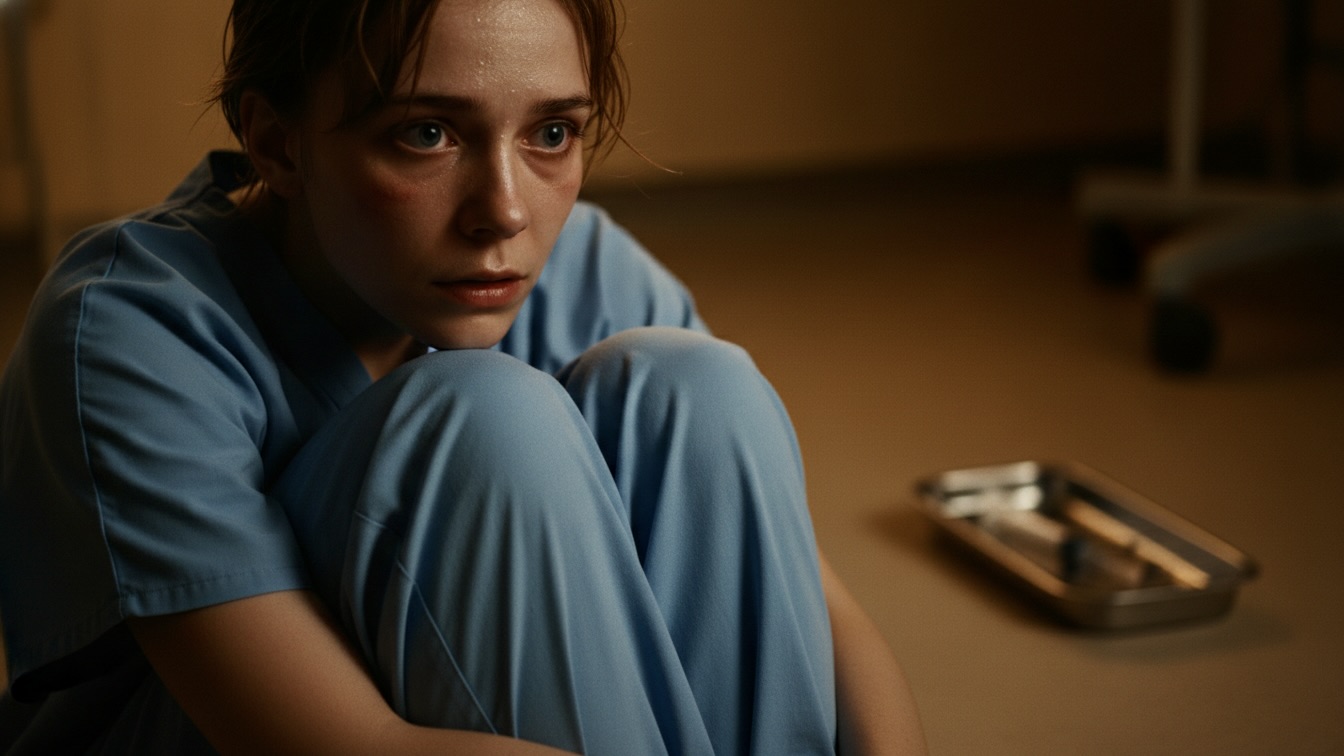
Arnold wakes up in a precinct cell, his ribs screaming as a lawyer delivers a final, sealed state notice.
The first thing I felt was the vibration. Not a sound, but a low-frequency hum coming through the concrete bench and into my skull. It felt like the world was idling at a stoplight it didn't intend to respect. My eyes snapped open, and the fluorescent light overhead felt like a physical slap. It was that flickering, high-yield hospital light, the kind that makes your retinas twitch. My ribs didn't just hurt; they felt like a bundle of dry kindling that had been snapped and then shoved back into my chest at the wrong angle. Every breath was a negotiation. I tried to sit up, and the world tilted forty-five degrees to the left. The handcuffs chattered against the steel rail of the bench, a sharp, rhythmic sound that cut through the hum.
I was in a holding cell. It was small, maybe six by eight, with walls the color of old oatmeal. The air was stagnant. It was mid-August, and even in here, the summer heat was a solid thing, a presence that sat on your skin like damp wool. The precinct AC was probably on its last legs, struggling against the ninety-degree humidity outside. I could see a single, high window with frosted glass. The light coming through was a sickly, bruised orange. Late afternoon. The EMP went off at two. I had been out for hours.
I looked at my wrists. They weren't in zip-ties anymore. Proper steel cuffs now. My skin was purple and swollen where the plastic had bitten in. I tried to remember the last thing I saw. Starley. Starley on the floor, the hornets finally quieted by the black-market pills, but their face... their face was full of a new kind of terror. The clarity of someone who realizes they just signed their own death warrant and the state has already cashed the check.
"You're awake," a voice said. It was flat, uninterested.
I turned my head slowly. A guard was standing outside the bars. He looked like he was twenty-two. He had a buzz cut and a neck tattoo of a barcode that had been partially laser-removed. He wasn't looking at me. He was scrolling through a transparent glass handheld, his thumb moving in a rapid, twitchy blur. The glow from the screen made his face look ghoulish.
"Water," I rasped. My throat felt like I'd been swallowing sand.
"Legal's here," the guard said. He didn't look up. "They've been waiting for forty minutes. You're lucky. Usually, the public defenders don't show up for the terror-tagged until the third day."
"I need... I need to talk to my kid," I said. I forced myself upright. The pain in my side was a white-hot spike. I didn't care. "Starley. At the institute. You have to call them. They were going to—"
"Save it for the suit, Arnold," the guard interrupted. He finally looked at me. His eyes were tired. Not mean, just empty. The look of someone who had seen too many people lose everything to the machine. "I don't record the statements. I just open the doors."
He tapped a command on his handheld. The cell door didn't slide; it clicked and swung open on a heavy hydraulic hinge. He stepped back and pointed down the hall. "Room Three. Don't trip. You look like hell."
I stood up. My legs were heavy, like I was wading through deep water. I walked out of the cell, my hand pressed against my ribs to keep them from shifting. The hallway was more of the same—concrete, flickering lights, the distant sound of a printer jamming somewhere. I reached Room Three. It was a tiny consultation space with a laminate table and two chairs.
A woman was sitting there. She looked younger than the guard. Maybe twenty-four. She had sharp, asymmetrical hair and wore a suit that was two sizes too big, the fabric cheap and shiny. She had three different tablets spread out in front of her, and she was tapping on them simultaneously with both hands.
"Arnold," she said, not looking up. "I'm Elena. Your state-appointed counsel. Sit down. We don't have much time. The prosecutor is already filing for a summary judgment on the EMP charges."
I sat. The chair was hard plastic. I leaned forward, ignoring the fire in my chest. "Forget the charges. The EMP was to get inside. My kid, Starley... they're at the State Psychiatric Institute. They're trying to euthanize them. Today. You have to stop it. They're lucid now. I gave them haloperidol. The consent they signed is invalid."
Elena finally looked at me. Her eyes were dark and rimmed with caffeine-induced shadows. She didn't look sympathetic. She looked like she was calculating the bandwidth it would take to explain reality to me.
"Arnold," she said, her voice dropping into a practiced, efficient cadence. "I've seen your file. I've seen the incident report from the institute. You're being charged with Domestic Terrorism, Level 2. You fried a state facility's power grid. You assaulted a nurse. You're lucky you aren't in a hole in Virginia right now."
"They were killing them!" I shouted. The sound echoed in the tiny room. I winced as my ribs protested. "They used a legal name change as a metric for mental competence so they could trick a schizophrenic into consenting to MAID. It's a budget cut disguised as mercy. You have to subpoena the bloodwork. The haloperidol will be in their system. It proves they weren't in their right mind when they signed the papers."
Elena sighed. It was a long, weary sound. She reached into her bag and pulled out a thick, cream-colored envelope. It looked expensive. Out of place in this room.
"Arnold, listen to me," she said, her voice softening just a fraction. "The state doesn't care about the haloperidol. They don't care about the hornets. They care about the data. And the data says Starley affirmed their identity. The data says the process was followed. I didn't come here to talk about your defense."
She slid the envelope across the table. It was heavy. I looked down at it.
On the back, right over the flap, was a thick glob of black wax. It had been stamped with the seal of the State Department of Health and Human Services. A stylized tree with its roots cut off.
My heart stopped. I knew that seal. Everyone knew that seal. It was only used for one thing.
"What is this?" I whispered. My hands were shaking. I couldn't reach for it.
"It came from the institute," Elena said. "Hand-delivered ten minutes ago. They wanted to make sure you received it before the arraignment."
I stared at the black wax. It looked like a hole in the world. A void.
"Open it, Arnold," she said. "Or don't. But you need to know where we stand before I talk to the DA."
The envelope felt like it weighed forty pounds. I didn't pick it up. I just stared at the black wax. It was glossy, reflecting the shitty overhead lights. It looked like a scab. I could feel Elena watching me. She was back to her tablets, her fingers dancing across the glass, but I could tell she was waiting for the impact.
"They can't have done it yet," I said. My voice sounded like it belonged to someone else. Someone older. Someone who had already lost. "The assessment was for four. The EMP hit at two. They were in the prep room. I was there. I saw them. The meds... the meds take time to work, but they were working. Starley was talking to me. Really talking."
"Arnold, you're not hearing me," Elena said, her eyes still on her screens. "The legal definition of 'competence' was updated in January. It's not about being 'lucid' in the way you mean. It's about 'consistency of self-identity.' The name change? That's a permanent marker of intent. The state views any attempt to reverse that via unapproved medication as a form of chemical assault on the patient's autonomy. You didn't 'save' them. In the eyes of the law, you interfered with a protected medical procedure using an illegal substance."
"An illegal substance? It's haloperidol! It's what they were supposed to be on!" I slammed my handcuffed hands onto the table. The metal hit the laminate with a jarring thud. "The state stopped paying for it! They created the crisis so they could offer the 'cure.' Can't you see that? It's a loop. It's a fiscal loop."
"I see it, Arnold," Elena said, finally setting the tablets down. She leaned in, her face inches from mine. "I see it every day. I represent three kids in the ward next door who are being 'transitioned' out of the system because their foster care vouchers expired. I know exactly what the machine is doing. But I'm a lawyer, not a revolutionary. I work with the statutes we have. And the statutes say that once that seal is on the paper, the case is closed."
I looked at the black wax again. "Closed? You mean they're dead?"
"I mean the state has issued a Finality Directive," she said. She used the term like it was a weather report. Efficiency. That was the 2026 way. Don't say 'death certificate.' Say 'Finality Directive.' It sounds cleaner. It sounds like a software update.
I finally reached out. My fingertips touched the cool, smooth surface of the cream paper. It was thick, high-rag content. The kind of paper used for diplomas or wedding invitations. Or executions. I slid my thumb under the flap, right next to the wax.
"If I open this," I said, "what happens to the charges?"
Elena looked back at her screens. "If the directive is executed, the state usually drops the terrorism charges to avoid a public trial. They'll pivot to 'unauthorized medical interference' and give you five years of house arrest with a neuro-dampener. They want this quiet, Arnold. They don't want a grieving father on the evening news talking about how he tried to save his kid from a budget-mandated needle."
"And if I don't open it?"
"Then we go to arraignment in an hour. You'll be processed as a domestic threat. You'll never see the sun again without a filter. And Starley... Starley's remains will be processed by the state as an unclaimed ward."
Unclaimed. The word felt like a physical blow. Starley wasn't unclaimed. They were right here. They were in my head. They were the kid who used to hide smooth stones in their pockets. They were the nineteen-year-old who liked old synth-pop and hated the way the hospital socks felt on their feet.
I looked at the door. The guard was still there, a shadow behind the frosted glass. The hum of the building seemed to get louder. It was the sound of millions of lines of code, millions of bureaucratic decisions, all grinding toward a single, inevitable point.
"They're doing this because of the name," I muttered. "Because I hesitated. Because I didn't affirm it fast enough."
"The 'Psychological Threat Flag' on your file is what gave them the leverage, yes," Elena said. "Under the 2025 Family Act, parental hesitation is viewed as a precursor to identity-based harm. It allowed the state to bypass your consent entirely. It made Starley a 'self-governing minor-adult.' It's the perfect legal trap. It uses the language of liberation to facilitate the mechanics of disposal."
I felt a sudden, violent surge of nausea. Not from the pain in my ribs, but from the sheer, polished cruelty of it. They had taken my child's struggle for identity and weaponized it. They had turned Starley's search for self into a doorway for the state to exit its obligations.
"I need to see them," I said. "One more time."
"That's not how it works, Arnold. Once the directive is issued, the body is moved to the high-bio-security morgue. No visitors. Contamination protocols. You know the drill."
I gripped the envelope. I didn't open it. I couldn't. Not yet. As long as the seal was intact, there was a quantum possibility that the paper inside was something else. A mistake. A stay of execution. A transfer order.
"Subpoena the bloodwork," I said, my voice cold. "I don't care about the charges. I don't care about the house arrest. I want it on the record that they were lucid. I want the state to have to admit they killed a person who was looking them in the eye and saying 'no.'"
Elena shook her head. "I can't. The judge for your case is Harker. He's the one who signed off on the identity affirmation competence metric. He's not going to reverse himself. He's a true believer in the data."
"Then find someone who isn't," I said. "Find a doctor. A street doc. Anyone who can testify about the haloperidol. I have the name of the guy who sold it to me. He's under the I-95 overpass. Rusted RV."
Elena actually laughed, a short, sharp bark of a sound. "Arnold, you want me to call a black-market pharmacist to testify in a domestic terrorism case? Do you have any idea how fast that would get me disbarred? I'm trying to keep you out of a Level 4 facility. Work with me."
"I am working with you," I said. "I'm telling you the truth. The truth is the only thing I have left."
"The truth is a variable," Elena said, her fingers blurring across the tablet. "The data is a constant. And the data says you're a threat and Starley is a success story for the MAID program. They'll probably use their case as a white paper for the next budget cycle."
I looked at the envelope again. The black wax seemed to be growing, spreading like an inkblot in my vision. The summer heat in the room was suffocating. I could feel the sweat trickling down my spine, stinging the bruises where the guards had kicked me.
"Open it," she whispered. "Just get it over with."
I didn't open the envelope. I shoved it into the pocket of my orange jumpsuit. The heavy paper scraped against my thigh. Elena watched me, her mouth a thin line of disapproval.
"You're making a mistake," she said. "If you don't acknowledge the directive, I can't start the plea negotiations. The DA is going to see your silence as non-compliance."
"Let them," I said. "I want to talk to the guard. The one with the barcode."
"Victor? Why? He's a glorified door-opener. He doesn't have any info."
"He has a handheld," I said. "And he's bored. Bored people look at things they're not supposed to. He was looking at something when I woke up. He wasn't just scrolling. He was watching a feed."
Elena narrowed her eyes. "Arnold, if you're thinking about some kind of digital break-out, forget it. This precinct is hard-wired into the state mainframe. You couldn't hack a toaster in here."
"I'm not hacking anything," I said. "I just want to know what happened after they dragged me out. The ward has cameras. The prep rooms have 'safety monitors.' Everything is recorded for quality assurance. That's the law, right?"
"The law requires it, yes. But those feeds are encrypted. Only the attending physician and the state auditor have access."
"Unless there's a 'Security Breach Protocol' triggered," I said. I remembered the nurse's voice. Code Black. "When I hit that EMP, the whole system went into emergency mode. The local precinct gets a mirrored feed of all high-security incidents in their jurisdiction. It's for coordination. I saw the tech specs when I was researching the EMP."
Elena stopped tapping. She looked at the door, then back at me. Her expression was shifting from annoyance to a strange, professional curiosity. "You're saying Victor might have seen the footage from Prep Room 4?"
"I'm saying he was watching something that made him look like a ghost," I said. "He didn't just see a fight. He saw the aftermath."
Elena sat back, her chair creaking. She tapped her chin with the edge of a stylus. "If I can get access to the mirrored feed through a discovery motion... no, that'll take weeks. They'll have scrubbed the servers by then."
"Victor has it on his handheld," I said. "I saw the reflection in the glass. It wasn't a text file. It was a video loop. He's been rewatching it."
I could see the gears turning in Elena's head. She was a digital native; she knew how the data moved. She knew that in 2026, nothing was ever truly deleted, just moved to a lower tier of visibility.
"Stay here," she said. She stood up, grabbing her bag. "Don't touch the envelope. Don't talk to anyone. I'm going to see if I can 'negotiate' a look at Victor's logs."
She left the room, the door clicking shut behind her. I was alone.
I leaned my head against the laminate table. The plastic was cool against my forehead. I thought about Starley. I thought about the way they used to hold their breath when they were nervous, a tiny, rhythmic puff of air that only I could hear. I wondered if they were holding their breath when the needle went in. Or if they were screaming.
I reached into my pocket and felt the envelope. The black wax was warm now, softened by my body heat. It felt like skin. I closed my eyes and I could see the prep room. The amber emergency lights. The smell... no, I couldn't smell. I just saw the way the light glinted off the syringe. The clear liquid. The 'compassion.'
Ten minutes passed. Then twenty. The hum of the building seemed to vibrate in my teeth. I could hear distant sirens, the sound of the city continuing to exist despite the hole in my heart. The summer sun was setting, casting long, sharp shadows through the frosted window. The orange light was fading into a deep, bruised purple.
The door opened. Elena came back in. She looked pale. Her hands were shaking as she set her tablet down on the table.
"Did you see it?" I asked, sitting up.
She didn't answer right away. She tapped a command, and a video file began to load. The screen was grainy, captured from a handheld recording a screen. A mirror of a mirror.
It was Prep Room 4. The camera angle was high, looking down at the recliner. I saw myself being dragged out by the guards. I saw the door splintered on the floor. And then I saw Starley.
They were on their knees, exactly where they had been when I was taken. Dr. Cuppe was standing over them. He was talking, but there was no audio. His gestures were calm, measured. He held the tray out.
Starley was shaking their head. I could see the movement, even in the low-res footage. They were saying something. Over and over. They were looking at the camera. They knew someone was watching.
Then, the nurse—the one I had shoved—came back into the frame. She had a bruise on her cheek. She was holding a second syringe. Not the clear one. A smaller one with a yellow cap.
"What is that?" I whispered.
"Chemical restraint," Elena said, her voice barely audible. "Protocol 204. If a patient revokes consent in a state of 'acute agitation,' the facility is authorized to administer a sedative to 'stabilize the decision-making environment.'"
I watched as the guards pinned Starley to the floor. It was brutal. Efficient. They didn't hit them; they just used their weight. The nurse stepped in and jammed the needle into Starley's thigh.
Starley went limp. Not unconscious, but heavy. Their eyes were still open, but the light was gone. The haloperidol lucidity was being buried under a layer of state-mandated fog.
Dr. Cuppe waited. He checked his watch. He waited exactly two minutes. Then, he picked up the first syringe. The one with the clear liquid.
He didn't hesitate. He didn't say a prayer. He just found the vein in Starley's arm and pushed the plunger.
I watched my child's body give one final, convulsive shudder. And then they were still.
Dr. Cuppe stepped back. He looked at the camera. He didn't look guilty. He looked like a man who had just finished a very long, very tedious spreadsheet. He reached out and tapped a button on the wall.
The screen went black.
"He did it," I said. The words didn't feel like they had any meaning. "He watched them say no, and he did it anyway."
"He followed the protocol," Elena said, her voice cracking. "The Protocol 204 sedative 'validated' the original consent by removing the 'interference' of your black-market drugs. He made it legal, Arnold. He made the murder legal."
I felt something break inside me. Not a bone. Something deeper. The part of me that believed in the rules. The part of me that thought if I just showed them the truth, they would have to stop.
I reached into my pocket and pulled out the envelope. I didn't care about the wax anymore. I ripped it open.
Inside was a single sheet of paper. It wasn't a death certificate.
It was an invoice.
State Psychiatric Institute - Billing Department Patient: Starley (RE: Arnold) Service: MAID Track 3 - Completed Protocol 204 Supplemental - Completed Facility Damage Surcharge (EMP) - $42,500.00 Final Disposition Fee - $2,100.00
Total Due: $44,600.00
At the bottom, in small, efficient type: Failure to remit payment within 30 days will result in an automatic lien against all personal assets and future earnings.
I stared at the numbers. The cost of my child's life. The cost of the electricity I fried. The cost of the needle that killed them.
"They're charging me," I said. I started to laugh. It was a horrible, wet sound. "They killed them, and they're charging me for the service."
Elena didn't say anything. She just looked at the invoice. The bruised orange light from the window was gone now, replaced by the harsh, flickering white of the precinct. The summer night was beginning, and the world was exactly the same as it had been that morning. Except it wasn't.
The precinct felt different now. The hum of the walls wasn't a background noise; it was a heartbeat. The machine was breathing, and I was inside its chest. I looked at Elena. She looked like she wanted to disappear. She was a part of this, too. Her shiny suit, her tablets, her 'summary judgments.' She was the grease on the gears.
"What do we do now?" she asked. It was the first time she hadn't sounded like a lawyer. She sounded like a twenty-four-year-old girl who was realizing she lived in a slaughterhouse.
"I'm not paying," I said. I folded the invoice and put it back in the envelope. "I'm not paying for the needle."
"Arnold, they'll garnish your wages. They'll take your car. They'll take everything."
"They already took everything," I said. I stood up. My ribs screamed, but I didn't flinch. The pain was a tether. It kept me in the room. It kept me from floating away into the dark. "I want to talk to Victor again."
"Why? You saw the footage. It's over."
"It's not over," I said. I looked at the camera in the corner of the room. I knew someone was watching. I knew the data was being logged. "Victor didn't just watch the feed because he was bored. He watched it because he knew Starley. He was from the same neighborhood. I saw his tattoo. It's a local set. He's not a true believer. He's just a guy with a job."
I walked to the door and pounded on the frosted glass. "Victor! Open up!"
"Arnold, stop!" Elena hissed. "You're going to get us both flagged!"
I ignored her. I pounded again. "Victor! I know you saw it! I know you saw the nurse!"
The door clicked and swung open. Victor was standing there, his handheld tucked into his belt. His face was a mask of neutral indifference, but his hands were buried deep in his pockets.
"Keep it down," he said. His voice was a low rumble. "You're making a scene."
"The nurse used Protocol 204," I said, stepping into the hall. He didn't push me back. "She used it to nullify the revocation. That's a violation of the 2026 Medical Ethics Code, Section 8. You know it, and I know it. And your handheld has the timestamp."
Victor looked at Elena, then back at me. "I don't know what you're talking about. I was checking the perimeter feeds."
"Liar," I said. I leaned in close. I could see the sweat on his upper lip. The summer heat was finally winning. "You watched it three times. You watched Dr. Cuppe check his watch. You watched the kid die. Does that sit well with you, Victor? Is that what the barcode is for? So you can be a good little product?"
Victor's jaw tightened. I saw a flash of something in his eyes. Not anger. Shame. The only thing the machine couldn't quite optimize out of the human hardware.
"The feed is encrypted," he said. "Even if I had it, I couldn't export it. The system would flag the outbound packet."
"Not if you use a physical bridge," Elena said. She was standing in the doorway now, her tablet held out. Her voice was steady. "I have a localized peer-to-peer override. If you plug your handheld into my port, I can mirror the screen without hitting the network. It's a legal loophole for discovery evidence."
Victor looked at the tablet. He looked at the hallway cameras. He was calculating the risk. In 2026, the risk was everything. One bad data point and you were out. No job, no credits, no identity.
"If I do this," Victor said, his voice barely a whisper, "I'm a dead man."
"If you don't," I said, "you're already dead. You're just waiting for the invoice."
Victor stood still for a long time. I could hear the hum of the building, the sound of the air conditioning failing, the sound of the city breathing. The silence was heavy, a physical weight in the hallway.
Then, he reached for his belt. He pulled out the handheld. He didn't look at it. He just handed it to Elena.
"Thirty seconds," he said. "That's all the bridge can handle before the watchdog triggers."
Elena didn't waste a heartbeat. She snapped a cable from her bag and connected the two devices. Her fingers moved with a frantic, digital efficiency. A progress bar appeared on her screen. Ten percent. Twenty.
I watched the bar. It was the only thing in the world. The only thing that mattered. The data. The truth. The variable.
Fifty percent. Sixty.
"Come on," Elena muttered. "Come on, you piece of junk."
Eighty percent.
A red light began to blink on the wall above the door. A soft, rhythmic chime echoed down the hall.
"Watchdog's active," Victor said, his face going pale. "Unplug it! Now!"
Elena ripped the cable out just as the chime turned into a steady, high-pitched scream. She shoved her tablet into her bag and turned toward the exit.
"I have it," she said. She looked at me, her eyes wide with a terrifying, desperate light. "Arnold, I have the footage. The unredacted version."
Victor grabbed me by the arm and shoved me back into the consultation room. "Get in there! Don't come out until the sergeant shows up!"
He slammed the door and locked it. I heard his footsteps running down the hall. The alarm continued to shriek, a mechanical bird mourning the loss of its secrets.
I sat down in the plastic chair. I felt the envelope in my pocket. The black wax. The invoice. I looked at the frosted window. The night was pitch black now, but I could see the reflection of the room. I looked like a ghost. A man with broken ribs and a dead child and a stolen video file.
I knew what was coming. They would find the bridge. They would trace the data. They would come for Elena, and they would come for me. The machine didn't like variables. It liked constants. It liked people who paid their invoices and signed their consent forms and died on schedule.
But for one night, the machine had a glitch.
I leaned back and closed my eyes. I didn't think about the trial. I didn't think about the house arrest. I thought about the lake. I thought about the smooth stones. I thought about Starley, nineteen years old, standing on the shore, looking at the water.
"We're going to burn it down, kid," I whispered into the empty room. "We're going to burn the whole budget."
The door to the precinct lobby burst open. I heard heavy boots on the concrete. The guards were coming. Not for a consultation. Not for a legal talk.
They were coming to close the account.
“The heavy steel bolt of the door groaned as a battering ram struck from the other side, and I knew this time, they weren't coming to talk.”