Format: Short Film / Anthology Episode | Est. Length: 10-12 minutes
Imagine a world where the horizon is a permanent haze of orange smog and the very act of breathing is a transaction; Seventy Percent Humidity serves as a pilot or standalone entry in an anthology series titled The Last Green. The series follows various "low-tier" citizens who discover and protect illegal, non-engineered biological artifacts—seeds, insects, or clean water—within a hyper-digitized, corporate-governed dystopia. Each episode explores the tension between the sterile safety of the "Upper Tier" and the organic, decaying reality of the "Districts," building toward a season-long narrative of a biological uprising.
Leo stands on a rickety stage in a sweltering community hall, his corporate lanyard sticking to his sweaty neck, as he tries to sell a starving, angry crowd on the idea of trading their thumbprints for "guaranteed" food paste. The tension peaks when his sister, Mia, refuses to look at him, and he feels the illegal, wilting tomato seedling in his bag pulse with a desperate need for water.
In a resource-starved future where nature is a crime, a corporate messenger must choose between his job and the survival of an illegal heirloom seedling. As the city’s power is cut, he risks everything to plant a "stubborn spark" of life in the ruins of a dead park.
The primary theme is the reclamation of humanity through the preservation of nature. The story pits the "Bio-Credit" system—a cold, data-driven method of survival—against the "Cherokee Purple" seedling, which represents beauty, history, and unmonitored life. It explores the moral cost of complicity, as Leo realizes that his "blue lanyard" makes him a tool of the very system that is starving his neighbors.
The secondary theme is the "solarpunk-noir" aesthetic of hope amidst decay. While the world is a "pressure cooker" of heat and corruption, the sudden rainstorm at the climax suggests that the Earth is not yet dead, only dormant. The episode functions as a meditation on the idea that survival is not just about calories, but about having something "that isn't theirs."
For Leo, the stakes are existential: if he is caught with the seedling, he faces the loss of his credits, his job, and a sentence in a reclamation camp. For the district, the stakes are life and death, as their refusal to register for Bio-Credits leads to a total energy blackout during a lethal heatwave. The seedling itself carries the weight of a lost world; its death would symbolize the final victory of the Board over the organic past.
The primary external conflict is between Leo and "The Board," personified by his supervisor, Miller, who views the district as a failing spreadsheet. Miller represents the cold, predatory nature of corporate governance that uses hunger as a lever for data collection. Internally, Leo struggles with his identity as a "messenger" for the oppressors while his sister, Mia, and the community leader, Arthur, provide the moral friction that forces him to acknowledge his own betrayal of his people.
Leo, a low-level registrar for the corporate Board, attempts to pitch the "Bio-Credit" biometric food system to the residents of a sweltering, impoverished district. The meeting turns hostile as Arthur, a man who once taught Leo’s sister how to fix a bike, calls out the Board’s corruption and the diversion of water to the Upper Tier. Leo, hiding an illegal Cherokee Purple tomato seedling in his backpack, feels the weight of his hypocrisy as his own sister, Mia, refuses to acknowledge him. When the registration quota isn't met, Leo’s supervisor, Miller, threatens him with termination and hints at the impending "de-prioritization" of the district.
Following a warning from Mia that the neighborhood council is targeting him, Leo retreats into the maintenance tunnels beneath the city. As the Board cuts the district’s power in retaliation for the failed registration, Leo makes a desperate trek to a derelict park. He plants the seedling in the dry earth of a broken fountain, rigging a crude drip-irrigation system from the fountain's leaks. A sudden, natural rainstorm breaks the heat dome, and Leo shields the plant with his body, finally severing his ties to the Board. He returns home to find Mia gone to join the resistance, leaving him a note to "keep the spark alive."
Leo (The Protagonist): Leo begins as a weary pragmatist, wearing his corporate lanyard like a leash and justifying his complicity as a means of survival. His psychological arc moves from a state of paralyzed fear and "thin" vocalization to a state of quiet, grounded rebellion. By the end, he is no longer a "Board boy" but a guardian of the soil, finding peace in the dirt and the rain.
Mia (The Catalyst): Leo’s sister is the moral compass of the story, representing the silent, simmering rage of the district. She starts the episode in a state of disappointed withdrawal, unable to look at the brother she perceives as a traitor. Her arc is one of transition into active resistance, eventually leaving Leo behind to join the underground movement, though her final note shows a lingering hope for his redemption.
Miller (The Antagonist): A mid-level corporate enforcer who smells of expensive cologne and "air-conditioned air." Miller is psychologically detached from the suffering of the districts, viewing the residents as data points to be manipulated. He serves as the personification of the Board’s "optimized" world, where everything—including Leo—is replaceable.
Arthur (Supporting): An elder statesman of the district whose face is a "map of exhaustion." He represents the memory of a better world and serves to remind Leo of the community he has abandoned for the sake of his credits.
The Presentation: Leo stands on a stage in 70% humidity, his tablet glitching from sweaty palms as he attempts to convince forty starving people to trade their biometric data for food paste. Arthur interrupts the pitch, exposing the lie that the district's water pumps failed mechanically when they were actually diverted to the Upper Tier. The scene ends with the crowd walking out and Mia leaving Leo alone under a flickering, distorted barcode projection.
The Threat: Miller arrives in the empty hall, his expensive suit a stark contrast to the grime, and informs Leo that the district’s energy subsidies will be pulled if registration doesn't hit the quota by Friday. Miller nearly discovers the illegal seedling in Leo’s bag, asserting his power by reminding Leo that he is easily replaced by anyone in the "slum." Leo feels the "leash" of his lanyard tighten as Miller exits, leaving him in the oppressive silence of the hall.
The Sub-Levels: Leo hides in the maintenance tunnels, sharing his last drops of water with the wilting seedling while navigating the "hidden city" his father once showed him. He receives a chilling text from Mia warning him not to come home because "they're looking for you," signaling his total exile from both the Board and his family. In the darkness, he realizes the seedling is the only thing he has left that isn't a lie, and he commits to saving it.
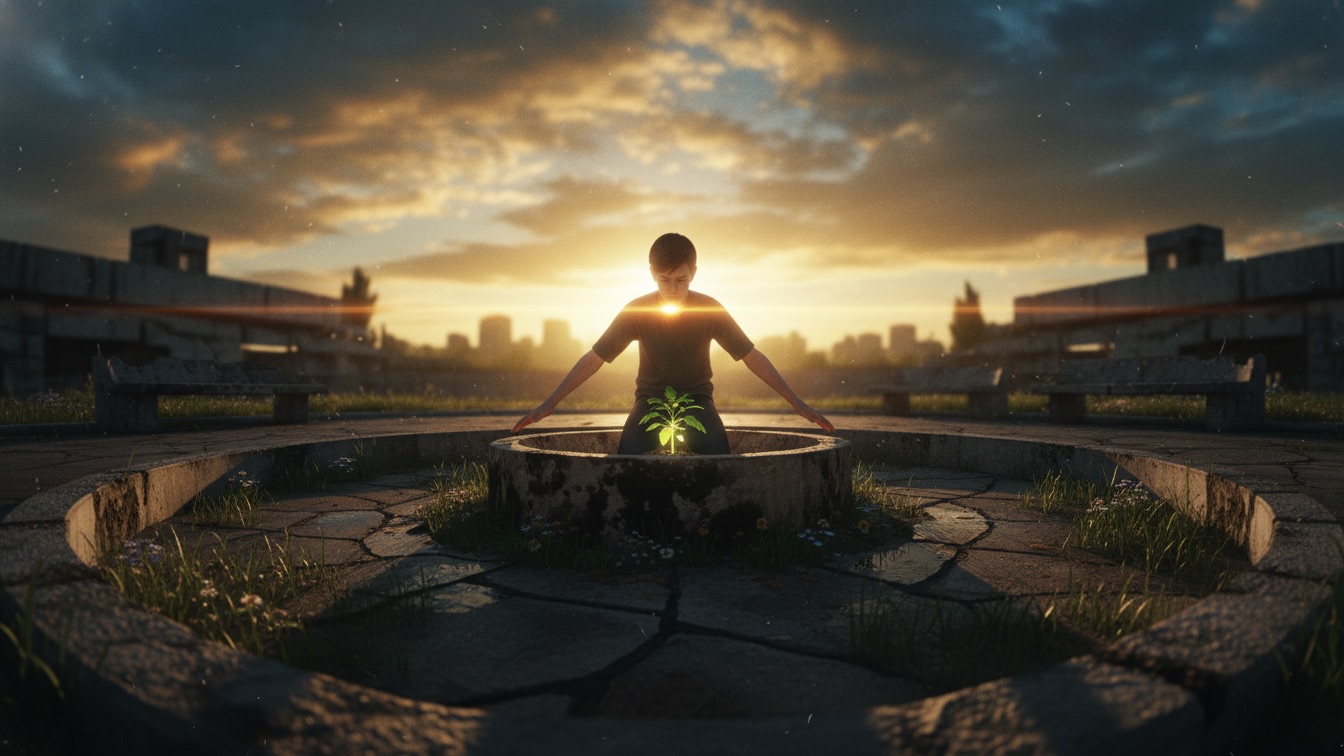
The Planting: Under the cover of a total district blackout, Leo sneaks into a derelict park and digs into the "poison" dirt near a dry fountain. He rigs a makeshift drip-irrigation system using a plastic tube and his broken tablet casing to catch a slow leak in the fountain's pipes. Mia finds him there, and they share a final, tense moment where she reveals the neighborhood's plan to burn the registration terminals before she vanishes into the shadows.
The Storm: As the heat dome reaches a breaking point, a natural rainstorm—the first in months—slams into the city, washing away the smog and grime. Leo laughs in the deluge, shielding the fragile Cherokee Purple with his hands as the "Board's" power over the weather is proven a fallacy. The scene captures a sensory shift from the "metallic tang" of the paste to the "crisp" smell of clean air and wet earth.
The Spark: Leo returns to his apartment to find it empty, Mia having fled to join the resistance, leaving only a note that reads "Keep the spark alive." He sits in the morning sun, his hands stained with "real dirt," and realizes he has finally disconnected from the machine. The episode ends with Leo looking toward the park, committed to his new role as a guardian of the illegal growth in the ruins.
The episode begins with a suffocating sense of claustrophobia and dread, mirrored by the thick, "breathed-in" air of the community hall. As Leo moves into the tunnels, the mood shifts to isolation and paranoia, a "migraine in the making" where every sound is a threat. The climax in the park offers a cathartic release; the transition from the dry, rhythmic drip of the fountain to the overwhelming power of the rainstorm provides a sensory explosion of relief. The final mood is one of quiet, resilient hope, shifting the audience from the anxiety of the system to the peace of the natural world.
If expanded, the season would follow Leo as he becomes an accidental figurehead for a "Green Underground." The Cherokee Purple seedling would serve as the first of many "biological keys" that can bypass the Board’s synthetic food monopoly. Leo would have to navigate a double life, using his remaining corporate access to sabotage the Bio-Credit system while Mia leads the overt, violent resistance in the streets.
The thematic escalation would focus on the Board's attempt to "sanitize" the districts by deploying biological agents to kill the emerging natural growth. The season finale would center on the first harvest of the tomato, where the act of eating "real food" becomes a revolutionary act that spreads across multiple districts. Leo and Mia’s relationship would serve as the emotional core, exploring whether a world can be rebuilt through growth (Leo) or if it must first be burned down (Mia).
The visual style is Industrial Decay vs. Biological Vibrancy. The Districts are shot with a shallow depth of field, using sickly yellows, oranges, and grays to emphasize the heat and smog. In contrast, the "Cherokee Purple" seedling is the only source of true, saturated color—a vibrant, deep green and eventually a rich purple—making it pop against the monochromatic grime of the city. The camera work should feel handheld and intimate during Leo’s moments of panic, transitioning to wide, stable shots when the rain begins to fall.
Tonal comparables include the gritty, lived-in futurism of Children of Men and the atmospheric tension of Blade Runner 2049. The sound design is crucial: the constant, "insect-like" whine of the projectors and the hum of the power grid should be replaced in the final act by the organic, chaotic sounds of the storm and the "gurgling" of the fountain pipes.
The target audience is adults (18-45) who gravitate toward speculative fiction, environmental thrillers, and "solarpunk" aesthetics. It appeals to viewers who enjoy grounded, character-driven dystopias like The Last of Us or Silo, focusing on the human spirit's resilience against systemic oppression. The short-form format makes it ideal for anthology platforms or as a high-impact digital pilot.
The pacing follows a "Pressure Cooker" structure, where the first 6 minutes are a slow, agonizing build-up of heat and social tension. The midpoint (the blackout) triggers a faster, more kinetic pace as Leo moves through the tunnels and the park. The final 2 minutes slow down significantly, allowing the audience to breathe with the protagonist and absorb the sensory shift of the rainstorm and the morning light.
Practical Effects: The rainstorm should be a practical effect to ensure the visceral reaction of the actor and the physical impact on the "dirt" are authentic. The seedling itself should be a high-quality practical prop or a real plant to maintain the "spark" of reality that the story demands.
Lighting: The transition from the "murky, gray twilight" of the hall to the absolute darkness of the blackout requires careful use of diegetic light sources, such as Leo’s dying LED flashlight and the "sickly glow" of light pollution. The final scene in the apartment should use naturalistic, soft morning light to contrast with the harsh, flickering fluorescent lights of the opening.


