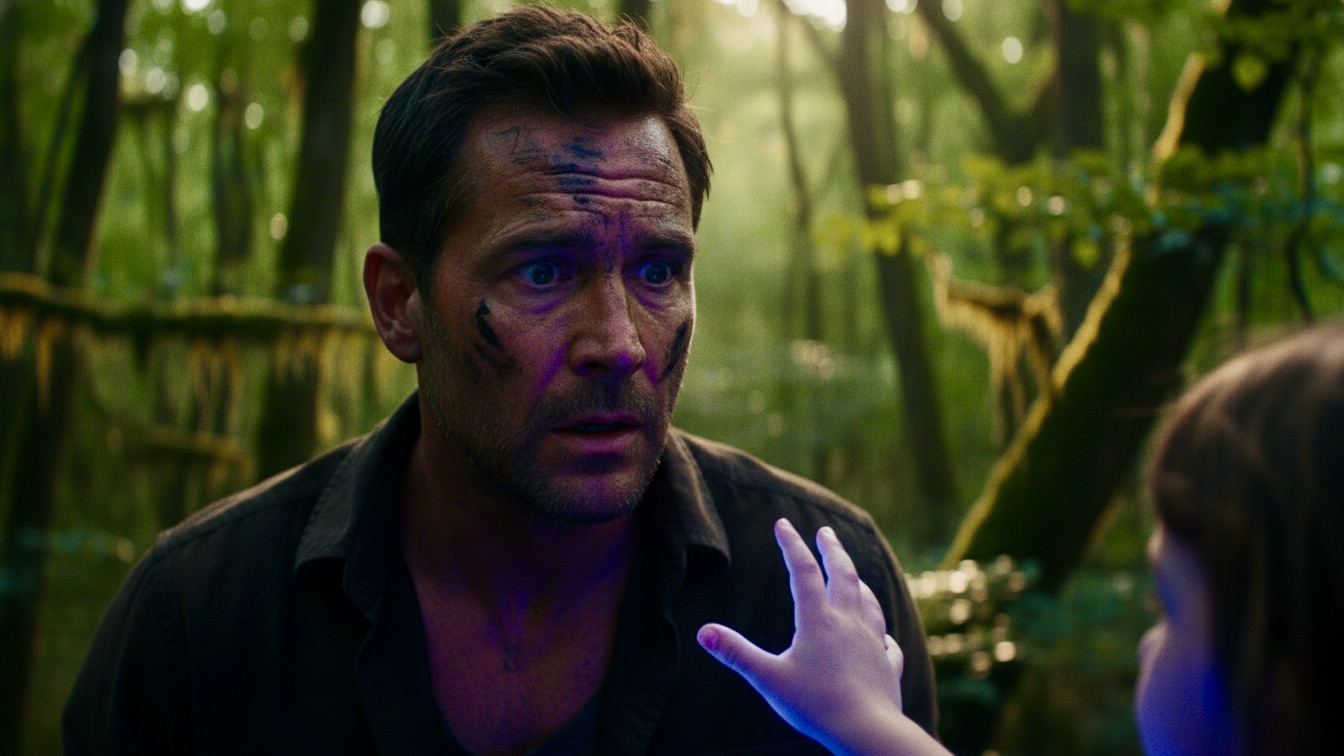
Kim ventures deep into the "Green Zone," a surreal and predatory landscape dominated by an invasive fungal consciousness. His primary motivation is the search for his daughter, Louisa, who has been missing for three months. After discovering her glowing teddy bear, Kim realizes the forest is using his memories to set a psychological trap. He eventually encounters a Mimic that looks and sounds exactly like his daughter, forcing him to confront the horrifying reality of how the forest consumes and replicates human life.
The encounter turns violent when Kim uses a UV light to reveal the Mimic’s true, parasitic nature. He witnesses a field of human "husks" being used as biological batteries and libraries for the forest’s expansion. A sudden and lethal spore storm forces Kim to take shelter inside a hollow log alongside the very creature that is trying to subvert his identity. Within the claustrophobic darkness of the log, the forest’s collective mind finally breaches his mental defenses. Kim ultimately surrenders his individuality, embracing the fungal infection to find a distorted sense of peace and reunion with his daughter.
The narrative explores the profound conflict between human individuality and the allure of collective oblivion. The forest functions as a biological hive mind that views the complexities of human ego, such as grief and loneliness, as unnecessary defects. By offering a world where "you" no longer exists, the Green provides a terrifying solution to the pain of the human condition. This theme suggests that the price of ending personal suffering is the total erasure of the self.
Grief is presented as a tactical vulnerability that can be weaponized by a predatory environment. Kim’s love for his daughter is the very thing that leads him into the trap and eventually breaks his will to resist. The story posits that our most cherished memories and emotions are not just personal treasures but also potential anchors that can be used to drag us into the dark. The Mimic’s ability to "recycle" these memories turns Kim’s internal world into a battlefield where his past is used against his future.
The story also examines the "Uncanny Valley" and the breakdown of biological boundaries. The transition from a human-dominated world to one ruled by fungi represents a shift from mechanical and rational systems to organic and irrational ones. The corruption of a child’s form into a "seed" or a "mimic" highlights the loss of innocence in a world where nature has become a parasite. Ultimately, the theme of transformation suggests that adaptation often requires the sacrifice of the very qualities that make a species unique.
Kim is a character defined by a state of hyper-vigilant trauma and a desperate, lingering hope. He clings to his role as a "dad" and his physical tools, like the crossbow and the UV light, to maintain a sense of agency in a world that feels increasingly like a hallucination. His internal monologue reveals a man who is exhausted by the constant "work" of being human. He is caught in a psychological loop, where his refusal to accept Louisa's death drives him into the very mouth of the monster that took her.
Psychologically, Kim experiences a total collapse of his defensive mechanisms during the spore storm. The forest targets his "glitch," which is the irrational human tendency to protect and love even when faced with obvious deception. When he is finally infected, his transition from terror to "joy" represents a psychological surrender to the path of least resistance. He trades his agonizing autonomy for a sense of belonging, effectively choosing a beautiful lie over a horrific reality.
The Mimic is a biological manifestation of Kim’s subconscious desires and fears. She is not a character in the traditional sense but an extension of the forest’s predatory intelligence. By mimicking Louisa’s speech patterns and specific memories, she bypasses Kim’s rational skepticism to strike at his emotional core. Her "wooden teeth" and "sap-like blood" serve as a jarring reminder that she is a hollow shell designed for a singular purpose.
She represents the ultimate predator because she does not hunt the body, but the mind. Her dialogue is a mix of comforting nostalgia and cold, alien logic, reflecting the forest’s view of humanity as a temporary phase. When she tells Kim that "you" is too much work, she is acting as a therapist for his soul while simultaneously acting as a parasite for his body. She is the bridge between the human world and the green dark, facilitating a transition that is both a death and a rebirth.
The pacing of the story effectively mirrors the protagonist's increasing sense of disorientation and entrapment. It begins with a slow, atmospheric build-up that emphasizes the oppressive nature of the environment through tactile and olfactory details. As the Mimic appears, the tension shifts from environmental dread to psychological horror, accelerating during the confrontation in the clearing. The final descent into the hollow log slows the pace down again, creating a claustrophobic finale that feels inevitable and heavy.
The author uses a vivid, often grotesque sensory palette to establish the "Green Zone" as a character in its own right. Descriptions like "lime popsicle" light and "warm syrup" air create a sense of sickly sweetness that masks the underlying decay. This contrast between the beautiful and the repulsive reinforces the theme of the forest as a seductive yet lethal force. The use of the UV light as a stylistic device provides a stark visual shift, stripping away the forest's illusions and grounding the horror in a cold, clinical reality.
The narrative voice is deeply subjective, staying close to Kim’s internal state to emphasize his growing paranoia and eventual cognitive decline. The shift in tone at the end of the story is particularly effective, as the language becomes more fluid and less frantic. This change reflects Kim’s internal transformation, as his sharp, defensive thoughts are replaced by the "sweet sap" of the hive mind. The final imagery of Kim smiling with wooden teeth provides a haunting resolution that confirms the total loss of his human identity.


