Format: Short Film / Anthology Episode | Est. Length: 10-12 minutes
This narrative serves as a visceral entry point into a world where biological horror meets psychological fragility, inviting the audience to envision a series where the environment itself is the primary antagonist. Through a lens of hyper-saturated decay and intimate grief, the story explores the terrifying beauty of a world that no longer belongs to humanity, setting the stage for a broader exploration of survival and surrender in the face of an inevitable green apocalypse.
The series, titled The Green Dark, is an anthology set in a post-cataclysmic era where a sentient, invasive fungal network has terraformed Earth into a predatory ecosystem. Each episode follows different survivors navigating the "Green Zones," where the forest utilizes stolen memories and biological mimics to harvest the remaining human population. The overarching narrative arc traces the slow collapse of human individuality as the global hive mind prepares for a final "Rebirth Storm" that will assimilate all terrestrial life.
Kim, a grieving father armed with a salvaged crossbow, ventures into a reality-warping fungal forest after finding his missing daughter’s clean hair tie. His hope is instantly weaponized against him when he discovers her glowing teddy bear pulsing in time with his own heartbeat.
A desperate father hunts for his missing daughter in a sentient forest that uses his own memories to lure him into a parasitic trap. He must choose between the agony of his human loss or a blissful, wooden-toothed union with the hive mind.
The episode explores the intersection of grief and biological horror, examining how the human desire for closure makes individuals vulnerable to predatory manipulation. It portrays grief not just as an emotional state, but as a tactical weakness that the "Green" exploits to bypass the survival instincts of its prey.
Furthermore, the story delves into the loss of self-identity and the seductive nature of collectivism. It contrasts the "messy" and painful struggle of human existence with the eerie, effortless peace of the fungal network, questioning whether the preservation of the individual is worth the cost of perpetual suffering.
For Kim, the stakes are both existential and physical; he risks losing his humanity to become an "incubator" for the forest’s expansion. If he fails to resist the Mimic’s psychological assault, he will not only die but will be recycled into a vector for the Spore-Storm, ultimately aiding in the extinction of the final human scrap-forts.
The primary external conflict is the "Green," a sentient fungal intelligence that utilizes Mimics—biological puppets crafted from harvested memories—to pacify and consume human subjects. Internally, Kim battles a debilitating paternal guilt and the overwhelming urge to surrender to a reality where his daughter is still alive, even if that reality is a parasitic illusion.
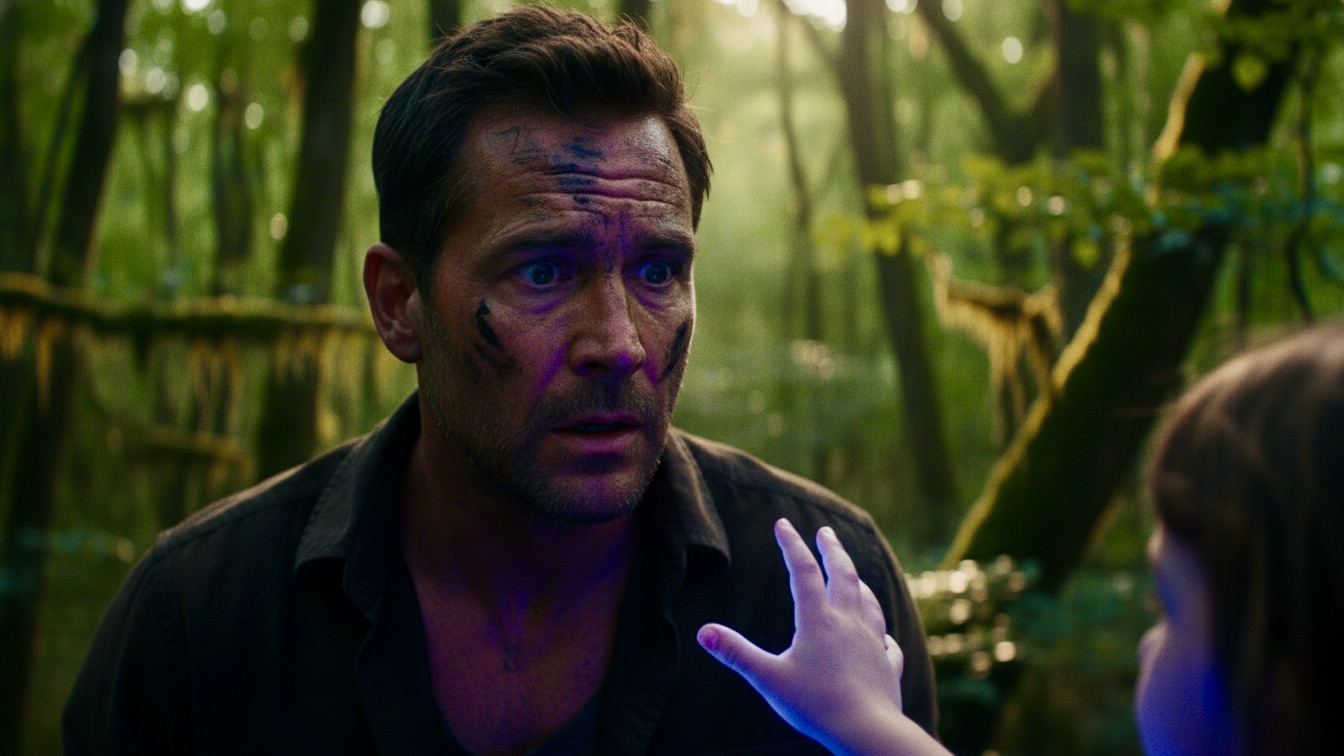
Kim traverses the surreal, lime-colored landscape of the Green Zone, discovering his daughter’s glowing teddy bear and encountering a Mimic that perfectly replicates her appearance and intimate childhood memories. Despite his UV light revealing the creature's horrific fungal nature and the field of human husks surrounding it, the Mimic uses private secrets to erode Kim's resolve as a lethal Spore-Storm descends upon the forest.
Kim and the Mimic take refuge inside a rotted redwood log that acts as a digestive organ, where the creature finally pierces his skin with a fungal filament to link him to the network. Instead of a painful death, Kim experiences a euphoric connection to the hive mind, seeing his daughter’s consciousness distributed within the moss and trees, leading him to discard his mask and embrace his transformation into a wooden-toothed seed of the forest.
Kim: A rugged survivor defined by hyper-vigilance and a refusal to accept the "Green" as a finality. At the start, he is a cynical hunter clinging to his salvaged crossbow as his only tether to reality, but his psychological defenses are systematically dismantled by the forest's mimicry. By the end of the episode, he has undergone a total psychological and physical capitulation, transitioning from a grieving father to a content, non-human extension of the fungal collective.
The Mimic (Louisa): A predatory manifestation of the forest's intelligence, appearing as a seven-year-old girl in a denim jacket. It transitions from a sympathetic, lost child to a cold, manipulative puppet-master, using its wooden teeth and silver threads to demonstrate that it is merely a tool of a much larger consciousness. It functions as a mirror for Kim’s desires, proving that the forest’s greatest weapon is its ability to provide a horrific version of what its victims miss most.
The Descent: Kim enters the Green Zone, struggling through deep moss and green water while his watch spins backward, signaling the high concentration of reality-warping spores. He finds Louisa’s glowing teddy bear, Barnaby, and realizes the forest is actively recycling his daughter’s belongings to set a psychological trap. He stands firm, gripping his crossbow, but the oppressive, "breathing" silence of the forest begins to erode his composure before he hears a familiar voice calling from the brush.
The Encounter: A girl matching Louisa’s description steps into the light, claiming she has been waiting in the shade, but Kim uses a UV flashlight to reveal her as a fungal puppet connected to the trees by silver threads. The Mimic mocks his humanity and reveals its jagged wooden teeth, showing him a field of human husks that serve as the forest's "library" of consumed souls. Kim fires his crossbow and ignites a fire-bomb to escape the creature's reach, but the sudden arrival of a Spore-Storm forces him into a desperate retreat.
The Assimilation: Kim and the Mimic take shelter inside a hollow log where the walls begin to sprout filaments that seek his flesh, offering him a choice between lonely survival or a blissful reunion with Louisa’s stored memories. The Mimic pierces his neck with a fungal needle, flooding his mind with the collective consciousness of the forest and showing him that Louisa is "distributed" throughout the ecosystem. Kim finally removes his mask to breathe in the spores, his teeth turning to wood as he steps out into the storm, no longer a man but a seed.
The episode begins with high-tension paranoia and sensory revulsion, characterized by the "sticky" and "gross" atmosphere of the Green Zone. It shifts into a heart-wrenching psychological drama during the confrontation with the Mimic, where the horror is grounded in emotional violation. The finale concludes in a state of eerie, horrific euphoria, moving from the frantic pace of survival to a slow, serene acceptance of the protagonist's own monstrous transformation.
If expanded, the season would follow the slow encroachment of the "Green" on the final human scrap-forts, with the transformed Kim serving as a recurring "herald" who lures other survivors into the forest. Each episode would focus on a different survivor’s specific grief or desire, showing how the forest tailors its Mimics to exploit unique human weaknesses, such as a soldier’s guilt or a leader’s exhaustion.
The overarching narrative would build toward the "Rebirth Storm," a global event where the forest’s mycelium finally breaches the walls of the last human strongholds. The season finale would reveal that the forest is not merely a predator, but a terraforming project meant to prepare Earth for a post-human era, leaving the audience to question if the "Green" is a villain or a necessary, albeit terrifying, evolution of life.
The visual style is "Bio-Luminescent Noir," utilizing a palette of sickly lime greens, bruised purples, and neon blues against the dark, rotting textures of the forest. The camera work should be claustrophobic and handheld during Kim’s trek to emphasize his isolation, transitioning to smooth, ethereal glides once the forest begins to take over his mind.
The tone is a blend of Annihilation’s surreal biological horror and the emotional weight of The Last of Us. Tonal comparables include the body horror of David Cronenberg mixed with the atmospheric dread of The Ritual, emphasizing the "wet" and "sticky" nature of the environment to create a sense of physical discomfort for the viewer that mirrors the protagonist's internal decay.
The target audience includes fans of high-concept sci-fi horror and psychological thrillers, specifically those aged 18-45 who enjoy anthology series like Black Mirror or Love, Death & Robots. It appeals to viewers who appreciate "elevated horror" that prioritizes thematic depth and atmospheric dread over traditional jump scares, as well as fans of post-apocalyptic fiction that explores the end of the human species.
The pacing is a "slow-burn crawl" that accelerates into a frantic, claustrophobic climax during the storm. The first four minutes focus on world-building and sensory dread, the middle four on the psychological dialogue between Kim and the Mimic, and the final four on the sensory overload of the Spore-Storm and Kim’s ultimate transformation. The 10-12 minute runtime ensures a tight, focused narrative that emphasizes the inevitability of the forest's victory.
The production requires extensive use of practical "slime" and fungal prosthetics to achieve the tactile, "sticky" feel of the Green Zone, particularly for the Mimic’s wooden teeth and the silver threads. The UV light sequence necessitates a specialized lighting rig that can shift the entire set’s color profile instantly to reveal the hidden fungal networks, creating a "shattering" effect for the audience.
The "hollow log" set should be designed as a modular, organic space that can "grow" filaments using pneumatic effects to simulate the forest's hunger. Sound design is critical, requiring a layered "hive-mind hum" that transitions from a distant bee-like buzz to a multi-tonal orchestral swell during the final assimilation scene to represent the overwhelming scale of the collective consciousness.


