The story begins with Leo, a man attempting to undergo a "low-information diet" to escape the crushing weight of global digital noise. He sits in a park during an oppressive heatwave, having powered down his phone to find a moment of peace. His solitude is interrupted by Maya, a friend who is hyper-stimulated by the constant stream of digital crises. She informs him of a potential water main hack, but their focus quickly shifts when they discover a ruggedized, encrypted USB drive hidden in the dirt.
Their discovery triggers a physical pursuit by mysterious men in a black SUV. Leo and Maya flee through the sweltering city streets, eventually seeking refuge in a laundromat and then an analog repair shop owned by Maya’s cousin, Sam. Inside the shop, they bypass the drive's encryption and discover a chilling spreadsheet. Rather than global secrets, it contains a list of local citizens marked for "neutralization" to clear the way for a development project. The global news Maya had been tracking served as a mere smokescreen for these local atrocities.
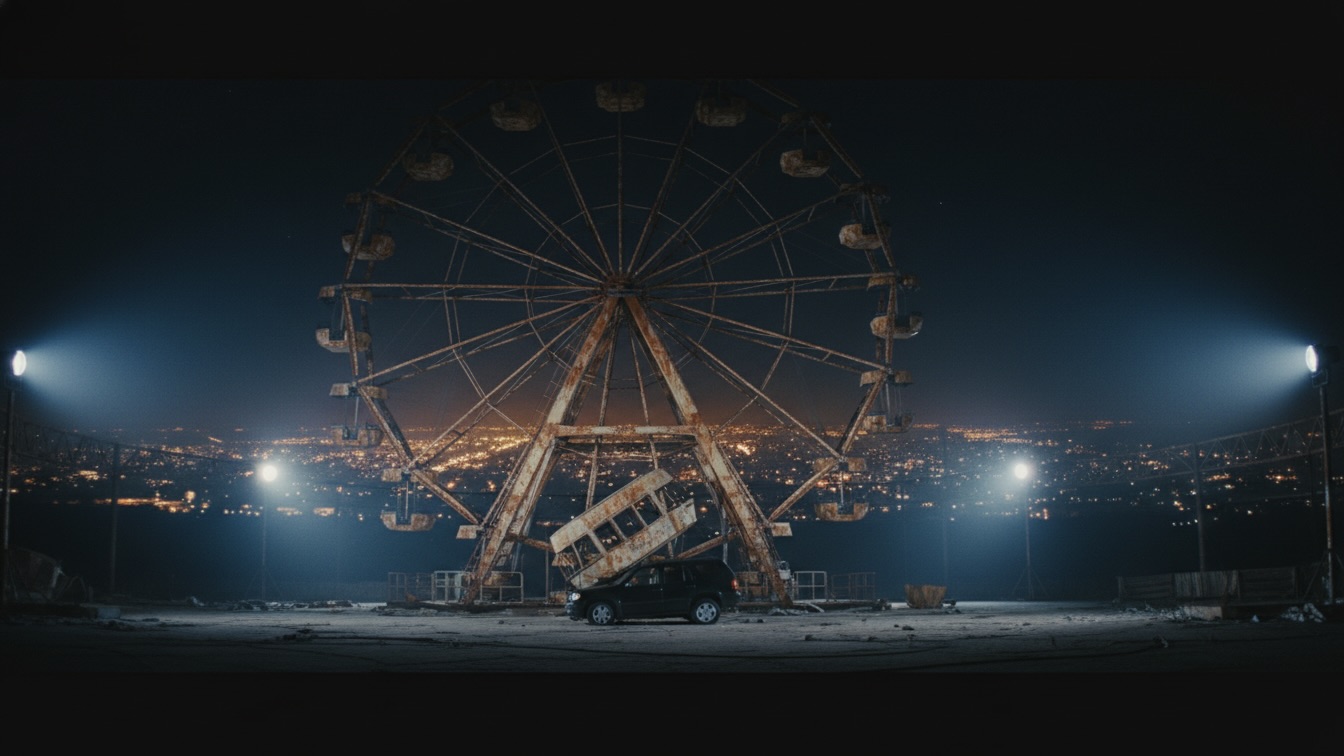
The antagonists track the power usage of the shop, forcing Leo and Maya to flee into subway maintenance tunnels. They emerge at an abandoned fairground where they are cornered by the men from the SUV. In a final act of desperation and resourcefulness, Leo uses the mechanical override of an old Ferris wheel to create a chaotic distraction. They escape the fairground and head toward a physical newspaper office, now fully committed to using the information they have to fight back against the corruption.
The central theme of the narrative explores the paralyzing effect of the modern digital landscape on the human psyche. Leo’s attempt at a "low-information diet" highlights the psychological exhaustion caused by "doom-scrolling" and the constant delivery of global trauma. The story suggests that the human brain is not evolutionarily equipped to process the collective suffering of eight billion people. This digital saturation creates a state of apathy or ineffective anxiety, which the protagonist desperately tries to avoid by disconnecting.
However, the story subverts the idea that simple disconnection is a viable solution. While Leo seeks peace through ignorance, the plot reveals that the "noise" of the digital world often serves as a tactical distraction. The global crises Maya follows are real, but they function as a smokescreen for local, tangible corruption that directly impacts their immediate environment. The narrative posits that true awareness is not about knowing everything happening globally, but about understanding the power structures operating in one's own backyard.
Another significant theme is the loss of agency in a data-driven world. Sam’s observation that people are merely "tenants in a digital world" reflects a psychological sense of displacement. The characters realize that even when they attempt to opt out, the physical and digital infrastructure of the city continues to track them as data points. The transition from being passive consumers of information to active participants in a local struggle represents the reclamation of their own lives and stories from the cold logic of "transactions."
Leo begins the story as a man in retreat, suffering from a profound sense of psychological burnout. He views the world through a lens of defensive apathy, believing that by shrinking his world, he can protect his sanity. His decision to power down his phone is an act of self-preservation, but it also borders on nihilism. He initially dismisses Maya’s concerns and the mysterious USB drive because he is terrified of being drawn back into the "garbage fire" of modern existence.
As the threat becomes physical, Leo’s character shifts from avoidant to protective and eventually to proactive. He realizes that his "low-information diet" was a luxury that left him vulnerable to the very reality he was trying to ignore. By the end of the chapter, his skepticism has transformed into a sharp, dangerous focus. He no longer seeks to hide from the world; instead, he chooses to engage with it on his own terms, using his surroundings to fight back against those who view people as mere obstacles to progress.
Maya serves as the psychological foil to Leo, representing the high-anxiety state of the hyper-connected individual. She is physically and mentally ravaged by her constant engagement with the digital feed, appearing much older than her twenty-one years. Her obsession with the "water hack" and other global crises is a manifestation of her need for control in an unpredictable world. She believes that if she can just see enough data, she can somehow navigate the chaos.
Through the course of the chase, Maya undergoes a sobering realization about the nature of the information she consumes. She discovers that her focus on global outrage blinded her to the disappearance of people in her own community. This realization brings a "terrifying clarity" to her character. She stops being a victim of the algorithm and starts using her technological literacy for a specific, local purpose. Her growth is marked by her willingness to smash her own phone, symbolizing her break from the digital leash that previously controlled her.
Sam represents the cynical wisdom of those who understand the underlying architecture of the modern world. He lives in a "cave of junk," surrounded by analog technology that cannot be easily tracked or manipulated by the grid. His character provides the necessary bridge between Leo’s desire for disconnection and Maya’s technological immersion. He understands that while the digital world is a facade, the physical infrastructure it controls is very real and very dangerous.
Psychologically, Sam is a man who has already accepted the grim reality that "nobody owns their life anymore." He is wary and survival-oriented, initially wanting nothing to do with the trouble Leo and Maya bring to his shop. Yet, his willingness to help them and his knowledge of the "Black-Box" drives suggest a past of quiet resistance. He acts as a mentor who strips away the characters' illusions, forcing them to see the world as a series of cold, calculated transactions rather than a narrative they can simply opt out of.
The pacing of the story expertly mirrors the psychological escalation of the characters. It begins with a slow, sweltering lethargy that reflects Leo’s attempted detachment, with long descriptions of the oppressive heat and the melting asphalt. As soon as the USB drive is introduced, the rhythm shifts into a high-tension thriller. The sentences become shorter and more punchy, reflecting the adrenaline and "respiratory soup" of the characters as they sprint through the city.
The author uses sensory details to ground the high-concept themes of digital surveillance in a visceral, physical reality. The heat is not just a setting; it is an antagonist that presses down on the characters like a weight. The contrast between the "hot grass and car exhaust" of the park and the "cool, damp air" of the tunnels emphasizes the transition from the public, watched world to the hidden, analog underworld. These sensory shifts help the reader feel the characters' desperation and the physical stakes of their journey.
The narrative voice is colored by a sharp, cynical irony that serves as a defense mechanism for both the protagonist and the author. Leo’s internal monologue is filled with observations about "sanity going to die" in the comments section and the absurdity of a "low-information diet" in a high-stakes chase. This tone provides a layer of social commentary that elevates the story from a simple pursuit plot to a deeper exploration of modern life. The final shift in tone from irony to grim determination signals the characters' psychological readiness to face the conflict ahead.


