Format: Short Film / Anthology Episode | Est. Length: 10-12 minutes
Imagine a high-tension anthology series titled The Signal Noise, where each episode explores the terrifying intersection of digital overload and physical reality. In a world drowning in 4K trauma and algorithmic distractions, the series follows ordinary people who stumble upon "the signal"—tangible, dangerous truths hidden beneath the static of global crises. This episode serves as a standalone entry that establishes the series' core conceit: that the most significant threats are often local, physical, and obscured by the very technology designed to keep us "informed."
In the midst of a record-breaking heatwave and a city-wide infrastructure hack, a young man’s attempt at a "digital detox" is shattered when his friend discovers an encrypted drive hidden in the dirt of a public park.
A disconnected cynic and his news-obsessed friend must survive a deadly manhunt after discovering a physical hit list hidden within a digital smokescreen. They must navigate a melting city to expose a local conspiracy before they become the next "resolved" entries on the drive.
The primary theme explores the "low-information diet" versus the necessity of local awareness, questioning whether global connectivity serves as a distraction from immediate, tangible threats. It delves into the weaponization of chaos, where large-scale digital crises—like water main hacks or grid failures—are manufactured to provide cover for localized, predatory political agendas.
The story also examines the psychological toll of the digital age, contrasting Leo’s forced apathy with Maya’s paralyzing anxiety. It suggests that true presence in the modern world requires a rejection of the "infinite feed" in favor of direct, physical action within one's immediate environment.
For Leo and Maya, the stakes are immediate survival against a professional extraction team that views them as loose ends in a high-stakes urban redevelopment scheme. On a broader level, the failure to deliver the drive means the permanent "neutralization" of local community leaders and the total erosion of truth in their city. If they are caught, the evidence of a localized purge vanishes, and the "noise" of the global crisis will successfully swallow the lives of those on the list.
The external conflict is a high-tension chase through a sweltering urban landscape, pitted against a technological surveillance apparatus that tracks the protagonists via the power grid and traffic sensors. This is personified by the "Hoodie Guy," a cold, transactional operative who views human lives as data points to be "resolved." Internally, Leo struggles with his desire for apathy and isolation, while Maya must overcome the paralyzing anxiety induced by the very digital world she is trying to save.
Leo is attempting a "phone-free" day in a sweltering park when Maya arrives, panicked by news of a city-wide hack. Their world narrows when they find a ruggedized USB drive and are immediately pursued by a mysterious black SUV, forcing them into a desperate flight through the city’s underbelly. They seek refuge in an analog repair shop where they decrypt the drive, revealing it isn't a global virus but a targeted hit list of local activists being "resolved" under the cover of the chaos.
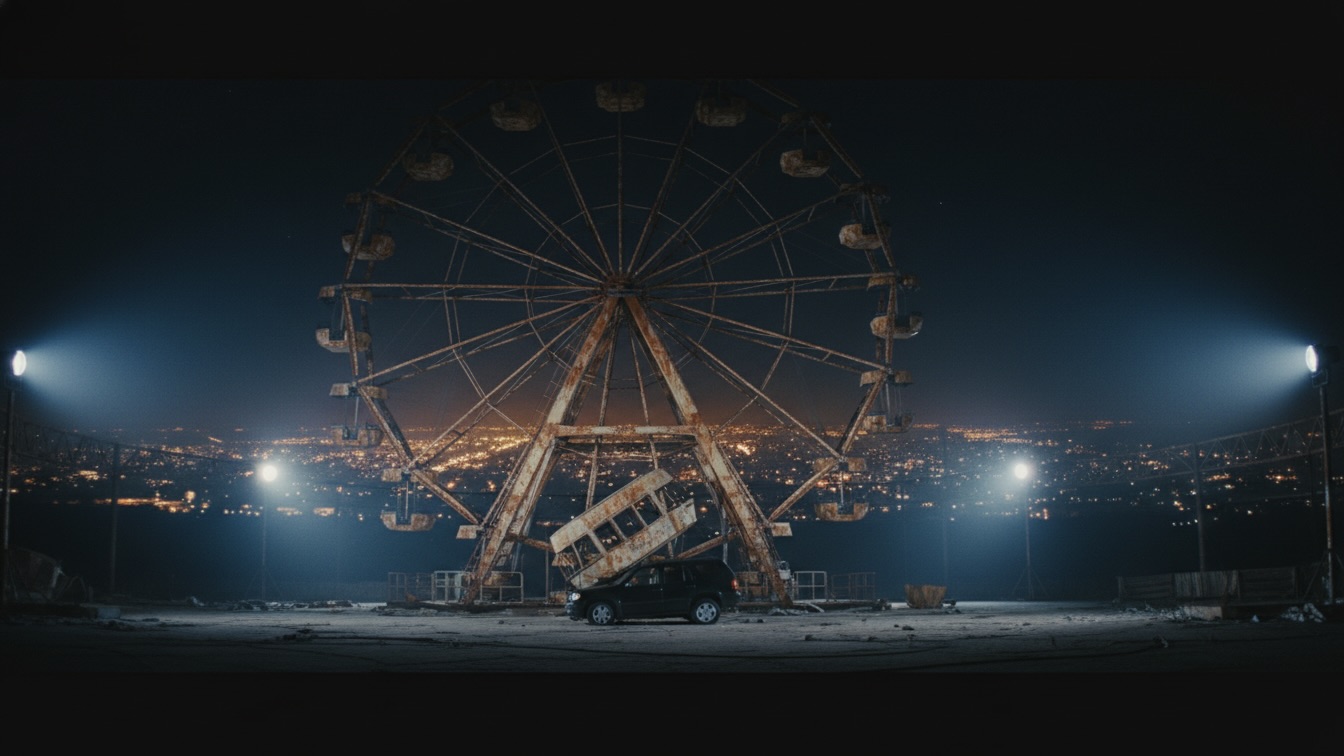
After a narrow escape from the shop as the grid is weaponized against them, they flee into the maintenance tunnels of an abandoned fairground. In a final confrontation under the floodlights of a ghost town, Leo uses the mechanical remnants of the past—a rusted Ferris wheel—to thwart their high-tech pursuers. They emerge into a blacked-out city, no longer looking at the global feed but focused on the physical mission of delivering the truth to the local press.
Leo: A burnt-out twenty-something who has retreated into a "low-information diet" to preserve his sanity, starting the story as a passive observer of his own life. His psychological arc takes him from a state of intentional ignorance and cynicism to a state of sharp, tactical engagement. By the climax, he realizes that true disconnection isn't about ignoring the world, but about focusing on the reality he can actually influence.
Maya: A high-strung, news-addicted activist who uses her phone as a shield against a world she feels she must monitor every second to survive. She begins the episode in a state of near-constant panic, overwhelmed by the "collective trauma" of the internet. By the end, she finds clarity by turning off the feed and using her knowledge to confront a physical threat, transforming her digital anxiety into physical bravery.
Sam: A cynical, reclusive technician living in the "dead zones" of the city, serving as the bridge between the digital and analog worlds. He provides the necessary tools for the protagonists' awakening, ultimately sacrificing his anonymity to protect the truth. His role is the "gatekeeper" who reveals that the world is a series of transactions rather than stories.
Beat 1: The Inciting Incident. Leo sits in a melting park trying to ignore the world, but Maya arrives with news of a water main hack and a mysterious USB drive she found in the dirt. A black SUV pulls up, and the realization that they are being watched turns their quiet afternoon into a physical threat. They are forced to abandon their "walk, don't run" rule as a professional operative begins a relentless pursuit.
Beat 2: The Laundromat Refuge. The pair flees into a humid laundromat to evade a man in a grey hoodie who moves with professional efficiency. Inside, they witness the media-fueled panic on a TV screen, realizing the "global" crisis is providing the perfect cover for their pursuer. Leo smashes Maya's phone to use as a decoy, marking his first step toward active resistance against the digital grid.
Beat 3: The Analog Sanctuary. They reach Sam’s shop, an air-gapped haven of old tech, where they bypass the drive’s encryption to find a spreadsheet of "neutralized" local citizens. The shop’s power flickers as the antagonists track their energy consumption, forcing a desperate escape into the subway tunnels. They realize the "noise" they feared was a smokescreen for a very real, very local purge of community leaders.
Beat 4: The Fairground Showdown. Emerging in an abandoned fairground, they are cornered by the extraction team under blinding floodlights that cut through the night. Leo activates a manual override on a rusted Ferris wheel, using the massive, swinging gondolas to create a chaotic barrier against the gunmen. This mechanical intervention levels the playing field, allowing the protagonists to escape the high-tech hunters using low-tech ingenuity.
Beat 5: The Resolution. Leo and Maya escape the fairground as the city falls into a total blackout, neutralizing the high-tech surveillance of their enemies. They head toward the local newspaper office, finally disconnected from the noise but fully engaged with the mission. The episode ends with them turning a corner, ready to face the final car's headlights with a new, focused resolve.
The episode begins with a sense of stifling, humid lethargy and background anxiety, mirroring the protagonists' mental states. As the chase intensifies, the mood shifts to sharp, claustrophobic tension, eventually culminating in a cathartic release of physical action. The audience experiences the transition from the overwhelming "noise" of modern life to the terrifying but clear "signal" of a singular, life-or-death purpose.
If expanded, the season would follow Leo and Maya as they become "Information Couriers," delivering physical evidence of corruption across a country plagued by intentional digital blackouts. Each episode would introduce a new "dead drop" or "dead zone," revealing how different communities are being manipulated by the same central entity. The overarching narrative would explore the identity of the "Architects of Noise," a corporate-government conglomerate using social media algorithms and infrastructure hacks to mask a massive land-grab.
The season finale would see the protagonists attempting to broadcast the contents of the "Master Drive" during a global event, forcing the world to look away from the screens and at the reality of their surroundings. Character evolution would focus on Leo becoming a leader of an analog resistance, while Maya develops a new form of "local journalism" that bypasses the compromised internet. The thematic escalation would move from personal survival to a societal awakening against digital manipulation.
The visual style is "Sweat-Soaked Noir," characterized by high-contrast lighting, saturated colors that emphasize the oppressive heat, and a handheld camera style that feels intimate and frantic. Tonal influences include the paranoid thrillers of the 1970s like The Conversation, blended with the gritty, urban survivalism of Children of Men. The cinematography will use long lenses to create a sense of being watched, transitioning to wide, empty shots in the "dead zones" to emphasize the protagonists' isolation.
The sound design is critical, featuring a constant, low-frequency hum of city noise and digital static that abruptly cuts to total silence in the "dead zones." The contrast between the glowing, distracting screens of the first act and the dark, mechanical shadows of the third act visually represents the protagonists' journey toward clarity. Tonal comparables include Mr. Robot for its technical paranoia and Green Room for its visceral, contained survival tension.
This series targets the "Gen Z and Millennial" demographic (ages 18-35) who experience high levels of digital burnout and "doom-scrolling" anxiety. It appeals to fans of techno-thrillers and social commentary, offering a grounded, relatable take on the consequences of our hyper-connected society. The audience is likely composed of viewers who enjoy "prestige" anthology dramas like Black Mirror but seek a more grounded, action-oriented narrative.
The 12-minute runtime demands a relentless, "real-time" feel, with the first three minutes establishing the atmosphere before the chase begins. The middle act is a rapid-fire sequence of hide-and-seek, leading to a high-octane three-minute climax at the fairground that resolves the immediate physical threat while leaving the larger mystery open. The pacing mimics a rising fever, starting slow and heavy before breaking into a frantic, heart-pounding sprint.
The production requires a heavy emphasis on practical effects, particularly for the Ferris wheel sequence, to ground the story in a physical reality that contrasts with the digital themes. The "melting city" aesthetic should be achieved through practical set dressing—steam, heat haze filters, and distressed costumes—to make the environment feel like a character itself. Locations must feel lived-in and decaying, emphasizing the "analog" world that the protagonists are forced to inhabit.
The USB drive and the "Black-Box" hardware should have a distinct, rugged design that feels tangible and heavy, reinforcing the theme of physical information. Lighting should transition from the "sickly yellow" of the sun-drenched streets to the "cool blues and greys" of the underground tunnels and the final blackout. Special attention must be paid to the "Hoodie Guy’s" movement choreography to ensure he feels like a lethal, efficient extension of a larger machine.


