A summer heatwave turns deadly when a digital minimalist and his news-obsessed friend find a drive containing local secrets.
The sun wasn't just shining; it was pressing down on everything like a physical weight. The asphalt on 5th Street felt soft under my sneakers, that weird, sticky give that tells you the city is starting to melt. I was sitting on a bench in the park, the kind made of recycled plastic that holds onto heat way longer than it should. My phone was in my pocket, powered down. That was the goal today. No notifications. No doom-scrolling. No updates on the war in a country I couldn't find on a map, no outrage over a tweet from a billionaire who didn't know I existed. Just me and the smell of hot grass and car exhaust.
It was hard. My pocket felt heavy, like the dead phone was a phantom limb that kept itching. I knew what was happening. Every thirty seconds, there was a new crisis. A flood in one hemisphere, a coup in another, a celebrity saying something stupid that everyone would pretend to care about for exactly six hours. It’s a trap. We weren't built for this. Our brains are designed to care about whether the neighbor’s dog is sick or if the grocery store is out of milk, not the collective trauma of eight billion people delivered in 4K resolution.
I wiped sweat from my forehead with the back of my hand. The air was thick. Static. A pigeon landed a few feet away, looking just as ragged as I felt. It pecked at a discarded wrapper, realized it was empty, and gave me a look of pure, unadulterated skepticism. I got it, bird. We're all just trying to find something real in the middle of a garbage fire.
Then I heard the vibration. Not my phone, but Maya’s. She was jogging toward me, her face flushed a deep, alarming red. She had her phone in her hand like it was a shield, or maybe a weapon. She didn't even say hi. She just shoved the screen in my face.
"Did you see?" she asked, her voice thin and ragged from the heat and the panic.
"Phone’s off, Maya," I said, trying to keep my voice flat. "I told you. I'm doing the thing."
"You can't do 'the thing' today," she snapped. She swiped aggressively on the glass. "Look at the feed. The whole grid is going crazy. They’re saying the water main on the north side was a hack. Not a burst. A hack."
I looked at her. Really looked at her. Her eyes were bloodshot. She had dark circles under them that looked like bruises. She was twenty-one, but the way she carried herself—hunched over that glowing rectangle—made her look sixty. "Maya, sit down. It’s ninety-eight degrees. You're going to pass out."
"I can't sit down, Leo! If the water is hacked, that means the cooling systems for the data centers are next. If the centers go down, the entire local network follows. We'll be blind."
"Good," I said. "Maybe we'll finally have a conversation without you checking your mentions."
She looked at me like I’d just suggested we start eating dirt. "This isn't a joke. People are freaking out. Look at the comments."
"No," I said. I stood up, feeling the heat rise from the pavement. "I’m not looking at the comments. The comments are where sanity goes to die. If the water's out, go buy a gallon of Distilled. If the internet goes down, read a book. The world isn't ending, Maya. It’s just Tuesday."
She started to say something, but then she stopped. She looked down at the ground near the base of the bench. A small, black object was tucked into the dirt, partially covered by a discarded coffee cup. It was a ruggedized USB drive, the kind they market to people who go hiking and want to make sure their spreadsheets survive a fall off a cliff.
"What’s that?" she asked, her focus shifting instantly. The news cycle was already being replaced by a new shiny object.
"Trash," I said. "It’s a city park. Everything is trash."
But she was already leaning down. She picked it up, brushing off the dry soil. It felt heavy in her hand. I could see the way her thumb traced the rubber casing. "This isn't trash, Leo. This is one of those high-end encrypted ones. Look at the serial number. It’s been filed off."
"Put it back," I said. A cold shiver ran down my spine, which was a feat considering the temperature. "Seriously. Put it back."
"Why? Someone lost it."
"Nobody loses a drive like that by accident. They leave it. It’s a dead-drop. Or it’s a trap. Or it’s just someone’s shitty demo reel. Either way, it’s not our business. Focus on your own lane, remember?"
"My lane is currently being flooded by a hacked water main," she said, her irony defense mechanism kicking in. "Maybe this is related. What if this is the key?"
"You've been watching too many movies," I said. "It's probably just a virus that will brick your laptop and steal your bank info. Give it to me."
I reached for it, but she pulled back. That was the moment. The split second where the global noise we’d been drowning in became a local, physical reality. A black SUV, the kind with windows so tinted they looked like obsidian, pulled up to the curb twenty yards away. It didn't park. It just hovered there, the engine a low, menacing hum against the backdrop of the city’s afternoon drone.
"Leo," Maya whispered, her bravado evaporating. "Who is that?"
"I don't know," I said. I grabbed her arm. "But we're leaving. Now. Walk. Don't run."
We started moving toward the tree line, the heat shimmering off the grass. My mind was racing. I’d spent months trying to shrink my world down to something manageable, trying to find peace in the quiet. And here I was, caught between a girl who couldn't stop looking at the world's problems and a car that looked like it was about to create some very specific ones for us. The drive was still in her hand. I could feel the weight of it, even from a distance. It was a physical manifestation of everything I’d been trying to avoid: a piece of information that demanded to be known.
Behind us, the SUV door opened. The sound of it—a heavy, mechanical thud—echoed through the park. I didn't look back. I just kept my eyes on the exit, the sweat stinging my eyes, wondering if the 'low-information diet' I’d been preaching was about to get me killed because I hadn't seen the warning signs coming.
We didn't make it to the trees. The guy who stepped out of the SUV wasn't wearing a suit. He wasn't some movie cliché of a federal agent. He was wearing a grey hoodie in a hundred-degree weather, the hood pulled low, and cargo pants that looked like they had too many pockets. He moved with a weird, jerky efficiency, like he was caffeinated to the point of vibration. He didn't yell. He didn't pull a gun. He just started walking toward us, his eyes locked on Maya’s hand.
"Run," I said. The 'walk don't run' rule was officially dead.
We bolted. The heat hit my lungs like steam. Every breath felt like I was inhaling soup. Maya was faster than she looked, fueled by a cocktail of anxiety and adrenaline. We ducked behind a row of overgrown hedges, our feet pounding against the dirt path. I could hear the guy behind us, the rhythmic slap of his boots. He wasn't sprinting; he was pacing us. He knew the park better than we did.
"Give me the drive!" I wheezed as we rounded a corner near the stagnant duck pond.
"No!" Maya yelled back, her voice cracking. "If I give it to you, he’ll just go after you!"
"That’s the point!" I shouted. We scrambled over a low stone wall, the rough granite scraping my palms. We were heading toward the street, toward the noise of traffic and the safety of a crowd, but the heat had emptied the sidewalks. Everyone with half a brain was inside, huddled near an AC unit, probably reading about the water main hack that Maya was so worried about.
We burst out onto 4th Street. A bus was pulling away from the curb, a cloud of blue diesel smoke billowing into the air. I looked back. The guy in the hoodie was at the wall. He didn't climb over it; he vaulted it in one clean motion. He was an athlete. Or a pro.
"In here!" I grabbed Maya and shoved her toward the entrance of an old laundromat. The sign above the door was missing half its letters, and the windows were filmed with years of grime. Inside, the air was even worse—hot, humid, and smelling of cheap detergent and scorched lint. A row of ancient dryers was spinning, adding a low-frequency rumble to the room. An old man sat in a plastic chair in the corner, staring blankly at a TV mounted to the wall. The news was on. A ticker at the bottom of the screen was screaming in red letters.
"Hide," I whispered. We ducked behind a row of industrial-sized washers.
I peered through the gap between two machines. The guy in the hoodie passed the window. He didn't even look in. He kept going down the street, his head swiveling left and right. He thought we’d kept running.
Maya was slumped against the side of a washer, her chest heaving. She still had the drive. She was looking at it like it was a holy relic. "We have to see what’s on it, Leo. We have to."
"Are you insane?" I hissed. "That guy is hunting us. We need to go to the police."
"The police?" She gave a short, jagged laugh. "Did you see the news? The police are busy dealing with riots at the water stations. There’s a blackout starting in the West End. They aren't coming for us. We're on our own. That’s the reality of the digital age, Leo. When things break, they break everywhere at once."
"This is exactly why I wanted to disconnect," I said, my voice shaking. "This noise... it creates this. This chaos. If everyone just stayed home and stopped checking their phones, that guy wouldn't be out there because nobody would care about what’s on that drive."
"But someone does care," Maya said. She wiped her face with her shirt. "And they care enough to chase us in a heatwave. That makes it real. More real than a headline."
I looked at the old man in the corner. He hadn't moved. The TV was showing a helicopter shot of a highway. Traffic was backed up for miles. People were out of their cars, waving their arms. It looked like the end of the world, but it was just a traffic jam exacerbated by a panic.
"Okay," I said, the skepticism in my gut warring with the need to survive. "We need a place with a computer that isn't connected to the web. An air-gapped machine. If we plug that into anything with a signal, they’ll find us in five minutes."
"I know a place," Maya said. She looked at me, and for a second, the burnout in her eyes was replaced by a sharp, terrifying clarity. "My cousin’s shop. He fixes old hardware. Typewriters, analog synths, 90s PCs. He doesn't even have a router."
"Where?"
"Six blocks. Through the alleys."
I looked out the window. The street was empty again. The sun was at its peak, turning the world into a bleached-out wasteland. "Six blocks. If we pass out from heatstroke, the guy wins by default."
"Then don't pass out," she said.
We slipped out the back door into the alley. The heat here was trapped between the brick walls, thick enough to chew. We moved through the shadows, stepping over trash bags that smelled like rot. Every sound—a cat jumping on a bin, the drip of a rusty pipe—made me jump. My heart was a frantic bird in my ribs. This was the 'immediate vicinity' I’d been trying to focus on. It wasn't peaceful. It wasn't okay. It was a humid, terrifying tunnel leading toward a mystery I didn't want to solve.
As we reached the end of the second block, I saw the SUV again. It was idling at the intersection, blocking our path. They hadn't lost us. They’d just narrowed the search area. They were using the grid. They were probably tracking the heat signatures or the city’s traffic cams.
"They're ahead of us," I whispered, pulling Maya back into the dark recess of a loading dock.
"How?" she asked. "We didn't tell anyone where we were going."
"The world is watching, Maya. Even when you think you've opted out, the infrastructure is still there. Every camera, every sensor. We're just data points to them."
She looked at her phone. The screen was dark, but she gripped it like a lifeline. "I'm turning it off. For real this time."
"Little late for that," I said. I looked around. We were trapped in a corridor of brick and heat. The only way out was up or through. And I wasn't much of a climber. "Give me your phone."
"Why?"
"Just give it to me."
She handed it over. I took it, felt the warm glass, and then I hurled it as hard as I could toward the opposite end of the alley. It smashed against a dumpster with a satisfying crack.
"Leo! That was a fourteen!"
"Now it's a decoy," I said. "If they're tracking the IMEI, they'll think we went that way. Now, move. We’re taking the basement stairs through the bakery."
We moved fast, the physical exertion finally pushing the mental exhaustion aside. There was no time to worry about the global economy or the state of the environment. There was only the next step, the next door, the next breath. It was the most present I’#d felt in years, and I hated every second of it.
The shop was tucked under a bridge, a narrow sliver of a building that looked like it was being crushed by the weight of the steel above it. A faded sign in the window read Analog Dreams. It was a cave of junk—stacks of CRT monitors, tangled nests of VGA cables, and the dusty carcasses of Commodore 64s. The air inside was ten degrees cooler, mostly because the sun couldn't penetrate the layers of grime and old tech piled against the glass.
Maya’s cousin, a guy named Sam who looked like he hadn't seen a vegetable since 2019, was hunched over a soldering iron. He didn't look up when we burst in. He just pointed at a sign on the counter that said NO REFUNDS.
"Sam, it's me," Maya gasped. She was leaning against a stack of speakers, her face covered in a film of alley dust.
Sam looked up, his eyes widening behind thick glasses. "Maya? What the hell? You look like you escaped a fire."
"Close enough," I said, shutting the heavy oak door and throwing the bolt. "We need a machine. Now. No internet, no Bluetooth, no nothing. Just a screen and a port."
Sam looked at me, then at Maya. He saw the drive in her hand. His expression shifted from confusion to a deep, wary suspicion. "That's a Black-Box series drive. You shouldn't have that."
"We found it," Maya said. "Someone was dropping it in the park. Now they're chasing us."
Sam set down his soldering iron. The silence in the shop was heavy, broken only by the hum of the bridge overhead. "If they're chasing you for that, you shouldn't be here. You're bringing heat to my shop."
"Sam, please," Maya said. "Just let us see what it is. Then we'll go. We just need to know what’s worth killing two kids over."
Sam sighed, a long, weary sound that made him look even more tired than I felt. He gestured to a workbench in the back. On it sat an old Toughbook, the kind used by the military in the early 2000s. It was a tank of a laptop, beige and scarred. "That thing hasn't seen a signal since the Bush administration. Plug it in. But if I hear a siren, you're out the back door."
I watched Maya plug the drive into the side of the laptop. My stomach was doing slow, heavy rolls. This was the moment of no return. Once you see something, you can't unsee it. You can't go back to the 'low-information diet' once the information is inside your head. It’s like a virus. It changes the way you look at the world.
"The world is a series of transactions, Leo," Sam said, leaning against a filing cabinet. "Most people think it's a series of stories. It’s not. It’s just data moving from point A to point B. Whoever owns the drive owns the transaction."
"I just want to own my own life," I muttered.
"Nobody owns their life anymore," Sam said. "We're just tenants in a digital world we didn't build."
On the screen, a progress bar crawled across the pixelated interface. The drive was encrypted, but Sam had a tool—a hardware bypass he’d built himself. He started typing, his fingers flying across the clacking keys.
"Maya, look at the news again," I said, nodding toward a small, battery-operated radio on the shelf. "See if they're mentioning the park."
She turned the dial. Static filled the room, then a voice cut through. "...reports of a localized disturbance in Central Park. Police are asking residents to remain indoors as the heatwave continues to strain the city’s resources. In other news, the global semiconductor shortage is expected to..."
"Localized disturbance," I repeated. "That’s us. We're a 'disturbance.'"
"They’re downplaying it," Maya said. "They don't want people to know there’s a hunt going on. It doesn't fit the narrative."
"Or maybe we're just not that important," I said, hoping it was true. "Maybe we're just a blip."
"Found it," Sam said.
We crowded around the screen. It wasn't a map of a hack. It wasn't a list of secret agents. It was a spreadsheet. Thousands of rows of names, addresses, and dates. Next to the names were columns with labels like Risk Assessment, Influence Quotient, and Neutralization Priority.
"What is this?" Maya whispered.
I scanned the list. My heart stopped. I saw a name I recognized. A local community organizer. Someone who’d been protesting the new development project down by the docks. Next to her name, the status read: Resolved.
"She moved away last month," I said. "Everyone said she just got burnt out and left."
"Look at the date," Sam said. "The 'resolved' status was logged two days before she disappeared."
I scrolled down. More names. More locals. This wasn't a global conspiracy. This wasn't about the water main or the semiconductor shortage. This was about our city. Our neighborhood. It was a list of people who were 'in the way.'
"This is the real work," Sam said, his voice low. "While everyone is looking at the big screen, screaming about the end of the world on Twitter, the people in charge are cleaning house. They use the global noise as a smoke screen. You're so busy worrying about a glacier melting that you don't notice the guy across the street getting shoved into a van."
Maya looked at me, her eyes filling with tears. "Leo, I... I spent all morning arguing with people about the water hack. I didn't even know these people were missing."
"That’s the trap," I said. The weariness in my bones felt heavier than ever. "The infinite information isn't there to make us smart. It’s there to make us blind to what’s right in front of us."
Suddenly, the shop lights flickered. The hum of the bridge overhead changed pitch. Sam stood up, his face pale. "They found the power draw. The shop is on a sub-meter. They’re here."
"How?" I asked. "There’s no signal!"
"They don't need a signal if they have the physical infrastructure," Sam said. He grabbed the Toughbook and slammed it shut. "They just track the load on the grid. They know someone is drawing power in a shop that’s supposed to be closed."
Outside, the sound of a heavy vehicle pulling onto the sidewalk made the floor vibrate. It wasn't just one SUV this time. It was a team.
"Back door," Sam said, pointing to a heavy steel door behind a wall of old televisions. "It leads to the subway maintenance tunnels. Go. Now."
"What about you?" Maya asked.
"I’m just a guy who fixes old junk," Sam said, though we both knew that was a lie. "I’ll tell them you broke in and I chased you off. Now go!"
We scrambled through the door, the cool, damp air of the tunnels hitting us like a slap. Behind us, I heard the front door of the shop splinter. Then there was a sound I’ll never forget—the sharp, electronic whine of a high-end scanner.
We were in the dark now. No phones. No news. No global updates. Just the sound of our breathing and the drip of water on stone. We had the drive. We had the truth. And for the first time in my life, I realized that being informed didn't make me anxious. It made me dangerous. The noise was gone. There was only the mission. Save the people on the list. Survive the summer. Shrink the world back down to a size where I could actually fight back.
The tunnels were a confusing mess of rusted pipes and abandoned track. The air was thick with the smell of wet iron and something ancient. We moved by the light of a small penlight Maya had snagged from Sam’s bench. The beam was weak, cutting through the dark in shaky arcs.
"Where does this lead?" Maya whispered. Her voice echoed, making it sound like a dozen people were talking at once.
"Sam said the old summer fairground," I said. "It’s at the end of the line. The city shut it down years ago, but the maintenance tunnels still connect to the park above."
We walked for what felt like hours. My legs were cramping, the salt from my sweat making my skin itch. Every few minutes, I’d stop and listen. Far behind us, I could hear the faint metallic clink of people moving through the tunnels. They weren't even trying to be quiet anymore. They knew we were trapped.
"Leo," Maya said, stopping. "I’m sorry."
"For what?"
"For dragging you into this. For always being on my phone. For... for caring about the wrong things."
I looked at her. In the dim light of the penlight, she looked small. Fragile. But there was a grit in her eyes I hadn't seen before. "Don't be sorry. You were right about one thing. Something was happening. You just had the wrong lens on."
"I thought if I knew everything, I could control it," she said. "But I didn't know anything. I just knew what they wanted me to see."
"We know now," I said. I patted the drive in my pocket. "We’re going to get this to the local paper. The physical one. The one that still prints on actual trees. No digital trail. Just the ink."
We reached a ladder. The rungs were cold and slimy. I climbed first, pushing up against a heavy iron grate. It groaned, protesting the movement, then swung open.
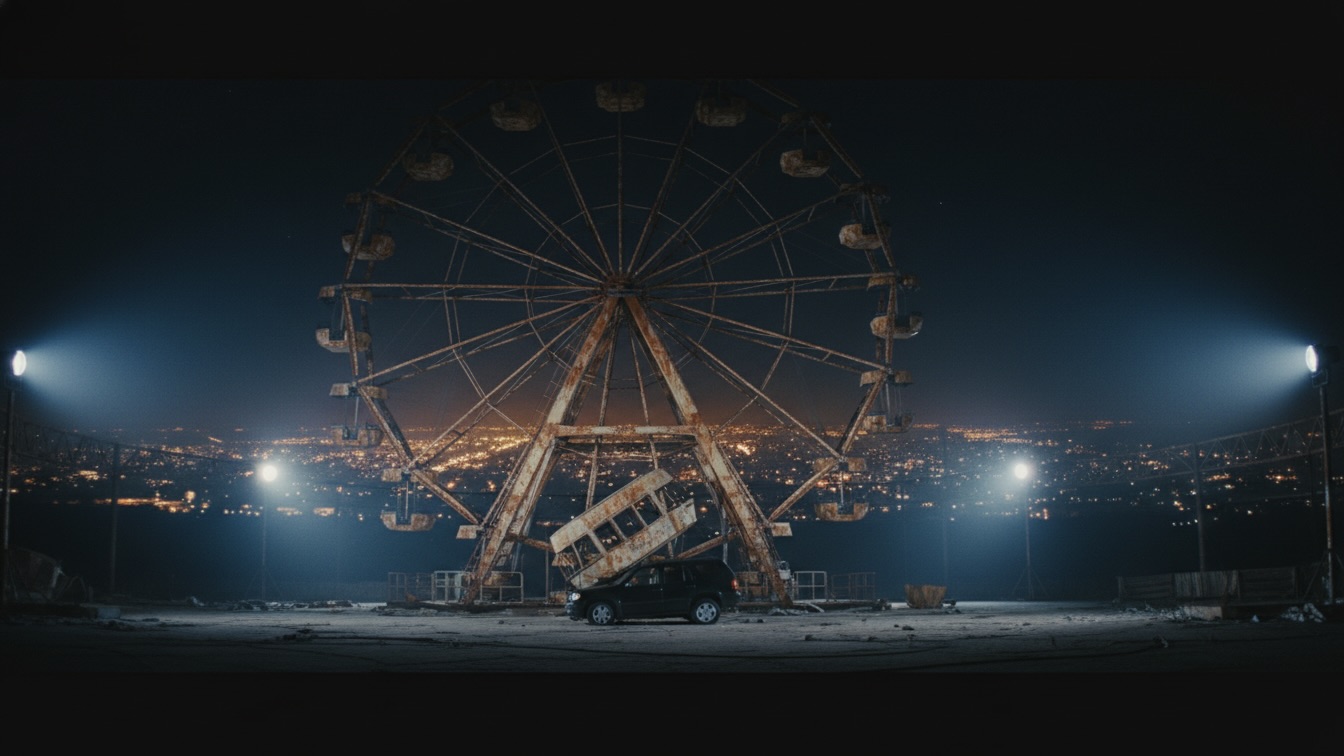
We emerged into the middle of the old fairground. It was a ghost town of summer memories. The skeleton of a wooden roller coaster rose up against the moonlit sky like the ribs of a dead whale. The Ferris wheel stood silent, its rusted gondolas swaying slightly in the hot night breeze. The heat hadn't broken. If anything, it felt more oppressive now, trapped in the bowl of the valley where the fairground sat.
"It’s beautiful," Maya whispered. "In a creepy way."
"It’s a dead zone," I said. "No cameras. No grid. This is where we make our stand."
We started across the overgrown plaza, our feet crunching on dried corn husks and broken glass. Suddenly, the floodlights snapped on.
I blinked, blinded by the sudden glare. The fairground was illuminated in a harsh, artificial white. Four figures stood at the perimeter, their shadows long and jagged across the asphalt. The SUV was parked near the carousel, its engine idling.
"Give us the drive, Leo," a voice called out. It was the guy in the hoodie. He’d taken the hood off. He was young, maybe my age. He looked like any other guy you’d see at a coffee shop, except for the cold, transactional look in his eyes.
"You're killing people," I shouted, my voice cracking. "For a development project? Really?"
"It’s not just a project," the guy said, walking slowly toward us. "It’s progress. The city needs to grow. People get in the way. It’s a simple calculation. You should understand that. You’re the guy who wants to simplify his life, right? This is the ultimate simplification."
"By erasing people?" Maya stepped forward, her hands shaking. "That’s not a calculation. That’s murder."
"The world is messy, Maya," the guy said. "We’re just cleaning it up. Now, the drive. Or we can make this very complicated for both of you."
I looked at Maya. She looked at me. In that moment, we didn't need words. We were on the same page. We weren't looking at the global feed. We were looking at the reality right in front of us.
"The thing about a low-information diet," I said, stepping back toward the Ferris wheel, "is that you learn to use what’s in your immediate vicinity."
I grabbed a heavy iron bar that had been propping up a nearby game booth. Maya grabbed a handful of heavy glass bottles from a discarded crate.
"You think you can fight us with trash?" the guy laughed.
"It’s not trash," I said. "It’s the world we actually live in."
I swung the bar, hitting the emergency release lever on the Ferris wheel’s main gear. I’d seen the schematics in Sam’s shop—old rides like this had a gravity-fed manual override. With a deafening screech of metal on metal, the massive wheel began to turn. The rusted gondolas swung wildly, creating a chaotic, moving barrier between us and the men.
"Go!" I yelled.
We dove into the moving machinery, using the swinging cars as cover. The men started shooting, the 'pop-pop-pop' of suppressed handguns echoing through the fairground. But they couldn't get a clear shot through the spinning wheel.
We scrambled up the side of the control booth, the heat of the friction-heated gears radiating against my skin. We were moving, acting, living. No more scrolling. No more paralysis.
We reached the back of the Ferris wheel, where the shadows were deepest. We jumped, landing hard on the sun-baked grass, and started running toward the fence that led to the city.
Behind us, I heard a crash as one of the gondolas tore free from its mooring, slamming into the SUV. The floodlights flickered and died.
We didn't stop until we hit the pavement of the city. The streetlights were out—the blackout had finally hit our sector. The world was dark, quiet, and for the first time in years, it felt manageable.
"We have to get to the paper," Maya said, her breath coming in short, sharp gasps.
"I know," I said. I looked at the drive in my hand. It was just a piece of plastic and silicon. It wasn't the world. It was just a job that needed doing.
As we turned the corner toward the downtown district, a set of headlights cut through the darkness behind us. A single car, moving fast.
I gripped the iron bar. Maya gripped the drive.
We weren't afraid anymore. We were focused.
“As we turned the corner toward the downtown district, a set of headlights cut through the darkness behind us, and I knew the chase wasn't over.”


