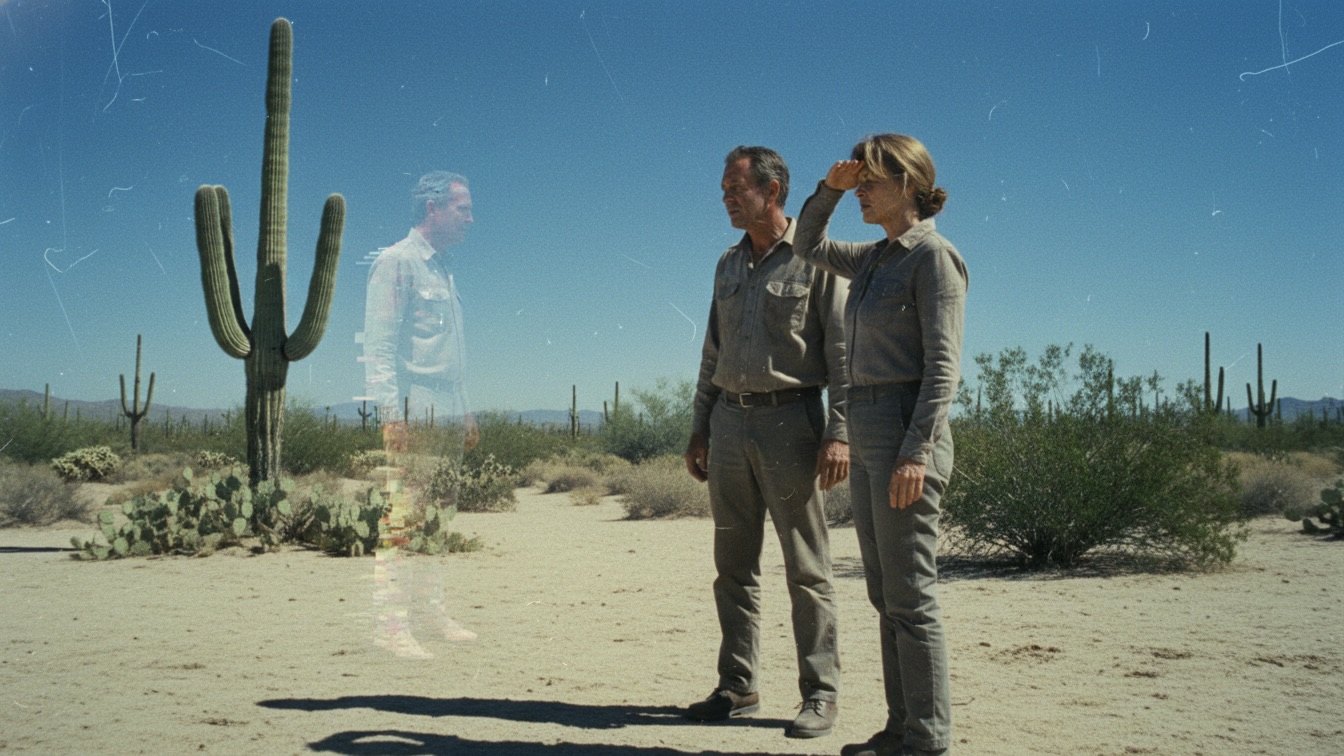
A closure trip turns physical as a Nevada valley projects an ex-couple's messy history into the desert air.
The air-conditioning in the 2019 Volvo was a suggestion, not a fact. Ben kept his hand on the gear shift, his knuckles white against the worn leather. Outside, the Nevada desert was a flat, yellow bruise under a sun that didn't care about their problems. The heat was a physical weight, pressing against the windshield. It felt like a transaction they couldn't afford. They had been driving for six hours, the silence between them thick with the residue of a twenty-year marriage that had ended in a cramped lawyer’s office three months ago. This trip was Wendy’s idea. 'Closure,' she had called it. To Ben, it felt more like a long-form audit of their failures.
"The apartment is too big for you, Wendy," Ben said. His voice was dry, the sound of sandpaper on wood. He didn't look at her. He watched a dust devil spin aimlessly in the distance. "You’ll just spend the whole time cleaning rooms you don't use. It’s a waste of square footage."
Wendy didn't flinch. She was looking at her phone, her thumb scrolling through a feed that likely wasn't loading. The signal had been dropping for the last twenty miles. "I like the light in the kitchen. You never noticed the light. You only noticed the mortgage."
"I noticed the mortgage because I paid it," Ben snapped. He felt the familiar heat in his chest, a sharp, localized burn. It was an old argument, a well-worn track in a record that had been playing since 2015. "It’s about logistics. You’re being sentimental at the expense of math."
"Math is just a way for you to avoid talking about why you're angry," Wendy said. She finally looked up. Her eyes were tired, the skin around them mapped with fine lines that Ben used to think were beautiful. Now, they just looked like a history of their disagreements. "Keep the apartment. I don't care. Just stop acting like you're doing me a favor by taking it."
Ben opened his mouth to respond, but the GPS on the dashboard spiked. The smooth, synthesized voice of the navigation system cut off mid-sentence. In its place came a sound that didn't belong in 2026. It was the screech of a 56k dial-up modem, a digital scream that vibrated in the plastic of the dash. The screen flickered, the map dissolving into a chaotic sprawl of green and black pixels.
"What is that?" Wendy asked, her hand moving to the dashboard as if to steady it.
"Probably the heat," Ben said, though he didn't believe it. He tapped the screen, but it was hot to the touch. The sound grew louder, a piercing electronic wail that made his teeth ache. Then, the engine simply gave up. There was no sputter, no mechanical failure. The tachometer dropped to zero, and the power steering vanished. Ben fought the wheel, guiding the heavy car onto the shoulder of the road. The tires crunched over gravel and dry brush, kicking up a cloud of dust that coated the windows. Then, silence. Even the modem sound vanished.
"Ben?" Wendy’s voice was small. She was looking out the passenger window.
"The battery's dead," Ben said, though the lights on the dash were still glowing a dim, sickly orange. He tried the ignition. Nothing. Not even a click. "Great. Just great. We're thirty miles from a gas station in a valley that doesn't exist on the map."
Wendy didn't answer. She opened the door, the heat of the desert rushing in like an oven blast. She stepped out onto the cracked asphalt, her boots crunching. Ben watched her through the glass. She walked a few feet away, her hand shading her eyes. Then she stopped. Her entire body went rigid.
Ben shoved his door open and climbed out. The sun hit him like a physical blow. "Wendy? What is it?"
She pointed toward a large saguaro cactus about twenty yards off the road. Ben followed her gaze. At first, he thought it was a heat shimmer, a trick of the light on the horizon. But the shape was too steady. It was a man, standing perfectly still. He was wearing a faded blue polo shirt and khaki shorts—the exact outfit Ben had worn on their disastrous vacation to Sedona three years ago. The figure was low-resolution, his edges shimmering with a digital fuzz, like a video file that hadn't fully buffered.
"Is that... you?" Wendy whispered.
As they watched, the figure’s mouth moved. The sound didn't come from the ghost; it came from the air around them, a hollow, echoing playback. "I just need space, Wendy. I just need some room to breathe."
The words were a direct quote from the night Ben had packed a bag and stayed at a Marriott for three days. The ghost-Ben didn't move. He just stood there, repeating the phrase over and over, his digital eyes fixed on nothing. The sunlight passed right through him, but he cast a faint, flickering shadow on the sand.
"This isn't happening," Ben said. He reached into his pocket and pulled out his phone. The screen was black, but as he stared at it, the glass began to glow. It wasn't the lock screen. It was a mirror, but the reflection wasn't his. It was his face, but distorted, the features melting and reforming like a deepfake gone wrong. He dropped the phone into the dirt.
"It's pulling from the cloud," Wendy said, her voice trembling. She wasn't looking at the ghost anymore; she was looking at the valley. The shimmering wasn't just around the cactus. It was everywhere. The very air seemed to be vibrating with a low-frequency hum. "Ben, look at the ground."
Around the car, the sand was moving. Not from the wind, but from a surge of data. Small, glowing icons—the 'like' hearts from Instagram, the 'unread' dots from their email inboxes—were manifesting in the dirt, flickering in and out of existence. The valley wasn't just a place. It was a hard drive. And they were the files being accessed.
Ben picked up his phone with two fingers, as if it were a dead animal. The device was vibrating with a rhythmic intensity that matched his pulse. The mirror-effect on the screen had faded, replaced by a scrolling list of every text message he’d ever sent Wendy during their final year of marriage. The text was tiny, white against a void of black, moving too fast to read, yet the weight of the words felt physical in his palm.
"We can't stay here," Ben said, his voice cracking. He looked back at the Volvo. It sat there like a tombstone. "We have to walk. If we get back to the main highway, maybe the signal will break."
Wendy nodded, but she was looking at the 'Ben' by the cactus. The ghost was starting to degrade, his polo shirt turning into a slurry of blue pixels that drifted into the heat. "He's still saying it. 'I need space.' You said that so many times I stopped hearing it. Now it's the only thing in the desert."
"Don't," Ben said. "Don't start the post-mortem now. We need to move."
They started walking east, following the line of the road. The heat was oppressive, but the atmosphere felt even heavier. Every few feet, the air would ripple. A ghost of a younger Wendy appeared briefly, sitting on an invisible chair, crying into her hands. The sound of her sobbing was thin and metallic, like it was being played through a cheap speaker. Ben tried to walk past it, but the sound seemed to follow him, sticking to his skin like sweat.
About a mile down the road, the path ahead simply ended. It wasn't a cliff or a barricade of rock. It was a wall of light. It stretched from the ground up into the cloudless sky, shimmering with a cold, blue luminescence. As they got closer, the light resolved into shapes. It was a physical barrier made of frozen, unread text messages. Thousands of them. They were stacked like bricks, the words glowing with an angry, neon intensity.
Why aren't you home? We need to talk about the car. Did you pick up the dry cleaning? I can't do this anymore.
Wendy reached out a hand, but Ben grabbed her wrist. "Don't touch it. It looks... solid."
"It's just data, Ben," she said, though she didn't sound convinced. She picked up a stone and threw it at the wall. The stone didn't bounce off; it hit the text and dissolved into a puff of white static. The wall hummed in response, the word 'Home' glowing brighter for a second before dimming.
"It’s a firewall," Ben whispered. "The valley is archiving us, and it’s built a perimeter. We're part of the dataset now."
They turned away from the road, heading into the scrubland, hoping to find a gap in the signal. The desert floor was no longer just sand and rock. It was littered with the detritus of their life. A digital representation of their old coffee maker sat on a rock, steam made of grey pixels rising from a non-existent pot. A translucent copy of their first dog, a golden retriever that had died in 2018, ran past them, silent and glowing, before vanishing into a cluster of sagebrush.
"This is low-key terrifying," Ben said. He wiped sweat from his forehead. "It’s not just the stuff we saved. It’s everything. Every fragment of junk we left in the cloud."
In the middle of a dry wash, a more elaborate projection began to form. The air thickened, the smell of ozone replaced by a sudden, jarring scent of overcooked steak and cheap red wine. A table appeared, draped in a white cloth that flickered like a failing fluorescent bulb. Two chairs, two plates, and two figures sat in the middle of the Nevada waste.
"Our first anniversary," Wendy said. She stopped walking. Her face went pale. "The Italian place on 4th Street. The one that went out of business."
The ghosts of their younger selves were toastng. The wine in their glasses wasn't liquid; it was a swirling mass of crimson static. The younger Ben smiled—a wide, genuine smile that the real Ben hadn't used in years. He leaned across the table and whispered something. The audio was garbled, a mess of digital artifacts, but the intent was clear.
Wendy walked toward the table. She reached out and picked up a piece of the 'bread' from a basket. It felt like cold plastic in her hand. She put it to her lips, then immediately spat it out. "It tastes like copper. Like licking a battery."
"It's not real, Wendy," Ben said, standing a safe distance away. He felt a pang of something he didn't want to name. Seeing that version of himself—the one who still thought things would work out—was worse than the heat. "It’s just a reconstruction. A shitty one."
"It’s accurate enough," she said, looking at the ghost of herself. The younger Wendy was wearing a dress she had long ago donated to Goodwill. "Look at how I'm looking at you. I actually liked you then."
"I liked you too," Ben said, the words feeling heavy and transactional. "But that version of us is dead. This place is just digging up the corpse."
As he spoke, the anniversary scene began to distort. The younger Ben's face elongated, his eyes turning into black pits of code. The table began to sink into the sand. The sound of their laughter turned into a high-pitched screech that made Ben cover his ears. They backed away as the entire memory collapsed into a pile of glowing dust.
The further they walked into the heart of the valley, the more the environment began to betray them. The silence of the desert was replaced by a low, persistent chatter. It wasn't the sound of the wind. It was the sound of thoughts.
"Did you hear that?" Wendy asked. She stopped near a clump of withered mesquite.
"Hear what?" Ben was staring at his phone again. The screen was now a mirror showing his own face, but his reflection was moving independently of him. The reflection-Ben was sneering, his lips curling in a way the real Ben tried to hide.
"She looks so old today," a voice said. It was Ben’s voice, but it didn't come from his mouth. It resonated from the rocks at their feet. It was flat, devoid of emotion, a pure data stream of a thought he’d had three hours ago in the car.
Wendy froze. She looked at Ben, her eyes wide. "You thought that?"
"I... I didn't say it," Ben stammered. He felt his face flush. "Everyone has petty thoughts, Wendy. It doesn't mean anything."
"I wish he'd just stop breathing so loudly," another voice broadcast. This one was Wendy’s. It came from the air above them, clear as a bell. "It’s like being in a room with a dying walrus."
Ben glared at her. "A dying walrus? Seriously?"
"It was a moment of frustration!" Wendy snapped. "The point is, we’re hearing it. The field is... it’s broadcasting our internal monologues."
They stood there in the heat, surrounded by the ghosts of their own resentment. The valley was playing back every minor grievance, every unspoken insult they had harbored during the drive. The air was thick with it.
He’s going to take the good TV. She’s going to ruin that apartment in a month. I wonder if I can sell his golf clubs on eBay. I wonder if she ever actually loved me or if she just liked the stability.
"Stop it," Wendy yelled at the sky. "Stop it!"
But the valley didn't stop. It was a biological museum, and they were the exhibits. Every secret thought was being archived, turned into a public record for an audience of two. Ben felt a deep, cynical exhaustion wash over him. This was the 'closure' Wendy wanted. Not a clean break, but a total exposure of the rot.
They scrambled up a rocky ridge, desperate to find some high ground. At the top, they saw it: an abandoned radio tower, its steel skeleton rusted and leaning at a precarious angle. It was hummed with a different frequency, a rhythmic thrum-thrum-thrum that seemed to push back against the digital chatter. Around the base of the tower, the air was clear. No ghosts, no scrolling text, no broadcasted thoughts.
"There," Ben said, pointing. "The tower. It’s an interference pattern."
They ran for it, their boots slipping on the loose shale. As they entered the shadow of the tower, the voices cut off instantly. The relief was physical, like stepping into a cool room after a day in the sun. Ben slumped against one of the steel supports, his chest heaving.
"It’s quiet," Wendy whispered. She sat on the ground, her head between her knees. "Finally."
Ben looked out at the valley from their vantage point. From up here, the scale of the phenomenon was visible. The entire basin was a shimmering grid of light and shadow. He could see the car, a tiny blue speck, surrounded by a swirling vortex of their shared history. It looked like a storm, a hurricane of data.
"It’s not hostile, you know," Wendy said after a long silence. She was tracing patterns in the dust with a stick. "The field. It’s just doing what it was designed to do. Or what it's evolved to do. It’s archiving us. Like we’re some rare species that’s about to go extinct."
"We are," Ben said. "The 'us' that existed for twenty years is extinct. This is just the forensic report."
"It’s invasive," Wendy said, her voice bitter. "It’s taking the most private parts of our lives and turning them into landscape features. It’s cynical. It’s like the universe is saying our pain is just more content for the hard drive."
Ben looked at her. In the shadow of the tower, she looked like herself again. No digital artifacts, no glowing text. Just a tired woman in the desert. "Maybe that’s all it is. Content. We think it’s this grand tragedy, but to the valley, it’s just a few terabytes of data that need a home."
He reached out, tentatively, and touched her shoulder. She didn't pull away, but she didn't lean into it either. The contact felt transactional, a momentary truce in a war that had no winners.
"We have to keep going," Ben said. "The tower won't hold the ghosts back forever. The sun is starting to go down. If we're still here when it gets dark... I don't want to see what this place does with our nightmares."
Wendy looked at the horizon. The sun was a deep, angry orange, casting long, distorted shadows across the desert. "You're right. Let's go. Before the data gets too heavy."
They left the safety of the radio tower as the light began to fail. The descent was harder in the twilight, the rocks losing their definition, blending into a grey-purple blur. The ghosts were returning, but they were different now. Darker. More aggressive. The 'Ben' from Sedona was back, but his face was now a swirling vortex of black pixels. He followed them at a distance, his movements jerky, like a corrupted video file.
"Don't look at him," Ben whispered. "Just keep moving toward the road."
But the ghost started to speak. It wasn't the repetitive phrase from before. This was something new. The voice was deep, resonant, and it carried a weight of desperation that the real Ben had never allowed himself to show.
"Wendy, please," the ghost said. "Don't leave. I'll change. I'll be the person you wanted. Just don't go."
Wendy stopped. She turned to look at the shimmering figure. "He never said that. You never said that, Ben."
"I know," Ben said. He grabbed her arm, trying to pull her forward. "It’s lying. The field is hallucinating. It’s filling in the gaps with what it thinks we want to hear. It’s a predictive algorithm, Wendy. It’s not real."
"But it sounds so much like you," she said, her voice breaking. "The you I remember from the beginning."
"It’s a trap," Ben said, his voice hard. "It’s trying to keep us here. It feeds on the proximity. It needs the data to stay alive."
The ghost-Ben lunged forward. It didn't have weight, but it had a physical presence that pushed against the air. It reached out for Wendy, its fingers dissolving into long ribbons of code. Wendy screamed, stumbling back.
Ben didn't think. He stepped between them. As the ghost collided with him, Ben felt a sensation like an electric shock. Cold, sharp, and profoundly wrong. He tackled the figure, his arms passing through the shimmering blue polo shirt as if it were smoke, but he felt a resistance, a magnetic push-back. He threw his weight into it, pinning the ghost against a large rock.
"Go!" Ben yelled over his shoulder. "Wendy, run for the car! The perimeter is right there!"
He could see the edge of the field now. A thin, vibrating line of white light that ran parallel to the highway. Beyond it, the desert looked normal. No ghosts, no glowing text.
Wendy hesitated for a heartbeat, looking at Ben struggling with a version of himself. Then she turned and ran. She sprinted across the sand, her breath coming in ragged gasps. She hit the white line and felt a momentary resistance, like walking through a heavy curtain, and then she was through.
Ben felt the ghost weakening. The further Wendy got from him, the less power the manifestation had. It began to flicker wildly, the Sedona outfit replaced by a suit, then a bathrobe, then a hospital gown. It was cycling through his entire history in seconds. With a final, desperate shove, Ben threw himself toward the line.
He tumbled onto the asphalt of the highway, the heat of the road burning his palms. He looked back. The ghost was gone. The valley was silent.
Thirty feet away, the Volvo sat on the shoulder. Its headlights suddenly flickered on, cutting through the deepening gloom with a bright, clean light. The engine turned over with a roar that sounded like the most beautiful thing Ben had ever heard.
He got to his feet, his muscles aching, and walked toward the car. Wendy was already in the passenger seat, her face hidden in her hands. Ben climbed behind the wheel. The dashboard was back to normal. The GPS showed a clear route to the next town.
He put the car in gear and started to drive. He didn't look at the rearview mirror, but he felt the pull of the valley behind them. He reached for the radio, hoping for some music, some news, anything to drown out the memory of the voices.
He turned the knob, but there was no music. There was only a steady, rhythmic sound. Lub-dub. Lub-dub. Lub-dub.
He looked at Wendy. She was looking at the radio.
"It’s us," she whispered.
It was the sound of their heartbeats. Two distinct rhythms, perfectly synchronized, playing through the car’s speakers. It was a final piece of data the valley had gifted them, or perhaps stolen from them.
They drove in silence, the desert stretching out into the dark. In the rearview mirror, Ben finally looked. The ghosts were still there, standing like statues in the fading light. They didn't move. They didn't speak. They just watched the car disappear into the summer night, two more files saved in a directory that would never be opened again.
“As the car crossed the state line, the heartbeat on the radio suddenly stopped, replaced by a single, terrifying note of dial-up static.”


