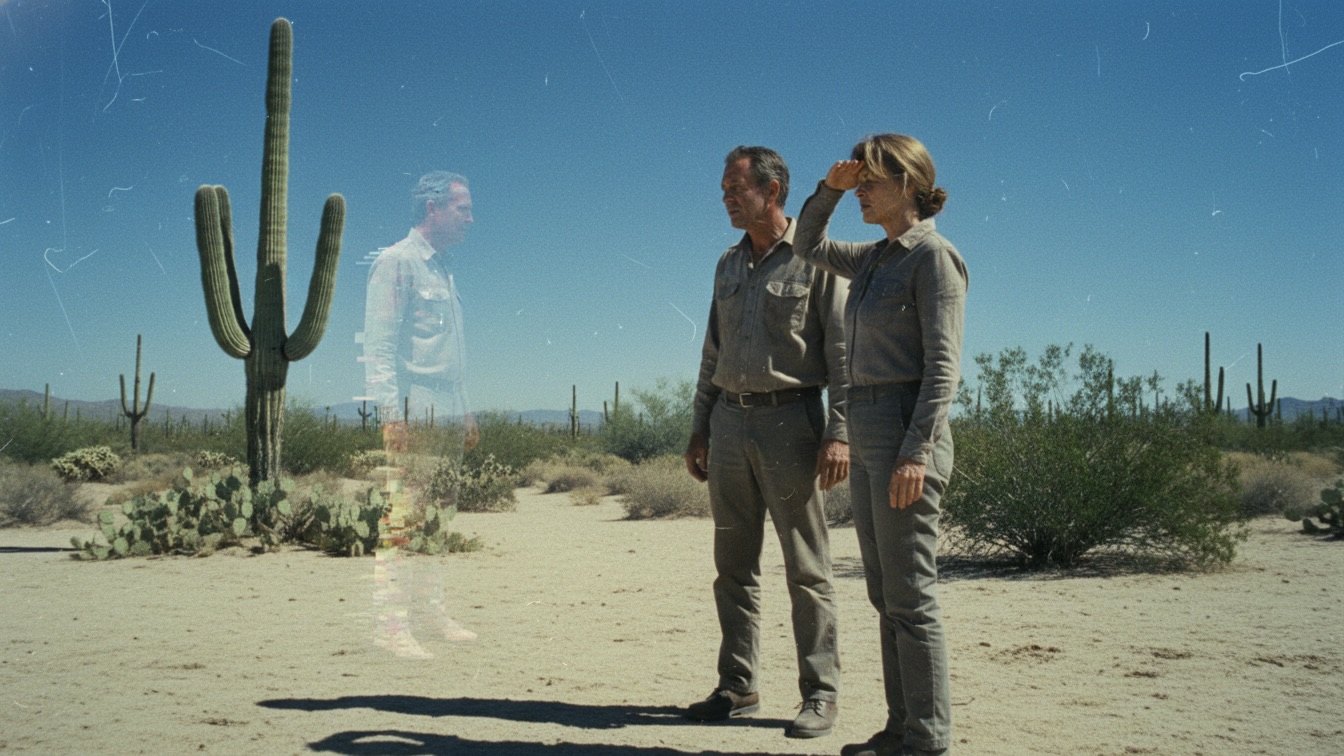
The narrative follows Ben and Wendy, a couple recently divorced after two decades of marriage, as they traverse the Nevada desert in a 2019 Volvo. Wendy has framed the journey as a quest for closure, while Ben views it with cynical detachment, seeing only the logistical failures of their union. Their mundane conflict takes a surreal turn when their vehicle suffers an inexplicable electronic failure in a remote valley. The environment begins to manifest digital remnants of their shared history, transforming the desert into a physical representation of their stored data.
As they attempt to navigate this "hard drive" landscape, they encounter low-resolution ghosts of their past selves and a massive wall constructed from unread text messages. The valley eventually begins broadcasting their private, resentful internal monologues, stripping away any remaining emotional privacy. They find temporary sanctuary at a radio tower that provides an interference pattern against the data-driven hauntings. After a final, violent confrontation with a digital manifestation of Ben’s own broken promises, they manage to cross the perimeter of the glitching valley. Although they escape back to the highway and the car restarts, the experience leaves them haunted by a final, intimate data point: the synchronized sound of their own heartbeats playing through the car’s speakers.
The central theme of the story is the terrifying permanence of the digital footprint and its impact on human memory. In the modern era, a marriage is not just a collection of shared moments but a massive repository of data, including texts, photos, and search histories. The Nevada valley serves as a literalization of "the cloud," where the detritus of Ben and Wendy's relationship is archived and replayed. This suggests that in the digital age, true closure is impossible because our failures are perpetually recorded and easily retrieved, preventing the natural erosion of painful memories.
Another significant theme is the breakdown of communication despite an abundance of information. The "Wall of Unread Messages" represents the paradox of the information age; Ben and Wendy have generated thousands of data points, yet they remain fundamentally misunderstood by one another. The desert broadcasts their internal monologues, revealing that their silence was never empty but filled with unvoiced grievances and petty insults. This highlights the idea that technology can archive the "what" of a relationship—the logistics and the messages—but it cannot bridge the emotional "why" behind the distance.
The narrative also explores the concept of the "forensic audit" of a relationship. Ben’s initial description of the trip as an audit becomes a physical reality as the valley forces them to witness the "corpse" of their marriage. The digital ghosts are not sentient entities but predictive algorithms, filling in the gaps of their history with what the environment thinks they want or need to hear. This suggests a cynical view of nostalgia, framing it as a corrupted file or a "deepfake" that obscures the reality of the present.
Ben is a character defined by his defensive pragmatism and his reliance on logic to avoid emotional vulnerability. He views the world through the lens of "math" and "logistics," using his role as the primary financial provider to justify his emotional distance. By focusing on the mortgage and the square footage of the apartment, he creates a buffer between himself and the pain of his failed marriage. He is a man who prefers the "shitty reconstruction" of a memory over the messy, unpredictable reality of a conversation.
His internal conflict is most visible when he encounters the digital ghost of his younger self in Sedona. This manifestation represents the version of Ben that still possessed hope and made promises he eventually broke. His violent struggle with this ghost at the edge of the perimeter is a symbolic attempt to kill his own guilt and the "predictive algorithm" of his failures. He is desperate to escape the data because he cannot reconcile his logical self-image with the evidence of his emotional negligence.
By the end of the story, Ben remains trapped in his own cynicism, even as he saves Wendy from the digital manifestation. He refuses to look in the rearview mirror, a final act of avoidance that mirrors his behavior throughout the marriage. However, the sound of the heartbeats on the radio forces him to confront a biological reality he cannot quantify or ignore. He is a man who has successfully escaped the "grid" but remains haunted by the undeniable, rhythmic evidence of a connection he claimed was extinct.
Wendy serves as the emotional observer of the narrative, the one who initially sought "closure" and "light." Unlike Ben, she is attuned to the aesthetic and sensory details of their environment, noticing the way the light hits a kitchen or the lines of history on a face. She is more susceptible to the valley’s manifestations because she is still looking for meaning in the wreckage of their twenty years together. Her willingness to approach the digital ghosts shows a lingering desire to reconnect with the people they used to be.
Her journey through the valley is one of disillusionment as she realizes that the "closure" she sought is actually a brutal exposure of their mutual resentment. Hearing Ben’s internal monologue about her aging or her breathing is a crushing blow to her sentimental hopes. She discovers that the "light" she valued is easily mimicked by the cold, blue luminescence of a firewall. This realization forces her to stop looking for meaning in the past and start running for her survival in the present.
Despite her vulnerability, Wendy displays a quiet resilience when she acknowledges that the valley is not hostile, but merely a mirror of their own existence. She understands the "transactional" nature of their final interactions more clearly than Ben does. When she reaches the highway, she is physically safe but emotionally hollowed out. Her silence at the end of the story, as she listens to the synchronized heartbeats, suggests a woman who has finally accepted that some data points are too heavy to carry and too intimate to be archived.
The pacing of the story expertly transitions from the slow, stifling tension of a failing marriage to the frantic, surreal horror of a technological nightmare. The initial descriptions of the Nevada heat as a "physical weight" and a "yellow bruise" set a tone of oppressive stagnation. As the electronic anomalies begin, the prose becomes more jagged and sensory, utilizing the "screech of a 56k dial-up modem" to evoke a sense of anachronistic dread. This shift in pacing mirrors the characters' loss of control as their private history becomes a public landscape.
The narrative voice is clinical yet melancholic, reflecting Ben’s own detached perspective while allowing for moments of haunting beauty. The author uses sensory details to bridge the gap between the organic and the digital, such as the taste of "copper" in the bread and the "slurry of blue pixels" on a shirt. These descriptions reinforce the theme that the characters' lives have been synthesized into content. The imagery of the "Wall of Unread Messages" and the "vortex of black pixels" creates a visual language for the intangible weight of digital regret.
The ending of the story provides a jarring contrast between the high-tech chaos of the valley and the simple, biological sound of heartbeats. This stylistic choice strips away the "digital fuzz" and "low-resolution" ghosts to leave the reader with a raw, undeniable human element. The final image of the ghosts standing like statues in the fading light serves as a powerful metaphor for the permanence of the past. The tone remains unresolved, refusing to offer a clean "closure" and instead leaving the characters—and the reader—suspended in the rhythmic silence of the desert night.


