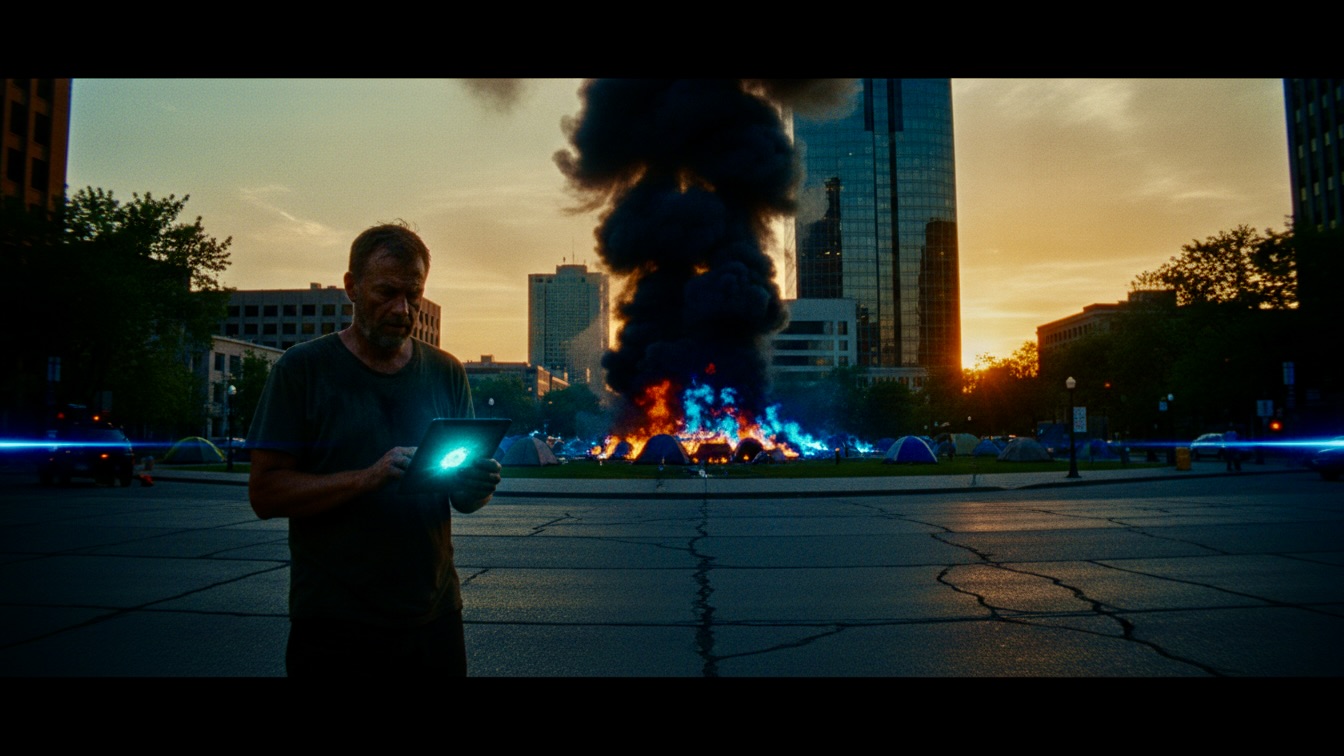
Kai Lennox navigates a sweltering Winnipeg tent city as arson and police pressure push the downtown core to collapse.
The heat in Winnipeg during July isn't just a temperature. It’s a weight. It sits on your shoulders like a wet wool coat, pressing the salt out of your pores until your shirt sticks to your spine. I stood at the edge of Central Park, watching the shimmer rise off the asphalt of Carlton Street. The park, once a patch of green for office workers to eat their overpriced salads, was now a sprawling grid of nylon and blue poly-tarps. Three thousand people lived here now. Maybe more. The census takers had given up weeks ago.
I wiped my forehead with the back of my hand. My skin felt gritty, coated in a fine layer of city dust and exhaust. I’m fifty-four. My knees tell me about the weather before the news does, and today they were screaming. I’d spent the morning handing out naloxone kits and clean socks, but the supply was running low. The city had throttled our funding again. 'Budgetary realignment,' they called it. I called it a slow-motion execution.
Sarah caught up to me near the statue. She was thirty years younger than me, full of a frantic energy that usually made me feel even older, but today she looked drained. Her blonde hair was pulled back in a messy knot, and her face was flushed a deep, alarming red. She handed me a lukewarm bottle of water. I didn't drink it. I pressed it against the back of my neck.
"The cops are stacking up on Ellice," she said. Her voice was flat. "Four cruisers. Two vans. They aren't just patrolling."
I looked toward the north end of the park. She was right. The white-and-black SUVs were idling, their exhaust adding more heat to the stagnant air. "Stenwick's deadline," I said. "He told the press the park would be 'returned to the public' by the weekend."
"We are the public," Sarah snapped. She kicked at a discarded cigarette pack. "Half these people worked at the warehouse before it shuttered. They've got nowhere to go, Kai. Nowhere."
"I know."
I started walking toward the center of the camp. The layout was a mess of narrow paths between tents. People sat on milk crates or pieces of cardboard, trying to catch a breeze that didn't exist. There was a low hum of conversation, punctuated by the occasional cough or the sound of a battery-powered radio. The air was thick. It carried the heavy scent of sun-baked nylon and the metallic tang of the nearby bus terminal.
I saw Old Pete sitting outside his tent—a massive, six-person beast held together with silver duct tape. Pete had been on the streets longer than I'd been sober. He was a fixture, a man who knew every crack in the sidewalk from Main Street to Sherbrook. He was whittling a piece of scrap wood, his movements slow and deliberate.
"Kai," he grunted, not looking up. "You brought the good stuff?"
"Just the basics today, Pete. Socks. Some gauze."
"Don't need gauze. Need a miracle. Or a fan."
I sat down on the curb next to him. The concrete was hot enough to feel through my jeans. "The police are getting restless, Pete. If things get loud, I need you to move the seniors toward the church. The basement is open."
Pete stopped whittling. He looked at me with eyes that had seen everything this city could throw at a person. "The church won't hold us all. And Stenwick knows it. He's not looking to move us, Kai. He's looking to delete us."
I didn't have an answer for that. Because I knew he was right. Councilor Stenwick was a man of 'optics' and 'efficiency.' He saw the camp as a stain on the city's push for a tech-corridor identity. To him, these weren't people; they were obstacles to a quarterly growth report.
I stood up, my joints popping. "Just keep an eye out. If you see anyone who doesn't belong here—anyone in high-vis vests or suits—you tell me."
"Already saw 'em," Pete said. He pointed toward the luxury condo construction site on the south side of the park. "Two guys. Surveyors, maybe. But they weren't looking at the ground. They were looking at the tents. Measuring the distance between the nylon and the dry grass."
A chill that had nothing to do with the summer heat crawled down my spine. The grass in the park was yellow and brittle. It hadn't rained in three weeks. One spark would turn this place into a furnace.
"When?" I asked.
"An hour ago. They went back into the site office."
I looked at the construction site. It was a skeleton of steel and glass, rising twenty stories above the misery below. 'The Meridian,' the sign said. 'Modern Living for the Bold.' It was being built by Kestrel Development, a company Stenwick had a significant, if obscured, interest in. The fire marshal had already flagged the camp as a hazard. If a fire started, it wouldn't be an eviction. It would be an insurance claim and a site clearance all in one.
I started walking toward the site office. My heart was thumping a jagged rhythm against my ribs. I'd been in this city's gutters. I'd tasted the ash. I knew how the machine worked. It didn't have a heart; it had a ledger. And right now, the people in this park were a liability that needed to be written off.
I reached the perimeter fence of the construction site. The gate was locked, but a security guard sat in a small booth, scrolling on his phone. He didn't look up until I rapped my knuckles against the glass. He was young, barely twenty, with a uniform that looked two sizes too big.
"Can't be here," he said through the glass.
"I need to speak to the site manager. Now."
"He's busy. Insurance stuff. Come back Monday."
"Tell him Kai Lennox is here. Tell him I know about the surveyors in the park."
The kid hesitated. He saw something in my face that made him pick up the radio. I waited, the sun beating down on my head, watching the police cruisers on the far side of the park. They were waiting, too. Everyone was waiting for the match to be struck.
The explosion wasn't a bang. It was a 'whump'—the sound of air being suddenly displaced by heat. It came from the north-west corner of the camp, near the cluster of tents they called 'The Annex.' I didn't wait for the security guard to come back. I turned and ran.
My boots pounded the pavement, the impact vibrating up through my shins. The air was suddenly different. The smell of the city—the exhaust and the dust—was replaced by something sharp and chemical. Accelerant. I knew that smell. It was the scent of a bad decision made in a dark alley.
"Fire!" someone screamed.
A pillar of orange-black flame shot up from a blue tarp tent. In seconds, the fire jumped to the next one. The nylon didn't just burn; it melted, dripping like liquid lava onto everything beneath it. I saw a woman scramble out of a tent, her sleeve catching. She rolled on the ground, sobbing, as the heat intensified.
I reached her and threw my jacket over her arm, smothering the flame. "Get to the street!" I yelled. "Sarah! Get the extinguishers from the van!"
Everything became a blur of physical collision. People were sprinting in every direction. I saw a man carrying a dog, his face masked by a wet rag. A mother was dragging two toddlers through the smoke, her eyes wide with a primal terror. The heat was a wall. It pushed back against me, singeing the hair on my arms. I felt a shove from behind—someone panicked, trying to get past. I stumbled, my palms hitting the hot grass, then scrambled up. No time to feel the sting.
I pushed deeper into the smoke. I had to reach the center. There were elderly people there, people who couldn't run. I saw Pete. He was standing near his tent, swinging a heavy wool blanket at a fire that was already too big to fight.
"Pete! Leave it!" I grabbed his shoulder. He was surprisingly heavy, rooted to the spot.
"My things, Kai! Everything's in there!"
"It’s gone, Pete! Move!"
I practically tackled him away just as a small propane canister inside a neighboring tent cooked off. The blast knocked us both to the ground. My ears rang with a high, piercing whine. I tasted copper in my mouth. My shoulder hit the leg of a metal picnic table, a dull thud that I knew would be a massive bruise tomorrow. I didn't care. I rolled over, coughing, the smoke thick and greasy in my throat.
I looked back toward the source of the fire. Through the shimmering heat and the shifting grey curtains of smoke, I saw them. Two men in dark hoodies, moving away from the flames toward the construction fence. One of them dropped a red plastic jug. It bounced off the concrete curb and rolled into the gutter.
I tried to stand, but the world tilted. The physical toll of the impact and the sudden oxygen deprivation made my head swim. I watched the men slip through a gap in the fence—the same fence that was supposed to be locked.
"Kai!" Sarah was there, her face smeared with soot. She had a small red fire extinguisher, but it looked like a toy against the wall of flame. "We can't stop it! The wind is picking up!"
She was right. A summer breeze had finally arrived, but it was a curse. It caught the embers and carried them across the paths, igniting tents fifty feet away. The camp was a tinderbox.
I grabbed the plastic jug from the gutter. It was empty, but the interior was wet. I unscrewed the cap and took a quick, shallow sniff. Racing fuel. High-octane. Not something a camper would have for a stove. This was professional.
"Get everyone to the fountain," I told Sarah, my voice rasping. "The concrete around the fountain is wide enough. It’s the only safe spot."
"The cops are blocking the exits!" she screamed over the roar of the fire.
I looked toward Ellice Avenue. The police hadn't moved to help. They had formed a line, their shields up, effectively trapping the fleeing crowd within the park's boundaries. They were letting it burn. They were watching the problem solve itself.
I felt a surge of cold, hard anger that cut through the heat. I tucked the fuel jug under my arm. "Keep them at the fountain. I'm going to talk to the officers."
I ran toward the police line. My lungs were burning. Every breath felt like swallowing needles. I reached the first cruiser and pounded on the hood. A young officer looked at me through the windshield, his expression unreadable behind polarized sunglasses.
"Move the cars!" I screamed. "People are dying in there!"
He didn't move. He didn't even roll down the window. He just pointed toward the senior officer standing near the van.
I turned and headed for the sergeant. He was a thick-necked man with a grey mustache, checking his watch. He looked like he was waiting for a bus, not watching a hundred homes go up in smoke.
"Sergeant! Open the line! We need ambulances!"
"Orders are to maintain the perimeter, sir," he said. His voice was calm, practiced. "For public safety."
"Public safety? There are kids in there! Look!"
I pointed back at the park. The black smoke was blotting out the sun. A scream echoed from the center of the camp—long, high, and then abruptly cut short. My stomach turned over.
"I have a fuel jug," I said, holding it up. "It was thrown by men coming from the Meridian site. This is arson. If you don't move these cars, you're accomplices."
The Sergeant’s eyes flickered to the jug. For a second, I saw a crack in his mask. A moment of human hesitation. Then his radio chirped.
"Hold the line," a voice said over the air. It was a voice I recognized. Councilor Stenwick.
The Sergeant looked at me, his face hardening back into stone. "Get back, sir. Or you'll be detained for interfering with a police operation."
I didn't back down. I stepped closer, until I could smell the peppermint on his breath. "Two people are already dead. I saw the bodies near the Annex. How many more do you need before you can sleep tonight?"
He didn't answer. He just put a hand on his holster.
I backed away, but I didn't go back to the fire. I turned toward the Meridian site. If the police wouldn't help, I’d find the people who started this. I had the evidence in my hand, and I had nothing left to lose but a few years of a life I’d already tried to throw away once before.
The lobby of the Kestrel Development headquarters was a cathedral of glass and white marble. The air conditioning was so aggressive it felt like a physical blow, a sudden, sharp contrast to the humid hell outside. I stood on the polished floor, dripping sweat and soot, clutching the red fuel jug like a holy relic.
The receptionist, a woman with perfectly manicured nails and a look of practiced indifference, didn't even look up until I leaned over her desk.
"I'm here to see Stenwick," I said. My voice was a wreck, a low growl of gravel and smoke.
"Do you have an appointment?" she asked, her gaze finally traveling up from her screen. She took in my singed shirt, the black streaks on my face, and the plastic jug. Her eyes widened, and she reached for a button under the desk.
"Don't," I said. "I’m not here to hurt anyone. I’m here to show him what his 'redevelopment plan' looks like in person."
Two security guards appeared from behind a set of elevators. They weren't the kids from the site. These were professionals—older, broader, with the flat eyes of men who had been paid to do unpleasant things for a long time. They moved with a synchronized grace that told me I wasn't going to win a fight.
"Sir, you need to leave," the taller one said. He reached for my arm.
I pulled back, holding the jug high. "This is evidence! Stenwick’s men torched the camp! There are bodies in the park!"
"Out," the guard said.
"Let him up."
The voice came from the intercom on the receptionist's desk. It was smooth, cultured, and entirely devoid of heat. Councilor Stenwick.
The guards hesitated. They looked at each other, then stepped back. They didn't like it, but they obeyed.
"Elevator four," the receptionist whispered, her face pale.
I stepped into the elevator. The doors slid shut, cutting off the noise of the lobby. The ascent was silent and fast. I watched the floor numbers climb on the digital display. 10. 20. 30. 40. My ears popped. I felt a wave of nausea, the physical reaction to the sudden change in pressure and the lingering adrenaline.
The doors opened on the top floor. The office was vast, with floor-to-ceiling windows that offered a panoramic view of the city. From up here, Winnipeg looked clean. The grid of streets was orderly. The trees were lush. You couldn't see the rust on the bridges or the needles in the alleys. And you couldn't see the fire.
Except you could.
Stenwick was standing by the window, his back to me. He was wearing a grey suit that probably cost more than my first house. To the north, a thick column of black smoke was rising into the blue summer sky, a dirty smudge on his perfect view.
"It’s quite a sight, isn't it?" he said, not turning around. "The end of an era. The birth of something better."
"People are dead, Stenwick," I said. I walked across the plush carpet, my boots leaving grey stains. I set the fuel jug on his mahogany desk.
He finally turned. He looked at the jug, then at me. He didn't look guilty. He looked annoyed, like I was a waiter who had brought the wrong wine.
"Accidents happen in encampments, Kai. You know that. Propane tanks, faulty wiring... it’s a tragedy, of course. But it’s also an inevitability."
"It wasn't an accident. I saw your guys. I have the accelerant. Pete saw them surveying the burn path an hour before it started."
Stenwick sighed. He walked over to a small bar and poured himself a glass of water. "Pete? The old man with the dementia? Not exactly a star witness. And that jug? It’s plastic. It’s common. You can find ten of those in any garage in the city."
"The security cameras at the site will show them," I said.
"The cameras were undergoing maintenance today," Stenwick replied. He took a sip of water. "A shame, really. But these things happen."
He walked back to the window. "Look at that land, Kai. It’s the heart of the city. And for three years, it’s been a festering wound. I’m just the surgeon. Sometimes surgery requires a bit of... cauterization."
"You're a murderer."
"I’m a visionary. In five years, no one will remember the people in those tents. They'll remember the park. They'll remember the new library, the artisan shops, the tax revenue. They'll remember me for saving downtown."
"I'm going to the press," I said. "I'm going to the feds."
Stenwick turned, and for the first time, his eyes went cold. The mask of the politician dropped, and the predator underneath leaned forward.
"You're an ex-junkie, Kai. You've got a record longer than my arm. You're barely holding onto your certification. Who is going to believe you? The word of a disgraced outreach worker against a city councilor?"
He stepped closer, his voice dropping to a whisper. "The police are already writing the report. 'Unattended cooking fire.' By tomorrow morning, the site will be bulldozed. The evidence will be under six feet of landfill. And if you keep talking, we might find something interesting in your apartment. A few grams of something that shouldn't be there. Maybe enough to send you back to Stony Mountain for a decade."
My heart hammered against my ribs. The physical threat was clear. He had the power, the money, and the cops. I was just a man with a plastic jug and a cough.
"The fire is still burning," I said.
"Not for long. The clearance order is being executed as we speak. For the safety of the residents, of course."
I looked out the window. Down below, I could see the tiny white sparks of the police cruisers moving in. They weren't there to help. They were there to push the survivors out into the streets, to disperse them so they wouldn't be a collective problem anymore.
"You think you've won," I said.
"I know I have. Now, leave. Go back to your gutters. It’s where you belong."
I didn't leave. I looked at the desk. There was a digital tablet, unlocked. A list of names and numbers. Kestrel Development. The Fire Marshal. The Chief of Police.
I reached out and grabbed the tablet.
"Hey!" Stenwick shouted.
I didn't run for the elevator. I ran for the emergency exit. I hit the crash bar, the alarm screaming in the small hallway. I didn't care about the noise. I was fifty-four, and my knees were killing me, but I’d spent twenty years running from things much worse than a councilor’s security team.
I bolted down the stairs, three at a time. My lungs were screaming, my vision blurring. I had the tablet. I had the proof of the communication between the developer and the city officials. It wasn't just the fire; it was the whole plan, laid out in emails and spreadsheets.
I heard the heavy boots of the guards on the stairs above me.
"Stop him!" Stenwick’s voice echoed down the stairwell, distorted by the concrete walls.
I didn't stop. I hit the thirtieth floor, then the twentieth. My legs were shaking, the muscles turning to jelly. I burst out into a hallway on the fifteenth floor, dodging a shocked accountant in a cubicle.
I found the service elevator. I jammed my finger into the button. The doors opened, and I slid inside just as the first guard reached the hallway.
As the elevator descended, I looked at the tablet. I started hitting 'forward' on the most damning emails. I sent them to every news outlet in the province. I sent them to the Premier. I sent them to the police oversight board.
By the time I hit the lobby, the 'Sent' icons were blinking.
I walked out the front door into the sweltering heat. The sun was still high, the sky still black with smoke. The city was still burning. But the ledger was about to change.
The air outside was even worse than before. The wind had shifted, blowing the thick, oily smoke directly into the downtown core. I stepped onto the sidewalk and immediately started coughing. It was a deep, racking sound that felt like it was tearing my ribs apart. I leaned against a lamppost, the metal hot against my shoulder, and looked toward the park.
It was a war zone.
The police had moved in. I could hear the rhythmic 'thump-thump-thump' of tear gas canisters being fired. The white clouds of gas were mixing with the black smoke of the fire, creating a hazy, suffocating fog that swallowed the streets. People were pouring out of the park, blinded and gasping.
I saw Sarah near the corner of Graham. she was helping an elderly man who was clutching a plastic bag—everything he owned. Her eyes were streaming, her face a mask of agony from the gas.
"Sarah!" I yelled, my voice barely a whisper.
She saw me and waved me over. I stumbled toward her, my legs feeling like they were made of lead. Every step was a struggle. The physical exhaustion was finally catching up to me, a heavy blanket of fatigue that threatened to pull me down to the pavement.
"We have to go," she said, grabbing my arm. "They're arresting everyone. They're putting them on buses to the outskirts."
"Did you get them to the fountain?" I asked.
"Most of them. But the cops don't care. They're clearing the whole area. They're calling it a 'public health emergency.'"
I looked at the tablet in my hand. The battery was at four percent. "I sent it. All of it. Stenwick's emails, the Kestrel contracts. It’s out there."
Sarah’s eyes widened. "Will it matter?"
"I don't know. But he won't be able to bury it now."
We started moving down a back alley, away from the main skirmish. The alley was narrow, the brick walls radiating the day's heat like an oven. We passed overflowing dumpsters and discarded pallets. The noise of the riot—the shouting, the sirens, the breaking glass—began to fade, replaced by the eerie silence of the forgotten parts of the city.
I felt a sharp pain in my chest. I stopped, clutching my side.
"Kai?" Sarah asked, her voice tight with worry.
"Just... give me a second."
I slid down the wall and sat on a pile of flattened cardboard. My heart was racing, a frantic fluttering that felt wrong. I looked at my hands. They were shaking. Not just from the adrenaline, but from the age. From the years of abuse I’d put my body through before I found this path.
I looked up at the sky. Through the narrow gap between the buildings, I could see the top of the Meridian site. It was still there, untouched by the fire, a monument to greed. But the smoke from the park was drifting past it, staining the glass.
"He thought he could just erase them," I said.
"He tried," Sarah said. She sat down next to me. She looked at the tablet. "What happens now?"
"Now the lawyers get involved. The investigations. The news cycles. Stenwick will fight it. He'll hire the best people to make it go away. But the fire... you can't un-burn a person, Sarah. Those two people in the Annex... they have names. I know them. One was a teacher. One was a mechanic. They weren't 'obstacles.'"
We sat in the alley for a long time. The sun began to set, turning the smoky sky a deep, bruised purple. The heat didn't break. If anything, it felt more stifling in the dark.
A police cruiser slowly cruised past the end of the alley, its blue and red lights reflecting off the wet pavement. They didn't see us.
I thought about the park. It would be a scorched earth tomorrow. The tents would be gone, replaced by yellow police tape and eventually, construction crews. The people I’d spent the last five years trying to help would be scattered to the corners of the city, hidden away in shelters or under bridges where they wouldn't ruin the view.
I felt a profound sense of loss. Not just for the camp, but for the city. Winnipeg used to be a place that looked out for its own. Or maybe I just wanted to believe that. Maybe it had always been like this, a place of hard lines and cold hearts, and I was just now seeing it clearly.
I stood up, my knees groaning in protest. I offered a hand to Sarah.
"Where are we going?" she asked.
"The church," I said. "They'll need help. The ones who made it out. They'll be hungry. They'll be scared."
"And then?"
"And then we start over. We find another park. We find another way. As long as there's a street, there will be people on it. And as long as they're there, we will be too."
We walked out of the alley and into the cooling night. The sirens were still wailing in the distance, a constant reminder of the chaos. But as we turned the corner toward the mission, I saw a group of people huddled together under a streetlamp. They were soot-stained and exhausted, but they were alive.
Pete was there. He saw me and gave a small, weary nod. He had managed to save his whittling knife.
I took a deep breath. The air still tasted like smoke, but the fire was out. For now.
I looked at the tablet one last time before the screen went black. The truth was out there, floating through the digital ether, waiting for someone to listen. I’d done my part. The rest was up to the city.
I walked toward the group, my shadow stretching long and thin across the cracked sidewalk. The summer was far from over, and the heat was still rising, but for the first time in years, I didn't feel like I was running.
I was just walking home.
“I looked back at the glowing towers of downtown, knowing that by morning, I’d either be a hero or a man with a target on his back.”


