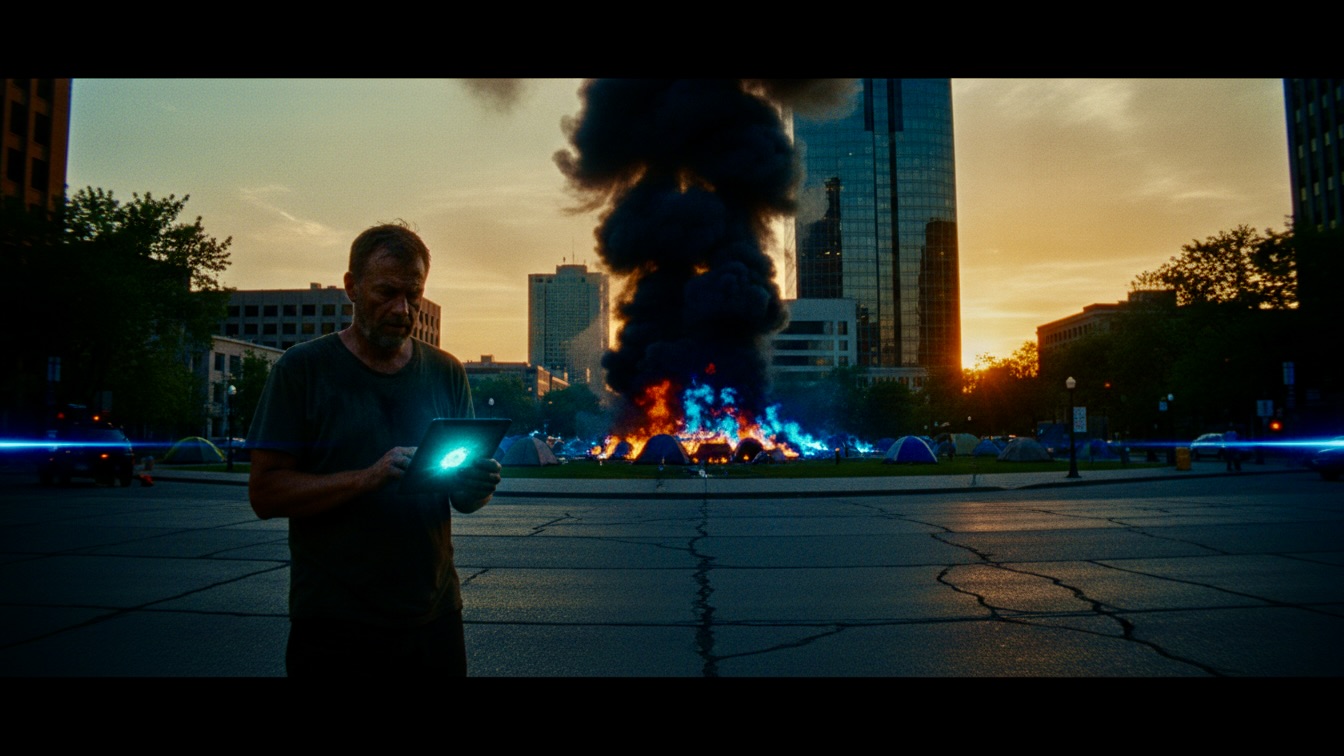
The story begins in the sweltering heat of a Winnipeg July, where a massive homeless encampment has taken root in Central Park. Kai Lennox, a weary fifty-four-year-old outreach worker and recovering addict, navigates the camp as tensions rise between the residents and the city. Councilor Stenwick has issued a deadline for the park to be cleared to make way for a luxury development called The Meridian. While the police gather on the perimeter, a suspicious fire breaks out, fueled by accelerants and designed to clear the area through violence rather than legal process.
As the camp burns, the police maintain a strict perimeter, effectively trapping the residents within the danger zone. Kai witnesses two men from the construction site fleeing the scene and recovers a fuel jug as evidence of arson. He bypasses the police line and enters the Kestrel Development headquarters to confront Stenwick directly. In the cooled, sterile environment of the forty-second floor, Stenwick admits to his role in the "cauterization" of the park, dismissing the lives lost as mere obstacles to urban progress.
In a final act of desperation and defiance, Kai steals Stenwick’s digital tablet containing incriminating emails and contracts. He flees down the stairwell, pursued by security, and manages to leak the data to the press and government authorities from a service elevator. The story concludes with Kai reuniting with his colleague Sarah and the survivors at a local mission. Although the park is destroyed and the future remains uncertain, Kai finds a sense of purpose in the collective survival of his community and the exposure of the truth.
The central theme of the narrative is the brutal intersection of gentrification and dehumanization. The story juxtaposes the "wet wool coat" of the Winnipeg heat experienced by the poor with the aggressive, clinical air conditioning of the Kestrel Development headquarters. This physical contrast mirrors the psychological distance between the characters. To Stenwick, the residents are not people but "festering wounds" and "liabilities" that must be written off to improve the city's quarterly growth reports.
Another prominent theme is institutional corruption and the complicity of law enforcement. The police do not act as protectors of the public; instead, they serve as the enforcement arm of corporate interests. By maintaining a perimeter while the camp burns, the officers become active participants in the arson. This highlights a systemic failure where the law is used as a tool to protect property and "optics" rather than human life, leaving individuals like Kai to operate outside the system to seek justice.
The narrative also explores the concept of atonement and the resilience of the marginalized. Kai is a man defined by his past failures, yet he finds his redemption through his commitment to those the city has discarded. The story suggests that while the "machine" of the city lacks a heart, the individuals within the gutters possess a profound communal strength. The fire serves as a literal and metaphorical purgatory, stripping away the residents' few possessions but failing to erase their existence or their right to occupy space.
Kai is a protagonist defined by physical and emotional weariness. His knees, which "tell him about the weather," serve as a constant reminder of his age and the toll of a difficult life. As a recovering addict, he possesses a unique perspective on the city’s underbelly, allowing him to see the "jagged rhythm" of corruption that others might miss. He operates from a place of quiet, determined empathy, rooted in the knowledge that he could easily be one of the people living in the nylon tents.
Psychologically, Kai is driven by a need to protect a community that mirrors his own past struggles. He is not a traditional hero; he is a man with "nothing left to lose but a few years of a life he’d already tried to throw away." This lack of attachment to his own status or safety makes him a dangerous adversary for Stenwick. His decision to steal the tablet and leak the emails represents a shift from passive service to active rebellion, suggesting that his moral compass has finally outweighed his exhaustion.
By the end of the chapter, Kai reaches a state of grim resolution. He acknowledges that the battle against gentrification is ongoing and that the "ledger" of the city is difficult to change. However, his movement toward the mission at the end of the story shows that he has transitioned from running away from his demons to walking toward a sense of home. He finds his identity not in his professional certification or his past record, but in his role as a witness and a protector for the "soot-stained and exhausted."
Stenwick serves as the personification of predatory capitalism and clinical sociopathy. He views the world through the lens of "optics" and "efficiency," completely detached from the human suffering his policies create. His office on the forty-second floor provides him with a panoramic view that obscures the "rust on the bridges" and the "needles in the alleys." This elevation is both literal and metaphorical, representing his belief that he is a "visionary" who exists above the moral constraints of the common citizen.
His dialogue reveals a man who has successfully rationalized mass displacement and arson as "surgery." He does not see himself as a murderer but as a surgeon performing a necessary "cauterization." This linguistic framing allows him to maintain a mask of cultured indifference even when confronted with the evidence of his crimes. He relies on the power of the state and the perceived illegitimacy of his victims to protect himself, confident that no one will believe an "ex-junkie" over a city official.
Sarah represents the frantic, raw energy of the younger generation of activists. Unlike Kai, who is tempered by years of observation, Sarah is "full of a frantic energy" that manifests as sharp anger and visible physical distress. Her face, flushed a "deep, alarming red," mirrors the heat and the urgency of the crisis unfolding in the park. She provides the emotional heartbeat of the outreach team, reacting with visceral horror to the police blockade and the destruction of the camp.
While she lacks Kai’s experience in navigating the high-stakes world of corporate espionage, her role is crucial in maintaining the safety of the survivors. She is the one who directs the residents to the fountain and eventually to the mission, acting as the practical hands to Kai’s strategic mind. Her character highlights the exhaustion inherent in social work, as even her youth cannot shield her from looking "drained" by the overwhelming weight of the city's cruelty.
Old Pete serves as the "fixture" of the camp, a man who embodies the history and memory of Winnipeg’s streets. He is a stoic figure, whittling wood with "slow and deliberate" movements even as the world around him begins to burn. His psychological state is one of profound acceptance; he has seen everything the city can throw at a person and no longer expects miracles. His wisdom is grounded in the physical reality of the sidewalk rather than the abstract reports of the city council.
The loss of Pete’s "massive, six-person beast" of a tent represents the total erasure of the residents' history. When he tells Kai that "everything’s in there," he is speaking to the tragedy of a life reduced to a few salvaged items and a whittling knife. Pete’s survival, and his small nod to Kai at the mission, provides a sense of continuity. He is the living proof that the city cannot "delete" its people as easily as Stenwick believes, as long as they have the will to remain.
The pacing of the chapter is masterfully handled, transitioning from a heavy, stagnant opening to a frantic, high-stakes climax. The initial descriptions of the Winnipeg heat create a sense of claustrophobia and impending doom, slowing the reader down to match Kai’s aching joints. When the fire erupts, the prose shifts into a kinetic, sensory-driven style. The transition from the "whump" of the explosion to the "pounding" of boots on pavement accelerates the narrative momentum, mirroring the protagonist's adrenaline.
Sensory details are used effectively to ground the reader in the grit of the setting. The author emphasizes the "metallic tang" of the bus terminal, the "smell of sun-baked nylon," and the "greasy" texture of the smoke. These details create a visceral experience that contrasts sharply with the "white marble" and "aggressive" air conditioning of the Kestrel headquarters. By focusing on these physical sensations, the narrative reinforces the divide between the lived reality of the park and the sterile isolation of the powerful.
The narrative voice is weary and noir-inflected, utilizing a first-person perspective that feels intimate and authentic. Kai’s internal monologue is peppered with cynical observations about "budgetary realignment" and the "machine" of the city. This voice lends authority to the story’s social commentary, as it comes from a character who has "tasted the ash." The tone remains somber throughout, but the ending provides a subtle shift toward a resilient, if not entirely optimistic, outlook on the human condition.


