Format: Short Film / Anthology Episode | Est. Length: 10-12 minutes
This story serves as a pilot or standalone entry in The Concrete Ledger, an anthology series exploring the hidden intersections of urban decay, corporate greed, and the marginalized voices of mid-sized North American cities. Each episode focuses on a different "liability" on the city’s balance sheet—from condemned tenements to shuttered community centers—and the individuals who risk everything to prevent them from being "written off." The series maintains a consistent focus on the friction between "modern living" and the human cost of progress, using a gritty, hyper-realistic lens to examine the systemic machinery of the modern metropolis.
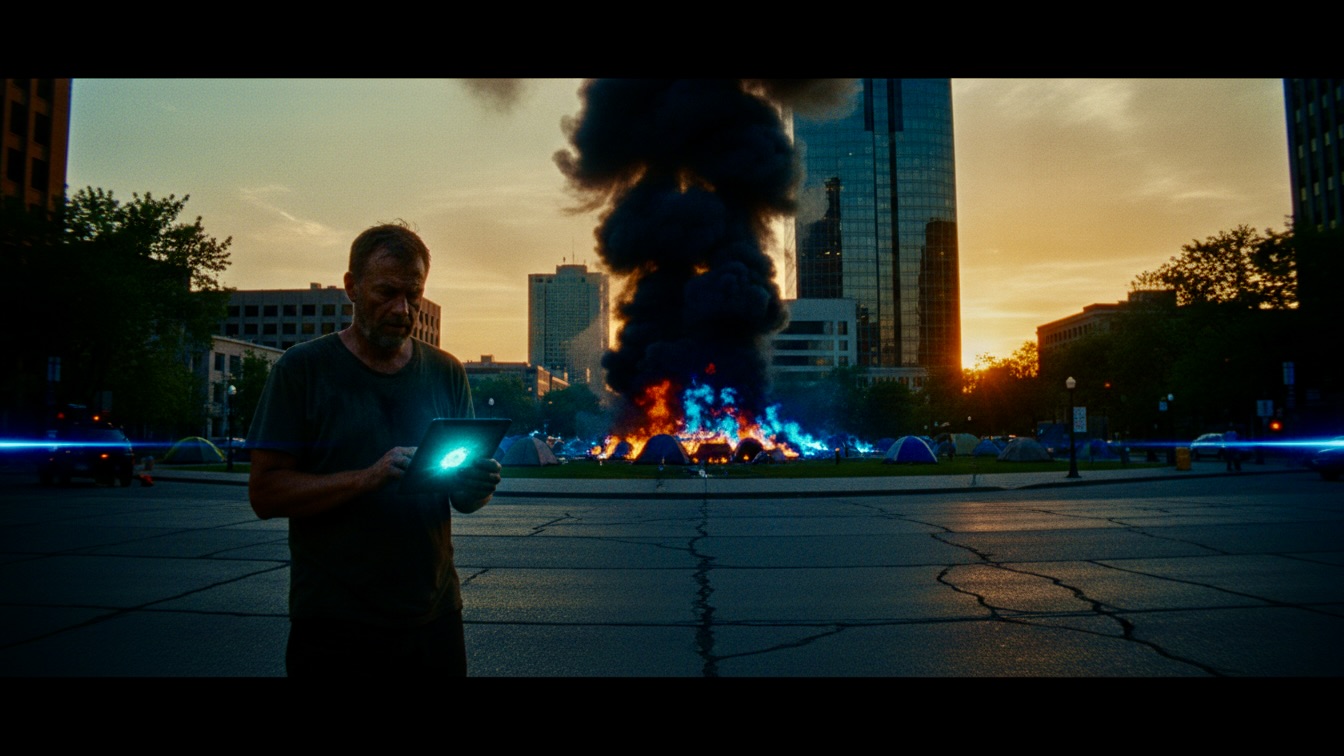
A shimmering heatwave turns a Winnipeg park into a tinderbox as police SUVs idle on the perimeter, waiting for a deadline that feels more like a death sentence. The silence is broken by a chemical "whump," and the screen fills with the sight of melting blue nylon.
An aging outreach worker must expose a state-sanctioned arson plot before a massive homeless encampment is incinerated to make way for luxury condos. Failure means the permanent erasure of three thousand lives and the total victory of corporate "cauterization."
Urban Displacement and Class Warfare are the central pillars of this narrative, highlighting how "revitalization" often serves as a euphemism for the violent removal of the poor. The story examines the concept of "The Disposable Person," where human lives are treated as obstacles to a quarterly growth report, and the only solution offered by the state is "deletion" rather than support.
The story also explores Redemption and the Weight of History, as Kai’s past as a "junkie" is weaponized against his current moral crusade. It asks whether a man with a "record longer than his arm" can ever truly challenge a man with a "grey suit," emphasizing that the truth is often less powerful than the person telling it.
For Kai, the stakes are his hard-won sobriety and his freedom, as Stenwick threatens to frame him for drug possession and send him back to prison. For the three thousand residents of Central Park, the stakes are literal survival against a fire designed to "delete" them from the city's ledger. If Kai fails to leak the evidence, the deaths will be ruled an accident, the land will be seized, and the survivors will be dispersed into the shadows without recourse.
The external conflict pits Kai against the combined might of the municipal government, the police force, and billionaire developers who view human beings as "liabilities." Councilor Stenwick serves as the personification of this cold, calculating machine, using "public safety" as a shield for arson. Internally, Kai struggles with his physical decline and the cynical realization that his years of service might be insufficient against a system that values property over people.
Kai Lennox navigates a brutal Winnipeg heatwave while tending to the three thousand residents of the Central Park encampment, only to discover that Councilor Stenwick plans to "return the park to the public" via a suspicious fire. When the blaze is ignited using high-octane racing fuel, Kai witnesses the police forming a perimeter to prevent escape, forcing him to choose between saving lives on the ground or striking at the heart of the conspiracy. He discovers a discarded fuel jug and realizes the fire was a professional job coordinated with the nearby Meridian luxury condo construction site.
Kai infiltrates the Kestrel Development headquarters, confronting Stenwick in his air-conditioned ivory tower while the city burns below. By stealing a tablet containing incriminating communications and leading security on a desperate chase down thirty flights of stairs, Kai manages to leak the truth to the press. He escapes into the smoky streets, reuniting with the survivors at a local mission, knowing that while the park is gone, the architects of the disaster can no longer hide behind a narrative of "accidental" tragedy.
Kai Lennox: A 54-year-old outreach worker with a history of addiction whose knees and spirit are beginning to fail him under the weight of the city’s indifference. He starts the story as a weary protector resigned to "budgetary realignments" but ends as a radical whistleblower who risks his remaining years to expose the truth. His arc is one of reclaiming his voice, moving from a man who "tasted the ash" to a man who sets the ledger straight.
Councilor Stenwick: A polished, predatory politician who views the city as a spreadsheet and human suffering as an "optics" problem to be solved with "efficiency." He remains unmoved by the deaths he causes, maintaining a chillingly detached belief that he is a "visionary" surgeon cutting away a "festering wound." He represents the ultimate antagonist: a man who believes his crimes are actually public services.
Sarah: A thirty-year-old outreach worker whose frantic energy serves as a foil to Kai’s cynical experience, representing the next generation of activists. She undergoes a harrowing transformation from a hopeful worker to a traumatized survivor, ultimately finding the strength to lead the displaced toward sanctuary. Her role is to ground the emotional stakes of the fire, providing the human connection that fuels Kai’s final desperate act.
Old Pete: A fixture of the Winnipeg streets who has been homeless longer than Kai has been sober, serving as the "memory" of the park. He is slow, deliberate, and observant, providing the crucial piece of intelligence regarding the "surveyors" that confirms the arson plot. His refusal to leave his burning tent highlights the tragedy of losing the only "home" one has left.
Beat 1 (The Pressure Cooker): Kai moves through the sweltering Central Park encampment, distributing dwindling supplies while observing the ominous buildup of police cruisers on the perimeter. He meets with Old Pete, who warns him about mysterious "surveyors" measuring the distance between nylon tents and dry grass. The heat is established as a physical antagonist that mirrors the rising social tension and the inevitability of the coming "deadline."
Beat 2 (The Spark): A chemical "whump" signals the start of the fire in the "Annex" section of the camp, sending the residents into a panicked frenzy as the nylon tents melt into liquid fire. Kai rescues a woman from the flames and attempts to coordinate an evacuation, only to realize the police have formed a line to trap the residents inside. He discovers a discarded fuel jug and sees men fleeing toward the construction site, confirming his suspicions of professional arson.
Beat 3 (The Ivory Tower): Kai infiltrates the Kestrel Development headquarters, contrasting the humid, smoky hell of the park with the sterile, freezing luxury of Stenwick’s office. He confronts the Councilor, who admits to the "cauterization" of the park while threatening Kai with a drug plant if he speaks out. In a desperate move, Kai seizes Stenwick’s tablet and leads security on a high-stakes chase down thirty flights of stairs, his failing knees screaming with every step.
Beat 4 (The Leak): From a service elevator, Kai frantically forwards incriminating emails to every major news outlet and oversight board in the province before the battery dies. He escapes into the smoke-filled streets, reuniting with Sarah and the survivors in a dark alley as the truth begins to circulate digitally. The story ends at a local mission, where Kai realizes that while the physical camp is gone, the community—and the fight—remains.
The episode begins with a sense of suffocating dread and exhaustion, transitioning into a visceral, high-octane panic during the fire sequence. The climax shifts from physical terror to a cold, intellectual fury during the confrontation with Stenwick, creating a sharp contrast between the "street" and the "suite." The ending provides a somber, resilient resolution, moving the audience from despair to a quiet, defiant hope as the survivors gather.
If expanded, the season would follow the legal and social fallout of the "Central Park Fire," tracking the grand jury investigation into Stenwick and Kestrel Development. Kai would evolve from a lone whistleblower into a reluctant figurehead for a city-wide housing movement, facing escalating threats from a system desperate to protect its "tech-corridor" future. The narrative would explore how the "ledger" of the city is rewritten by those who refuse to be deleted.
Secondary arcs would follow Sarah as she manages the influx of displaced residents into the city's overstretched mission system, and Old Pete as he becomes a key witness in the arson trial. The season would culminate in a public hearing where the digital evidence Kai leaked is pitted against the "official" police reports, testing the city's capacity for true justice.
The visual style utilizes a high-contrast, "sweaty" aesthetic, with long lenses and handheld cameras capturing the claustrophobia of the camp. The color palette shifts from the jaundiced yellows and burnt oranges of the fire to the sterile, blue-tinted whites of the corporate headquarters. Close-ups on textures—gritty skin, melting nylon, polished marble—emphasize the physical divide between the two worlds.
The tone is a blend of urban noir and social realism, drawing comparisons to the gritty atmosphere of The Wire and the corporate-thriller tension of Michael Clayton. The sound design is crucial, contrasting the roar of the fire and the rhythmic "thump" of tear gas with the eerie, low-frequency hum of the Kestrel headquarters' HVAC system.
This content is designed for adult viewers (18-45) who consume prestige social dramas and political thrillers on platforms like HBO, FX, or Hulu. It appeals to audiences interested in contemporary social issues, systemic corruption, and character-driven narratives that offer a "street-level" perspective on urban politics. The story's focus on a "disgraced" hero fighting a "visionary" villain resonates with viewers looking for morally complex, high-stakes storytelling.
The pacing follows a "slow burn to explosion" structure, with the first third establishing a heavy, atmospheric dread before the fire accelerates the tempo into a relentless thriller. The confrontation in the Kestrel building serves as a high-tension midpoint, followed by a frantic "escape" sequence. The final two minutes slow down significantly to allow the emotional weight of the aftermath to settle, ensuring the 10-12 minute runtime feels both urgent and profound.
The fire sequence requires significant practical effects coordinated with digital set extensions to safely simulate the "melting nylon" effect without endangering the cast. The production must prioritize a "lived-in" look for the Central Park set, using authentic materials and "city dust" to create a visceral sense of place. The contrast in lighting between the park and the office should be achieved through distinct color grading in post-production.
The "stairwell chase" sequence requires a location with a consistent architectural look to allow for seamless editing across multiple floors. Sound design should be layered to emphasize Kai’s physical distress—his labored breathing and the "popping" of his joints—to heighten the audience's empathy for his physical sacrifice. Practical "racing fuel" jugs and soot-smearing kits will be essential for maintaining the gritty, tactile reality of the "street" scenes.


