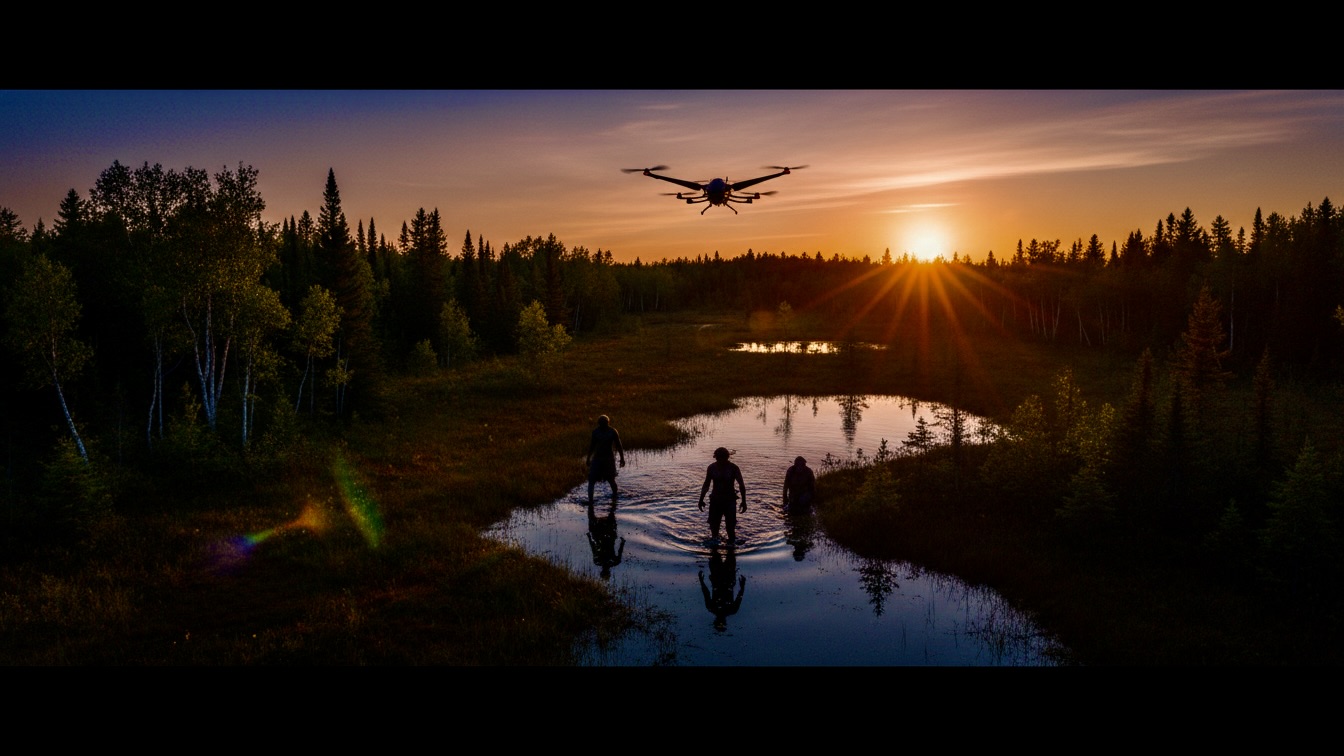
A group of digital ghosts flees into the sweltering Ontario bush, pursued by drones and a total financial erasure.
The heat doesn't care if you have a bank account. It doesn't care if your social credit score is a flat zero or if the government officially decided you don't exist. It just sits on your chest. I wiped the sweat from my eyes, my fingers coming away grimy and smelling of pine sap and desperation. My pocket felt wrong. For ten years, there was a weight in my right pocket. A glass and titanium slab that connected me to everything. Now, it’s just air. A vacuum. Every few minutes, my thumb twitches, reaching for a screen that isn't there, looking for a notification that will never come. That’s the first thing they take: your tether. Then they take your ability to eat.
"Jules, my boots are literal ovens," Jay muttered behind me. He was twenty-two, a kid who thought liberty was something you bought with Bitcoin until the exchanges blacklisted his facial ID. Now he was just a guy in overpriced hiking gear that was rapidly falling apart in the humidity. "I think I have a blister the size of a loonie. Can we just... I don't know, stop? For like five minutes?"
I didn't turn around. If I stopped, the momentum would die, and we’d all just sink into the muskeg. "If you stop, the black flies will eat you before the drones do. Pick a struggle, Jay."
"I’m picking the struggle where I don't lose a toe," he snapped, but I heard his boots squelch in the mud. He was still moving. Good. Behind him, the Elder was silent. He didn't complain about the heat or the bugs. He just walked, his eyes scanning the canopy with a rhythm I couldn't match. He was the only one who seemed to belong here, in this green wall of Northern Ontario bush that was trying to swallow us whole.
It was July, and the forest was aggressive. Everything was growing too fast, fueled by a week of torrential rain and then this sudden, punishing sun. The smell of rotting vegetation was thick, weaving through the scent of crushed ferns. It wasn't the clean, crisp woods from a tourism ad. It was a swampy, humming machine of decay and rebirth. I missed the smell of my apartment. Not the actual smell—which was mostly stale coffee and old books—but the certainty of it. The way the air conditioning hummed a steady C-sharp. Here, the only hum was the mosquitoes, and they sounded like a thousand tiny needles being sharpened.
"How much further to the creek?" Jay asked. His voice was thinner now. He was reaching that point where the irony wears off and the reality of being a fugitive starts to set in. "You said the signal drops there. My brain feels like it’s being microwaved by the satellites."
"Dead Signal Creek is another two miles," I said, checking the paper map. A real, physical map. It felt like an ancient relic, something from a museum. No GPS. No blue dot telling me exactly where I was and how many minutes until I reached my destination. Just lines on a page and the compass clipped to my pack. "The geography there is weird. Steep ridges, heavy iron deposits. It’s a natural Faraday cage. If we make it there, we’re invisible."
"Invisible and broke," Jay said. "I tried to use my card at that last roadside stand. The one with the wilted corn. The reader didn't even say 'declined.' It just turned red. Like, solid red. No text. Just the color of 'go to jail.'"
"You're lucky it didn't ping a recovery team," I said. I remembered my own 'deletion.' It happened in the middle of a Tuesday. I was standing in front of my Grade 11 history class, talking about the 1920s, when my smart-watch buzzed once, hard. I looked down, expecting a text. Instead, there was a system message: 'Account Suspended: Policy Violation.' By the time the bell rang, my school email was gone. My health insurance was void. My rent payment, scheduled for that afternoon, bounced. I was a teacher who had suggested, in a private group chat, that maybe the new digital currency laws were a bit over-reaching. One screenshot later, and I was a ghost.
"They don't need to arrest us," I told the group when we first met in that basement in Sudbury. "They just turn us off. You can't buy gas. You can't buy bread. You can't even get into your own apartment if it has a smart lock. You just... drift."
Now we were drifting through the deep green. The sun was starting to dip, but it didn't get cooler. It just got orange. The light filtered through the birch trees, hitting the white bark in a way that should have been beautiful, but it just felt like a spotlight. We were looking for a way out of a country that had decided we were bugs in the software. And in 2026, the software was everything.
We hit the edge of an old logging road about an hour before dusk. It was barely a road anymore, just two ruts of gravel and weeds being reclaimed by the forest. At the intersection sat a collapsed shack that might have been a gas station back when people still used internal combustion and physical coins. Now, it was a skeleton of wood and rusted corrugated metal. A single, solar-powered vending kiosk stood near the road, its screen flickering with a ghostly blue light that looked alien against the darkening woods.
Jay stumbled toward it before I could stop him. He was desperate. We all were. Our water was warm and tasted like the plastic bladders in our packs, and our protein bars were sawdust.
"Jay, don't," I hissed, but he was already tapping the screen.
"It’s just a kiosk, Jules. It’s not a drone. I just want a drink. A real one. Something with bubbles."
He swiped his hand over the biometric scanner. It was a reflex. We’d been trained for years to just wave and pay. The machine whirred, a mechanical sound that felt loud enough to wake the entire province. For a second, a logo for a soda brand appeared, bright and inviting. Then, the screen changed. It didn't show a price. It didn't show his balance. A massive, crimson rectangle filled the display. No words. Just that flat, aggressive red. It stayed there for three seconds before the machine emitted a sharp, piercing chirp.
"Get away from it!" the Elder barked, his first words in miles.
Jay backed up, his face pale. "It... it didn't even give me an error code. It just looked at me. It knew who I was and it just said 'no.'"
"It did more than that," I said, grabbing his arm and pulling him back into the treeline. "That chirp was a handshake. It just logged your location. We have to move. Now."
"I just wanted a Coke," Jay whispered. He looked like he was about to cry, but the heat had dried him out too much for tears. "How did we get here? I had forty thousand in my savings. I worked three jobs for that. It’s just... gone? Like it never existed?"
"The money is there," I said, pushing him through a thicket of raspberry bushes. The thorns tore at my shins, but I didn't feel it. "It’s just not yours anymore. It belongs to the state's definition of a 'compliant citizen.' You don't fit the definition, so the money doesn't recognize you."
We scrambled down a steep embankment, heading toward the sound of rushing water. This was Dead Signal Creek. It wasn't a creek so much as a jagged tear in the earth where the water fought its way through black rock. As we descended, the air changed. It stayed hot, but the 'weight' lifted. My skin didn't feel like it was being scanned. It’s a psychosomatic thing, I know, but you can feel the absence of the grid. It’s a silence that isn't just about noise. It’s the silence of not being watched.
We reached the water’s edge. The creek was high, churning with summer runoff. I looked down and saw something caught in a tangle of driftwood and grey mud. It was a piece of fabric, faded and frayed. I pulled it out with a stick. It was a flag. The 'Convoy 2022' logo was barely visible under the grime.
"A relic from the first time they flipped the switch," I said, tossing the wet fabric back into the mud. "When they froze the bank accounts of the protesters. People laughed back then. They said it was just a temporary measure for an emergency. They didn't realize it was a demo."
"My dad was there," the Elder said, looking at the flag as it drifted away in the current. "He told me that the day the money died was the day the soul of the country went into the cloud. You can't hold a soul in a cloud. It just evaporates."
"We need to cross," I said, looking at the churning water. "The other side is the 'Grey Zone.' No towers. No sensors. Just trees and the people who learned how to live without a login."
Jay was sitting on a rock, staring at his hands. "I can't do it, Jules. I’m a digital person. I don't know how to be a physical one. If I’m not on the grid, I’m just... meat. I’m just a bag of bones in the woods."
"Then be a bag of bones that’s hard to find," I said, crouching in front of him. "Look at me, Jay. You are more than your balance. You are more than your 'Wrongthink' flags. You’re here. You’re breathing. That machine back there? It’s a liar. It says you aren't real, but my eyes say you are. Which one do you trust?"
He looked up, his eyes bloodshot and wide. "I trust the red light. It’s the only thing that’s been honest with me in weeks."
"Then use that anger," I said, pulling him up. "Use it to get across this water. Because if we stay here, the Recovery Team will be honest with you too. And their honesty involves a zip-tie and a 're-education' center."
We waded into the creek. The water was surprisingly warm, but the current was treacherous. We linked arms—the Elder, Jay, and me. We were a chain of unpersons, three glitches in a perfect system, fighting against the gravity of a world that wanted us deleted. The rocks were slippery, coated in a fine green algae that felt like grease. I lost my footing once, the water surging up to my chest, and for a second, I thought about letting go. I thought about how easy it would be to just let the creek take me. No more hiding. No more hunger. Just a long, quiet float into the dark.
Then the Elder’s hand tightened on my arm. His grip was like iron. He didn't say a word, but the strength in his fingers told me everything I needed to know. We weren't done yet. Not by a long shot.
The sound started as a low-frequency thrum, something you felt in your molars before you heard it with your ears. It was the sound of a hornet the size of a lawnmower. We were halfway up the ridge on the far side of the creek, deep in a stand of ancient hemlocks that blocked out most of the sun. The shadows were long and jagged, stretching across the needle-covered floor like reaching fingers.
"Drone," the Elder whispered. He didn't even look up. He just dropped to the ground, pulling Jay with him.
I hit the dirt a second later. The smell of damp earth and decaying needles pressed into my face. I stayed perfectly still, my heart hammering against the forest floor. The thrumming grew louder, vibrating through the trees. It was a 'Vulture' model—a high-end enforcement drone equipped with thermal imaging, facial recognition, and a voice box that could play a recording of your own mother's voice if it thought it would make you surrender.
It hovered directly above our canopy, the downdraft from its rotors whipping the hemlock branches into a frenzy. A shaft of light broke through the needles, illuminating a patch of ferns just inches from my head. The drone was searching. It was looking for the one thing we couldn't hide: our heat. In the humid summer air, we were three glowing lanterns against a slightly cooler background.
"It’s going to see us," Jay hissed into the dirt. "The thermal... it’s too hot out here. We’re radiating like stoves."
"Stay still," the Elder commanded. He reached into his pack and pulled out a bundle of something wrapped in damp buckskin. He unwrapped it to reveal a thick, greyish-black sludge. Without a word, he began smearing it over his exposed skin. He passed the bundle to me.
"River mud and crushed cedar," he whispered. "It’ll mask the signature for a few minutes. Fast."
I grabbed a handful of the cold, gritty muck and slapped it onto my face. It felt disgusting—slimy and smelling of ancient rot—but I didn't care. I smeared it over my neck, my arms, and even through my hair. I passed it to Jay, who looked at it with a mix of horror and desperation before diving in. We turned ourselves into creatures of the swamp, erasing our humanity with the very earth we were trying to claim.
Above us, the drone’s voice activated. It wasn't my mother. It was a generic, soothing female voice—the kind used for meditation apps and airline safety videos.
"Attention, Citizens. You have wandered outside the designated safety perimeter. Your biometric signatures indicate elevated stress levels. Please remain where you are. A Recovery Team is en route to provide medical assistance and restore your digital access. Peace is participation. Compliance is community."
"Peace is a lie," Jay muttered through a mouthful of mud.
The drone descended lower, the rotors screaming now. It was trying to get a visual through the branches. I watched a beetle crawl across a nearby leaf, its iridescent shell glowing in the stray sunlight. It was so small, so indifferent to the mechanical god hovering above us. It just existed. It didn't need a bank account or a social media profile. It just was.
After what felt like an hour, but was probably only five minutes, the thrumming began to fade. The drone moved off to the north, its sensors likely confused by the sudden 'cooling' of the three heat signatures it had been tracking. We stayed down for another ten minutes, just to be sure.
When we finally stood up, we were unrecognizable. We were grey-black ghosts, our eyes the only human thing left.
"We need to find shelter," I said, wiping a glob of mud from my eyelid. "The sun is going down, and if there’s one drone, there’s a swarm."
We pushed on, the terrain getting steeper and more choked with fallen timber. We were moving through an old-growth section that hadn't seen a chainsaw in a century. It was beautiful in a terrifying way—massive trunks that seemed to hold up the sky, their roots twisting like snakes over the mossy rocks.
Just as the last of the light was bleeding out of the sky, we stumbled upon it. A cabin. It was tucked into a natural hollow between two ridges, built of rough-hewn logs and capped with a rusting tin roof. It looked like it was melting back into the forest. The porch had collapsed, and the windows were blank, dark eyes.
I pushed the door open. It groaned on leather hinges. The air inside was still and smelled of woodsmoke that had gone cold decades ago. I pulled out my small LED flashlight—one of the few battery-powered things I’d risked bringing, wrapped in three layers of lead-lined foil—and clicked it on for a split second.
The room was a tomb of things that were missing. There was a table with three chairs, but one chair was missing its back. There was a woodstove, but the pipe had rusted away. On the wall, a calendar from 2024 hung by a single nail, the pages curled and yellowed. In the corner, a pile of old clothes lay like a discarded skin.
"People lived here," Jay said, his voice echoing in the small space. "Recently."
I pointed the light at the floor. Scratched into the floorboards near the door were names. Dozens of them. Names followed by dates.
'Sarah Miller. Deleted May 12, 2025.' 'David Chen. Zeroed August 3, 2025.' 'The Thompson Family. Unpersons. September 2025.'
There were no names for 2026.
"They didn't make it," I whispered.
I looked at a small shelf near the window. There was a child’s toy there—a plastic dinosaur, its green paint peeling. It was a reminder of a life that had been stripped of its context. Without a house, without a school, without a digital footprint, that toy was just a piece of trash. And the child who owned it? In the eyes of the state, they were just a calculation error that had been corrected.
"Freedom is a cold business, Jules," the Elder said, sitting on the edge of a moth-eaten cot. "People think it’s a parade. It’s not. It’s a long walk in the dark where nobody knows your name."
I sat on the floor, my back against the rough log wall. The mud was drying on my skin, tightening like a second, brittle layer of flesh. I thought about my classroom. I thought about the way the light hit the chalkboard at 3:00 PM. I thought about my cat, who I’d had to leave behind with a neighbor, hoping they wouldn't be flagged for associating with me.
I realized then that I wasn't just mourning my country. I was mourning the version of myself that believed in it. The Jules who thought that if you were 'polite' and 'did the right thing,' the system would protect you. That Jules was dead. She’d been deleted. And the thing that was left—this mud-covered, starving woman in a rotting cabin—was something entirely new. Something the system didn't have a name for yet.
We didn't sleep. You don't sleep when you know a Recovery Team is hunting you with ATVs and thermal goggles. We left the cabin at 3:00 AM, moving by the faint light of a crescent moon. The humidity had finally broken, replaced by a pre-dawn chill that made the dried mud on our skin crack and itch.
By dawn, we reached the Big Marsh. It was a massive, shimmering expanse of reeds and stagnant water that stretched for miles. In the winter, it would be a flat, frozen highway. In July, it was a maze of waist-deep muck and swarms of biting flies that could drive a person insane.
"The settlement is on the other side," the Elder said, pointing toward a distant line of dark hills. "If we can cross this, the ATVs can't follow. They're too heavy. They’ll sink."
We started across. It was agonizing. Every step was a battle against the suction of the mud. The smell was overwhelming—a sulfurous, gagging stench of disturbed swamp gas. We waded through thickets of cattails that sliced at our hands. Jay was struggling, his breath coming in ragged gasps.
Suddenly, the sound of engines cut through the morning air. High-pitched, angry whines.
"Snowmobiles?" Jay asked, panicked.
"ATVs with tracks," I said, looking back. On the far shore of the marsh, three dark shapes emerged from the trees. They were moving fast, their wide tracks allowing them to skim over the softer ground. "They’re here."
A voice boomed over a long-range acoustic device. It was loud enough to vibrate the water around us.
"Jules Victor. Jay Aris. You are in violation of the National Stability Act. This is Commander Poport of the Federal Recovery Team. Cease your movement immediately. We have your biometric signatures locked. There is nowhere to go."
"Keep moving!" I yelled, grabbing Jay’s pack and shoving him forward.
We were three-quarters of the way across when the first ATV hit the deep mud. It roared, its tracks spinning and throwing up a massive plume of black filth. It slowed, then tilted dangerously to the left. The engine screamed in protest, but the swamp was winning. The other two vehicles stopped at the edge of the deep water, their headlights cutting through the morning mist like the eyes of frustrated predators.
A figure stood up on the lead ATV. Even from a distance, I could see the tactical gear, the HUD-equipped helmet. That was Poport. He raised a rifle—not a kinetic one, but a Long Range Acoustic Device (LRAD) aimed directly at us.
"The pain is optional, Jules!" he shouted. "Just come back. We can fix your status. We can restore everything!"
"He’s lying!" Jay screamed back, his voice cracking. "You can't restore a life you already deleted!"
We dove into a thick stand of black spruce on the far side just as a pulse of high-frequency sound hit the trees behind us. It felt like a physical blow to the back of my head, a nauseating vibration that made my vision swim. But then we were deep in the woods, the terrain rising sharply into the rocky hills. The ATVs couldn't follow us here. The swamp had held them back.
We climbed for hours. We didn't talk. We didn't rest. We were fueled by pure, adrenaline-soaked terror. Finally, as the sun reached its zenith, we crested a final ridge.
Below us lay a valley that didn't appear on any modern map. It was a collection of small, sturdy cabins, canvas tents, and garden plots. Smoke curled from a few chimneys. There were people down there—real people, moving between the buildings. No screens. No drones. Just the physical work of survival.
"We’re here," the Elder said, a ghost of a smile touching his lips.
We descended the slope, our legs shaking. As we entered the perimeter of the settlement, a woman stepped out from one of the cabins. She was wearing a faded flannel shirt and work pants. She didn't ask for our IDs. She didn't scan our faces.
"You look like you’ve had a long walk," she said, her voice warm and human. "There’s fresh trout on the fire. Sit down."
We sat on a bench made of split logs. A man handed us tin plates with grilled fish and wild greens. It was the best thing I had ever tasted. The salt, the fat, the char of the fire—it was real. It was a sensory experience that couldn't be digitized or revoked.
As the sun began to set, casting long, golden shadows across the clearing, I walked to the edge of the settlement. From this height, I could look back toward the south. Far on the horizon, I could see a faint, flickering glow. It was the lights of the city, thirty miles away.
In that city, millions of people were checking their notifications. They were tapping screens, worrying about their scores, and living in a world of light and glass. They were 'safe.' They were 'connected.' And they were one 'wrongthink' away from being exactly where I was.
I looked at my hands. They were stained with mud and fish scales. They were scarred and dirty. But they were mine. For the first time in my life, I wasn't a data point. I wasn't a consumer. I wasn't a citizen.
I was just a person.
I looked at the distant lights of the country I used to love, a country that had become a giant, polite machine for erasing anything that didn't fit the code. I felt a profound, crushing melancholy, not for the life I’d lost, but for the millions of people who didn't even know they were already gone.
I turned my back on the lights and walked toward the fire.
“I looked at the flickering lights of the world that had deleted me and realized that for the first time in my life, I was actually dangerous.”


