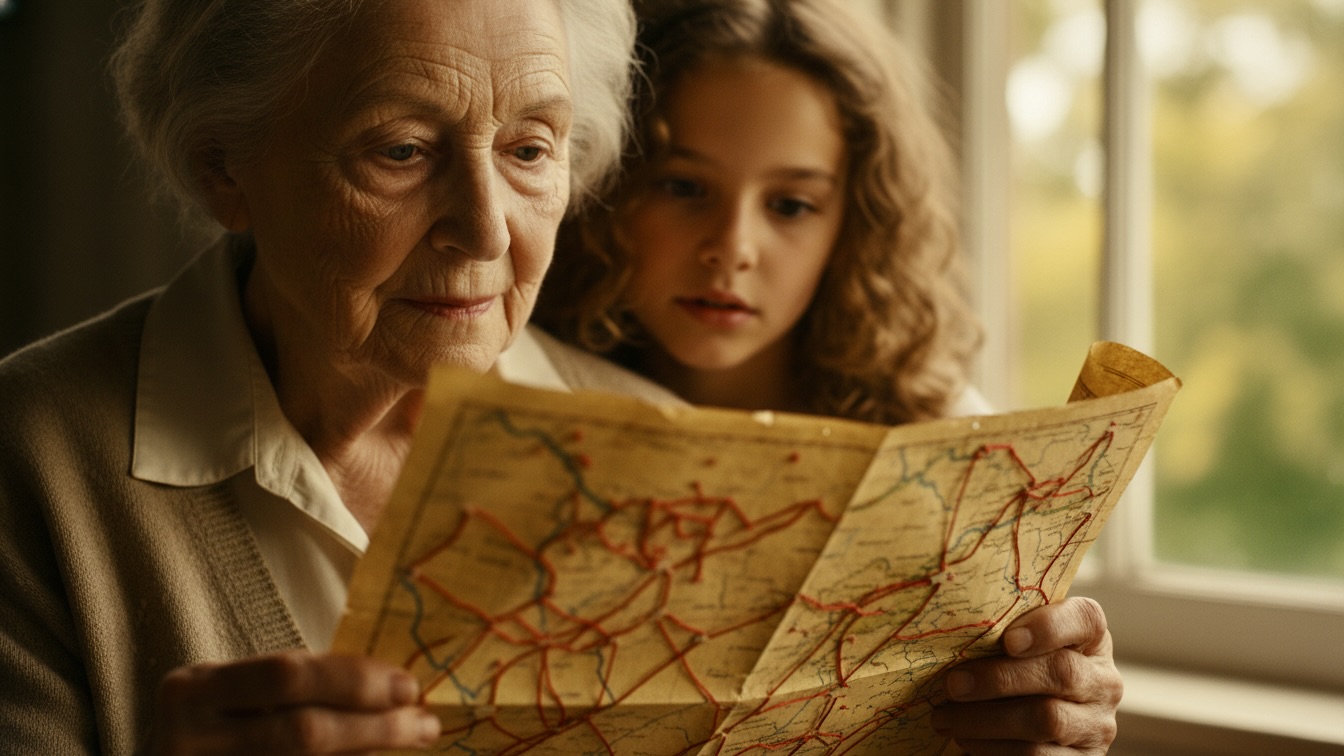
A hidden map inside an old quilt leads two unlikely friends into the sweltering heat of a summer mystery.
The heat didn't just sit in the room; it owned the place. It felt like a heavy, wet wool coat that nobody asked to wear. Francine sat in her favorite chair, the one with the cracked green vinyl that always bit into the back of her legs. She didn't move much. Moving cost energy, and energy was expensive these days. Across the table, Tanya was leaning so far forward her forehead almost touched the sewing machine. The machine was old. It didn't have a screen or a fancy computer brain. It just had a heavy metal pedal and a needle that went up and down with a sound like a tired heart.
"Is it supposed to make that clicking noise?" Tanya asked. She didn't look up. She was focused on a scrap of blue denim.
"It’s been clicking since before you were born," Francine said. She picked up a pair of heavy iron scissors. They were dull, but they got the job done if you squeezed hard enough. "Everything clicks eventually. You just have to learn the rhythm."
Francine looked out the window. The street was empty. The sun was so bright it turned the pavement white. Even the birds seemed too tired to fly, hiding in the shadows of the big oak trees that lined the park. This town was a series of trades. You traded your morning for a paycheck, your paycheck for some food, and your food for the strength to do it all again tomorrow. It was a cycle that made everyone’s eyes look a little bit gray, even in the middle of July.
"I think I broke it," Tanya said. She pulled her foot off the pedal. The clicking stopped. A bird landed on the windowsill, chirped once, and then flew away as if it realized it had made a mistake.
"You didn't break it. You just jammed the bobbin," Francine sighed. She stood up, her knees popping. She walked over to the machine. "Move your hands. You're going to get a needle through your thumb, and I don't have the bandages for that kind of drama today."
Tanya leaned back. She was ten, but she had the posture of someone who had already decided that the world was mostly a scam. She wore a bright yellow t-shirt with a cartoon cat on it, but the cat looked as grumpy as she did. "Why are we doing this again? My mom said I needed a hobby that wasn't on a screen, but this feels like work. Like, actual work."
"Because if you don't know how to fix things, the world owns you," Francine said. She fished a tangled mess of white thread out of the machine's guts. "If you can't sew a button, you have to buy a new shirt. That’s how they get you. They want you to keep buying. They want you to think everything is disposable. But a good stitch? That stays."
Francine reached into a basket of old clothes they were supposed to be turning into a quilt. It was a pile of memories that nobody wanted anymore. Flannel shirts from grandfathers who had moved to Florida. Flowery dresses from girls who had grown up and moved to the city. At the bottom of the pile was a heavy vest made of thick, dark canvas. It felt different. It felt like it had a weight that didn't come from the fabric.
"What's that?" Tanya asked, her interest finally piqued.
"Just an old work vest," Francine said. She turned it over. The pockets were reinforced with leather. It was stained with something dark—maybe oil, maybe old dirt. As she shook it out, something crinkled inside the lining.
Francine frowned. She ran her fingers along the hem. There was a lump. A flat, stiff lump that didn't belong there. She took her seam ripper—a tiny tool that looked like a bird's beak—and carefully picked at the threads.
"Wait, are you allowed to do that?" Tanya whispered.
"I'm eighty years old, Tanya. I’m allowed to do whatever I want with a piece of trash," Francine muttered.
The threads gave way. Francine reached inside the lining and pulled out a piece of thick, yellowed paper. It was folded into a tight square. The paper felt like it had been soaked in wax. It was tough and smelled faintly of old cedar and something sharp, like vinegar.
"It’s a map," Tanya said, her eyes going wide. "Is it a treasure map? Please tell me it’s a treasure map."
Francine unfolded it slowly. Her hands were shaky, but she kept them steady by pressing them against the table. The map wasn't drawn with a pen. It was stitched. Fine, red silk thread traced a path through a series of hand-drawn trees and a jagged line that looked like the creek behind the old mill. At the end of the red line was a small, embroidered X.
"It's not a treasure map," Francine said, though her voice lacked conviction. "It’s probably just some kid’s game from forty years ago. People used to have to make their own fun before the internet."
"But look at the date in the corner," Tanya pointed to a small set of numbers. July 14, 1972. "That’s like... ancient history. And look at the name. Silas."
Francine froze. The name Silas hit her like a bucket of cold water. She looked at the vest again. She recognized the stitching on the collar now. It was a cross-stitch pattern she hadn't seen in decades. A specific, messy way of tying off the ends that only one person ever used.
"Silas wasn't a kid," Francine whispered. "He was a surveyor. And he didn't play games."
The clock on the wall of the community center had a stutter. Every few seconds, the second hand would jump, then pause, as if it was reconsidering the whole idea of moving forward. Francine stared at it, then back at the map. The red thread seemed to glow in the late afternoon light that was currently bleeding through the dusty blinds.
"Who was Silas?" Tanya asked. She was standing on her tiptoes now, trying to see over Francine’s shoulder. "Was he your boyfriend?"
"Don't be ridiculous," Francine snapped, though her cheeks felt a little warmer than they should have, and it wasn't just the summer heat. "He was a friend. He worked for the county. He was supposed to map out the old property lines before the big developers came in and started turning everything into parking lots. He disappeared one summer. Just walked into the woods and didn't come back. Most people figured he just got tired of the heat and moved to Canada."
"But he left his vest," Tanya said. "Why would you leave your vest if you were going to Canada? It’s cold there. Even in the summer, probably."
Francine didn't answer. She was looking at the X. It was positioned right near the old iron bridge, the one that had been closed off since the nineties because the wood had rotted through. It was a place where the weeds grew taller than a grown man and the mosquitoes were the size of small birds.
"We should go," Tanya said.
"Go where? It’s ninety-five degrees out there. I’m not going anywhere except to the fridge to get a glass of water," Francine said. She tried to fold the map back up, but the paper was stiff and stubborn. It didn't want to go back into its hiding place.
"You’re curious," Tanya challenged. "I can see it in your eyebrows. They’re doing that thing where they get all scrunched up. Like you’re trying to solve a math problem."
"My eyebrows are always scrunched. It’s called aging," Francine retorted. But she looked at the vest. Silas had been a man of secrets. He used to say that the only way to keep something safe was to sew it into the world. He’d hide notes in the hems of his curtains and coins in the lining of his hats. He didn't trust banks, and he certainly didn't trust the people running the town.
"If he hid this," Francine mused, more to herself than to the girl, "he wanted it to be found by someone who knew how to look. Someone who knew about the lining."
"That’s you!" Tanya bounced on the balls of her feet. "You’re the best at looking. You found my lost earring in the shag rug last week in like, two seconds."
Francine looked at the girl. Tanya’s eyes were bright. For the first time all summer, she didn't look bored. She didn't look like she was waiting for her phone to charge. She looked like she was standing on the edge of something real. And Francine, despite her weary bones and her skepticism about the world, felt a tiny spark of something she hadn't felt in a long time. It was a small, flickering flame of adventure.
"The bridge is two miles away," Francine said. "Through the woods. In this heat, we’ll be melted into puddles before we get halfway."
"I have my reusable water bottle," Tanya said, slamming it down on the table. It was covered in stickers of space aliens and glitter. "And I have my boots. Let's go, Francine. Before the sun goes down and the ghosts come out."
"There are no ghosts," Francine said, but she reached for her sun hat. It was a wide-brimmed straw thing that made her look like a giant mushroom. "Just people who didn't know when to quit."
They left the community center, the door clicking shut behind them. The air outside was like stepping into a giant's mouth. It was hot and humid, the kind of weather that made your clothes stick to your skin the second you moved. They walked past the old hardware store, where Mr. Henderson was sitting out front on a folding chair, fanning himself with a piece of cardboard.
"Where you two headed?" he called out, his voice raspy from years of smoking and complaining.
"None of your business, Arthur," Francine called back.
"Too hot for secrets!" he yelled, but he didn't get up. Nobody got up if they didn't have to.
They turned off the main road and onto the dirt path that led toward the creek. The grass here was yellow and dry, crunching under their boots. The sound of cicadas was a constant, high-pitched scream in the trees, a wall of noise that seemed to push against them.
"Do you think Silas found gold?" Tanya asked. She was swinging her water bottle by the strap.
"In this town?" Francine laughed. "The only gold in this town is the yellow paint on the fire hydrants. Silas was looking for something else. He was obsessed with the old deeds. He thought the town council was stealing land from the farmers by moving the boundary markers at night."
"That’s like... super illegal," Tanya said.
"The world is full of things that are super illegal, honey. Most people just look the other way because it’s easier than fighting," Francine said.
They reached the edge of the woods. The trees offered a bit of shade, but the air was even thicker here. It smelled of damp earth and rotting leaves. Francine held the map out, her eyes squinting at the red stitches.
"The red line follows the bend in the creek," she said. "We stay close to the water. It’ll be cooler there, anyway."
The creek wasn't much of a creek anymore. It was more of a series of stagnant puddles connected by a thin trickle of muddy water. Still, it was the only landmark they had. They scrambled down the bank, Tanya sliding on her backside and laughing while Francine picked her way down slowly, using a sturdy oak branch as a walking stick.
"Watch out for the poison ivy," Francine warned. "Three leaves, leave it be. Five leaves, it’s probably something else but don't touch it anyway."
"I know, I know," Tanya said, but she was already poking at a large, flat rock with a stick. "Hey, look! A crawfish!"
"Focus, Tanya. We aren't on a nature hike. We have a map to follow."
They walked along the edge of the water. The mud was thick and black, making a wet, sucking sound every time they stepped. It was a transaction: the mud took their clean boots, and in exchange, it let them pass. Francine’s back was starting to ache, a dull throb that reminded her she wasn't twenty anymore, or even sixty. But she kept her eyes on the map.
"The red thread turns here," Francine said, pointing to a spot where a massive, fallen willow tree blocked the path. Its branches were like long, green fingers reaching into the mud. "We have to go around."
"Or under!" Tanya said, already dropping to her hands and knees. She crawled through a gap in the branches, her yellow shirt disappearing into the greenery.
Francine sighed. "I am too old for crawling."
She managed to scramble over the trunk, her breath coming in short, ragged bursts. On the other side, the woods felt different. The trees were closer together, and the light was dimmer. It was a place where time seemed to have stopped. An old tire was half-buried in the dirt, and a rusted-out soda can from the seventies sat on a stump, its colors faded to a ghostly gray.
"We’re close," Francine whispered. She could feel it. A strange prickle on the back of her neck that had nothing to do with the heat.
They reached the old iron bridge. It was a skeleton of a thing, its rusted beams covered in thick vines of honeysuckle. The smell of the flowers was overwhelming, sweet and heavy, like a perfume that was trying too hard to hide something.
"The X is right under the north support," Francine said. She looked at the bridge. It looked like it could collapse at any moment. "Stay back, Tanya. This thing isn't safe."
"I’m faster than you," Tanya said, her voice dropping to a whisper. "If it starts to fall, I’ll jump."
"No one is jumping. Just... stay close to the bank."
Francine approached the massive stone pillar that held up the end of the bridge. The stones were covered in moss and carvings—initials of people who were likely long gone. She ran her hand over the rough surface, searching for something that didn't feel like stone.
"There," she said.
A small, iron ring was embedded in the masonry, nearly hidden by a thick patch of ivy. It was rusted nearly solid. Francine grabbed it and pulled. Nothing happened. She pulled again, her face turning a deep shade of red.
"Let me help," Tanya said. She grabbed the ring with both hands, and together, they leaned back.
With a loud, grinding screech that sounded like a scream, a small stone block slid forward. It wasn't a solid part of the pillar; it was a drawer. A secret compartment built into the very foundation of the bridge.
Inside the drawer was a metal box. It was an old lunch tin, the kind with a rounded top and a wire handle. It was covered in a layer of fine, red dust—rust that had flaked off the bridge over the last fifty years.
"Is it gold?" Tanya whispered, her hands shaking.
"It’s too light for gold," Francine said. She lifted the tin out. It felt hollow. She sat down on a flat rock, her legs finally giving out from the exertion. She placed the tin on her lap.
"Open it," Tanya urged. "Open it!"
Francine flipped the latches. They were stiff, but they snapped open with a sharp clack. She lifted the lid.
There was no gold. There were no jewels.
Inside the tin was a stack of papers, wrapped in plastic to keep out the damp. On top of the papers was a small, silver locket and a single, perfectly preserved embroidery needle made of bone.
Francine picked up the papers. They were official-looking documents—deeds, survey maps, and letters written in a sharp, hurried hand. She scanned the first page. Her eyes widened.
"It’s the truth," she whispered. "Silas didn't move to Canada. He found out that the mayor and the sheriff were redrawing the maps to steal the park land for a factory. He hid the original deeds here so they couldn't destroy them."
"So we can save the park?" Tanya asked. "They want to put a big warehouse there next year. My dad said it’s going to ruin the view."
"We can do more than save the park," Francine said, a grim smile spreading across her face. "We can prove that this whole town was built on a lie. A transaction that never should have happened."
But as she reached for the locket, she noticed something else in the bottom of the tin. A small, handwritten note.
To Francine. I knew you’d be the one to find the seam. Don't go to the police. They’re in on it. Find the third map. It’s in the bell tower.
The sun was starting to dip below the horizon, turning the sky a bruised purple. The heat hadn't let up, but the shadows were getting longer, stretching across the creek like dark fingers. Francine clutched the tin to her chest. The weight of it felt different now. It wasn't just a box of old papers; it was a bomb.
"We have to go back," Francine said, her voice urgent. "Now. Before it gets dark."
"But the bell tower!" Tanya pointed back toward the town. The silhouette of the old church stood out against the darkening sky. "The note said the third map is there! We have to get it!"
"We aren't getting anything tonight," Francine said. "We have to get this home and look at it properly. We don't know who’s watching."
Tanya looked around. The woods, which had seemed exciting an hour ago, now felt oppressive. Every snap of a twig sounded like a footstep. Every rustle of the leaves sounded like a whisper.
"Do you think they know?" Tanya asked. "The people in the note?"
"The people in the note are mostly dead or retired," Francine said. "But their kids are still running things. And secrets like this? They don't stay buried. They just wait for someone to dig them up."
They hurried back the way they came. The climb up the bank was harder this time, their muscles tired and their spirits frayed. When they finally reached the dirt path, Francine stopped to catch her breath. She looked back at the bridge. It looked peaceful in the twilight, but she knew better. It was a monument to a crime.
As they walked through the town, the atmosphere felt even heavier. The streetlights flickered on, casting a sickly yellow glow on the pavement. A black sedan was idling in front of the community center. It was a sleek, modern car that looked out of place in this tired town. The windows were tinted so dark you couldn't see who was inside.
"Is that... your car?" Tanya asked, her voice trembling.
"I drive a 2012 hatchback with a dent in the bumper, Tanya. Does that look like my car?" Francine whispered.
She grabbed Tanya’s hand. Her palm was sweaty, but her grip was firm. "Don't look at it. Just walk. We’re going to my house. It’s closer."
They ducked into an alleyway, cutting behind the hardware store. Francine’s heart was hammering against her ribs like a trapped bird. She hadn't felt this kind of fear in years—not since the night Silas had walked away. She had always wondered why he hadn't asked her to go with him. Now she knew. He was protecting her. He had left the trail for her to find when she was ready. Or when the world needed it.
They reached her small, clapboard house at the end of the street. The porch light was buzzing, surrounded by a cloud of moths. Francine fumbled with her keys, her hands shaking so hard she dropped them twice.
"Come on, come on," she hissed.
Finally, the lock turned. They burst inside and Francine slammed the door, throwing the deadbolt. She leaned against the wood, gasping for air.
"Are we safe?" Tanya asked. She was huddled on the rug, her yellow shirt stained with mud and sweat.
"For now," Francine said. She walked over to the kitchen table and dumped the contents of the tin out.
She picked up the locket. It was heavy silver, tarnished with age. She pressed the tiny button on the side. It popped open to reveal two pictures. One was of a young Silas, smiling with a gap between his front teeth. The other was of Francine, her hair in long braids, holding a piece of embroidery.
Behind the photos was a tiny, folded piece of red silk.
"It’s another map," Tanya whispered.
Francine unfolded it. This one was even more detailed. It showed the interior of the church, with a line leading up the spiral stairs to the bell tower. But there was something else. A warning, stitched in black thread at the bottom.
The transaction is never over. They are still watching the seams.
Suddenly, there was a heavy knock on the front door. Not a polite knock. A loud, rhythmic thud that made the glass in the windows rattle.
"Francine?" a voice called out from the porch. It was deep and smooth, the kind of voice that belonged to someone who never had to raise it to get what they wanted. "It’s Mayor Victor. I saw your lights were on. I was hoping we could have a little chat about some... old property records that might have gone missing from the archives."
Francine looked at Tanya. The girl’s eyes were wide with terror. Francine felt a cold wave of skepticism wash over her. Of course. The town wasn't just a series of transactions. It was a trap. And she had just stepped right into the middle of it.
She reached out and grabbed her heavy iron scissors from the side table. They weren't much of a weapon, but they were sharp enough to cut through the thickest canvas.
"Hide under the table, Tanya," Francine whispered. "And don't make a sound."
She walked toward the door, her back straight and her eyes hard. She was a crafter. She knew how to build things, and she knew how to take them apart.
"I'm coming, Mr. Mayor," she called out, her voice steady. "But I hope you brought your checkbook. Because the price of silence just went up."
“The heavy thud on the door sounded again, and this time, the handle began to turn slowly, as if the person on the other side already owned the room.”


