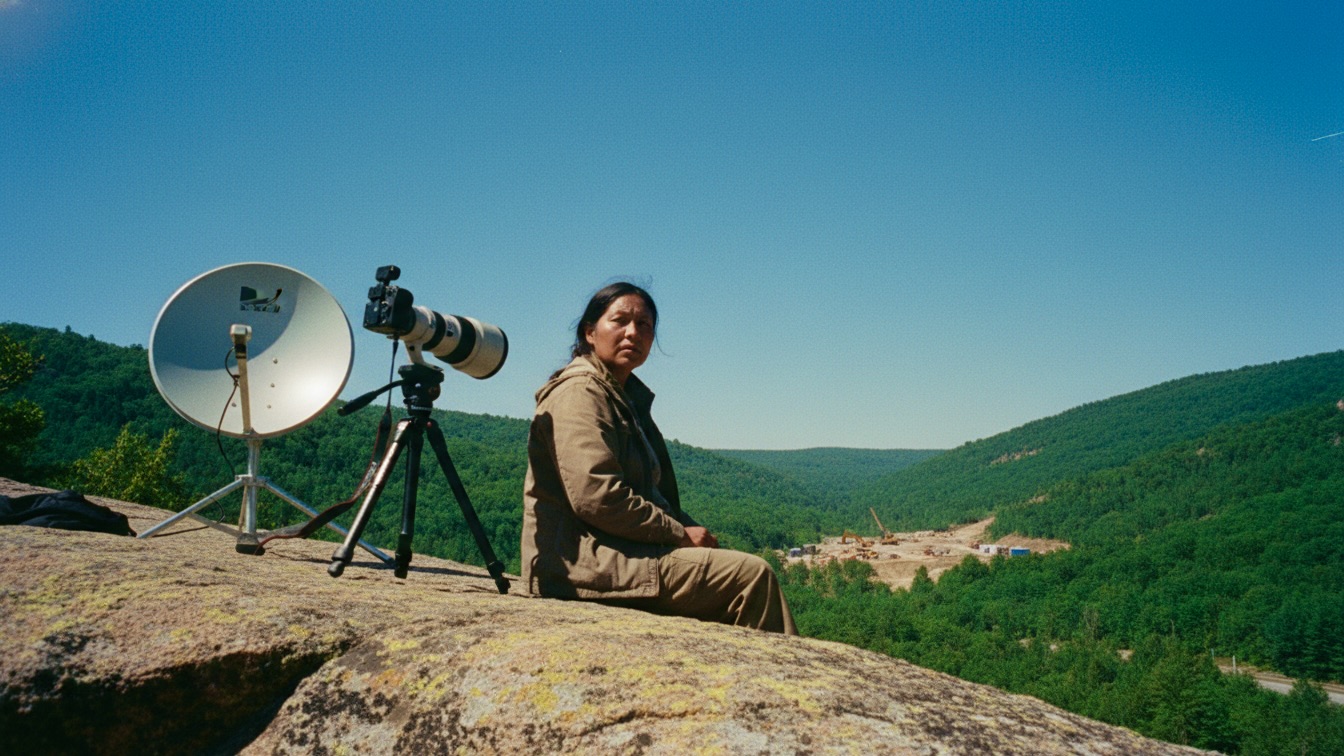
Sarah stares into the fire as legal news from Ottawa threatens to dismantle the land defenders' last peaceful options.
The heat didn't leave when the sun went down. It stayed in the black soil and the heavy needles of the fir trees. Sarah sat on a plastic crate that had 'Property of Northern Dairy' embossed on the side in faded white letters. Her lower back ached. It was a dull, rhythmic throb that started at the base of her spine and radiated out toward her hips.
She’d been on her feet for fourteen hours, mostly standing on the gravel shoulder of the access road, watching the white trucks roll by. The dust from the road had settled into the creases of her skin, making her feel like she was wearing a thin suit of grit. Every time she blinked, she felt the scratch of it against her eyeballs.
In the center of the clearing, a small fire licked at three logs of windfall cedar. It wasn't for warmth. It was for the smoke to keep the mosquitoes back and for a sense of center. Leo was poking at the coals with a peeled stick. He was twenty-two, wearing a hoodie despite the temperature, the sleeves pushed up to reveal corded forearms. He had a tablet propped up on his knees. The blue light from the screen fought with the orange flicker of the wood. It made his face look bisected, half-digital, half-primal.
"It's live," Leo said. He didn't look up. "The text of the amendment. They’re calling it the Public Order Streamlining Act."
Sarah didn't move. She watched a spark leap from the cedar and die in the dirt. "Streamlining. That's a good word for it. Clean. Like a knife."
"They’re giving the Minister of Natural Resources the power to designate 'critical infrastructure zones' without a cabinet vote," Leo continued. His voice was flat, the way people talk when they're reading something that makes them feel small. "Within those zones, any assembly of more than five people that 'impedes economic flow' is a federal offense. Minimum six months."
Ben, sitting to Sarah’s left, let out a slow breath. He was fifty, a man who had spent most of his life in the bush. His hands were thick and calloused, the fingernails permanently stained with grease and earth. He was nursing a lukewarm cup of tea in a dented tin mug. "They’ve been wanting that since the blockade in 2020. They just waited for a summer hot enough that people were too tired to fight back."
Sarah felt a tightness in her chest. It wasn't the smoke. It was the feeling of the walls moving in. The forest was vast, stretching for hundreds of miles in every direction, but the legal reality was shrinking her world down to the width of the crate she was sitting on. She looked at her hands. They were shaking, just a little. She tucked them under her armpits.
"They cry about our blockades being illegal," Sarah said. Her voice was quiet, but it carried across the fire. "But when we point out they’re breaking their own court rulings on the Emergencies Act, they appeal. They want to silence ‘hate’ but have no problem labeling us radicals when we defend the land."
She laughed, a short, jagged sound that didn't have any humor in it. It felt like a stone in her throat. The unfairness of it wasn't new, but the scale was different now. Before, there had been a process. A slow, frustrating, often rigged process, but a process nonetheless. This new legislation felt like an ending. It felt like the government was tired of pretending to listen.
"We should go to the highway," Leo said. He finally looked up from the tablet. His eyes were bright, reflecting the fire. "If we stay here, we're just waiting to be picked up in the middle of the night. If we go to the highway, there are cameras. There are people."
"There are also more cops," Ben said. "And that new surveillance tech they're testing in the valley. They’ll have our faces indexed before we even get the banners up."
Sarah watched the way the smoke drifted. It moved in a slow, lazy spiral toward the canopy. The air was stagnant. There was no wind to move it, no relief from the weight of the humidity. She felt claustrophobic in the open air.
"They’re building the machinery," Sarah said. She reached out and took the tablet from Leo. The screen was warm. The text was dense, filled with clauses and sub-clauses that felt like a cage built out of grammar. "The question is whether we dismantle it before they turn it on everyone."
Leo leaned forward. "How? We can’t dismantle a law with a sign, Sarah. They’re rewriting the rules of the game while we’re still trying to figure out where the goalposts are."
"We don't play the game," Sarah said. She handed the tablet back. "We stop the machine."
She stood up. Her knees popped, the sound loud in the quiet of the camp. She walked to the edge of the clearing, where the darkness of the trees started. The forest at night was usually a place of comfort for her, but tonight it felt like it was holding its breath. The insects were loud, a constant, vibrating thrum that seemed to match the frequency of her own anxiety. She looked up. The stars were muffled by the haze of the heat and the smoke from fires burning a hundred miles to the north.
She thought about the river. It was a mile away, down a steep embankment. It was the reason they were here. The pipeline was supposed to go under it, burrowing through the bedrock and risking the water that fed the entire valley. The government saw a line on a map. Sarah saw the place where she had learned to swim, where her father had taught her how to read the ripples for trout.
"Sarah?" Ben called out.
"I'm fine," she said.
She wasn't fine. She felt like she was drowning in dry air. She needed something to break. She needed a shift, a change in the pressure, a sign that the world wasn't just going to close in on them until there was nothing left but the sound of the white trucks and the hum of the drones.
They moved to the communal tent an hour later. It was a large, heavy-duty canvas structure they’d reinforced with tarps and plywood. Inside, a single LED lantern hung from the center pole, casting long, distorted shadows against the walls. A folding plastic table sat in the middle, covered in topographical maps, half-empty water bottles, and a scatter of loose tobacco.
There were six of them now. Maya and David had come back from the scout point near the bridge. They looked exhausted. Maya’s hair was matted with sweat, and David had a fresh scrape across his cheekbone from a low-hanging branch.
"They’ve got three more units at the gate," Maya said. She sat down heavily on a camp chair. "Not the regular RCMP. These guys are wearing tactical gear. No name tags. Just numbers."
"ERF?" Ben asked, referring to the Emergency Response Team.
"Maybe. They’ve got the dogs too," David said. He reached for a water bottle and drained half of it in one go. "They aren't just patrolling. They're setting up a perimeter. They’re getting ready for something."
Leo tapped the tablet screen. "They’re waiting for the bill to pass. It goes to third reading tomorrow morning. They’ll have Royal Assent by noon. By one o'clock, this whole area is a no-go zone."
Sarah stood by the map. She traced the line of the river with her index finger. The blue vein of the water looked fragile against the heavy green of the forest. The pipeline route was a red gash that cut across it.
"If they clear us out tomorrow, we lose the river," Sarah said. "Once they start the boring, there's no stopping it. The legal injunctions will take years, and by then, the pipe is already in the ground."
"So we go louder," Leo said. "We call the media. We get the blockades on the main road started tonight."
"The media won't come," Sarah said. "Not for another protest in the woods. They’ve seen this movie before. They’ll just run a clip of the Minister saying we’re extremists and then cut to the weather."
She looked at Leo. He was vibrating with energy, the kind of nervous, aggressive energy that leads to mistakes. He wanted a fight because a fight was easier to understand than a slow erasure.
"We need to change the story," Sarah said.
"How?" Maya asked. "We're thirty people in the middle of nowhere. They have the law, the guns, and the drones."
Sarah didn't answer right away. She was looking at the topographical lines near the ridge. There was an old logging road, decommissioned in the eighties, that ran parallel to the pipeline route but higher up the mountain. It was overgrown, washed out in places, but it overlooked the main construction staging area.
"If we can't stop them here, we go where they aren't looking," Sarah said.
"The ridge?" Ben asked, leaning in. "That road is a mess, Sarah. You’d need a goat to get up there."
"Exactly," Sarah said. "They aren't watching it. They’ve got their sensors on the access road and the bridge. They think we’re going to dig in here and wait for the bus. If we move the core group to the ridge, we can see everything. We can document the boring. We can show people what they’re doing to the headwaters."
"Documenting isn't stopping," Leo spat. "I'm tired of taking pictures of our own defeat."
Sarah turned to him. Her eyes were hard. "It’s not about pictures, Leo. It's about leverage. If we can show they’re violating the environmental specs on the boring—and they will, because they’re in a rush—we can force a federal audit. Even with the new law, they can’t ignore a safety violation that threatens the water table. It’s the only crack in their armor."
Leo looked like he wanted to argue, but he stayed quiet. The logic was sound, even if it wasn't the heroic stand he wanted.
"It’s a long hike," Ben said. "We’d have to leave everything we can’t carry. The tents, the heavy gear, the kitchen. We’d be living out of packs for weeks."
"It’s summer," Sarah said. "We don't need much."
"What about the others?" Maya asked. "The ones who aren't up for a ten-mile scramble up a goat path?"
"They stay here," Sarah said. "They keep the fires going. They keep the cops busy. They act as the decoy. If the cops think we’re all still here, they won't look for us on the ridge until it’s too late."
She felt a strange sensation in her chest. It wasn't the tightness from before. It was a lightening. The plan was risky, and it was grueling, but it was an action. It was a way to move when the world wanted them to stay still.
Sarah looked around the table. The faces of her friends were etched with exhaustion and doubt, but there was a flicker of something else. A shared recognition. They were land defenders. This was what they did. They adapted. They endured.
"Pack only what you need," Sarah said. "Water, batteries, cameras. We move at three a.m. Before the sun hits the valley."
David nodded. "I’ll check the radios. We’ll need a relay if we’re going to get a signal out from the ridge."
"I'll talk to the aunties," Maya said. "They’ll stay with the main camp. They know how to handle the RCMP better than any of us anyway."
Sarah walked out of the tent. The air outside was still hot, but the stars seemed a little brighter. The haze was thinning. She took a deep breath, the smell of dry pine and old canvas filling her lungs. It wasn't enough oxygen yet, but it was a start. She looked toward the mountain, its silhouette a jagged black line against the sky. Somewhere up there was a different vantage point. A way to see the whole picture instead of just the narrow strip of road in front of them.
She went back to her crate and sat down. She needed to rest, but her mind was racing. She thought about the machinery. The laws, the drones, the tactical teams. They were powerful, but they were rigid. They relied on predictability. They expected a blockade. They didn't expect a group of people to vanish into the high country and watch from above.
She closed her eyes. She could feel the vibration of the earth, the deep, slow pulse of the land. It had been here long before the pipeline, and it would be here long after. She just had to make sure it wasn't scarred beyond repair.
"Three o'clock," she whispered to herself. "Three o'clock."
The climb was a slow torture of loose shale and grabbing branches. Sarah’s pack felt like it was filled with lead shot. Every step required a conscious effort of will. She could hear the heavy, rhythmic breathing of the others behind her. Nobody spoke. The only sounds were the crunch of boots on rock and the occasional metallic clink of a carabiner.
They reached the old logging road just as the first grey light of dawn began to bleed into the eastern sky. It wasn't a road anymore. It was a narrow corridor of young alders and berry bushes that had reclaimed the gravel. The air was cooler up here, a thin, sharp mountain air that tasted of stone and snowmelt.
Sarah stopped to catch her breath. Her shirt was soaked with sweat, sticking to her back in the cool breeze. She looked down into the valley. The main camp was a tiny cluster of dots far below, the smoke from the morning fire a thin white thread. Further along the river, the staging area was a hive of activity. Even from this distance, she could see the white trucks and the yellow shape of the drilling rig. It looked like an insect from this height, a parasite clinging to the side of the mountain.
"We made it," Leo whispered. He dropped his pack and leaned against a mossy boulder. His face was pale, his eyes rimmed with red.
"Not yet," Sarah said. "We need to get to the overlook. Another mile."
They pushed on. The road narrowed as it skirted a steep drop-off. To their left, the mountain rose in a wall of granite; to their right, the world fell away into a green abyss of treetops. The scale of the landscape was dizzying. It made the legal battles in Ottawa feel like something happening on another planet.
Sarah felt a sense of vertigo, but it wasn't from the height. It was the sudden expansion of her perspective. For months, she had been focused on the gate, the road, and the immediate confrontation. Now, she could see the whole watershed. She could see how the river wound its way through the valley, feeding the wetlands and the forests before emptying into the sea. It was one single, interconnected system, and the pipeline was a needle being pushed into a vital vein.
They reached the overlook at six a.m. It was a flat shelf of rock that projected out from the ridge, providing an unobstructed view of the boring site. David immediately began setting up the long-range camera and the satellite uplink.
"Look at that," Ben said, pointing.
Down at the site, they were unloading huge sections of steel pipe. But there was something else. A group of men in white coveralls were standing near the riverbank, looking at a series of monitors.
"They’re testing the pressure," Sarah said. She took a pair of binoculars from her pack and adjusted the focus. "They’re ahead of schedule. They’re going to start the pilot hole today."
"On a Sunday?" Leo asked.
"They want to get it done before the bill is challenged in court," Sarah said. "They’re sprinting."
She watched through the lenses. The men in white coveralls looked agitated. One of them was pointing at the ground near the drill head. There was a dark patch of mud that shouldn't have been there.
"David, get the lens on the drill head," Sarah commanded. "Zoom in on the runoff pit."
David adjusted the camera. The image appeared on his laptop screen, sharp and clear. The mud near the drill head wasn't just mud. It was a thick, grey slurry that was bubbling up from the earth.
"Bentonite leak," Ben said, his voice grim. "They’ve hit a fissure in the rock. That stuff is toxic to fish. It’ll smother the spawning beds in hours."
"Are they stopping?" Maya asked.
Sarah watched. The men at the site were looking around, checking the perimeter. They didn't see anyone. They didn't know they were being watched from three thousand feet above. One of the men gestured to the drill operator. The massive machine groaned and began to turn again. The grey slurry began to flow faster, spilling over the lip of the containment pit and trickling toward the river.
"They're burying it," Leo said, his voice trembling with rage. "They’re just going to keep drilling and hope the river washes it away before anyone notices."
"Not today," Sarah said. She felt a surge of cold, clear energy. The claustrophobia was gone. The machinery was right there, exposed and failing. "David, is the link live?"
"Uploading now," David said. "It’s going straight to the environmental agency and the three biggest news desks in the province. High-def, timestamped, and GPS-tagged."
Sarah looked at the screen. The image of the grey sludge oozing into the pristine blue water was undeniable. It was a physical fact that no amount of legislative maneuvering could erase.
"Send it," Sarah said.
She felt a strange sense of calm. The weight that had been pressing down on her for weeks was gone. She was no longer a victim of a shrinking world. She was a witness. And in the digital age, a witness was the most dangerous thing you could be.
They sat in silence for the next hour, watching the data bars on the laptop crawl toward completion. The sun climbed higher, burning off the last of the morning mist. The valley below was bathed in brilliant summer light, the greens and blues of the landscape so vibrant they looked painted.
Suddenly, David’s phone chirped. Then again. And again.
"It’s hitting," he said. "The provincial regulator just issued an emergency stop-work order. It's all over social media. The Minister is being asked for a comment in ten minutes."
Sarah looked down at the site. A white truck was speeding toward the drill head. The men in white coveralls were waving their arms. The massive machine slowed, then stopped. The grinding roar that had echoed through the valley for weeks died away, replaced by the sound of the wind in the pines.
"They stopped," Leo whispered. He sounded like he couldn't believe it.
"For now," Sarah said. "But we’re here. And we’re watching."
She walked to the edge of the rock shelf and sat down, her legs dangling over the precipice. The air was cool and fresh. She could feel the sun on her face. For the first time in a long time, she felt like she could breathe.
The afternoon sun was fierce, but up on the ridge, a steady breeze kept the heat from becoming oppressive. They had established a semi-permanent camp in the ruins of an old forestry cabin, a structure of rotting logs and a rusted tin roof that they’d patched with a heavy tarp. It wasn't comfortable, but it was functional.
Sarah sat on the porch, sharpening a small knife on a whetstone. The rhythmic shick-shick of the blade was the only sound besides the distant cry of a hawk. Down in the valley, the staging area was a ghost town. The drill was silent, its long neck tilted toward the sky like a dead animal. There were police cars at the gate, but they weren't moving. The stop-work order was holding.
Ben walked out of the cabin, carrying two tin plates of beans and rice. He handed one to Sarah.
"The aunties called," he said. "The cops tried to move in on the main camp an hour ago, but the news crews arrived at the same time. They backed off. For now, everyone is safe."
Sarah took a bite of the food. It was bland and lukewarm, but it felt like the best meal she’d ever had. "They’ll try to find a way around the order. They’ll say the leak was contained. They’ll bring in their own 'experts' to say the water is fine."
"Maybe," Ben said. "But the footage David got... you can't unsee that. The public is pissed, Sarah. Even the people who wanted the pipeline don't want the river poisoned. You hit a nerve."
Sarah looked out over the valley. The sense of clarity she’d felt in the morning hadn't faded. If anything, it had sharpened. She realized that the 'machinery' she’d been so afraid of wasn't a monolithic, unstoppable force. It was a collection of people, rules, and machines, all of them prone to failure, arrogance, and greed. And when they failed, they were vulnerable.
Leo came out of the cabin, looking more relaxed than she’d seen him in weeks. He was holding his tablet, but he wasn't reading the news. He was looking at a map of the upper watershed.
"There are four more sites like this," Leo said, pointing to the screen. "Places where the geology is unstable. If they try to drill there, they’ll have the same problem. We need to get teams to those ridges too."
Sarah nodded. "We will. We’ll set up a network. A high-ground watch. They want to streamline the law? We’ll streamline the resistance."
She felt a quiet sense of purpose. The adventure wasn't over; it was just changing shape. They were no longer just protesters at a gate. They were the eyes of the mountain.
As the sun began to dip toward the horizon, painting the sky in streaks of gold and orange, Sarah walked away from the cabin. She climbed a small knoll that offered a view of the back side of the ridge, looking into the heart of the wilderness. It was a vast, untouched expanse of green, a sea of peaks and valleys that stretched all the way to the coast.
She thought about the legislation in Ottawa. She thought about the tactical teams and the drones. They felt small now. They were temporary. The land was permanent.
She sat down on the dry needles of a giant fir tree. The air was cooling rapidly, the scent of the forest changing from the baked-earth smell of the day to the damp, mossy scent of the night. She closed her eyes and listened.
She heard the wind. She heard the distant rush of the river, free and flowing. She heard the heartbeat of the world.
She stayed there for a long time, watching the stars emerge one by one. The air was clear. The burden she’d been carrying—the fear, the exhaustion, the sense of hopelessness—had been replaced by a quiet, steady resolve.
She wasn't naive. She knew the fight would be long. She knew they would face more laws, more police, more attempts to silence them. But she also knew that they had found a way to fight back that didn't rely on the rules of the people trying to break them. They had found the high ground.
Sarah stood up and brushed the needles from her pants. She felt light. She felt strong. She felt like she could walk for a thousand miles if she had to.
She walked back toward the cabin, where the small fire was being lit for the night. The smoke rose straight and true into the darkening sky.
"Everything okay?" Maya asked as Sarah approached.
"Yeah," Sarah said. "Everything is clear now."
She sat down by the fire, her back straight, her eyes bright. The summer night was warm, the air was full of oxygen, and for the first time in her life, Sarah Two Rivers knew exactly where she was supposed to be.
“She looked at the map, then back at the silent drill in the valley, knowing that the real battle for the headwaters had only just begun.”


