The narrative begins in a state of physical and psychological stagnation as Sarah and her companions endure a sweltering summer night in a forest camp. They are land defenders positioned against a pipeline project that threatens their local watershed. The tension escalates when Leo reveals the details of the Public Order Streamlining Act, a piece of legislation designed to criminalize their presence and dismantle their protest through legal maneuvers. Sarah realizes that their current strategy of standing on the road is no longer viable against the encroaching legal and police machinery.
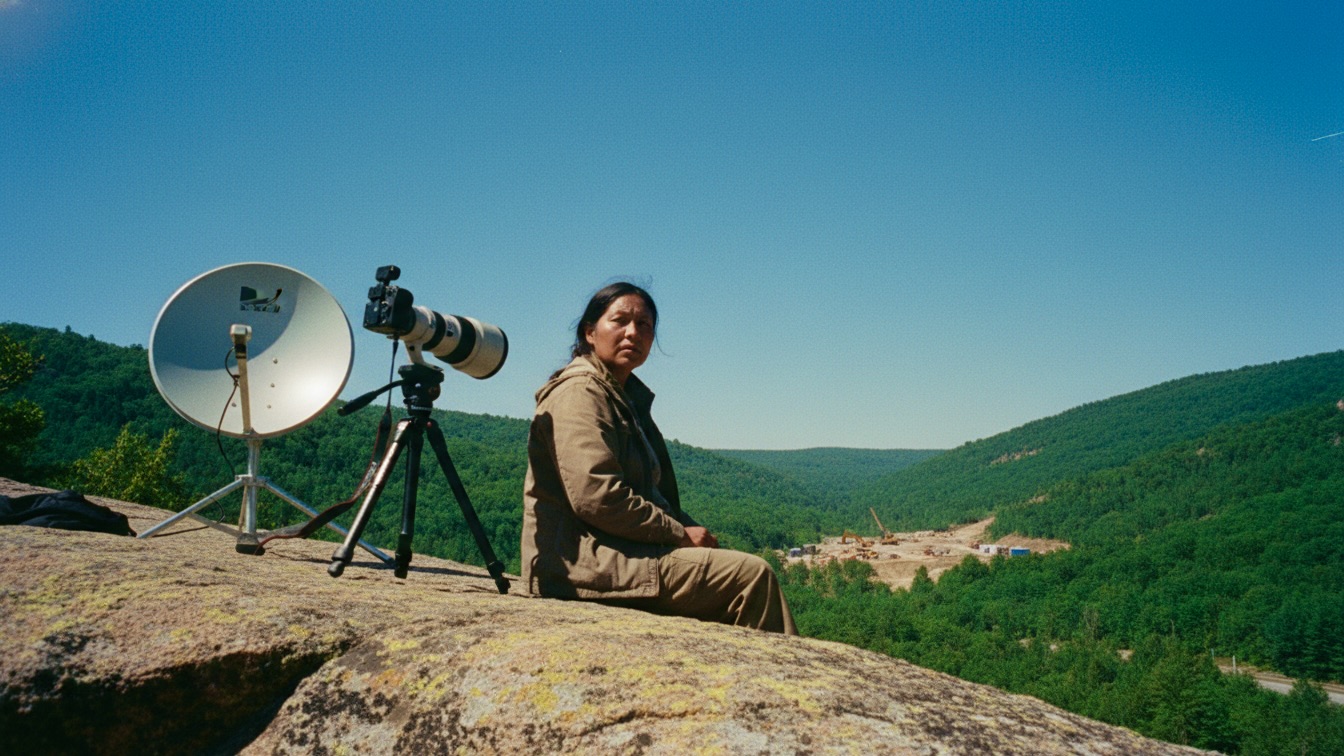
In a strategic pivot, Sarah leads a core group of activists away from the main camp to an abandoned logging road high on a ridge overlooking the construction site. The climb is grueling, reflecting the internal struggle and exhaustion of the characters. Once they reach the overlook, they use high-definition cameras and satellite technology to monitor the pipeline boring process. They witness a significant environmental disaster in real-time as a toxic bentonite leak begins to poison the river.
The story concludes with a tactical victory for the group. By documenting the leak and uploading the footage immediately to news outlets and environmental regulators, they bypass the legislative barriers that sought to silence them. The government is forced to issue an emergency stop-work order, halting the construction. Sarah experiences a profound sense of relief and clarity, moving from a feeling of claustrophobia to a renewed sense of purpose and connection to the land.
The central theme of "Dry Pine" is the conflict between bureaucratic "machinery" and the organic reality of the natural world. The legislation described by Leo represents a cold, sterile attempt to rebrand suppression as "streamlining." This linguistic manipulation serves as a cage, attempting to reduce a vast, living ecosystem into a series of "critical infrastructure zones." Sarah’s realization that the government is "tired of pretending to listen" highlights the theme of state-sanctioned erasure of indigenous and environmental voices.
Another prominent theme is the evolution of resistance in the digital age. The story contrasts traditional methods of protest, like physical blockades and signs, with the power of the "witness." While the government can easily label physical assembly as "extremist," it struggles to argue against the objective, digital proof of environmental damage. The tablet and the satellite uplink become tools of liberation rather than just sources of anxiety, demonstrating that technology can be reclaimed to serve the land.
The narrative also explores the psychological weight of environmental stewardship. The heat and the "dry air" are not just weather conditions; they are metaphors for the suffocating pressure of a losing battle. The transition from the valley floor to the "high ground" serves as a thematic ascent from victimhood to agency. By changing their vantage point, the characters shift from being obstacles in a legal game to being guardians of a watershed, emphasizing that perspective is a prerequisite for effective action.
Finally, the story touches upon the permanence of the land versus the temporary nature of human structures. The pipeline is described as a "needle" or a "parasite," while the mountain and the river represent a deep, slow pulse that predates and will outlast the political conflict. This theme provides the characters with a sense of stoic resolve. They recognize that while they may not dismantle the entire system, their role as "the eyes of the mountain" is a vital part of a much longer, ancestral struggle for survival.
Sarah is a woman defined by her deep, visceral connection to her surroundings and her role as a reluctant but decisive leader. At the beginning of the story, she is physically burdened, her back aching and her skin coated in the "grit" of the road. This physical discomfort mirrors her internal state of anxiety and claustrophobia. She feels the walls of the law closing in on her, and her laughter is described as a "stone in her throat," indicating a psychological block caused by the unfairness of the system.
Her leadership style is characterized by pragmatism and a refusal to engage in the "heroic" but futile gestures that Leo craves. She understands that the "machinery" of the state is rigid and relies on predictability. By choosing to move to the ridge, she demonstrates an ability to adapt and find the "crack in the armor" of her opponents. This shift from the valley to the mountain represents her psychological journey from feeling like a victim of "dry air" to becoming a clear-eyed witness.
By the end of the chapter, Sarah has undergone a transformation from exhaustion to resolve. The act of sitting on the precipice with her legs dangling over the edge shows a newfound comfort with risk and a release from the fear that previously paralyzed her. She finds her "high ground" both literally and figuratively. She ends the narrative not with a sense of final victory, but with the quiet, steady strength of someone who knows exactly where she belongs in a long-term conflict.
Leo represents the restless, tech-savvy energy of a younger generation of activists. He is introduced as a figure "bisected" by the blue light of his tablet and the orange light of the fire, symbolizing his dual existence in the digital and primal worlds. His frustration is evident in his desire for a visible fight and his dismissive attitude toward "taking pictures of defeat." He views the struggle through a lens of immediate conflict and feels the weight of the new legislation as a personal diminishing of his power.
Despite his initial aggression and skepticism toward Sarah’s plan, Leo is essential to the group's success. He provides the technical data that informs their strategy and ultimately facilitates the digital strike that stops the drill. His transition from "vibrating with nervous energy" to a state of relaxed focus suggests that he needs a clear, actionable plan to channel his anger. By the end of the story, he has shifted his focus from the news of his own suppression to the maps of the watershed, indicating a growth in his strategic thinking.
Ben serves as the grounded, historical anchor of the group. As a fifty-year-old man who has spent his life in the bush, he provides the perspective of long-term endurance. His "thick and calloused" hands and "grease-stained" fingernails mark him as a man of labor and practical knowledge. He understands the patterns of the government, noting that they have been waiting for a summer hot enough to exhaust the people. His role is to provide context and to validate the difficulty of the physical tasks they face.
He is not a man of many words, but his presence is a stabilizing force for Sarah. When he questions the difficulty of the climb or the necessity of leaving behind their gear, he isn't being a contrarian; he is ensuring the group is prepared for the reality of their choices. His quiet acceptance of the plan and his work with the "aunties" at the main camp show a man who understands the importance of communal support and different roles within a movement. Ben represents the resilience of those who have seen many such battles and continue to stand.
The pacing of the narrative skillfully reflects the emotional arc of the characters. The opening scenes are slow and heavy, saturated with sensory details of heat, dust, and physical pain. This creates a sense of stagnation and impending doom that mirrors the legislative "cage" being built around the activists. As the group decides to move to the ridge, the pacing quickens, and the descriptions become sharper and more focused on action and movement. The climb itself is described with a rhythmic intensity that emphasizes the physical cost of their resistance.
The tone of the story is somber and atmospheric, utilizing the environment as a psychological mirror. The "dry pine" and "stagnant air" of the beginning evoke a sense of hopelessness, while the "thin, sharp mountain air" of the ridge suggests clarity and a new beginning. The author uses contrast effectively, particularly the "blue light" of the digital screens against the "orange flicker" of the cedar fire. This stylistic choice highlights the intersection of modern technology and ancient land defense, a recurring motif throughout the text.
Sensory details are used to ground the reader in the physical reality of the characters' lives. The "scratch of grit" against Sarah's eyeballs and the "popping" of her knees are small, intimate details that make her struggle feel authentic. The soundscape is also carefully constructed, moving from the "vibrating thrum" of insects and the "hum of drones" to the "grinding roar" of the drill. When that roar finally stops, the sudden silence is a powerful stylistic tool that emphasizes the impact of their victory.
The narrative voice is a close third-person perspective that remains tightly focused on Sarah’s internal experiences. This allows the reader to feel the "tightness in her chest" and the "lightening" of her spirit as the plan unfolds. The language used to describe the legislation—"clauses and sub-clauses that felt like a cage built out of grammar"—is particularly effective. It turns an abstract legal concept into a tangible, threatening object, reinforcing the story's central conflict between the artificial and the natural.


