Harlan returns to a house that no longer knows him, finding a bright yellow lock on his front door.
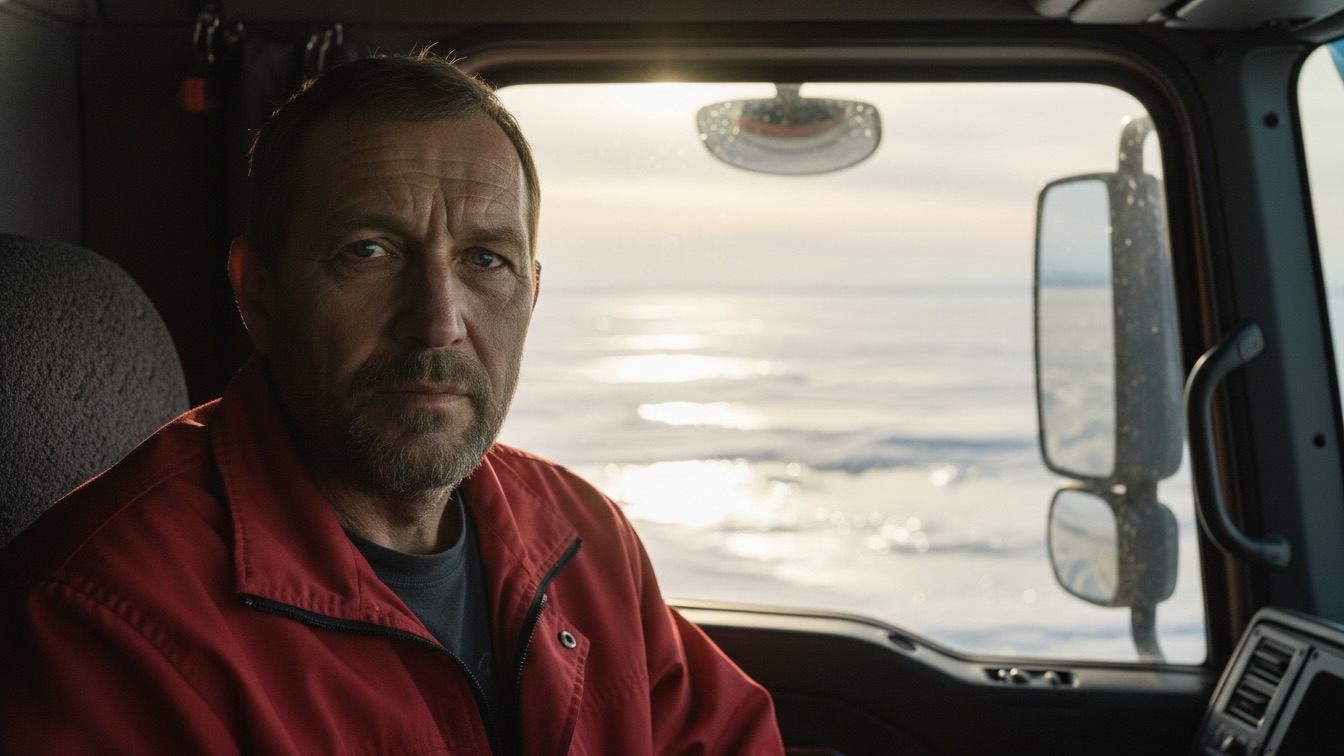
The truck tires crunched over the gravel. It was a loud sound. It sounded like a giant eating dry cereal. Harlan did not like the sound. It meant he was home, but the home was different. The summer sun was still up, but it was low. It was a pale, weak yellow. It did not feel like summer. It felt like the world was holding its breath, waiting for the ice to come back. The driveway was long and narrow. It was lined with pine trees that looked like tall, skinny men in ragged green coats.
Harlan pulled the air brake. The truck hissed. It was a big, angry cat hiss. The whole machine shook for a second, then went still. The engine was hot. He could feel the heat through the floorboards. It felt like a fever under his boots. He sat there for a long time. He did not move. He just looked at the house.
The house was a white box with a gray roof. It looked small from the high cab of the truck. It looked like a toy someone had forgotten in the weeds. The weeds were tall now. They were brown and dry. They scraped against the side of the truck like fingernails. Harlan rubbed his eyes. His eyelids felt like they had sand under them. He had been driving for sixteen hours. His brain felt like a crumpled piece of paper.
He looked at the passenger seat. The seatbelt was still flat. The dust on the dashboard was thick. He took his finger and drew a small circle in the dust. Then he wiped it away. He reached into his heavy jacket pocket. The money was there. It was a thick, lumpy block of paper. It felt like a heavy rock. It was the money from the Chief. It was the price of the ice.
"We're here, Sarah," he said.
His voice was a dry rattle. It sounded like it belonged to someone else. He opened the heavy door. The metal handle was cold. It was always cold now. He climbed down the steps. One, two, three. His boots hit the dirt. The ground was hard. It did not give. It was like walking on a giant's bone.
He walked toward the front door. He noticed things that were missing. The blue flowerpots were gone. Sarah had always kept them on the porch. They were filled with bright red flowers that looked like tiny velvet hats. Now, there were only gray circles of dirt on the wood. The wind chime was gone, too. It used to make a tink-tink-tink sound that reminded Harlan of ice cubes in a glass. Now there was only a rusted hook.
He reached the door. He reached for his keys. He had them on a ring with a plastic tag that said 'Harlan's Rig'. But he stopped.
There was something new on the door.
It was a padlock. It was a bright, shiny yellow. It looked like a piece of candy stuck to the old wood. It was huge. It had a heavy steel bar that went through a new metal bracket. Next to the lock, there was a piece of paper. The paper was taped to the door with clear tape. The tape was starting to peel at the corners.
Harlan leaned in. The words were big and black. They were printed by a machine.
PROPERTY SEIZED.
He felt a sharp pain in his chest. It was not a heart attack. It was a sudden, violent coldness. It felt like he had swallowed a jagged piece of ice. He reached out and touched the yellow lock. It was smooth. It was very hard. He pulled on it. The metal clanked. It was a dead sound.
"No," he whispered.
He walked to the window. He put his hands against the glass. He tried to look inside. It was dark. The curtains were closed. They were the yellow curtains Sarah had picked out because they looked like sunshine. Now they just looked like old teeth. He could not see anything. He felt like he was looking into a giant, empty eye.
He went back to the door. He kicked it. His heavy boot hit the wood with a dull thud. The yellow lock did not move. It just sat there, shining in the fading light. It was a wall. It was a big, yellow 'No'.
He turned around and leaned his back against the door. He looked at his truck. The red paint was bright in the sun. The truck was the only thing that still looked real. Everything else was a ghost. The house was a ghost. The yard was a ghost.
He reached into his pocket and pulled out the money. He looked at the crumpled bills. He counted them in his head. Four thousand dollars. It was a lot of money to the Chief. It was a lot of money to the people in the dark town. But Harlan knew the bank. The bank did not care about four thousand dollars. The bank wanted the whole house. They wanted the land. They wanted the memories.
He felt a tear run down his cheek. It felt hot. It felt like a tiny trail of fire. He wiped it away with the back of his rough hand.
"I'm not going to cry," he said. "I'm too tired to cry."
He walked back to the truck. He did not look back at the yellow lock. He climbed into the cab. The air inside was still warm. It felt like a hug from a giant. He sat in the seat and stared at the steering wheel.
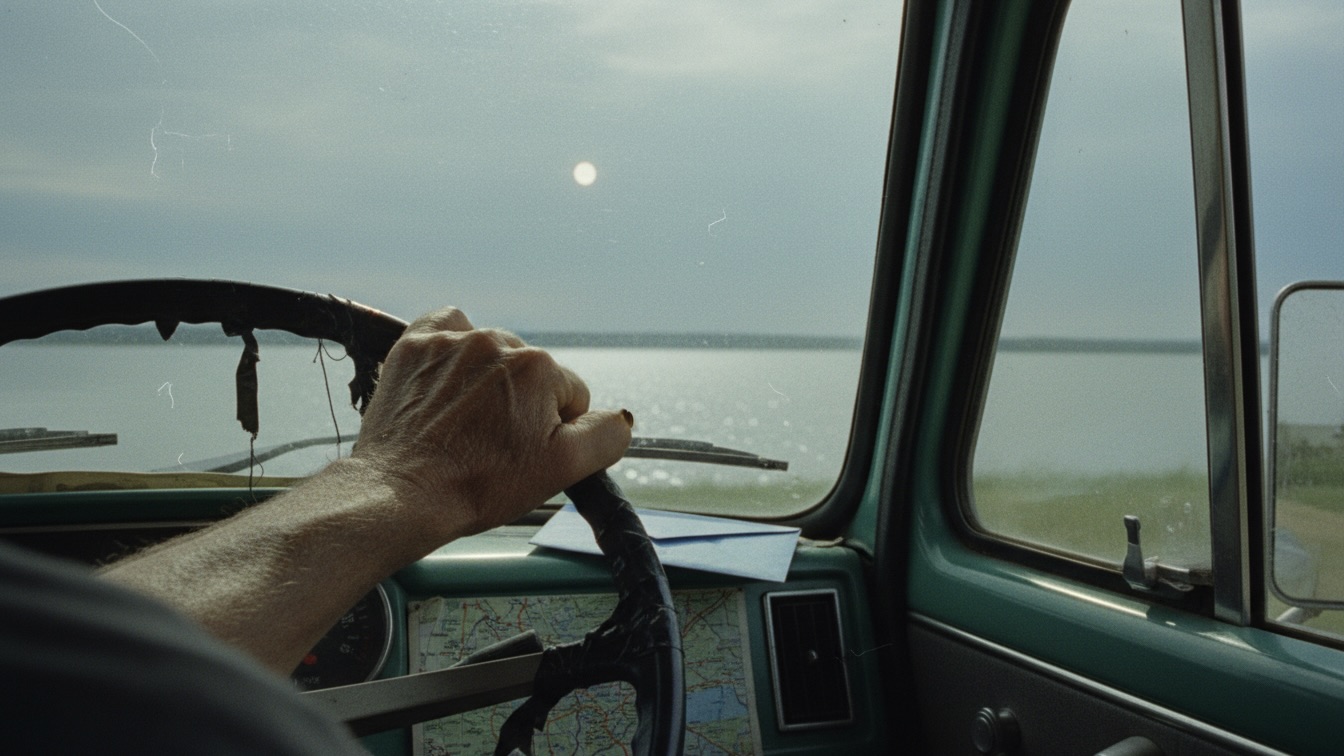
He opened the glove box. It was full of papers. There were maps. There were receipts for fuel. There were old candy wrappers. And there was an envelope.
It was a blue envelope. It had Sarah's handwriting on it. The letters were round and soft. They looked like little clouds. It was addressed to her sister, Maya. Maya lived in the city. The city was a long way away. It was full of tall buildings and loud noises.
Sarah had written the letter three years ago. She had never mailed it. She had tucked it into the glove box one day when they were driving to the lake.
"I'll mail it later," she had said.
But later never came. The ice got thin. The world got cold. And Sarah went away.
Harlan picked up the envelope. It felt light. It felt like a bird's wing. He looked at the money in his other hand.
He could go to the bank tomorrow. He could give them the money. They might let him back in the house for a month. They might take the yellow lock off the door. But then what? In a month, the money would be gone. The house would still be empty. Sarah would still be gone.
He looked at the blue envelope.
"Maya," he whispered.
He remembered Maya. She had the same eyes as Sarah. They were bright, curious eyes. Maya would want to know. She would want the letter.
He put the money in the glove box. He put the blue envelope on top of it. He turned the key.
The engine roared. It was a big, brave sound. It filled the cab. It pushed the silence away. Harlan grabbed the gear shift. He looked at the house one last time. The yellow lock was a small dot of color in the shadows.
"Goodbye, house," he said.
He pushed the truck into gear. The giant tires began to turn. He drove down the long driveway. He drove away from the white box and the gray roof. He drove toward the city.
The highway was a long, gray ribbon. It stretched out forever. Harlan watched the white lines on the road. They looked like teeth. Zip, zip, zip. The truck was a red beetle crawling across a giant's back. The sun had finally gone down. The sky was a deep, bruised purple. It looked like a giant grape.
Harlan’s hands were glued to the steering wheel. The black tape was sticky. It felt like the truck was part of his body. He didn't feel his legs anymore. He only felt the vibration of the road. It went up through his boots, into his knees, and settled in his teeth.
He looked at the clock on the dash. It was midnight. The numbers were glowing green. They looked like little alien eyes.
"Are you hungry?" a voice asked.
Harlan didn't jump. He was too tired to jump. He looked at the passenger seat. Sarah was there. She wasn't a real person. She was a memory made of moonlight and dust. She was wearing her favorite blue sweater. The one with the hole in the elbow. She was holding a sandwich wrapped in tin foil.
"I have ham and cheese," the memory-Sarah said. "You need to eat, Harlan. You're getting skinny. Your face looks like a shovel."
"I'm not hungry, Sarah," Harlan said. He spoke to the air. "I'm just driving."
"You're always just driving," she said. She leaned her head against the window. "Where are we going? This isn't the way to the quarry."
"We're going to see Maya," Harlan said.
The memory-Sarah went quiet. She looked out at the dark trees. The trees were passing by so fast they looked like a solid wall of black.
"Maya hates the truck," Sarah said softly. "She says it’s too loud. She says it’s a monster."
"It’s not a monster," Harlan said. "It’s a home. It’s the only home I have left."
He reached out to touch her hand, but his fingers only felt the cold vinyl of the seat. The memory-Sarah faded. She turned into a shadow, then a blur, then she was gone. The seat was empty again. The seatbelt lay flat.
Harlan felt a sharp pang of loneliness. It was a physical weight. It felt like a heavy stone sitting on his tongue. He couldn't swallow it. He just had to carry it.
He passed a sign. CITY LIMITS - 50 MILES.
The road began to change. There were more lights now. There were gas stations that looked like glowing mushrooms. There were billboards for things Harlan didn't need. JEWELRY. LAWYERS. NEW CARS. The colors were too bright. They hurt his eyes. They were aggressive.
He felt small. In the bush, the truck was a king. It was the biggest thing on the road. It was a hero. But here, the truck was just a dirty, old machine. It was a nuisance. People in small, shiny cars honked at him. They zipped around him like angry bees.
"Keep your pants on," Harlan grumbled.
He gripped the wheel tighter. His knuckles were white. He felt a bead of sweat roll down his neck. It felt like a cold bug. He didn't like the city. The city was full of people who didn't know how to be quiet. They didn't know how to listen to the ice.
He thought about the money in the glove box. Four thousand dollars. In the city, that was nothing. It was a few months of rent. It was a fancy dinner for some people. But to the Chief, it was everything. It was the survival of a whole town.
He felt a sudden urge to turn around. He could go back to the north. He could sleep in the truck by the lake. He could be alone with the trees.
But then he felt the blue envelope in the glove box. It was a physical presence. It was a promise.
"I'm coming, Maya," he whispered.
He saw a tall building on the horizon. It was covered in lights. It looked like a giant birthday cake. It was the first skyscraper. Harlan had not seen a skyscraper in five years. It looked impossible. It looked like it was going to fall over and crush the world.
He shifted gears. The truck groaned. It was tired, too. It wanted to rest. Its metal joints were aching. Its oil was dirty.
"Just a little further, girl," Harlan patted the dashboard.
The traffic got thicker. The air got heavier. It wasn't the cold, clean air of the north. It was thick with the breath of millions of people. It was full of the sound of tires on pavement. It was a constant hum. A hum that never stopped.
Harlan felt a headache starting. It was a dull throb behind his eyes. It felt like a tiny hammer hitting his skull.
He followed the signs for downtown. He was looking for a street called Maple. Sarah had mentioned it once. Maya lived in an apartment on Maple Street. It had a red door and a broken buzzer.
He drove through a neighborhood of small, brick houses. They were all huddled together. They looked like they were trying to keep each other warm. There were no yards. There were only concrete squares.
He saw a street sign. MAPLE ST.
He turned the truck. The street was narrow. It was lined with parked cars. The truck was too big for the street. It was like a whale trying to swim in a bathtub.
"Watch out," Harlan said to a blue sedan. He missed its mirror by an inch.
He saw the apartment building. It was tall and brown. It had a red door.
He found a spot at the end of the block. It was a loading zone. He didn't care. He pulled the air brake.
HISS.
The truck stopped. The engine died. The silence was sudden and loud. It was a different kind of silence than the one in the north. It was a silence filled with the distant sounds of the city.
Harlan sat there. He didn't move. He looked at the red door.
He reached into the glove box. He took the blue envelope. He took the block of money. He stuffed them into his jacket.
He looked in the mirror. He saw an old man. His hair was messy. His beard was gray and wild. His eyes were red.
"You look like a hobo, Harlan," he said.
He didn't care. He climbed out of the truck. The city air hit him. It was warm. It was too warm. It felt like standing too close to an oven.
He walked toward the red door. Every step felt heavy. His boots made a loud clack-clack-clack on the sidewalk. People looked at him. They saw the giant man in the dirty jacket and they moved away. They were afraid of him.
Harlan didn't blame them. He was afraid of himself, too.
The buzzer was indeed broken. It was a small plastic button that had been pushed in so many times it was stuck. Harlan pressed it anyway. Nothing happened. He waited. He looked at the names on the little metal boxes.
MAYA Victor. APARTMENT 4B.
He pushed the door. It was heavy. It didn't open. He knocked. He knocked with his big, heavy fist.
BOOM. BOOM. BOOM.
The sound echoed in the hallway. It sounded like the ice cracking on the lake.
"Who is it?" a voice yelled from inside.
It was a woman's voice. It was sharp. It was annoyed.
"It’s Harlan," he said.
There was a long silence. A very long silence. Harlan could hear the sound of his own breathing. It was loud and ragged.
Then, he heard the sound of footsteps. They were light footsteps. They were the sound of someone who didn't weigh much.
The door opened.
Maya stood there. She looked just like Sarah. It was a shock. It was like seeing a ghost in the daylight. She had the same nose. The same way of holding her shoulders. But her hair was short. It was dyed a bright, neon pink. It looked like a tropical bird.
She was wearing a big, oversized t-shirt with a picture of a cat on it. She looked at Harlan. Her eyes went wide.
"Harlan?" she said. "What are you doing here? It’s two in the morning."
"I know," Harlan said. He felt like a giant standing in her doorway. He felt like he was taking up all the air.
"Did something happen?" she asked. Her voice got soft. "Is it... is it about the house?"
"The bank locked the door," Harlan said. "They put a yellow lock on it."
Maya sighed. She leaned against the doorframe. She looked tired. She had dark circles under her eyes.
"I told you, Harlan," she said. "I told you three years ago to sell that place. You can't keep a house like that on a driver's salary. Not with the way things are."
"I know," Harlan said.
"So why are you here?" she asked. She looked past him at the street. "Where’s your truck? Did you drive that monster all the way here?"
"It’s at the end of the block," Harlan said.
"You’re going to get a ticket," she said. "The city hates that truck."
"I don't care about the ticket," Harlan said.
He reached into his pocket. He pulled out the blue envelope.
"Sarah wrote this," he said. "Three years ago. I found it in the glove box."
Maya looked at the envelope. Her hand trembled as she reached out to take it. She touched the paper like it was made of glass.
"She never sent it," Maya whispered.
"She was going to," Harlan said. "She just... she ran out of time."
Maya opened the envelope. She pulled out a single sheet of yellow lined paper. She began to read.
Harlan watched her. He watched her eyes move back and forth. He saw her lip quiver. He saw a tear fall onto the paper. It made a small, dark circle. s "What does it say?" Harlan asked.
Maya didn't answer for a long time. She just kept reading. Then she folded the paper carefully and put it back in the envelope.
"She said she was sorry," Maya said. Her voice was thick. "She said she was sorry for leaving the city. She said she missed me. She said she wanted me to come visit in the summer. She said the flowers were beautiful."
Harlan looked at his boots. The flowers. The red velvet hats in the blue pots. They were gone now. Everything was gone.
"There’s something else," Harlan said.
He pulled out the block of money. He held it out to her.
"What is that?" Maya asked. She looked at the money like it was a pile of snakes.
"It’s four thousand dollars," Harlan said. "It’s the money from the Chief. For the fuel."
"Why are you giving it to me?" she asked.
"Because the bank is going to take the truck," Harlan said. "They’re going to take everything. If I give them this money, it just delays the end. It doesn't stop it."
"Harlan, I can't take your money," Maya said. She stepped back.
"Take it," Harlan said. His voice was firm. It was the voice he used when he was talking to the ice. "Take it and move. Get a better apartment. One with a buzzer that works. One that’s safe."
"What about you?" she asked. "What are you going to do?"
Harlan looked at the red door. He looked at the neon pink hair. He looked at the ghost of Sarah in her eyes.
"I’m going to drive," he said.
"To where?"
"North," Harlan said. "The ice is melting, Maya. The world is changing. I want to see it before it’s gone. I want to be where it’s quiet."
"You’re crazy," she said. But she took the money. Her fingers brushed his. Her skin was warm. It was the only warm thing he had felt in a long time.
"Maybe," Harlan said.
He turned around. He started to walk away.
"Harlan!" Maya called out.
He stopped. He didn't turn back.
"Sarah loved you," she said. "In the letter... she said you were the only thing that kept her warm."
Harlan felt a giant hand squeeze his heart. He didn't say anything. He couldn't. He just nodded and kept walking.
He reached the truck. He climbed into the cab. He felt the weight of the money gone from his pocket. He felt light. He felt empty.
He looked at the passenger seat.
"We did it, Sarah," he said.
The seat was empty. There was no moonlight ghost. There was only the dust and the smell of old coffee.
He started the engine. It was a roar of freedom. It was a roar of goodbye.
He drove down the street. He didn't look at the red door. He didn't look at the skyscrapers. He looked at the road. The long, gray ribbon that led back to the trees.
He was a driver. That was all he was. That was all he ever would be.
He shifted into fifth gear. The truck gained speed. The city began to fade in the rearview mirror. The lights became small dots, then they were gone.
The world was dark again. It was the way Harlan liked it. It was a world of shadows and engine noise.
He reached out and touched the empty seat.
"Where to now?" he asked.
The only answer was the hum of the tires on the pavement. Zip, zip, zip.
He drove into the night. He drove toward the place where the summer never quite arrived. He drove toward the end of the road.
The sun came up over the pines. It was a cold, white sun. It looked like a pale eye watching the world. Harlan was back in the bush. The air was different here. It was thin and sharp. It didn't taste like anything. It just felt like needles in his throat.
He was low on fuel. The needle on the gauge was pointing to the red line. It looked like a warning finger.
He pulled over at a small gas station. It was just a single pump and a shack made of corrugated metal. There was a sign that said LAST FUEL FOR 200 MILES.
Harlan got out of the truck. His legs were shaking. He felt like he was made of glass. He felt like if he tripped, he would shatter into a thousand pieces.
He walked to the shack. An old man was sitting on a wooden crate. He was wearing a hat that said 'Fishing is Life'. He was carving a piece of wood with a small knife.
"Mornin'," the old man said. He didn't look up.
"Need diesel," Harlan said.
"Pump’s working. Price is high," the man said.
Harlan reached into his pocket. He found a few crumpled bills. It was the last of his personal money. It was enough for half a tank.
He walked back to the pump. He pulled the heavy nozzle. He listened to the fuel rushing into the tank. It sounded like a thirsty animal drinking.
He looked at his truck. It was covered in mud and salt. It looked like it had been through a war. The red paint was almost gray. The bumper was still missing. The metal frame was exposed. It looked like a ribcage.
"Going far?" the old man asked. He had finished his carving. It was a small wooden bird.
"As far as the road goes," Harlan said.
"Road ends at the lake," the man said. "Ice is gone. Nothing but mud and water now."
"I know," Harlan said.
He finished fueling. He put the nozzle back. He walked to the shack and handed the man the money.
"You're that driver," the man said. He looked at Harlan's face. "The one who took the fuel to the Oji-Cree."
"I'm just a driver," Harlan said.
"They’re talking about you," the man said. "They say you’re a ghost. They say you drove on water."
"The ice was thick enough," Harlan said.
"Not anymore," the man said. He looked at the sky. "The world is melting, son. We’re all going to be swimming soon."
Harlan didn't answer. He went back to the truck. He climbed inside.
He looked at the passenger seat. He didn't see Sarah anymore. The memory was fading. It was like a photograph that had been left in the sun. The colors were washing out. The edges were curling.
He felt a strange peace. It was a cold peace, but it was peace. He didn't have a house. He didn't have a wife. He didn't have a future. He only had the truck and the road.
He drove toward the lake.
When he reached the shore, he stopped. The ice was gone. The lake was a vast, gray ocean. The water was choppy. It had white caps that looked like teeth. The ice road was just a memory.
He saw the town of Oji-Cree across the water. It was a tiny cluster of black dots. He could see a single wisp of smoke rising from a chimney. They were still there. They had the fuel. They were warm.
He sat there for a long time. He watched the waves hit the shore. He watched the sun climb higher in the sky.
He reached into the glove box one last time. He found a small, silver locket. It was Sarah’s. He had forgotten it was there. He opened it. Inside was a tiny picture of them on their wedding day. They were young. They were smiling. They looked like they knew a secret.
Harlan closed the locket. He held it in his hand. It felt warm.
He looked at the water.
"I'm going to miss you, Sarah," he said.
He threw the locket into the lake. He watched it fly through the air. It was a tiny spark of silver. Then it hit the water with a small splash. It sank quickly. It went down into the dark, cold water. It went to where the ice lived.
Harlan put the truck in reverse. He turned around. He drove back toward the main road.
He didn't know where he was going. He didn't have a map. He didn't need one. He would just drive until the fuel ran out. He would drive until the truck stopped.
He felt the vibration of the engine. It was a heartbeat. It was his heartbeat.
He was the last driver. He was the ghost of the ice road.
He shifted gears. The truck roared. It was a beautiful sound. It was the sound of a giant waking up.
He drove into the summer that felt like winter. He drove into the fading light. He drove until the road became the sky.
“He watched the needle touch the absolute bottom of the gauge and didn't lift his foot from the pedal.”