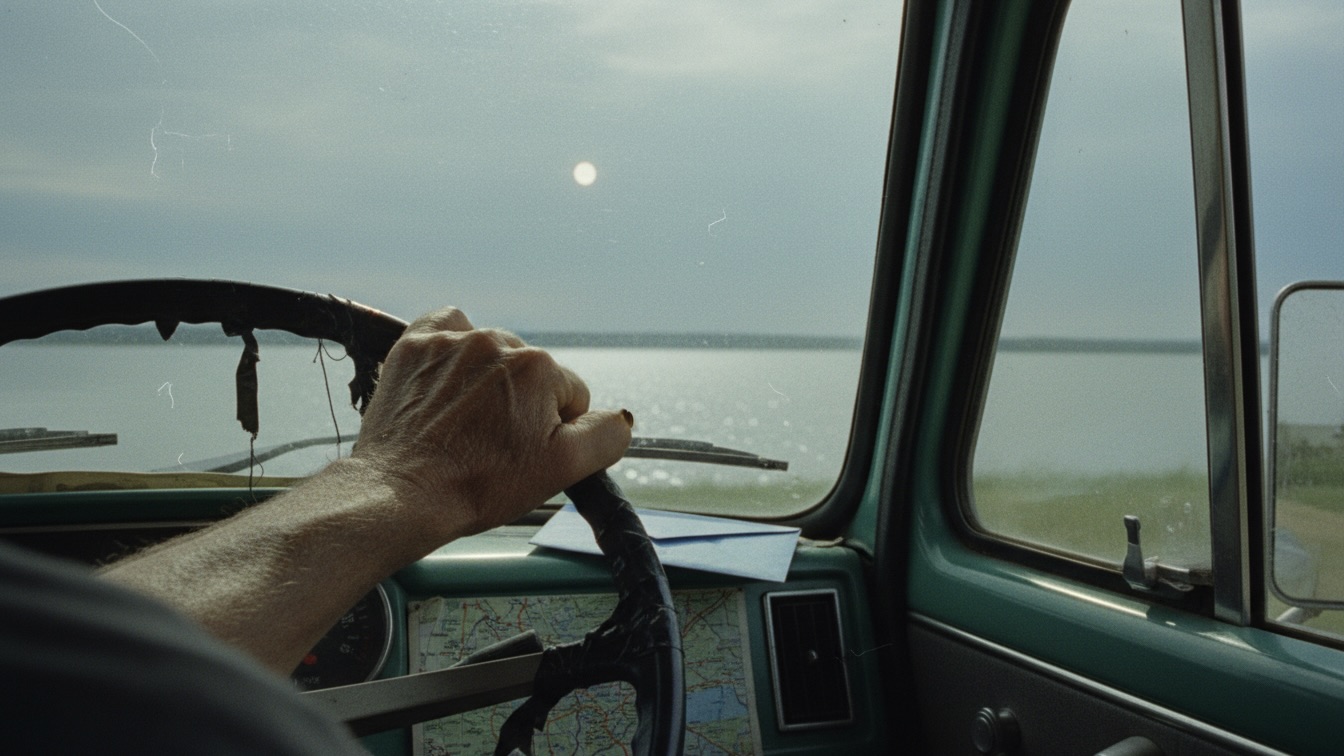
Harlan returns from a grueling sixteen-hour haul to find his home physically and legally barred from him. The presence of a bright yellow padlock and a seizure notice on the door signals the final collapse of his domestic life. Haunted by the memory of his late wife, Sarah, he realizes that the four thousand dollars he earned is insufficient to save the house from the bank. Instead of attempting a futile reclamation of the property, he chooses to honor Sarah’s memory by seeking out her sister, Maya, in the city.
The journey to the city serves as a transition from his isolated northern life to a jarring urban environment. Along the way, Harlan experiences a vivid psychological manifestation of Sarah, who occupies the passenger seat of his truck. Upon reaching the city, he delivers a long-lost letter and his remaining cash to Maya, providing her with a means to escape her own hardships. This act of altruism allows Harlan to sever his final ties to society and the past.
In the concluding movements of the story, Harlan returns to the northern bush, only to find the landscape transformed by a warming climate. The ice roads he once mastered have vanished, replaced by mud and open water. After discarding Sarah’s locket into the lake, he accepts his fate as a nomadic figure. He drives away from the literal and metaphorical "end of the road," embracing a future of perpetual motion.
The narrative explores the profound intersection of personal grief and environmental decay. The "ice" functions as a dual symbol, representing both the literal foundation of Harlan’s career and the frozen state of his emotional life. As the world warms and the ice melts, Harlan is forced to confront the reality that the structures he relied upon—his marriage, his home, and his industry—are liquefying. This environmental shift mirrors his internal journey from a state of frozen mourning to a fluid, albeit desolate, acceptance of loss.
Isolation and the search for identity within a machine are also central themes. Harlan’s truck is not merely a tool; it is described as an extension of his body and his only true home. The story suggests that for those who have lost their social and domestic anchors, the rhythm of labor becomes a surrogate for existence. His refusal to fight the bank for the house indicates a realization that "home" was tied to Sarah’s presence rather than the physical structure. Once the human connection is severed, the "white box" of the house becomes a ghost, leaving the truck as the only remaining vessel for his identity.
Finally, the story examines the concept of legacy and the weight of unspoken words. The blue envelope, tucked away and forgotten for years, represents the unfinished business that keeps the living tethered to the dead. By delivering this letter to Maya, Harlan performs a ritual of closure that Sarah could not complete. The act of giving away the money further emphasizes a theme of spiritual divestment. He chooses to invest in the future of the living rather than prolonging the agony of a dead past, ultimately finding a cold peace in his emptiness.
Harlan is a man defined by stoicism and a deep-seated psychological fragmentation. His long hours of driving have blurred the lines between his internal thoughts and the external world, leading him to perceive his truck as a living entity. He suffers from a profound sense of displacement, feeling like a "hobo" or a "ghost" when confronted with the modern world of the city. His primary defense mechanism is his commitment to the road, which provides a rhythmic distraction from the "jagged piece of ice" he feels in his chest.
Psychologically, Harlan exhibits signs of complicated grief, evidenced by his auditory and visual hallucinations of Sarah. He speaks to her as if she were present, using these interactions to process his guilt and loneliness. However, he is also remarkably self-aware; he recognizes that the memory-Sarah is made of "moonlight and dust." This suggests that while he clings to her image, he is also preparing himself to let her go. His decision to throw the locket into the lake is the climax of his psychological arc, marking his transition from a man haunted by the past to a man who has accepted his own obsolescence.
Although Sarah is deceased before the story begins, she is the most influential force in Harlan’s life. She is characterized through Harlan’s sensory memories—the "red velvet hats" of her flowers, her "round and soft" handwriting, and her favorite blue sweater. These details paint a picture of a woman who provided the warmth and color in an otherwise cold, gray existence. Her absence is not just a lack of personhood but a lack of light, as evidenced by the way her yellow curtains now look like "old teeth."
Sarah’s role in the narrative is to act as a moral and emotional compass for Harlan. Her unfinished letter to Maya provides him with a final mission, giving his aimless driving a temporary purpose. Through Harlan’s hallucinations, she also acts as a voice of concern, reminding him to eat and questioning his path. Ultimately, Sarah represents the "summer" that Harlan can no longer reach. Her memory is a beautiful but fading photograph that he must eventually release to the "dark, cold water" of the past.
Maya serves as a mirror to Sarah and a bridge to the future. Her appearance is a "shock" to Harlan because she possesses Sarah’s physical traits but inhabits a completely different world. Her neon pink hair and urban apartment represent a modernity that Harlan find alien and aggressive. Despite her initial annoyance at his late-night arrival, her reaction to the letter reveals a deep, underlying vulnerability. She represents the potential for life to continue and evolve, even after a tragedy has occurred.
Her interaction with Harlan highlights the disconnect between the rugged, northern life he leads and the practical realities of the city. She is the one who points out the futility of his driver’s salary and the inevitability of his loss. By accepting the money, she becomes the recipient of Harlan’s final act of service. She provides him with the validation that Sarah loved him, which is the final piece of emotional sustenance he needs before disappearing back into the wilderness.
The author employs a stark, minimalist prose style that reflects Harlan’s weary and utilitarian worldview. Short, punchy sentences create a rhythmic pacing that mimics the "zip, zip, zip" of tires on the pavement or the mechanical throb of an engine. This linguistic simplicity emphasizes the sensory details, such as the "crunch" of gravel or the "hiss" of air brakes. By using such direct language, the narrative mirrors the harsh, uncompromising environment of the north and the blunt trauma of Harlan’s poverty.
Simile and personification are used extensively to animate Harlan’s surroundings, suggesting his profound isolation. The truck is an "angry cat," the pine trees are "men in ragged green coats," and the white lines on the road are "teeth." These comparisons create a world that feels alive and often predatory, reflecting Harlan’s internal state of hyper-vigilance and exhaustion. The house itself is personified as having an "empty eye," which heightens the sense that the world is watching Harlan’s downfall with cold indifference.
Color symbolism plays a crucial role in establishing the tone and emotional shifts of the chapter. The "pale, weak yellow" of the sun and the "bright, shiny yellow" of the padlock link the natural world to the legal mechanisms that have ruined Harlan. In contrast, the "blue" of the envelope and Sarah’s sweater represents a cooling, nostalgic comfort that is slowly being erased. The "deep, bruised purple" of the city sky and the "neon pink" of Maya’s hair signal a transition into a world that is vibrant but "hurts his eyes." These color cues guide the reader through Harlan’s emotional landscape, from the warmth of memory to the cold reality of his final journey.


