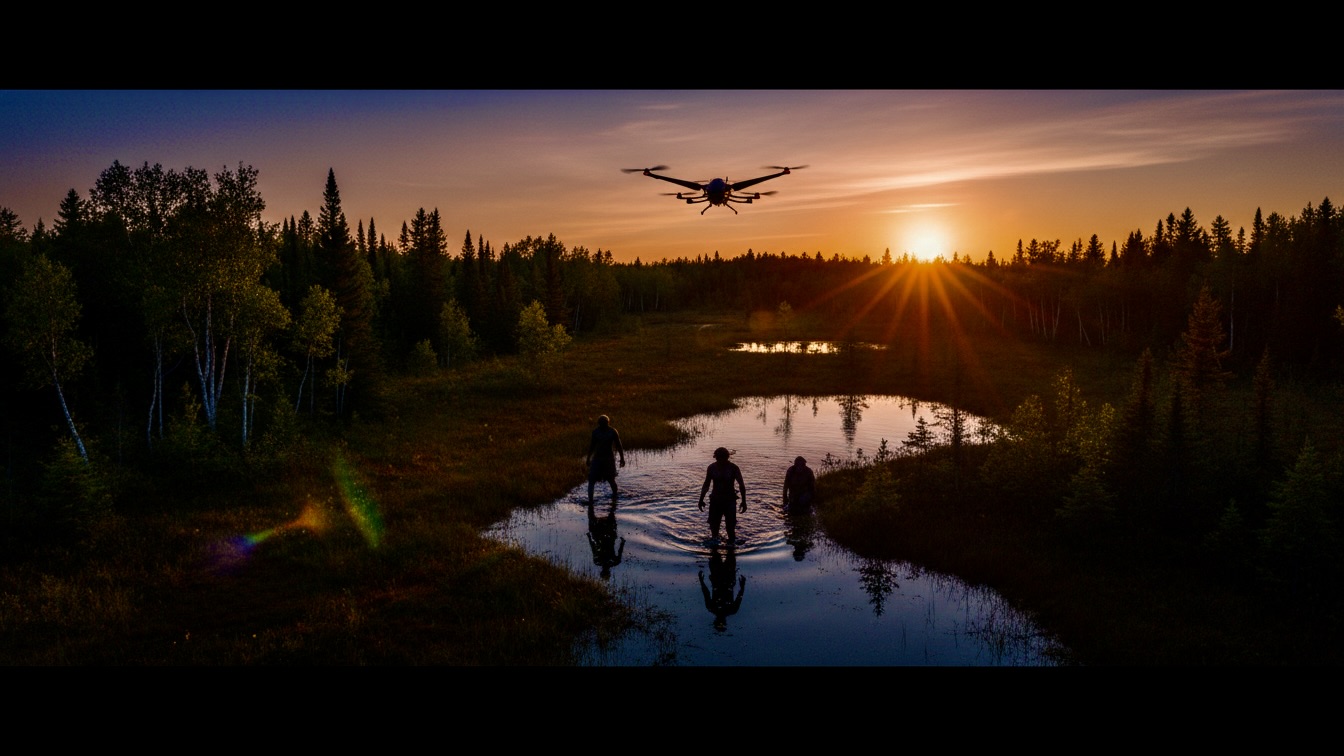
The narrative follows three "unpersons"—Jules, Jay, and an enigmatic Elder—as they navigate the punishing wilderness of Northern Ontario to escape a totalizing digital surveillance state. Having been "deleted" from society through the revocation of their social credit and digital identities, they seek refuge in Dead Signal Creek, a geographical anomaly that acts as a natural Faraday cage. Along the journey, they narrowly evade a high-tech "Vulture" drone by masking their thermal signatures with river mud and outpace a federal recovery team led by Commander Poport across a treacherous marsh. The chapter concludes with their arrival at a clandestine settlement of fellow outcasts, where Jules finally finds a sense of physical reality that exists independently of the state’s digital ledger.
The central theme of the story is the terrifying intersection of digital identity and human existence, exploring how a modern state can effectively "erase" a human being without physical execution. By weaponizing the digital infrastructure of daily life—bank accounts, smart locks, and biometric scanners—the system transforms the protagonist into a ghost while she is still breathing. This digital dehumanization suggests that in a hyper-connected world, the "soul" of a person is no longer an internal essence but a collection of data points held in a cloud. When those points are deleted, the individual loses the ability to interact with the world, turning the act of survival into a subversive, analog struggle.
Another prominent theme is the dichotomy between the simulated safety of the city and the brutal authenticity of nature. The "software" that governs the characters' former lives is presented as a polite but cold machine that demands total compliance in exchange for convenience. In contrast, the Northern Ontario bush is described as an aggressive, decaying, and vibrant entity that does not care about social credit scores. While the forest is dangerous, it offers the only space for genuine freedom because it is "invisible" to the grid. This suggests that true liberty in a technological age may only be found in the "Grey Zones" where the signals fail and the physical self is the only self that remains.
The story also delves into the psychological trauma of "unpersoning," particularly through the character of Jay. His struggle highlights the dependency of the younger generation on digital validation, where he feels like "just meat" or a "bag of bones" without a network connection. This reflects a broader societal shift where human value is increasingly extrinsic, tied to a balance or a score rather than inherent worth. The narrative posits that the first step to reclaiming one's humanity is the painful process of mourning the version of oneself that the system created and protected.
Jules serves as the narrative’s grounded, pragmatic anchor, driven by a survivalist instinct that was forged the moment she was "deleted" for a private conversation. As a former history teacher, she possesses an analytical perspective that allows her to recognize the systemic shifts occurring around her, such as the freezing of bank accounts being a "demo" for a larger rollout. Her internal conflict is defined by a profound sense of loss; she is not just fleeing a government, but mourning the version of herself that believed in the system’s benevolence. This psychological weight is manifested in her phantom limb-like reflex of reaching for a smartphone that is no longer in her pocket.
Throughout the trek, she assumes a maternal yet stern leadership role, particularly toward Jay, whom she must constantly push to prevent his psychological collapse. Her resilience is tested during the crossing of Dead Signal Creek, where she briefly contemplates the ease of letting the current take her. However, her decision to keep fighting signifies a transition from a "citizen" who follows rules to an "unperson" who defines her own reality. By the end of the chapter, she has shed her former identity entirely, embracing a scarred, dirty, and authentic version of herself that the system cannot quantify.
Jay represents the tragic vulnerability of a generation that has never known a world without digital mediation. He is a young man who mistook digital assets like Bitcoin for true liberty, only to find that the state can revoke his access to the physical world as easily as a password reset. His character is defined by a frantic, almost infantile desperation for the comforts of the grid, illustrated by his dangerous attempt to use a vending kiosk despite the risks. This act shows that his addiction to the "handshake" of technology is more powerful than his fear of capture.
Psychologically, Jay is the most fragile of the trio, teetering on the edge of an existential crisis because he cannot conceive of himself as a purely physical being. He views his own body as a "bag of bones" when it is disconnected from the network, suggesting a total loss of self-esteem once his digital status is revoked. His growth, though slow, is prompted by Jules’s insistence that he is real because she can see him, forcing him to shift his trust from the "red light" of the machine to the human connection of his companions. He serves as a cautionary figure for the loss of autonomy in a society that replaces physical skills with digital permissions.
The Elder functions as the spiritual and practical guide for the group, representing a link to a pre-digital past and an ancestral understanding of the land. He is the most composed of the three, moving through the bush with a rhythm that suggests he never truly belonged to the digital world to begin with. His silence is not a sign of weakness but of intense observation, as he scans the canopy for threats that the younger characters can only hear. He is the one who understands that freedom is a "cold business," stripped of the performative nature of modern protests or social media activism.
His role is pivotal in the group's survival, specifically when he provides the mud and cedar mixture to mask their heat signatures from the "Vulture" drone. This act demonstrates his mastery over the physical environment, using the earth itself to defeat the most advanced technology of the state. He is the physical manifestation of the "Grey Zone," a person who has already learned to live without a login and who views the digital world as a fleeting, soul-evaporating illusion. His iron grip on Jules’s arm during the creek crossing symbolizes the strength of the old world pulling the new world out of its own despair.
The pacing of the chapter is expertly managed, mirroring the physical and psychological toll of the journey. It begins with a slow, oppressive atmosphere, where the heat and humidity create a sense of stagnant dread. This tension gradually escalates as the characters encounter the "Red Light" kiosk and the drone, shifting the narrative into a high-stakes survival thriller. The climax at the marsh, involving the pursuit by Commander Poport and his ATVs, provides a frantic burst of action that contrasts sharply with the somber, quiet resolution at the settlement.
Sensory details are used with great effect to ground the high-concept dystopian themes in a visceral reality. The author focuses heavily on unpleasant smells—pine sap, rotting vegetation, sulfurous swamp gas, and the "ancient rot" of the river mud—to emphasize the gritty nature of their escape. These "analog" sensations serve as a constant reminder of what the characters have gained in exchange for their digital comfort. The sound design of the story is equally evocative, from the "low-frequency thrum" of the drone to the "piercing chirp" of the kiosk, creating an auditory landscape where technology is always a predatory presence.
The narrative voice is one of weary resilience, filtered through Jules’s perspective as she observes the collapse of her civilization. The tone is melancholic yet defiant, capturing the "crushing melancholy" of realizing that millions of people are still trapped in a system that has already erased their individuality. The prose is sharp and unsentimental, reflecting the "cold business" of freedom that the Elder describes. By focusing on the small, physical details—a plastic dinosaur, a faded flag, or the texture of grilled trout—the style reinforces the story's central argument that reality is found in the tangible and the unquantifiable.


