Format: Short Film / Anthology Episode | Est. Length: 10-12 minutes
Imagine a series that peels back the grime of a modern metropolis to reveal the secret pulses of humanity beating beneath the concrete, where every episode explores a hidden act of urban resistance. This episode serves as a cornerstone for The Hidden City, an anthology series centered on the "Underground Spring," a decentralized collective of citizens reclaiming forgotten spaces through guerrilla gardening. Each installment follows a different outsider—a skeptic, a developer, or a lost soul—who accidentally stumbles into this secret world and is forced to confront their own values in the face of rapid gentrification. The series explores the tension between corporate sterility and organic community, weaving a season-long narrative of a city rediscovering its soul one vacant lot at a time.
Simon, a cynical journalist desperate to save his flatlining career, ruins his designer jeans digging in the mud for corporate dirt, only to unearth a rusted copper box containing a list of gardening supplies and mysterious addresses.
A disgraced reporter unearths a secret network of urban guerrilla gardeners while searching for evidence of corporate corruption. He must decide whether to exploit the discovery for a career-saving scoop or protect the city’s last pockets of beauty from the very developer he intended to expose.
The primary theme is the conflict between Cynicism and Hope, specifically how a transactional worldview can blind an individual to acts of genuine grace. Simon represents the modern "vulture" culture that feeds on rot, while the Underground Spring represents a "radical humanity" that operates without the need for profit or recognition.
Secondary themes include Urban Reclamation and the Ethics of Transparency. The story questions whether "the truth" is always a public good, especially when revealing it provides ammunition for those who wish to destroy beauty for the sake of a corporate balance sheet.
For Simon, the stakes are existential and professional; he is a man whose identity is tied to a failing career in a world of clickbait, facing the choice between personal gain and moral integrity. For the Underground Spring and the residents of the Heights, the stakes are the physical survival of their sanctuary spaces, which face immediate destruction if their locations are revealed to the developer, Miller.
The external conflict is driven by Miller, the unseen but looming developer whose "glass and steel" vision threatens to erase the neighborhood's character. Internally, Simon battles his own deep-seated cynicism and the "vulture" instincts that compel him to see every hidden thing as a sin. Malaya serves as a philosophical antagonist, challenging Simon's worldview and forcing him to confront the "devoid of grace" reality he has constructed for himself.
Simon, a journalist struggling to remain relevant in an era of AI-generated content, investigates a developer named Miller by digging in a lot slated for demolition. He discovers a rusted copper box that he believes contains evidence of bribery, but instead finds a collection of index cards detailing gardening supplies and neglected urban addresses. He is confronted by Malaya, a member of a secret group called the Underground Spring, who accuses him of looking for rot where there are only roots. Simon initially views the group’s activities as a fraudulent scheme to manipulate property values, threatening to expose them to save his career.
Driven by a mix of lingering suspicion and professional habit, Simon visits the addresses on the cards and discovers a network of "anonymous beauty"—vibrant gardens maintained by ordinary citizens in the city's harshest corners. The experience shatters his cynicism, leading him to realize that the true scandal is the corporate erasure of these non-profit spaces. Instead of writing a hit piece, Simon publishes a "radical transparency" exposé that celebrates the gardens and mobilizes the public. The resulting outcry forces the city council to protect the sites, transforming Simon from a predatory reporter into a guardian of the city’s hidden life.
Simon: A cynical, high-strung journalist whose "jaw is locked so tight it felt like his teeth might crack" at the start of the story. He begins as a "vulture" seeking to exploit secrets for professional survival but undergoes a psychological shift as his cynicism "cracks" like a resetting rib. By the end, his breathing is deep and rhythmic, having found purpose in protecting beauty rather than exposing rot.
Malaya: The stoic and "coolly composed" leader of the Underground Spring who wears a canvas apron stained with chlorophyll. She acts as the moral compass of the episode, possessing an earthy wisdom that contrasts with Simon’s frantic, "glitch in the system" energy. She remains steadfast in her mission, moving from a position of defensive secrecy to one of cautious acceptance of Simon’s help.
Miller (Supporting/Antagonist): An unseen corporate force representing the "sterile complex of glass and steel." His influence is felt through the threat of his bulldozers and the economic pressure he exerts on the neighborhood, serving as the catalyst for both Simon’s desperation and the Underground Spring’s resistance.
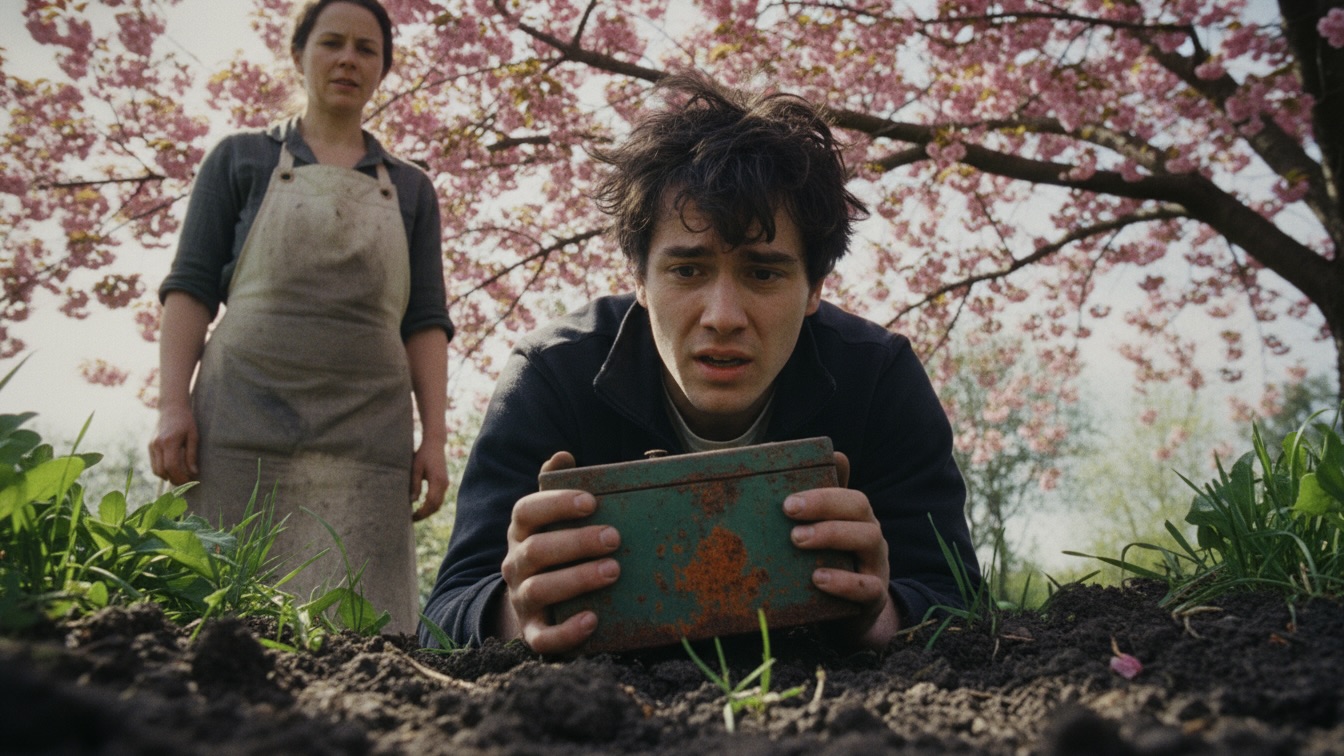
Simon frantically digs in the mud under a cherry tree, his designer clothes ruined as he unearths a rusted copper box he believes contains evidence of corporate bribery. The metallic clang of the shovel against the box provides a moment of high tension, followed by the screeching of hinges as he pries it open. He is crushed to find only index cards listing gardening supplies and obscure addresses instead of the expected ledger of sins.
Malaya emerges from the shadows, confronting Simon with a cool, composed demeanor that highlights his status as a "glitch in the system." Their verbal sparring establishes the conflict between Simon’s transactional worldview and Malaya’s philosophy of "grace" and "humanity." Simon threatens to expose the group as a fraud, while Malaya challenges him to see the truth behind the secret gardens and the "vulture" soul he possesses.
Simon embarks on a "pilgrimage" to the addresses on the cards, expecting to find evidence of property manipulation but discovering vibrant, anonymous pockets of life in the city's most neglected corners. He witnesses a retired man watering primroses and a teenager reading under a plum tree, causing his long-held cynicism to physically "crack" like a rib resetting. This journey serves as the midpoint where his investigative focus shifts from finding a scandal to understanding a miracle.
Returning to his apartment, Simon rejects the easy path of a clickbait exposé on Miller’s bribes and instead writes a "fortress" of facts about the Underground Spring. The scene captures his feverish intensity as he types through the night, reclaiming the sense of wonder and purpose he had lost to the sea of AI-generated content. He hits "publish" at dawn, signaling his final transformation from a predator to a protector of the city’s hidden beauty.
The aftermath sees the city council halt the demolition, transforming the secret gardens into a public cause and stalling Miller’s bulldozers. Simon meets Malaya one last time under the cherry tree, acknowledging that while the immediate threat is gone, the fight for the city's soul is ongoing. He ends the episode not with fear, but with a renewed readiness to "keep digging" for the truths that actually matter.
The episode begins with a mood of "Desperate Noir," characterized by Simon’s frantic, claustrophobic anxiety and the cold, damp setting of the muddy lot. As Simon investigates the addresses, the mood shifts into "Lyrical Realism," where the tension of the investigation is replaced by a sense of quiet wonder and visual warmth. The climax offers a "Cathartic Resolution," moving from the blue-light intensity of Simon’s late-night writing to the bright, hopeful clarity of the morning sun filtering through cherry blossoms.
A full season would track the escalation of the conflict between the Underground Spring and Miller’s corporate entity, "Apex Development," as the gardens move from secret sanctuaries to a city-wide political movement. As the gardens become public knowledge, the collective must deal with the pressures of legalization, city bureaucracy, and internal disagreements over whether to remain anonymous or become a formal organization.
Simon would evolve into the group’s unofficial chronicler, uncovering deeper layers of the city’s history and other "underground" movements that have been suppressed by corporate interests. The season would culminate in a high-stakes legal and social battle to pass a "Right to Beauty" ordinance, testing whether the radical humanity of the Spring can survive the transition into the light of the "real world."
The visual style utilizes a high-contrast palette, moving from the cold, desaturated blues and greys of the corporate city to the hyper-saturated, warm greens and florals of the gardens. Handheld camera work during Simon’s frantic digging creates a sense of nervous energy, which stabilizes into smooth, wide shots and slow pans as he discovers the beauty of the pocket parks.
The tone is "Urban Noir meets Botanical Hope," drawing comparisons to the investigative grit of Spotlight blended with the whimsical, grounded magic of Amélie. The sound design emphasizes the harsh, mechanical noises of the city—subways, honking, construction—gradually giving way to the organic sounds of wind through leaves and water hitting soil.
The target audience includes adults (25-54) who enjoy character-driven dramas with social relevance, such as fans of The Bear or Rectify. It appeals to viewers interested in urbanism, environmentalism, and stories about personal redemption and the search for meaning in a digital, corporate age. The sophisticated tone and thematic depth make it suitable for premium streaming platforms or anthology-focused networks.
The 12-minute runtime is structured into three distinct acts: the Discovery (minutes 1-4), the Pilgrimage (minutes 5-8), and the Resolution (minutes 9-12). The pacing is rapid and tense during the opening confrontation to reflect Simon’s internal state, slows down significantly during the lyrical exploration of the gardens to allow the audience to experience the "grace" Malaya describes, and accelerates again during the climactic writing montage.
Production requires a mix of gritty urban locations—alleys, laundromats, and bus stops—and meticulously designed "guerrilla" garden sets that look organic and lived-in rather than professionally landscaped. The copper box and the index cards are key hero props that require a weathered, aged texture to emphasize the history of the secret movement.
Special attention must be paid to the "cherry tree" location, which serves as the visual bookend for the episode; it must transition from a site of muddy desperation to a place of sun-drenched triumph. Practical floral effects and seasonal blooming schedules should be factored into the shooting timeline to ensure the "riot of color" described in the script is captured authentically.


