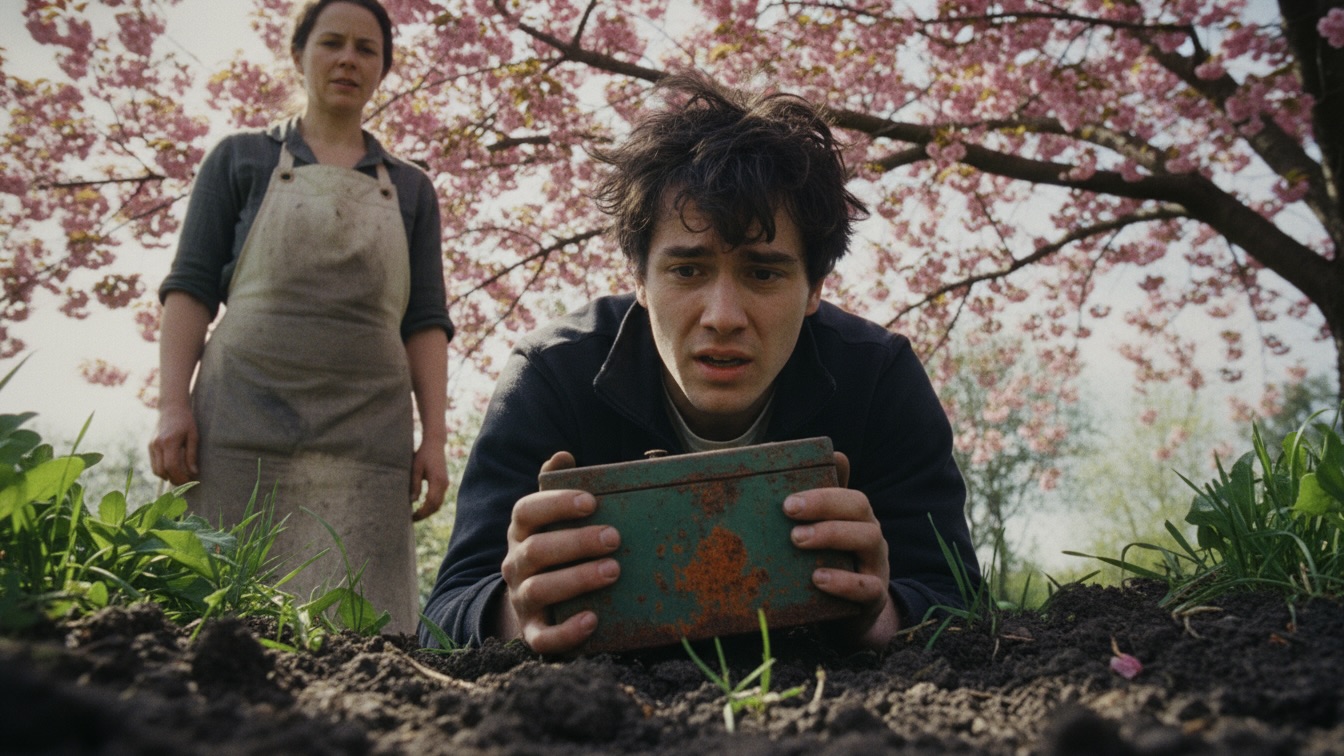
Simon is a journalist desperate to revive his failing career by uncovering a scandal involving a powerful developer named Miller. He spends his morning digging in a vacant lot, hoping to find evidence of corruption or bribery buried beneath the earth. Instead, he discovers a rusted copper box containing index cards that detail gardening supplies and addresses for neglected urban spaces. This discovery initially fills him with disappointment and suspicion, as he struggles to see the value in anything that does not serve a transactional or scandalous purpose.
His investigation is interrupted by Malaya, a woman who belongs to a secret collective known as the Underground Spring. She challenges Simon’s cynical worldview, accusing him of looking for rot when he should be looking for roots. Despite his initial resistance and his attempt to frame the secret gardens as a fraudulent scheme, Simon decides to visit the addresses listed in the box. As he travels through the city, he encounters pockets of unexpected beauty and life in places previously defined by decay and neglect.
The experience triggers a profound internal shift in Simon, leading him to realize that the true scandal is the systemic erasure of these non-profitable spaces. Rather than writing a hit piece on the developer or the gardeners, he crafts an evocative exposé that brings the Underground Spring into the light. His article sparks a public outcry that halts Miller's demolition plans. The story concludes with Simon standing in the original lot, no longer a predatory observer but a participant in the protection of the city’s hidden grace.
The central theme of the story is the conflict between economic utility and aesthetic grace. Miller represents the corporate drive to transform the city into a "sterile complex of glass and steel," a vision where every square inch must generate profit. In contrast, the Underground Spring represents a radical reclamation of space for the sake of beauty and humanity. The narrative suggests that when a society prioritizes financial "balance sheets" over the psychological need for nature and community, it loses its soul.
Another significant theme is the nature of perception and the ethics of journalism. Simon begins the story as a "vulture," a man who can only find value in decay and betrayal. He is a victim of a media landscape that prioritizes clickbait and scandal over substance. The story tracks his evolution from a man who uses his curiosity as a "scalpel" to one who uses his words as a "fortress." This transition highlights the idea that the truth is not just about uncovering hidden sins, but about revealing hidden virtues that the world has chosen to ignore.
The story also explores the concept of "radical transparency" as a tool for social preservation. Malaya and her group operated in secret to protect their work from being crushed, yet it was the public revelation of their efforts that ultimately saved them. This creates a complex dialogue about the necessity of secrets in an oppressive system versus the power of the collective gaze to validate and protect what is vulnerable. Simon’s act of publishing the story suggests that some things are only safe once they are known and cherished by the many.
Simon is a man defined by his physical and psychological tension. At the start of the chapter, his locked jaw and ruined designer clothes symbolize a person who is ill at ease with his environment and himself. He is driven by a desperate need for professional survival, which has warped his perception of reality into a "grid of transactions." Psychologically, he is suffering from a form of professional burnout that has manifested as a deep, reflexive cynicism toward human motives.
His transformation is depicted through his physical reactions to the world around him. As he visits the gardens, the "cynicism in his chest" begins to crack, a sensation likened to a rib resetting. This suggests that his previous worldview was not just a mental state but a physical deformity that hindered his ability to breathe and function. By the end of the narrative, his "deep and rhythmic" breathing indicates a restoration of his internal balance and a newfound sense of purpose that transcends his earlier ego-driven ambitions.
Simon’s journey is one of reclaiming his identity as a storyteller rather than a predator. He moves from seeking "dirt" to understanding "roots," a linguistic shift that mirrors his psychological growth. His decision to write about the Underground Spring with "feverish intensity" marks his return to the idealistic roots of his youth. He finally understands that his role is not merely to report on the world’s rot, but to defend the "anonymous beauty" that makes life worth living.
Malaya serves as the story’s philosophical anchor and Simon’s primary antagonist-turned-mentor. She is described as someone who belongs to the earth, wearing a soil-stained apron that acts as a badge of her commitment to the physical world. Unlike Simon, who is a "glitch in the system," Malaya is integrated into her environment. She possesses a calm, composed authority that allows her to see through Simon’s professional facade and identify his underlying spiritual poverty.
Her role is to challenge Simon’s binary view of the world. She uses sharp, evocative metaphors to describe his behavior, calling him a "vulture" and a "hawk." This indicates her high level of emotional intelligence and her ability to diagnose the psychological ailments of those around her. She does not fear Simon’s investigation; instead, she dares him to be the "villain" he seems destined to be. This challenge is a calculated move that forces Simon to confront the moral implications of his work.
By the end of the story, Malaya’s "small smile" suggests that she recognized Simon’s potential for change all along. She remains a guardian of the city’s secrets, but she is pragmatic enough to accept Simon’s "radical transparency" as a necessary evil. Her final warning about Miller’s persistence shows that she is not a naive dreamer but a seasoned warrior in a long-term struggle. She represents the enduring resilience of the community against the encroaching coldness of corporate expansion.
The narrative employs a rich array of sensory details to create a vivid contrast between the urban environment and the natural world. The "scent of wet asphalt" and the "metallic clang" of the shovel establish a gritty, industrial atmosphere that reflects Simon’s initial state of mind. As the story progresses and Simon discovers the gardens, the imagery shifts toward the organic and vibrant, featuring "blooming primroses" and "blossoming plum trees." This transition in sensory focus mirrors the protagonist’s internal shift from cynicism to wonder.
The pacing of the chapter is carefully calibrated to reflect Simon’s psychological state. The beginning is frantic and breathless, with short, punchy sentences that mimic his "hammering" heart and "jagged gasps." As he begins to explore the gardens and eventually sits down to write, the prose becomes more fluid and rhythmic. This change in cadence underscores the theme of Simon finding his "flow" again, transitioning from the frantic search for a "clickbait" scandal to the steady, deliberate work of meaningful journalism.
The narrative voice is third-person limited, staying close to Simon’s internal experiences while providing enough distance to observe his flaws. The author uses metaphors of medicine and biology—scalpels, patients, rot, and roots—to frame the conflict as a matter of health and sickness. This stylistic choice reinforces the idea that the city’s obsession with profit is a disease, and the secret gardens are the cure. The final image of the "vulture" learning to "sing" provides a poignant and satisfying resolution to the metaphorical framework established early in the text.


