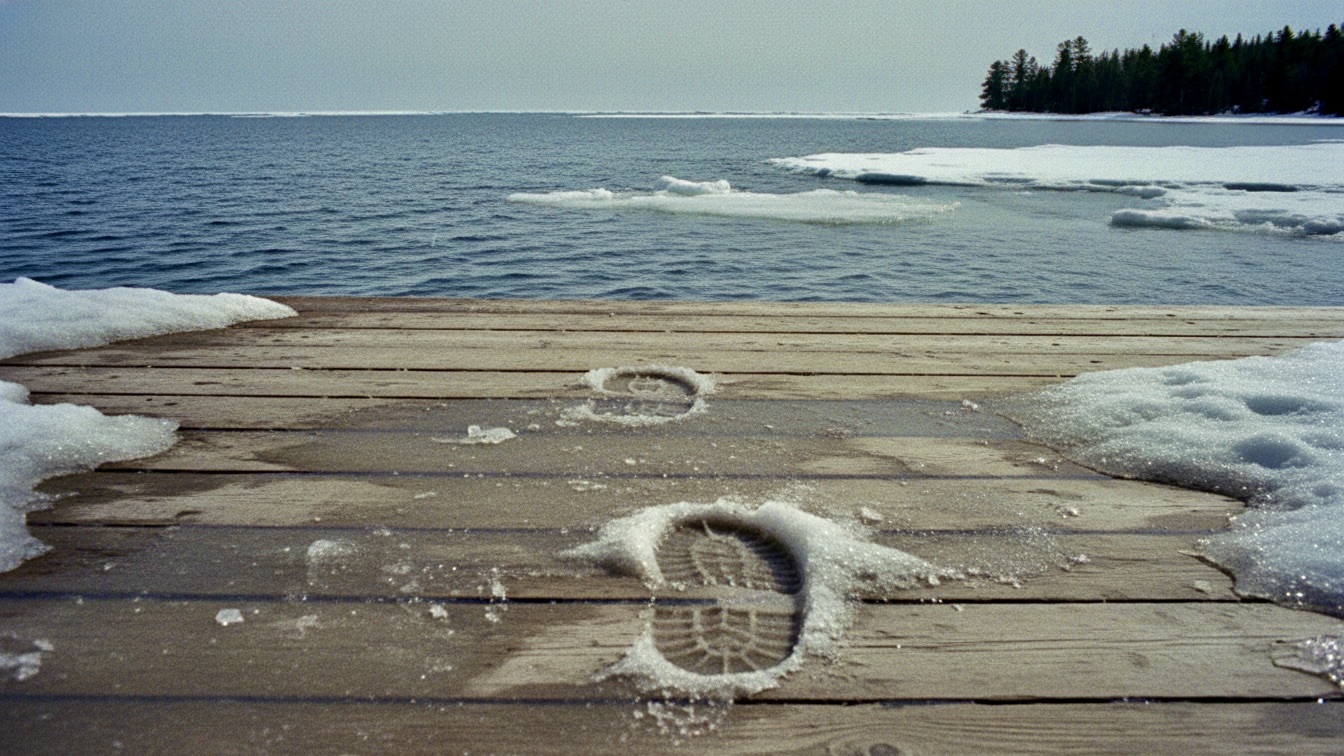
Ex-detective Andrews finds bootprints in the slush, suspecting a local leader has faked his death to escape taxes.
Andrews felt the cold in his teeth. It was a sharp, biting cold that didn't care about his thick wool coat or the heavy boots he wore. Spring in this part of the world wasn't flowers and sunshine. It was mud. It was gray slush that looked like chewed-up paper. It was the sound of ice groaning on Lake Superior like a giant waking up from a bad nap. His dog, a big, yellow ball of fur named Buster, didn't mind the cold. Buster thought the mud was a gift from the universe. He kept sticking his nose into the dirty snow and pulling out old sticks that smelled like rot.
Andrews watched the water. The lake was a flat, dark gray. It looked heavy, like a sheet of lead. People said the lake never gave up its dead. That was a big, scary thought for a small town, but Andrews didn't buy it. He didn't buy much of anything these days. To him, the world was just a place where people traded things they didn't own for things they didn't need. He was tired. His knees hurt. His eyes felt like someone had rubbed sand in them. He had been a detective for twenty years, and all he had to show for it was a bad back and a dog that liked to eat trash.
He saw them near the edge of the pier. The tracks. They were deep in the soft, melting slush. They were big—size twelve at least. They marched straight toward the water, where the ice had broken away into jagged chunks. The prints stopped right at the edge. To anyone else, it looked like someone had walked into the freezing lake and never came back out. It looked like a tragedy. It looked like an end.
Andrews leaned over, his joints popping like dry twigs. He stared at the left footprint. There it was. The drag. Every few steps, the left heel didn't lift all the way. It scraped the mud, leaving a little tail behind the print. He knew that drag. He had seen it for two decades in the grocery store, at the town hall, and at the bank. It belonged to Reeve Thompson. Thompson was the man in charge of the town's money, or at least the money he hadn't spent on fancy watches and trips to places that didn't have snow.
"Look at that, Buster," Andrews muttered. The dog sniffed a frozen puddle and ignored him. "He thinks he’s clever. He thinks he can just walk into the big bathtub and disappear."
Andrews didn't call the police. He didn't scream for help. He just stood there, smelling the fishy air and the wet dog. He knew Thompson wasn't in the lake. Thompson was too fond of himself to drown. Drowning was messy. Drowning was quiet. Thompson liked noise. He liked being the center of attention. This wasn't a suicide. This was a magic trick. It was a way to make the tax man go away. The town was missing a lot of money, and Thompson was the one with the keys to the safe.
By the afternoon, the town was a mess. People were gathered at the town square near the big bronze statue of a fish. They were crying and holding candles that wouldn't stay lit in the wind. The air smelled like cheap wax and sadness. It was loud. Everyone was talking at once, sharing stories about how great the Reeve was. They called him a hero. They called him a pillar of the community. Andrews sat on a bench across the street, holding a paper cup of coffee that tasted like burnt dirt. He watched them. He saw the way they wiped their eyes and then looked around to see who was watching them cry. It was a performance. It was a play where everyone forgot their lines.
"He was a good man," a woman said as she walked by. She was wearing a bright pink scarf that looked too new.
"He was a man," Andrews said. He didn't look at her. He just looked at his coffee. The woman huffed and walked faster. Andrews didn't care. He was busy watching the blue van parked three blocks down, right in front of the house where Sarah-Jane lived. Sarah-Jane didn't work, but she had a house with a big porch and a car that cost more than Andrews' pension. Everyone knew she was Thompson’s friend. A very close friend. A friend who liked expensive things.
Sarah-Jane came out of the house. She wasn't crying. She was wearing a leather jacket and sunglasses, even though the sky was the color of a wet sidewalk. She started carrying boxes to the van. They looked heavy. Her arms were tense, and she moved fast. She didn't look like someone who had just lost a friend. She looked like someone who was late for a flight. She slammed the back door of the van. The sound echoed off the brick buildings, sharp as a gunshot.
Andrews stood up. His legs felt heavy, but he walked toward the van. Buster trotted beside him, his tail wagging for no reason. When Andrews reached the van, Sarah-Jane was locking the driver's side door. She froze when she saw him. Her face was tight, her skin looking like it had been stretched too thin.
"Busy day?" Andrews asked. He leaned against the side of the van. The metal was cold.
"I'm leaving," she said. Her voice was flat. "Nothing left for me here."
"That’s a lot of boxes for a quick trip," Andrews said. He nodded toward the back of the van. "Must be some heavy memories in there. Or maybe just the town’s property tax revenue from 2024."
Sarah-Jane didn't blink. She reached into her pocket and pulled out a pack of gum. She popped a piece into her mouth and chewed slowly. The smell of fake mint filled the air, cutting through the scent of the melting lake. She looked at Andrews like he was a bug she wanted to step on.
"You done?" she asked.
"The tracks at the lake," Andrews said. "He forgot about the heel-drag. It’s a very specific habit. Hard to break, even when you're pretending to be a ghost."
Sarah-Jane leaned in. She was shorter than him, but she felt big. "Get a hobby, Andrews. Seriously. You’re just a hater. You sit on that bench and you hate everyone because they’re doing things and you’re just... old."
"I'm not a hater," Andrews said. "I'm a witness. There's a difference."
"No, there isn't," she snapped. She got into the van and started the engine. It roared to life, coughing out a cloud of blue smoke. "The world is moving on. You should try it. Or don't. Nobody cares."
She backed out of the spot, nearly clipping Buster’s tail. Andrews watched the red taillights disappear around the corner. He felt a weird twitch in his eye. He wasn't angry. He wasn't even surprised. He just felt heavy. He felt like the lake—cold and full of things that shouldn't be there. He walked back to his small apartment, the one above the hardware store. The stairs creaked. The air inside smelled like old mail and dog hair.
He sat down at his computer. It was an old machine that whirred like a jet engine every time he turned it on. He had a friend, a guy he used to work with, who moved down to Florida to work security for a big resort. The friend had sent him a link to the resort’s security feed a long time ago, mostly so they could joke about how many people forgot to wear sunscreen.
Andrews clicked the link. The screen flickered. The image was bright and colorful. It was a different world. There was green grass. There were blue pools. There were palm trees that swayed in a warm breeze. It looked fake. It looked like a postcard. He scrolled through the cameras. He didn't know what he was looking for until he saw it.
Camera 4. The parking lot. A man was walking toward a silver convertible. He was wearing a loud shirt with pineapples on it and a big straw hat. He looked happy. He looked relaxed. He looked like a man who didn't have a care in the world. The man reached the car and stopped. He turned to look at something off-camera.
As he started walking again, his left foot didn't lift all the way. It scraped against the pavement. A distinct, unmistakable drag. The man hopped into the car, a woman with bright blonde hair joining him in the passenger seat. She looked like Sarah-Jane, only tan. They laughed, and the man pulled away, leaving a small scuff mark on the pristine Florida asphalt.
Andrews stared at the screen. The light from the monitor made his eyes water. He reached out and touched the glass, right over the man’s face. The man who was supposed to be at the bottom of a freezing lake. The man who had stolen the town’s future so he could drink juice out of a coconut.
Andrews leaned back in his chair. He looked at Buster, who was fast asleep on a rug, his paws twitching as he dreamed of squirrels. The room was quiet, except for the hum of the computer. Outside, the spring wind rattled the windowpane. It was a lonely sound. He thought about the people in the square with their candles. He thought about the fake tears and the bronze fish. He thought about how easy it was to lie when everyone wanted to believe the lie.
He reached for his phone. He had the number for the state police in his contacts. He could end it. He could bring the Reeve back to the cold and the mud. He could prove he was right. He stared at the screen for a long time. His finger hovered over the call button. The screen on his computer timed out, turning black. In the reflection of the dark monitor, Andrews saw his own face. He looked tired. He looked like a man who had seen too much and done too little.
He put the phone down on the desk. He didn't call. Not yet. He watched the black screen, thinking about the size twelve prints in the mud and the way the ice was melting into nothing. The world was trash, but at least it was consistent. He stood up, his knees barking in pain, and went to the kitchen to feed the dog. As he poured the kibble, he heard a soft knock at his door, slow and rhythmic, like a secret code he wasn't supposed to know.
“As he poured the kibble, he heard a soft knock at his door, slow and rhythmic, like a secret code he wasn't supposed to know.”


