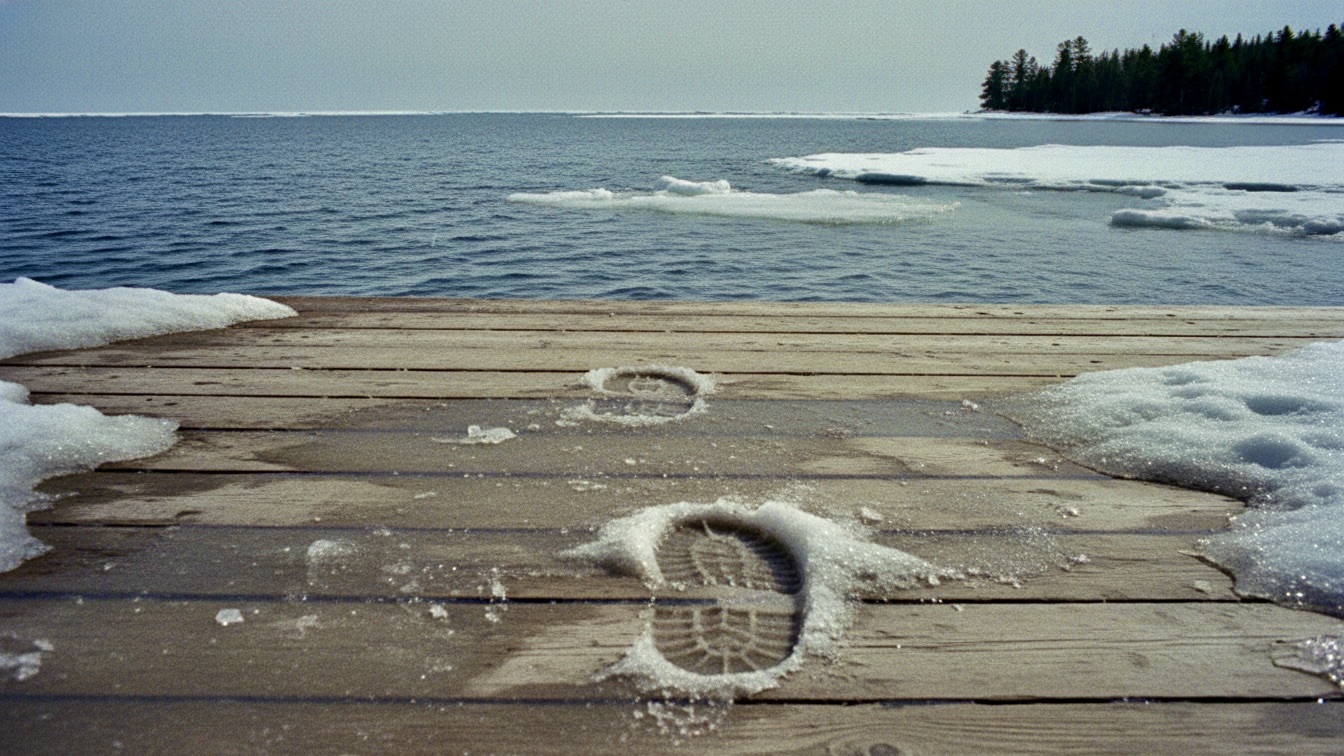
The story follows Andrews, a weary retired detective living in a bleak, muddy town on the shores of Lake Superior. While walking his dog, Buster, Andrews discovers footprints in the slush leading to the lake’s edge, which the town interprets as the tragic suicide of Reeve Thompson, a prominent local official. Andrews, however, recognizes a distinct heel-drag in the prints that he has observed for twenty years, leading him to realize that Thompson has faked his death to escape with stolen municipal funds.
As the town engages in a performative display of mourning, Andrews remains a detached observer, eventually confronting Thompson’s associate, Sarah-Jane, as she prepares to flee. He later confirms his suspicions by accessing a resort security feed in Florida, where he witnesses Thompson and Sarah-Jane enjoying their ill-gotten gains in a tropical paradise. The chapter concludes with Andrews sitting in his dark apartment, contemplating whether to report the crime to the state police, only to be interrupted by a mysterious knock at his door.
The narrative deeply explores the theme of performative reality versus underlying truth. The townspeople participate in a collective delusion, choosing to mourn Thompson as a "pillar of the community" rather than acknowledging the corruption that has drained their resources. Their candles and tears are depicted as a stage play where everyone has forgotten their lines, suggesting that society often prefers a comfortable lie to a painful, complicated reality. Andrews stands as the antithesis to this, acting as a "witness" who refuses to buy into the manufactured grief.
Another central theme is the physical and psychological weight of aging and obsolescence. Andrews is defined by his chronic pain, his "barking" knees, and his feeling of being a relic in a world that is "moving on." This stands in stark contrast to Thompson’s attempt to shed his identity and start over in a sun-drenched environment. The story suggests that while one can change their location and their clothes, physical habits like the heel-drag remain as indelible marks of one's true history.
The corruption of the American dream is also evident in the contrast between the decaying, muddy North and the "fake" postcard beauty of Florida. Thompson’s success is built on theft, and his paradise is viewed through a digital screen, making it feel hollow and artificial. Andrews perceives the world as a marketplace of hollow trades, where the "future" of a town can be easily swapped for a silver convertible and juice in a coconut. This cynicism highlights a moral vacuum where justice is a choice rather than an inevitability.
Andrews is a man defined by his exhaustion and a deeply ingrained sense of professional observation. After twenty years as a detective, he has developed a clinical, almost detached view of human nature, seeing the world as a place of transactional disappointment. His physical ailments, such as his aching joints and sandy eyes, mirror his internal fatigue with a society he no longer respects. He does not seek the thrill of the hunt; instead, he carries the burden of knowing the truth in a world that does not want to hear it.
His relationship with his dog, Buster, provides the only glimpse of unalloyed affection in his life, though even this is tempered by his gritty realism. Andrews views himself not as a hero, but as a witness, a role that isolates him from the community. He experiences a profound moral paralysis at the end of the chapter. Despite having the evidence to destroy Thompson’s new life, he hesitates, suggesting he may feel that the effort of seeking justice is futile in a world that is "trash."
Reeve Thompson is an antagonist characterized by his narcissism and his contempt for the community he served. He is a man who "likes noise" and "being the center of attention," which makes his faked suicide a final, grand performance. His vanity is his primary motivation, as he prefers the "fancy watches" and tropical warmth to the cold, muddy reality of the town he exploited. He represents a modern breed of predator who uses his social status as a shield for his criminality.
Despite his attempts to reinvent himself in Florida, Thompson is betrayed by his own body. The persistent heel-drag is a psychological marker of his inability to truly escape his past or his nature. He believes he has executed a "magic trick," but to an observer like Andrews, he is merely a thief who has moved from one stage to another. His laughter in the Florida sun highlights his lack of remorse and his total disconnection from the lives he ruined.
Sarah-Jane serves as the pragmatic accomplice who lacks the sentimentality of the townspeople and the weary morality of Andrews. She is described with sharp, tense imagery, suggesting a woman who is constantly on edge and ready to pivot toward her own interests. Her interaction with Andrews reveals her disdain for the "old" world he represents. She views his commitment to the truth as a sign of being a "hater" who is stuck in the past while she and Thompson move toward a brighter, albeit stolen, future.
She is the bridge between the two worlds of the story, transitioning from the leather jacket of the cold North to the tanned, blonde aesthetic of the Florida resort. Her lack of grief over Thompson’s "death" confirms her role in the conspiracy and her cold, calculating nature. She does not seek redemption or even a hidden life; she simply wants the luxury that the stolen money provides. To her, Andrews is not a threat to be feared, but a bug to be stepped on, reflecting her belief that the world belongs to those who take what they want.
The narrative employs a gritty, noir-inspired tone that emphasizes the sensory discomfort of the setting. The author uses vivid, often grotesque metaphors, such as the ice groaning like a "giant waking up from a bad nap" and slush that looks like "chewed-up paper." These descriptions create a visceral sense of the environment's hostility, which serves as a backdrop for Andrews' internal gloom. The contrast between the "fishy air" of the North and the "fake mint" of Sarah-Jane’s gum highlights the artificiality of the characters' lives.
Pacing in the chapter is deliberate and slow, mirroring the methodical movements of the protagonist. The story lingers on small details, such as the pop of Andrews' joints or the specific way a heel scrapes the ground, which builds a sense of mounting tension without relying on traditional action. This slow build-up makes the final revelation on the computer screen feel more impactful. The transition from the gray, heavy atmosphere of the lake to the "bright and colorful" security feed of Florida provides a jarring shift that underscores the story's themes of illusion and reality.
The narrative voice is deeply rooted in Andrews' perspective, providing a cynical and weary commentary on the events. This internal monologue is essential for establishing the psychological depth of the story, as it allows the reader to see the "performance" of the town through the eyes of a professional skeptic. The ending is particularly effective, utilizing a cliffhanger that shifts from the digital world of the security feed back to the physical reality of a knock at the door. This stylistic choice leaves the reader in the same state of uncertainty and tension as the protagonist.


