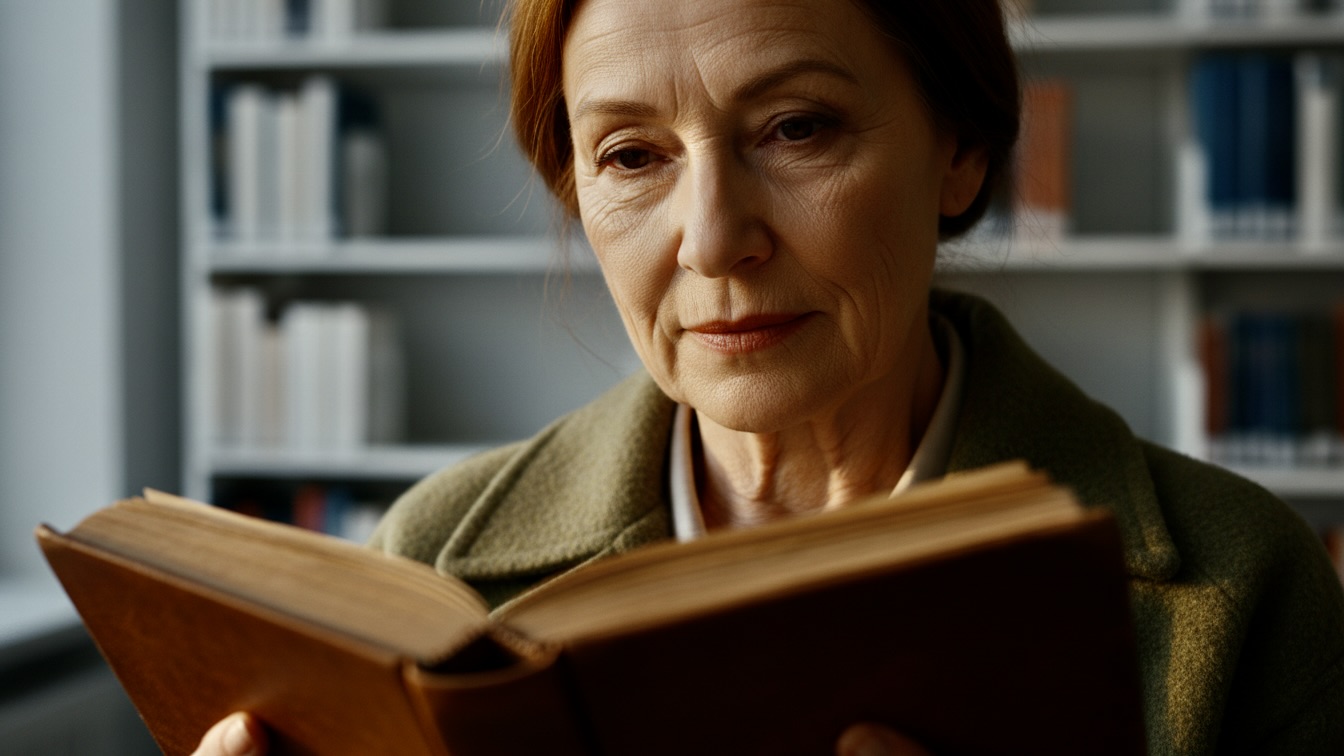
A retired librarian finds a hidden ledger that reveals the dark secrets behind her town's bright, fake new books.
The library did not smell like old paper anymore. It smelled like a new car. It smelled like the plastic wrap on a slice of cheese. Clara stood in the center of the room. The sun was bright. It was too bright. It hit the white floor and bounced back into her eyes. Everything was clean. Too clean. The shelves were full of books with shiny covers. They were the Optimized Editions. They all had the same font. They all had the same bright pictures. None of them had been touched by a hand that was dirty or a hand that was tired. Clara reached out. She touched a book called Our Town: A Happy Start. The cover was slick. It felt like a countertop. It did not feel like a book.
She opened it. The pages were thick and white. There were no marks in the margins. No one had ever folded a corner down to save their place. The ink was dark and flat. She looked for the section on the Big Flood. She remembered the flood. She remembered the water in the basement. She remembered the mud on the stairs. But the book said something else. It said the flood was a small bath for the town. It said the Mayor had saved everyone with a giant umbrella. It said everyone was happy. It was a lie. Clara knew it was a lie because her own basement had stayed wet for three years. She closed the book. The sound was a dull thud. It was not the sharp snap of an old spine. It was the sound of something fake hitting something fake.
Mayor Knowles walked through the door. He wore a suit that did not have a single wrinkle. His shoes did not make a sound on the white floor. He looked like he was made of the same plastic as the books. He smiled. His teeth were very white. They looked like the keys on a brand-new piano.
"Morning, Clara," he said.
"The books are new," she said.
"Optimized," he corrected. "Better for the kids. Easier to read. No confusing parts."
"The flood wasn't like this," Clara said. She pointed at the book.
"It's the new history," the Mayor said. "The one we need. The old ones were messy. Too many sad parts. We don't want the children sad, do we?"
Clara looked at his eyes. They were blue, but they were flat. They were like the sky on the cover of the books. They did not have any depth.
"The sad parts happened," she said.
"Not anymore," he said.
He walked away. He didn't even look back. Clara watched him go. She felt small. The library felt huge. The white walls felt like they were leaning in. She felt like she couldn't breathe. The air was too clean. It didn't have any dust in it. It didn't have any life. She needed to leave. She grabbed her coat. It was an old coat. It had a hole in the pocket. It was the only real thing in the room. She walked out into the spring air. It was warm. The grass was green. It was the kind of green that hurt to look at.
She walked toward the river. The river didn't care about optimized editions. The river was brown and full of sticks. It was messy. It was real. She followed the path to the big oak tree. It was the tree where Henry used to sit. Henry was gone now. He had gone away during the last Spring Cleaning. Everyone said he had gone to a better place to help with the books. But he hadn't come back. He hadn't even sent a postcard.
Clara reached the tree. It was old. Its bark was rough. It felt like a scab. She liked the way it felt. It was a physical fact. She found the knot in the wood. It was shaped like an eye. She pressed it. The wood didn't move at first. She pressed harder. Her thumb turned white. Then, a small piece of the tree clicked. It swung inward. It was a hollow spot. Henry had made it years ago. He said it was for secrets. Inside the hole was a book. It was not optimized. It was an old ledger. It had a leather cover. It was stained with coffee and sweat. It smelled like him. It smelled like tobacco and old wool.
She pulled it out. Her hands were shaking. She opened the first page. It was a list. There were names written in Henry's messy handwriting. He always wrote with a fountain pen. The ink had soaked into the paper.
"List of the Uncleaned," the top of the page said.
Clara saw names she knew. Mr. Henderson from the bakery. Mrs. Gable from the school. Tommy's dad. And then she saw the last name on the list. It was Henry. Beside every name, there was a signature. It was the same signature every time. It was a big, curly signature. It was the signature of Mayor Knowles. He hadn't sent them to help with books. He had signed them away. He had deported them. The paper felt heavy in her hands. It felt like it weighed a hundred pounds. She looked at the date. It was three years ago today. The day the Spring Cleaning began.
Clara felt a cold wind. It wasn't the air. It was the feeling of a secret being opened. She looked at the woods across the river. The woods were thick. They were dark. No one went there. The Mayor said the woods were dangerous. He said the trees were sick. But the trees looked fine to Clara. They looked like trees.
She put the ledger in her coat pocket. It was heavy. It bumped against her hip as she walked. She didn't go back to the library. She didn't go home. She walked across the old stone bridge. The stones were loose. They clattered under her boots. She stepped into the woods. The light changed. It wasn't bright and white anymore. It was green and gold. It was dappled. It felt like being underwater.
She walked for a long time. The branches caught on her coat. The mud pulled at her shoes. She followed a small trail. It wasn't a trail for cars. It was a trail for feet. She saw a patch of wild onions. She smelled them. They were sharp and stinging. She saw a rabbit. It didn't run away. It just watched her.
Then, she heard it. It wasn't a scary sound. it was the sound of a hammer. Clack. Clack. Clack. And then, the sound of someone laughing. It was a real laugh. It wasn't the polite laugh of the Mayor. It was a belly laugh. It was loud.
She pushed through a thicket of bushes. She stopped.
There was a village. It wasn't made of plastic. It was made of wood and stone. There were gardens everywhere. People were digging in the dirt. They were covered in mud. They looked tired, but their eyes were bright. They were planting seeds. They were building a small barn.
"Clara?"
She turned. It was Henry. He looked older. His hair was completely white. He was wearing a shirt that had been patched three times. He was holding a shovel. He dropped the shovel. It hit the dirt with a soft thud.
"Henry," she said.
He ran to her. He didn't say anything. He just hugged her. He smelled like woodsmoke and earth. He felt solid. He wasn't a memory. He was a person.
"We thought no one would come," he whispered.
"The books," Clara said. "They changed the books."
"We know," Henry said. "That's why we stay here. We grow our own food. We write our own stories. Real ones."
Clara looked around. She saw Mrs. Gable. She was teaching a group of children under a tree. They weren't reading optimized editions. They were reading old books. Books with torn covers. Books that smelled like history.
"The Mayor signed the orders," Clara said. She pulled out the ledger.
Henry looked at it. He didn't look angry. He just looked sad.
"He thinks he's cleaning the world," Henry said. "But he's just emptying it."
"I have to go back," Clara said.
Henry looked at her. "Why?"
"The Festival," she said. "Tomorrow is the Spring Festival. Everyone will be there. The Governor is coming. He's going to give a speech about the New Harmony."
"It's dangerous," Henry said.
"I'm a librarian," Clara said. "I know how to handle paper."
She stayed the night in the village. She slept on a bed made of pine needles and wool. It was the best sleep she had in years. The air was full of oxygen. It felt like her lungs were finally opening up. She wasn't claustrophobic anymore. The world was big. It was giant. And she was a part of it.
In the morning, the villagers gave her bread. It was warm and crusty. She walked back through the woods. She felt different. She didn't feel like a retired woman in an old coat. She felt like a messenger.
Town Square was decorated with white ribbons. Everything was perfect. The grass had been mowed so short it looked like a carpet. The Mayor stood on a stage. He looked very proud. The Governor was there, too. He was a large man with a voice that sounded like a drum.
"A new era!" the Governor shouted. "A clean town! A perfect history!"
The crowd clapped. They clapped because they were told to. Their faces were blank. They looked like the people in the books.
Clara stood at the back. She had the ledger. She had torn out the pages. She began to walk through the crowd. She didn't shout. She didn't scream. She leaned in close to Mrs. Miller.
"Your son isn't at the school in the city," Clara whispered. "He's in the woods. He's planting apples."
She handed Mrs. Miller a scrap of paper with the son's name and the Mayor's signature. Mrs. Miller's eyes went wide. She looked at the paper. She looked at the Mayor. Her face changed. It wasn't blank anymore. It was full of a sharp, bright fire.
Clara moved to the next person.
"Your brother is alive," she whispered. "He's building a barn. He misses your soup."
She handed out the pages. The whispers started to grow. They weren't loud, but they were everywhere. They sounded like the wind in the trees. They sounded like a prayer.
"Henry is there," she told a group of old men. "He has a library in a hollow oak."
On the stage, the Governor was still talking. "We have removed the clutter! We have optimized our lives!"
But no one was listening to him anymore. They were looking at the papers in their hands. They were looking at each other. The white ribbons on the trees began to look like bandages. The clean grass looked like a cage.
Mayor Knowles saw Clara. He saw the papers. He stepped to the edge of the stage. His face stayed perfect, but his hands were shaking.
"Clara," he said into the microphone. His voice echoed. "What are you doing?"
Clara walked to the front of the stage. She held up the last page of the ledger. It was the page with the signatures.
"I'm reading the old books," she said.
Her voice wasn't loud, but the microphone caught it. The whole square heard her.
"There are no old books!" the Mayor shouted. "They were recycled! For the future!"
"You can't recycle people," Clara said.
She turned to the crowd.
"The woods are full of our neighbors," she said. "They are growing real food. They are telling real stories. The flood was messy. The world is messy. And I like it that way."
One by one, the people in the square began to walk away. They didn't run. They just turned their backs on the stage. They turned their backs on the Governor and his loud drum voice. They walked toward the river. They walked toward the stone bridge.
Mrs. Miller was the first to cross. She was holding the scrap of paper like a map.
Mayor Knowles stood on the stage. He was alone now. The Governor had gone to his car. The white ribbons were blowing in the wind. One of them caught on a branch and tore.
Clara sat on a bench. She was tired. Her legs ached. She watched the town empty out. She watched the people find the path into the green light of the trees. The library was behind her. It was a big, white box full of plastic lies. She didn't want to go back inside.
She looked down at her hands. They were dirty. There was mud under her fingernails from the woods. There was ink on her thumb from the ledger. She smiled. It was a real smile. It felt heavy and slow on her face.
She reached into her pocket. She found a small piece of the bread the villagers had given her. She broke off a crumb and put it on the bench. A small bird landed near her. It was a sparrow. It wasn't a bright, optimized bird. It was brown and speckled. It looked at her with a sharp, black eye. It took the crumb and flew away.
Clara leaned back. The sun was setting. The light wasn't white anymore. It was orange and purple and deep, dark blue. It was the color of a real sky. She closed her eyes. She could hear the river. It was moving fast. It was carrying the winter away. It was making room for the spring. It was loud. It was messy. It was exactly what it was supposed to be.
She felt a hand on her shoulder. She didn't have to look to know who it was. The air was full of the smell of woodsmoke.
"Is it time?" Henry asked.
"Yes," Clara said.
She stood up. She didn't look at the library. She didn't look at the stage. She looked at the bridge.
"Let's go home," she said.
They walked together. The stones clattered under their feet. The sound was like music. It was the sound of a secret that wasn't a secret anymore. It was the sound of the truth hitting the ground. As they reached the edge of the woods, Clara stopped for a moment. She looked back at the town. The lights were coming on in the houses, but the houses were empty. The town looked like a toy. It looked like something you could pick up and put in a box.
She turned away. The woods were waiting. The garden was waiting. The real stories were waiting to be written in the dirt and the ink and the hearts of the people who had been forgotten.
She took a deep breath. The air was cold now, but it was clear. It felt like drinking cold water from a mountain stream. She felt light. She felt like she could walk forever.
"The Mayor will come looking," Henry said.
"Let him," Clara said. "He doesn't know how to find things that aren't on a list."
They disappeared into the trees. The shadows were long and dark, but they weren't scary. They were just shadows. And in the dark, you could see the stars much better.
Clara reached into her pocket and felt the empty space where the ledger had been. She didn't need the list anymore. She knew all the names by heart. She would tell the children the stories. She would tell them about the flood. She would tell them about the mud. She would tell them about the library that smelled like old paper and the man who signed his name in curly ink. She would tell them everything. And the children would listen, and they would know that the world was big and messy and beautiful, and that they were a part of it, too.
“She would tell them everything.”


