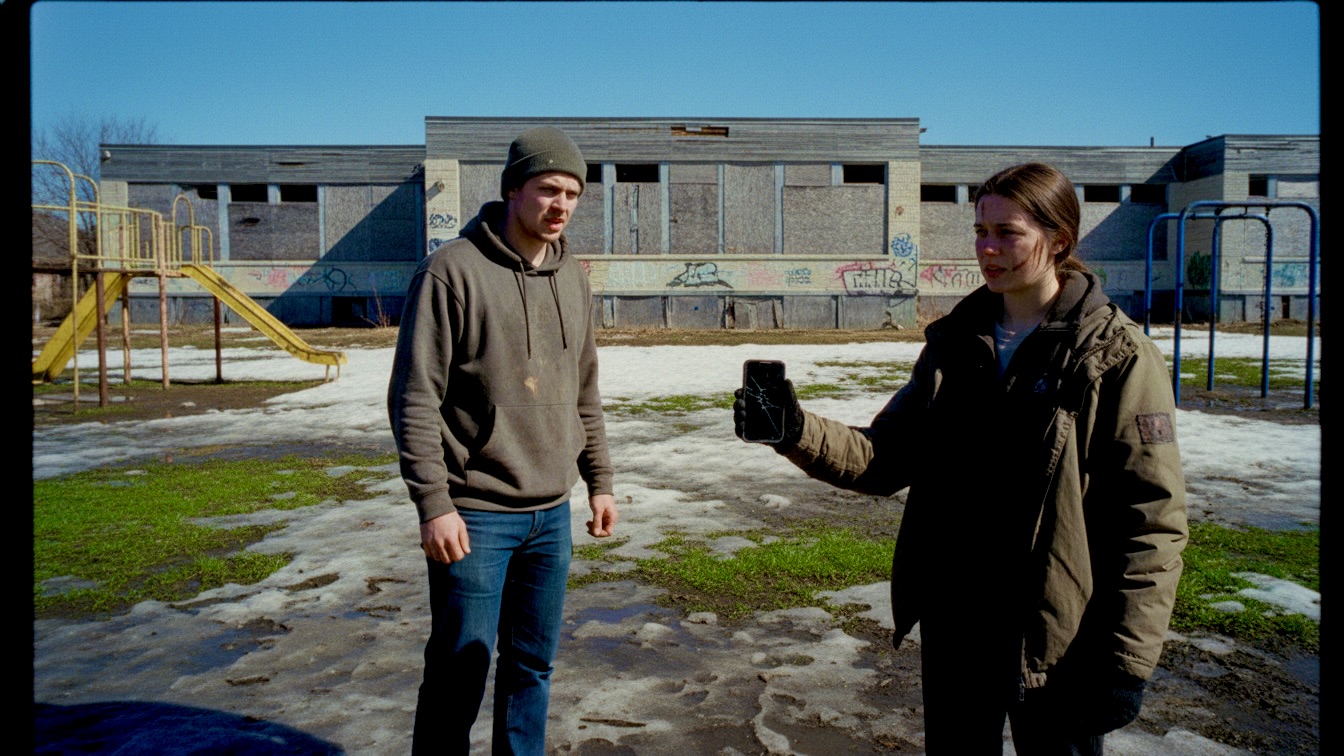
Stacey stood in the freezing slush, waiting for the brother of the missing girl to cross the abandoned playground.
The mud sucked at the rubber soles of Stacey’s boots. It was the second week of March, and the spring thaw had turned the ground behind the old Oakhaven High School into a swamp. The snow was no longer white. It was a diseased brown, melting into deep puddles that reflected the flat, gray sky.
Stacey shoved her freezing hands deeper into the pockets of her oversized parka. She stood next to the rusted swingset. There were only two black plastic seats left. The middle one was gone. The empty chain hung down, swaying a little in the cold wind, the metal links clinking against the support pole. It sounded like loose change. The fading light of the afternoon made the shadows long and thin.
Everything here was missing something. The high school behind her was boarded up, huge sheets of plywood covering the shattered windows. The paint on the brick exterior was peeling off in long, dirty strips. The town had shut it down three years ago due to asbestos, and now it just sat there, rotting in the middle of the neighborhood. The playground equipment was stripped of its color, faded to dull yellows and sickly reds.
Stacey checked her watch. Her phone screen was cracked, a spiderweb of glass obscuring the time. Four-fifteen. He would be here soon. He always walked this way after his shift at the hardware store. It was a shortcut through the woods, a straight line from the commercial strip to the cramped duplexes on the east side of town.
Her toes were numb. The cold seeped through the thick rubber of her boots, chilling her bones. She shifted her weight, listening to the wet squelch of the mud. Her stomach churned with a mix of adrenaline and nausea. She was crossing a line today. She knew it. The true-crime podcasts she listened to on double-speed every night always warned about getting involved. The hosts, with their calm, practiced voices, always said to leave it to the professionals.
But the professionals in this town were lazy.
Stacey looked up. A figure emerged from the tree line.
It was Benji. He walked with his head down, the hood of his gray sweatshirt pulled up over a black beanie. He had his hands shoved into his jeans pockets, his shoulders hunched against the wind. He walked fast. It was the walk of someone who wanted to be invisible.
Stacey stepped out from the shadow of the swingset, planting her boots directly in the middle of the narrow dirt path.
Benji did not look up until he was ten feet away. When he saw her, his pace slowed, but he did not stop. His jaw tightened. He tried to step to the right, aiming to bypass her through the slushy grass.
Stacey moved right, blocking him.
Benji stopped. He looked at her. His eyes were dark, ringed with heavy, purple exhaustion. He looked like he had not slept a full night in a month. Which made sense. It had been exactly thirty-four days since his sister, Maya, went missing.
"Move," Benji said. His voice was flat, scraped hollow by the cold and whatever he was holding back.
"I need to talk to you," Stacey said. Her own voice sounded entirely too loud in the quiet of the empty playground.
"I have nothing to say to you, Stacey. Get out of my way."
He tried to step to the left. Stacey moved left. The mud splashed up against the denim of her jeans.
Benji let out a sharp breath through his nose. He dropped his head back, looking up at the gray sky for a second before snapping his gaze back to her. The muscles in his neck were tight.
"Are you doing a bit right now?" Benji asked. "Because I am not in the mood for your weird internet detective crap today. I worked a nine-hour shift. My feet are wet. My mom is crying in the kitchen right now, and I have to go home and pretend I know how to fix it. Move."
"I found something," Stacey said.
The words hung in the freezing air. For a split second, Stacey saw a flicker of something in Benji’s eyes. Hope, maybe. Or terror. But it vanished instantly, replaced by a defensive wall of pure anger.
"Shut up," Benji said, taking a step closer. He was taller than her by half a foot, and the sudden proximity made Stacey’s heart hammer in her chest. "Do not do this. Do not play games with me."
"I am not playing a game," Stacey said, holding her ground. She forced herself not to step back into the puddle behind her. "I know you think I am just some freak who listens to too many podcasts, but I actually found something."
Benji laughed. It was an ugly, broken sound. "You are a freak, Stacey. You live on Reddit. You think my sister is content. You think she is a ten-part series for your commute. You think this is a mystery. She is my sister."
"I do not think she is content," Stacey said, her face flushing hot despite the wind.
"You posted a timeline of her disappearance on Twitter," Benji spat, pointing a gloved finger at her face. "You made a graphic. A graphic with little icons. Like it was a school project. You tagged the local police department like that was going to do anything. You treat her life like it is a puzzle for you to solve because you are bored."
Stacey swallowed hard. The acid in her stomach rose. He was right about the graphic. She had spent four hours in Canva making it. She thought it would help. She thought the visual layout would make people understand the gaps in the timeline. But hearing him say it out loud made it sound incredibly stupid. It made her sound sick.
"The cops are doing nothing," Stacey said, her voice dropping lower.
"I know the cops are doing nothing," Benji yelled, the sound echoing off the boarded-up walls of the high school. "I sit in that precinct every single morning. I talk to the desk sergeant who looks at me like I am a piece of garbage stuck to his shoe. I know they do not care. She is an eighteen-year-old Indigenous girl who went to a party and never came home. They wrote her off as a runaway the second I filed the report. You think you are telling me something new?"
His chest heaved. His hands were out of his pockets now, clenched into fists at his sides. The knuckles of his cheap knit gloves were white.
Stacey looked at the empty swing chain swinging in the breeze. The missing thing. The gap. The town was full of gaps. People fell into them and the town just paved over the top.
"They did not search the ravine," Stacey said quietly.
Benji froze. The anger in his posture hitched, catching on the sudden shift in the conversation. "What?"
"The police," Stacey said, looking back at him. "They said they ran a grid search through the woods behind the water tower. The ravine. They told the news they cleared it. I watched the press conference. Chief Miller stood at the podium and said they utilized canine units and thermal imaging."
"They did," Benji said, his voice losing its edge, replaced by a deep, weary confusion. "I saw the trucks."
"They parked the trucks at the trailhead," Stacey said. She reached into her pocket, her fingers closing around the cold, hard plastic object she had been carrying all day. "They walked the upper ridge. They never went down into the gully. The mud was too thick. The brush was too dense. They stayed on the path. I know, because I went down there this morning."
"You went into the ravine?" Benji asked. "Are you insane? The snow melt makes that place a river."
"It is a swamp," Stacey corrected. "Like this. But the water washes things down from the ridge. If you drop something on the path, the runoff carries it into the gully. The cops did not bother to check the catch-basins. They just checked the dirt trail, patted themselves on the back, and went home to eat dinner."
Benji stared at her. His breathing was shallow. He looked at her pocket. "What did you find?"
Stacey pulled her hand out of her parka. She opened her palm.
Sitting in the center of her pink, freezing hand was a black, rectangular cell phone. It was thick, cheap plastic. A burner. The screen was shattered, a massive impact point right in the center with cracks radiating outward to the plastic bezels. The charging port at the bottom was packed with wet, brown dirt.
Benji did not move. He just stared at the phone.
"I found it buried in a snowbank at the bottom of the ravine," Stacey said. "Under a pile of dead ferns. The snow was melting off it. I saw the black plastic sticking out of the white."
"That is not her phone," Benji said. His voice sounded like it was coming from very far away. "Maya had an iPhone. A white one. With a stupid glitter case."
"I know," Stacey said. "I saw the pictures of her holding it on her Instagram. But she did not have her iPhone on her when she disappeared. The cops found her iPhone plugged into the wall charger in her bedroom. You know that."
Benji nodded slowly. He did know that. It was the detail that kept him awake at night. Maya never went anywhere without her phone. The fact that she left it on her nightstand meant she either intended to come right back, or someone took her before she could grab it.
"So whose phone is that?" Benji asked, his eyes locked on the cracked screen.
Stacey flipped the phone over. On the back, stuck to the cheap textured plastic of the battery cover, was a piece of yellow masking tape. Written on the tape, in faded black sharpie, was a single letter.
M.
Benji’s breath caught in his throat. He took a step forward, his boots sinking deep into the slush. He reached out, his hand shaking so badly he could barely keep his fingers straight. He hovered his hand over the phone, afraid to touch it.
"She was keeping secrets," Stacey said. She hated how calm she sounded. She hated that part of her brain was analyzing the situation like it was a plot point. She forced herself to feel the cold, to feel the wet mud in her boots, to stay grounded in the terrible reality of the moment. "People who leave their real phones at home when they go out at night usually have a second one. A burner. Something untraceable."
Benji’s hand dropped. He did not take the phone. Instead, his knees buckled.
It happened fast. One second he was standing, and the next, gravity just pulled him down. He landed hard in the slush, his knees hitting the frozen mud with a dull thud. He sat back on his heels, the dirty water instantly soaking through his jeans. He put his hands over his face.
He did not cry. He just let out a long, ragged exhale that turned into a cloud of white vapor in the freezing air.
Stacey did not know what to do. The podcasts never covered this part. They never talked about the physical weight of grief. They just played sad piano music and transitioned to an ad break for meal kits. Reality was much worse. Reality was a nineteen-year-old boy sitting in a puddle of freezing mud behind an abandoned high school, realizing his sister had a hidden life.
Stacey knelt down in the slush across from him. The cold water immediately soaked through the knees of her jeans, stinging her skin.
"Benji," she said softly.
He dragged his hands down his face. His skin was pale, his eyes red and raw. "If I give this to the cops, they will lose it," he said. His voice was entirely devoid of hope. "They will put it in an evidence locker and they will never look at it. Or they will say it is damaged and throw it away. They do not want to find her. They want her to stay missing so they do not have to do paperwork."
Stacey looked down at the phone in her hand. The dirt in the charging port was drying, turning into a hard crust.
"We are not giving it to the cops," Stacey said.
Benji looked up at her. "What?"
"I have a needle in my car," Stacey said, her brain moving fast now, slipping into the familiar, comfortable rhythm of problem-solving. "We can clean the dirt out of the charging port. I have a universal cable. We can plug it into the cigarette lighter. We can turn it on."
Benji stared at her. The wind picked up, rattling the empty swing chain against the metal pole. The sun was dipping below the tree line now, painting the gray sky with bruised shades of purple and dark blue.
"If we turn it on, we ruin the chain of custody," Benji said. "Any lawyer would get whatever is on there thrown out of court."
"There is no court case right now," Stacey said, her voice hard. "There is no suspect. There is no investigation. There is just a desk sergeant drinking bad coffee and your mom crying in the kitchen. We need to know where she went. We need to know who she was talking to."
Benji looked at the phone. Then he looked at Stacey. For the first time, the anger was gone. In its place was a desperate, terrifying alliance. He realized, with a sickening drop in his stomach, that the weird, true-crime obsessed girl who lived on the internet was the only person in the entire town who had actually looked for his sister.
"Okay," Benji said. He pushed himself up from the mud, his wet jeans clinging to his legs. He reached down and grabbed Stacey by the forearm, pulling her to her feet. His grip was tight. "Okay. Where is your car?"
"Parked on Elm," Stacey said, sliding the phone back into her pocket.
They walked together. They did not speak. They moved away from the rusted swingset, away from the boarded-up high school, leaving deep footprints in the melting snow. The shadows swallowed the playground behind them.
Stacey’s mind raced. She thought about the cracked screen. She thought about the dirt. She thought about the battery.
They reached the street. Stacey’s car, a beat-up Honda Civic, sat under a dying streetlamp. She unlocked it, and they both climbed in. The interior was freezing. Stacey jammed the key into the ignition and started the engine. The heater blasted cold air into their faces.
Stacey opened the center console and dug through a tangle of receipts and loose change until she found a small sewing needle. She pulled the burner phone from her pocket and held it under the dim yellow dome light.
Benji watched in silence as she carefully picked the dried mud out of the charging port. She worked methodically, scraping the metal contacts clean. When the port was clear, she grabbed a black charging cable from the floorboard and plugged it into the bottom of the phone. She jammed the other end into the car’s USB adapter.
Nothing happened.
The screen remained black. The cracks in the glass caught the reflection of the streetlamp outside.
"It is dead," Benji said, hitting the dashboard with the heel of his hand. "It has been in the snow for a month. The water ruined the battery. The cold killed it."
"Give it a second," Stacey said, her eyes fixed on the device. Her heart beat heavily against her ribs.
They sat in the freezing car, the engine idling loudly. The heater slowly began to blow warm air. Thirty seconds passed. A minute. Two minutes.
Benji leaned his head back against the headrest and closed his eyes. "It was a stupid idea," he whispered.
Stacey did not look away from the phone.
Suddenly, a faint, pale light bled through the cracks in the glass.
Benji snapped his head up.
The screen flickered, struggling to push light through the shattered display, until a large, white battery icon appeared in the center of the black void, pulsing slowly as a thin sliver of green filled the bottom edge.
“The screen flickered, struggling to push light through the shattered display, until a large, white battery icon appeared in the center of the black void, pulsing slowly as a thin sliver of green filled the bottom edge.”


