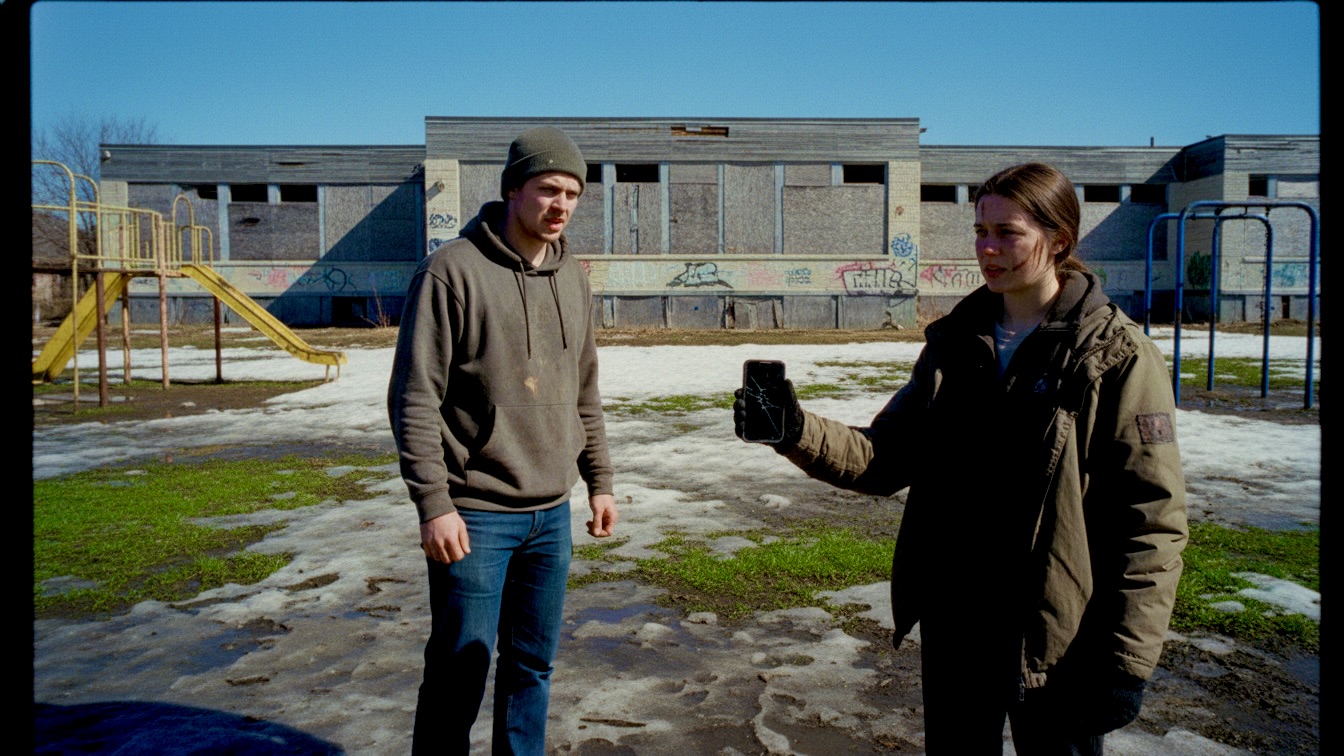
Stacey, an amateur true-crime enthusiast, meets Benji behind an abandoned high school during a bleak March thaw. She confronts him with the news that she has found a potential piece of evidence regarding his missing sister, Maya. Benji initially reacts with hostility, accusing Stacey of treating his family's tragedy like a hobby or internet content. He is exhausted by the indifference of the local police and the emotional toll of his sister’s thirty-four-day disappearance.
The tension shifts when Stacey reveals she searched a ravine the police ignored and recovered a damaged burner phone. Despite his skepticism and emotional exhaustion, Benji realizes that Stacey is the only person taking the search seriously. They retreat to her car to clean the device and attempt to power it on. In the cramped, cold interior of the vehicle, Stacey uses a needle to clear the charging port while Benji watches in desperate silence. After a tense wait, the phone flickers to life, signaling a breakthrough in their unofficial investigation.
One of the most prominent themes is the dehumanization inherent in the modern true-crime phenomenon. Benji serves as a vocal critic of this culture, pointing out how Stacey’s digital graphics and timelines reduce his sister’s life to a puzzle for public consumption. This creates a psychological friction between the consumer of tragedy and the victim of it, highlighting the voyeuristic nature of digital sleuthing. Stacey’s realization that her Canva project looks "sick" in the face of real grief underscores this moral conflict.
The story also explores the theme of systemic neglect, particularly concerning missing Indigenous women. The dialogue reveals a sharp critique of law enforcement, which Benji describes as lazy and dismissive. The "gaps" mentioned by Stacey represent not just physical spaces like the ravine, but also the institutional failures that allow certain individuals to be forgotten by society. The town’s choice to "pave over" these gaps suggests a collective desire to ignore uncomfortable realities.
Decay and stagnation permeate the narrative, mirrored by the setting of the abandoned high school and the diseased slush of the spring thaw. Everything in the town is described as missing something, suggesting a collective trauma that goes beyond Maya’s disappearance. The physical environment reflects the internal state of the characters, who are stuck in a frozen limbo of grief and inaction. The transition from winter to spring is not depicted as a rebirth, but as a messy, swampy exposure of what was hidden.
Stacey operates from a place of intellectual detachment that borders on a psychological coping mechanism. She consumes true-crime media at double speed, a detail that suggests a need to process information rapidly to avoid the emotional weight of the subject matter. Her focus on Canva graphics and Reddit threads indicates a desire for control and order in a world that feels chaotic and indifferent. She uses the structure of "investigation" to navigate a reality that she finds otherwise overwhelming.
Psychologically, she struggles with the realization that her hobby has real-world consequences and causes genuine pain to those involved. When Benji calls her a freak, she feels a flash of shame, yet she cannot abandon her analytical nature. She finds comfort in problem-solving, using her focus on technical details to navigate the overwhelming reality of Benji’s grief. She is crossing a line from observer to participant, a transition that brings both adrenaline and nausea.
Her motivation seems to be a mix of genuine altruism and a desperate need for validation. She wants to prove that she is more capable than the lazy professionals she criticizes. By finding the phone, she validates her own obsessions and justifies her social isolation. She is the only one who looked in the gully, suggesting that her "weirdness" is actually the only thing providing Maya with a chance at being found.
Benji is a character defined by profound emotional and physical exhaustion. His description, including the purple shadows under his eyes and his wet clothes, paints a picture of a young man who has been hollowed out by uncertainty. He carries the heavy burden of being the emotional anchor for his grieving mother while navigating his own despair. Every step he takes is heavy, reflecting the literal and figurative mud he is forced to wade through.
His initial anger toward Stacey is a protective barrier, a way to shield his sister’s memory from what he perceives as a cynical internet culture. He views Stacey’s interest as an intrusion, a sentiment born from the frustration of being ignored by the authorities. His outburst at the playground is a release of the pressure he feels from being treated as an inconvenience by the local police department. He resents that his sister's life has become "content" for people who do not know her.
Beneath his hostility lies a desperate, flickering hope that he cannot quite extinguish. When he sees the letter "M" on the burner phone, his physical collapse into the mud signifies the breaking of his defensive walls. He is forced to accept help from the person he resents most because she represents his only path toward the truth. His alliance with Stacey is born of necessity, marking a shift from solitary mourning to active, albeit terrifying, discovery.
The pacing of the chapter is deliberate, mirroring the slow, grueling process of a real-life search. The author spends significant time establishing the bleakness of the environment before the central conflict of the phone is introduced. This build-up creates a sense of dread that pays off when the phone finally flickers to life in the dark car. The transition from the wide, empty playground to the cramped car interior heightens the intimacy and tension of the final moments.
Sensory details are used effectively to ground the reader in the physical discomfort of the scene. The "sucking" mud, the "diseased brown" snow, and the "stinging" cold of the slush create a visceral experience of the setting. These descriptions reinforce the idea that the characters are submerged in a situation that is messy and difficult to navigate. The sound of the empty swing chain clinking like "loose change" adds a haunting, auditory layer to the theme of loss.
The tone is consistently somber and cynical, reflecting the characters' lack of faith in the town’s institutions. The narrative voice is sharp and observant, often highlighting the contrast between the polished world of podcasts and the grimy reality of the ravine. This stylistic choice emphasizes the gravity of the situation and the high stakes of the characters' alliance. The final image of the pulsing battery icon provides a stark, mechanical contrast to the organic decay described throughout the chapter.


