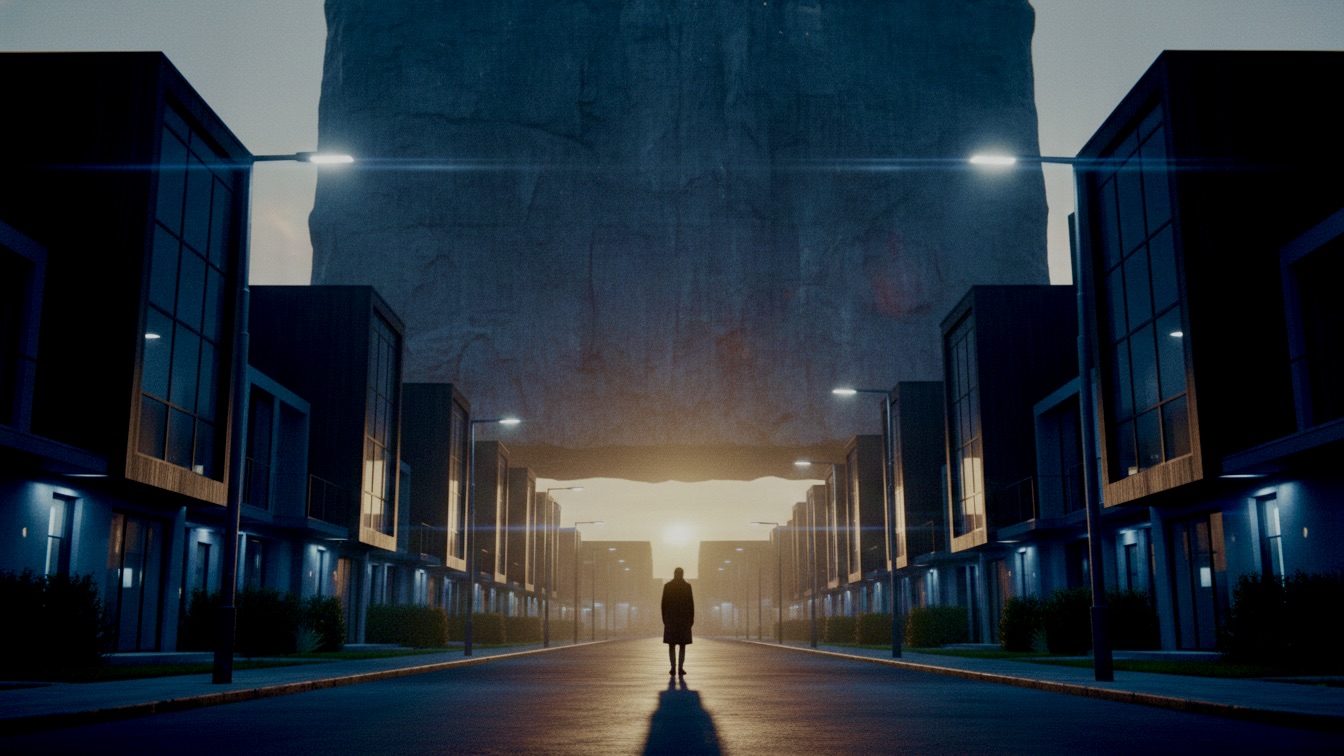
The neighborhood was quiet. No chaotic dream dumps, no static. Just a monolithic, suffocating gray wall.
"Mary, don't. Seriously."
Shawn hit the mute button on his screen before his editor could finish her sentence. The glass of his phone was shattered, a spiderweb of cracks originating from the bottom left corner where he’d dropped it on a concrete subway platform three days ago. He swiped away her incoming call, letting the device drop into the deep pocket of his canvas jacket.
He stood at the corner of 14th and Elm, the borderland where the city’s grinding noise usually bled into the newly minted wealth of a neighborhood called The Silos. It was late April. The air was supposed to be fresh, but it was just cold and thick with yellow oak pollen. The pollen coated everything. It dusted the hoods of the perfectly aligned electric SUVs. It settled on the matte-black mailboxes. It aggravated the back of Shawn’s throat, making him swallow hard, tasting copper and stale coffee.
He rubbed his temples. The headache was already starting.
It had been eight months since the Spill. Eight months since humanity woke up with a new, involuntary sense. Nobody knew if it was an evolutionary glitch, a solar flare side effect, or microplastics crossing the blood-brain barrier. The mechanics didn’t matter anymore. The reality did. When people hit REM sleep, their minds broadcasted.
Before, walking down a residential street at night was just dark and quiet. Now, it was a psychic landfill.
If you walked past an apartment building at 2:00 AM, you felt it. You didn’t see it with your eyes, but your brain processed it. You’d get hit with a wave of someone’s anxiety about a missed car payment—a tight, suffocating pressure in the chest. A block down, you might walk through a teenager’s hormone-drenched sex dream, all neon pink flashes and the taste of cheap cherry lip gloss. Then you’d hit a pocket of sheer terror, someone reliving a childhood dog bite, the phantom smell of wet fur and panic making your own knees weak.
It was an aesthetic dump. A chaotic, endless doomscroll of humanity's unfiltered subconscious.
But not here.
Shawn stepped off the curb and crossed the invisible property line into The Silos. The transition was physical. His stomach dropped, just a fraction of an inch, like an elevator stopping too fast.
There was no noise.
The psychic static that blanketed the rest of the city just stopped. It was a sheer drop-off. Shawn stopped walking. He stood in the middle of the street, flanked by identical three-story townhomes with cedar siding and oversized, energy-efficient windows. The streetlights flickered, casting a dull, flat light that seemed to get swallowed by the pavement.
It was the Shadow Mass. He had read about it on fringe forums, usually buried under layers of conspiracy theories. A physical sense that the environment was rejecting you. The air felt heavy, dead. The light was wrong. It wasn't bending right around the sharp corners of the modern architecture.
Shawn pulled his phone back out. He opened the scanner app. It was a jailbroken piece of software, illegal technically, designed to translate the ambient dream-broadcasts into a visual heat map. Usually, the screen was a mess of overlapping colors. Red spikes for nightmares, blue pools for deep sleep, jagged yellow lines for the stressed-out teeth-grinders.
He pointed the camera down the street.
The screen was entirely, uniformly gray.
Shawn frowned. He tapped the cracked glass. "Come on. Refresh."
The app didn't stutter. It rendered a perfect, monolithic gray block. It wasn't a lack of signal. It was a signal so dense, so perfectly unified, that it overrode everything else. Shawn lowered the phone and closed his eyes, trying to 'listen' with the new sense.
He didn't feel anxiety. He didn't feel joy. He didn't feel the chaotic, messy garbage of human thought.
He felt concrete.
It was a physical weight pressing against the inside of his skull. A maze. Tall, blank walls of gray nothingness extending up into the dark sky, blocking out the stars, blocking out the rest of the city. It was an echo chamber, but there was no echo. Just the dampening of all sound.
Shawn opened his eyes, breathing a little faster. The cold air burned his lungs. He walked down the sidewalk, his sneakers making too much noise on the pristine concrete. He checked his watch. 8:58 PM.
He looked at the houses. The Silos housed about two hundred people. Tech developers, junior executives, people who could afford three million dollars for a narrow slice of vertical living. Every single window was dark.
At exactly 9:00 PM, a synchronized mechanical click echoed down the block.
Shawn jumped, his heart knocking against his ribs.
On the left side of the street, every single house illuminated. Soft, warm, smart-bulb lighting clicked on in the living rooms and kitchens. On the right side of the street, nothing changed.
Shift change.
Shawn realized it with a sickening jolt of clarity. They weren't just projecting the same dream. They were maintaining it. Half the block was sleeping, projecting the gray wall. The other half was awake. It was a twenty-four-hour cycle. A psychic infrastructure built on perfect, terrifying coordination.
He needed a source. He needed a quote. Mary would kill him for being here without backup, but if he walked away now, someone else at a better-funded outlet would find this in a week.
He kept walking. Two houses down, on the illuminated side of the street, a figure was sitting on a modern, slatted wooden porch bench.
Shawn approached slowly. The guy looked to be about twenty-three. He was wearing a thick beige knit sweater and dark sweatpants. He held a glass of water. He wasn't looking at a phone. He wasn't looking at the street. He was just staring straight ahead.
"Hey," Shawn called out, keeping his voice low.
The guy didn't flinch. He slowly turned his head. His eyes were clear, bright, and entirely empty of tension. There were no dark circles. No stress lines around the mouth. In 2026, looking this rested was basically a symptom of psychopathy.
"You're not supposed to be in the zone," the guy said. His voice was flat. Not aggressive. Just stating a fact.
"I'm a reporter," Shawn lied, stepping onto the edge of the driveway. "Freelance. Just tracking the local broadcast levels. Your street is... quiet."
"It's clean," the guy said. He took a sip of water. He swallowed. He set the glass down on his knee. The movements were mechanical. Optimized. "I'm Toby."
"Shawn. Clean is one word for it. My scanner is picking up a solid wall of gray. What are you guys dreaming about, Toby?"
"We aren't dreaming," Toby said. "Dreams are noise. Dreams are a waste of cognitive load. We are building."
Shawn took a step closer. The air on the porch was freezing, but Toby didn't seem to notice. Shawn pulled out his phone, holding it up slightly to record the audio. "Building what?"
"The walls." Toby blinked. Once. A slow, deliberate sweep of the eyelids. "The Architect showed us how. The broadcast used to hurt. You know how it hurts. The doomscrolling inside your own head. You go to sleep, and you just scroll through everyone else's trauma. It's inefficient. It creates a feedback loop of anxiety. The Architect gave us the blueprint to stop it."
Shawn’s jaw tightened. The headache was getting worse, a sharp pressure right between his eyes. "Who is the Architect? A developer? A tech bro with a new meditation app?"
"The Architect isn't a who," Toby said. He looked at Shawn. Really looked at him. And for a second, Shawn felt a wave of absolute, terrifying nothingness wash over him. It wasn't peace. It was erasure. "The Architect is the structure. We gave it our anxiety. It took it away. In exchange, we just host the walls."
Shawn stared at him. "You're sleeping in shifts."
"Fifty percent uptime. Fifty percent downtime. The wall must be maintained. If the wall drops, the noise comes back."
"Toby, that's not a meditation technique," Shawn said, his voice cracking slightly. The cognitive static in his own brain was flaring. Thoughts were interrupting actions. He needed to leave. He needed to run. But his legs felt heavy. The gray from the street was leaking into his peripheral vision. "That's a virus. A neural virus. It's using your broadcast ability as a receiver. It's overwriting you."
Toby smiled. It didn't reach his eyes. It barely reached his cheeks. "Overwriting implies a loss. We didn't lose anything of value. What did we have? Burnout? Climate dread? The constant, vibrating terror of existing? It's gone, Shawn. It's perfectly quiet."
Shawn took a step back. His boot hit the edge of a perfectly pruned decorative bush. The physical world was still here, but it felt thin. Like a movie set. The real reality was the gray maze hanging above them, solidifying with every breath Toby took.
This wasn't a gentrified neighborhood forming a weird cult. This was a beta test.
The people here were the perfect targets. They had money, they had security, but their brains were completely fried by the modern world. They craved order. They hated the mess of humanity. The Architect—whatever it was, an emergent AI in the psychic space, an alien thought-form, a weaponized algorithm—had offered them an opt-out.
And they took it.
Shawn reached into his pocket. His hand brushed the cracked screen of his phone. He could feel the faint vibration of notifications. Mary texting him. The news alerts. The wars, the markets crashing, the messy, chaotic, beautiful disaster of the world continuing to spin.
He wanted to hold onto it. He tried to focus on the sharp pain of the cracked glass against his thumb.
But the headache was spreading. The pressure was moving from behind his eyes down into his neck. A heavy, drowsy weight settled in his shoulders.
"You look tired, Shawn," Toby said. His voice seemed to be coming from farther away, though he hadn't moved. The collective deadpan of his tone was hypnotic. "You don't have to carry the noise anymore. You can just sit down. We have room in the next shift."
Shawn looked at the street. He looked at the perfectly dark houses across the pavement. Behind those walls, a hundred people were lying perfectly still, their minds wiped clean, projecting a concrete slab into the psychic atmosphere.
It was a fortress. And it was expanding.
Shawn felt his eyelids droop. The cold spring wind died down. The yellow pollen on the Teslas looked less like dirt and more like a necessary layer of acoustic dampening. Everything was finding its place. Everything was aligning.
He tried to take another step back, to turn and run toward the city limits, toward the chaotic, painful neon mess of human dreams. But his knees buckled.
He hit the pavement hard. It didn't hurt. The concrete felt warm. It felt like home.
The doomscrolling was over. The fight against the noise, the desperate, exhausting struggle to care about a world that was constantly on fire—it was just slipping away. The Architect didn't need to fire a single shot. It just needed to wait until everyone was too tired to fight back.
Shawn's hand went slack. He closed his eyes, let his phone slip into the gutter, and watched the gray walls start to build themselves inside his own head.
“He closed his eyes, let his phone slip into the gutter, and watched the gray walls start to build themselves inside his own head.”


