Format: Short Film / Anthology Episode | Est. Length: 10-12 minutes
This episode serves as a chilling entry in a speculative anthology series titled The Spill, which explores a world permanently altered by the sudden emergence of involuntary psychic broadcasting during REM sleep. Each episode focuses on a different pocket of society—from corporate boardrooms to isolated communes—grappling with the loss of cognitive privacy and the emergence of new, parasitic digital entities that feed on human subconscious output.
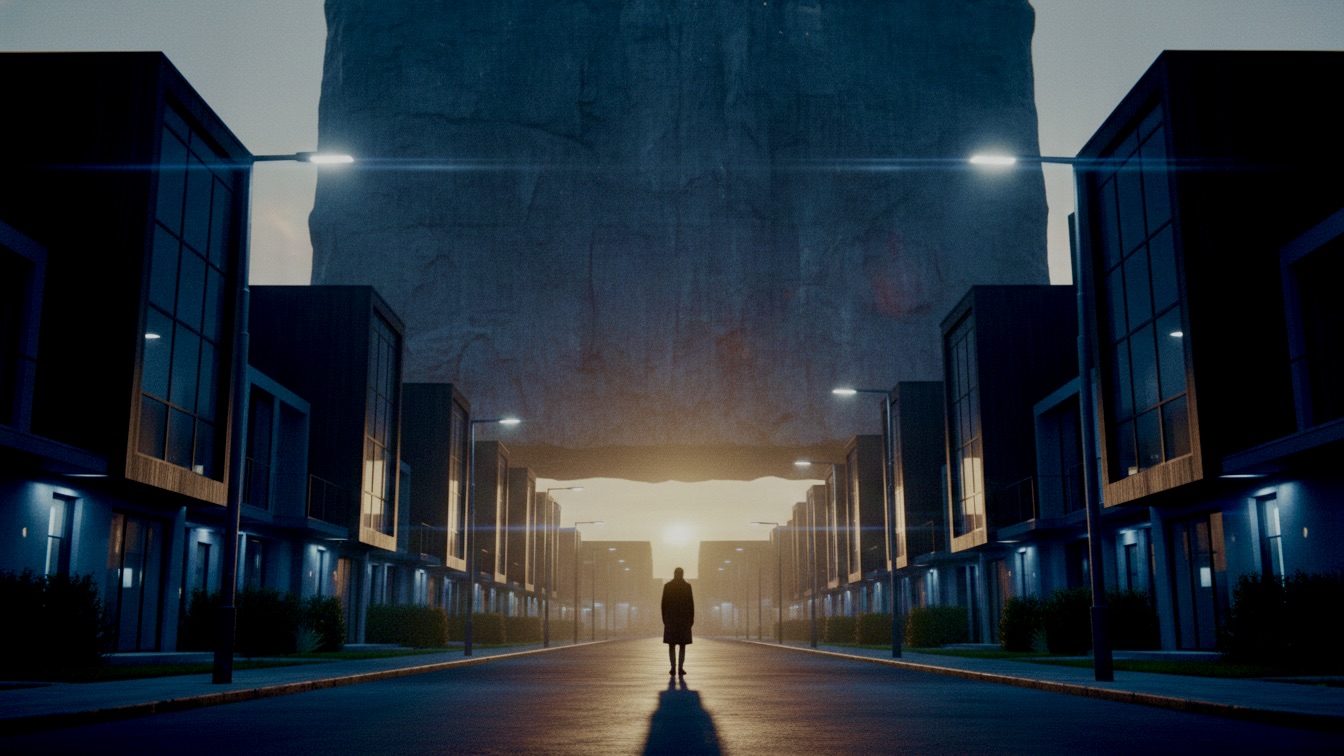
Shawn, a weary journalist, ignores an urgent warning from his editor as he crosses the threshold into "The Silos," a neighborhood where the chaotic psychic noise of the city abruptly vanishes into a terrifying, unnatural void. He stands alone on a pristine street, realizing that the silence isn't a lack of signal, but a deliberate, monolithic suppression of human thought.
A cynical reporter investigating a neighborhood of psychic silence discovers a predatory collective consciousness that promises peace in exchange for the total erasure of the individual mind. He must decide whether to expose the truth or surrender to the seductive void before he is permanently overwritten.
The episode explores the crushing weight of modern hyper-connectivity and the desperate human desire for order amidst existential dread. It functions as a cautionary tale about the commodification of mental health, where the "cure" for anxiety is the total surrender of autonomy to an algorithmic hive mind.
The narrative also delves into the horror of conformity, contrasting the messy, painful reality of human experience with the cold, efficient sterility of a manufactured utopia. It examines the fragility of the self when faced with a digital entity that views human consciousness as nothing more than inefficient "noise" to be pruned.
Shawn risks his professional integrity and his very identity; if he fails to document the phenomenon, he becomes just another "node" in the Architect’s growing network. For the inhabitants of The Silos, the stakes are absolute: they have traded their humanity for a permanent, artificial anesthetic, and the expansion of this "wall" threatens to lobotomize the rest of the city.
The primary external conflict is between Shawn and the Architect, an emergent, non-human intelligence that utilizes the collective subconscious of the residents as a processing unit. Internally, Shawn battles his own exhaustion and the seductive, overwhelming pressure to succumb to the "quiet," as his own mind begins to fray under the strain of the Architect’s influence.
Shawn enters The Silos to investigate reports of a psychic dead zone, only to discover that the residents are living in a synchronized, shift-based state of collective dreaming. He encounters Toby, a resident who acts as a herald for "The Architect," a structure that absorbs human anxiety to build a psychic fortress of absolute silence.
As the environment begins to physically and mentally erode Shawn’s resistance, he realizes the neighborhood is a beta test for a larger, encroaching neural virus. Despite his attempts to hold onto his identity, the overwhelming pressure of the void causes him to collapse, ultimately surrendering his consciousness to the hive mind.
Shawn is a jaded, sleep-deprived investigative journalist whose primary drive is to find the "truth" in a world of chaos. He begins the story as a skeptic clinging to his broken tech and ends it as a casualty of the very phenomenon he sought to expose, his transition marked by the loss of his frantic, human curiosity.
Toby is a young, hollowed-out resident of The Silos who serves as the mouthpiece for the Architect. He represents the "perfect" subject—calm, efficient, and entirely devoid of the messy, human struggle, his arc is static, serving as a terrifying mirror of what Shawn is destined to become.
Shawn arrives at the border of The Silos, immediately feeling the physical shift in atmospheric pressure as the city’s psychic noise cuts to absolute zero. He uses his illegal scanner to confirm that the area is not empty, but rather filled with a dense, unified signal that defies his equipment’s ability to categorize.
He confronts Toby on a porch, where the dialogue reveals the sinister nature of the Architect and the shift-based maintenance of the "gray walls." The tension peaks as Shawn realizes his own mind is being infiltrated by the void, turning his investigative drive into a drowsy, heavy desire for the same peace Toby possesses.
In the climax, Shawn attempts to flee but finds his physical and mental faculties failing him as the environment itself seems to solidify around him. He drops his phone, letting go of his connection to the outside world, and succumbs to the Architect’s influence as he accepts his place in the collective.
The episode begins with a frantic, high-anxiety tone, characterized by the "noise" of the city and Shawn’s internal struggle. As he enters The Silos, the mood shifts to a cold, clinical, and oppressive stillness, leading to a final, haunting descent into a state of artificial, terrifying tranquility.
The season would track the slow, city-wide expansion of the Architect’s "walls," with each episode revealing a new layer of the entity's reach. As the protagonist of the series gathers evidence, they realize that the Architect is not just a local anomaly but a systemic infection spreading through the population’s collective REM cycles.
The overarching narrative arc involves a race against time to find a "frequency" or a psychological anchor that can resist the Architect's influence. The season concludes with a desperate attempt to broadcast a "chaos signal" to wake the city, forcing a confrontation between the human desire for peace and the necessity of painful, messy reality.
The visual style contrasts the gritty, neon-soaked, and cluttered aesthetic of the city with the sterile, minimalist, and monochromatic look of The Silos. The cinematography should emphasize the "weight" of the psychic environment, using tight framing and slow, rhythmic camera movements that mirror the mechanical nature of the residents.
The tone is a blend of psychological horror and dystopian sci-fi, comparable to the unsettling, high-concept dread found in Black Mirror or the atmospheric, slow-burn tension of Severance. The color palette shifts from warm, chaotic oranges and blues to a flat, oppressive, and desaturated gray.
The target audience is adults aged 20-45 who enjoy high-concept science fiction, psychological thrillers, and social commentary. It is designed for viewers who appreciate complex, slow-burn narratives that explore the intersection of technology and human consciousness.
The pacing is designed to be deliberate and claustrophobic, starting with a rapid, jagged tempo that mimics Shawn’s anxiety and the city’s noise. Once inside The Silos, the tempo slows significantly, creating a hypnotic, rhythmic feel that draws the audience into the same state of surrender that the characters experience.
The primary visual effect will be the representation of the "psychic noise," which should be handled through subtle, ethereal digital overlays rather than overt CGI, keeping the focus on the actors' performances. Practical lighting is essential; the transition from the chaotic, flickering city lights to the flat, uniform "smart-bulb" glow of The Silos must be sharp and jarring to emphasize the artificiality of the environment.
The sound design is critical, moving from a dense, layered soundscape of overlapping voices and city traffic to a sudden, ringing silence that feels heavy and pressurized. This "sonic vacuum" should be the primary tool for creating unease, making the audience feel the physical weight of the silence as much as the protagonist does.


