My battery hit one percent, forcing me out of my digital coma and into the rotting community centre.
"Are you even alive right now?" Lucy asked.
I did not look up from my screen. The blue light reflected off my glasses, casting a pale glow over my face in the dim, humid air of the Ojiway Falls community centre. My thumb swiped up. A video of a guy building a mud hut in the jungle played for three seconds. Swipe. A girl crying in her car about her iced coffee order. Swipe. A podcast clip featuring a man with a microphone explaining why breakfast is a scam.
"He is completely dead," Sam said from my left. "His brain is soup. He is just a meat sack holding a device."
"I am absorbing content," I said, my voice flat, my eyes still glued to the glass. "I am becoming powerful."
"You are becoming a loser," Lucy said. She kicked the toe of my left sneaker. Her boot was wet. It left a smear of gray slush on the white canvas of my shoe.
I finally blinked. My eyes burned. It felt like someone had rubbed sand under my eyelids. I looked up. The Ojiway Falls arena was a massive, echoing cavern of corrugated steel and disappointment. It was mid-April. Outside, the brutal Northwestern Ontario winter was finally breaking, turning the town into a swamp of brown water, exposed garbage, and road salt. Inside, it was supposed to be cold enough to maintain the ice rink for the final peewee hockey tournament of the season. It was not cold.
Water dripped from the metal rafters. Plink. Plink. Plink. The drops hit the ice below, creating little craters in the surface. The ice itself looked sick. It wasn't the hard, bright white sheet it was supposed to be. It was gray, soft, and pooling with water at the edges near the boards. The entire building smelled like wet dog, stale fries, and forty years of athletic sweat baked into the concrete.
"I cannot sit here anymore," Lucy said. She zipped up her jacket. It was a vintage bomber she had bought at the thrift store two towns over, the leather cracked and peeling at the shoulders. "It is literally raining inside."
"The roof has leaked since we were in kindergarten," I said. I looked back down at my phone. Swipe. A compilation of car crashes set to lo-fi hip hop.
"It is not the roof," Sam said. He stood up, his knees popping loud enough to echo in the empty bleachers. "The ice is melting. It is eighty degrees in here. I am sweating through my hoodie."
He was right. The air was thick and heavy, pressing against my skin. The back of my neck was damp. But I did not care. The real world was currently a sloppy, rotting mess of melting snow and dying small-town infrastructure. The screen in my hand was an endless, frictionless void where nothing mattered and everything was brightly colored. I preferred the void.
"We are going to the gas station to get taquitos," Lucy said. "Are you coming or are you going to sit here until you merge with the plastic bench?"
"I will stay," I said. Swipe. A tutorial on how to clean a cast-iron skillet.
"Suit yourself, freak," Sam said. I heard their footsteps heavy on the hollow metal bleachers, clanging all the way down to the concrete floor. The heavy glass doors at the front of the arena squealed open and slammed shut. I was alone.
I settled back against the hard plastic seat. A cramp shot up my right calf. I ignored it. I shifted my weight, trying to find a comfortable angle on the rigid bench. My phone battery was at seventy-two percent. I had hours. I dove back in.
The scroll is not an activity. It is a state of being. You do not watch the videos; you let them wash over you. It is a digital anesthetic. The hours bled out. The sun, visible through the high, dirty skylights of the arena, shifted from a harsh morning glare to a dull, bruised afternoon purple. The shadows in the arena lengthened. The dripping sound from the ceiling got faster. Plink-plink-plink. The ice down below was turning into a shallow pool of black slush.
My thumb joint started to click every time I swiped. My neck ached, a dull, throbbing pain at the base of my skull from looking down for so long. My mouth was dry, tasting like morning breath and stale air. But I did not stop. The algorithm fed me. It knew exactly how long I lingered on a video of a hydraulic press crushing a bowling ball. It knew I would skip anything with loud, abrasive music in the first half-second. It mapped my brain, and I let it.
I lost track of time entirely. The natural light faded, replaced by the harsh, buzzing fluorescent tubes high above the rink. They flickered, casting a sickly yellow pall over the melting ice.
Then, the warning flashed on my screen.
Ten percent battery remaining.
My chest tightened. A jolt of actual adrenaline hit my system, cutting through the brain fog. Ten percent. That was nothing. That was maybe twenty minutes of scrolling if I turned the brightness all the way down. I tapped the screen, dragging the brightness slider to the bottom. The colors washed out, the videos becoming murky and hard to see. But it wasn't enough.
Swipe. Five minutes later.
Five percent battery remaining.
I sat up straight. The spell was broken. Panic, cold and sharp, pierced my stomach. I needed a charger. I patted my jacket pockets. Empty. I checked my backpack sitting on the bench next to me. I unzipped the main compartment, shoving aside a crushed notebook, a stale protein bar, and a bunch of loose pens. My fingers brushed against the familiar, smooth white plastic of my charging block and the frayed cord.
I pulled it out. Now I just needed an outlet.
I stood up. My legs felt like they belonged to someone else. They were numb, the blood rushing back into my feet with a painful, prickling sensation. I stumbled slightly, catching myself on the metal railing. The arena was dead silent, save for the constant dripping of water. I looked down at the ice. It was totally ruined. The painted red and blue lines beneath the surface were warped and distorted by the water pooling on top.
I walked down the bleachers, my steps heavy and clumsy. I reached the concourse level. The floor was sticky. I scanned the cinderblock walls. There was an outlet near the old concession stand. I walked over, my wet shoes squeaking on the linoleum.
I plugged the block in. Nothing. I looked closer. The outlet was covered in a thick layer of dust and a piece of duct tape that had peeled away at the edges. Dead.
I checked my phone. Two percent.
"Come on," I muttered. My voice sounded loud and raspy in the empty building.
I started walking down the main hallway that wrapped around the back of the arena. This was where the dressing rooms were. The air here was even hotter. It felt like I was walking into a sauna. The smell of mildew was overpowering. I checked the wall outside Dressing Room A. The outlet there was physically smashed, the plastic faceplate cracked and missing pieces.
One percent.
The little battery icon in the corner of my screen was a sliver of red. It was dying. I was about to be left alone with my own thoughts in a rotting building. I needed power.
I kept walking. The hallway grew darker. The fluorescent lights back here were entirely burned out. The only illumination came from the emergency exit signs glowing a dull red. The heat was becoming oppressive. I unzipped my jacket. Sweat prickled at my hairline.
Why was it so hot? It was April. The building's heating system should have been shut off weeks ago, especially with the ice melting. But the air felt thick, charged with a strange, dry energy.
I reached the end of the hallway. There was a heavy metal door painted a peeling, industrial gray. A faded plastic sign bolted to it read: AUTHORIZED PERSONNEL ONLY. MECHANICAL.
I put my hand on the doorknob. The metal was warm to the touch. Actually warm. Not just room temperature. It felt like it was baking from the inside.
I turned the knob. It clicked, unlocking, and I pushed the door open.
A blast of hot air hit me in the face, smelling of hot dust, melting plastic, and ozone. It was like opening an oven. The noise hit me a second later. It was a low, mechanical roar, a constant, vibrating hum that rattled my teeth. It did not sound like a boiler. It did not sound like an HVAC system. It sounded like a jet engine idling on a runway.
I stepped inside.
The stairs were concrete, descending into the darkness of the basement. The walls were unfinished cinderblock, stained with decades of water damage. I pulled my phone out. The screen was black. It had died. I was completely disconnected.
I gripped the metal handrail. It was vibrating. I walked down the stairs, the heat intensifying with every step. My t-shirt clung to my back. The noise grew louder, drowning out the sound of my own breathing. I reached the bottom landing.
There was another door. This one was propped open with a rusted paint can. Bright, artificial blue and green lights spilled out from the crack, painting the concrete floor in neon streaks.
I walked toward the light and pushed the door all the way open.
I stopped dead.
The basement of the Ojiway Falls community centre was supposed to hold the Zamboni water tanks, the Freon compressors for the ice rink, and the main electrical panels.
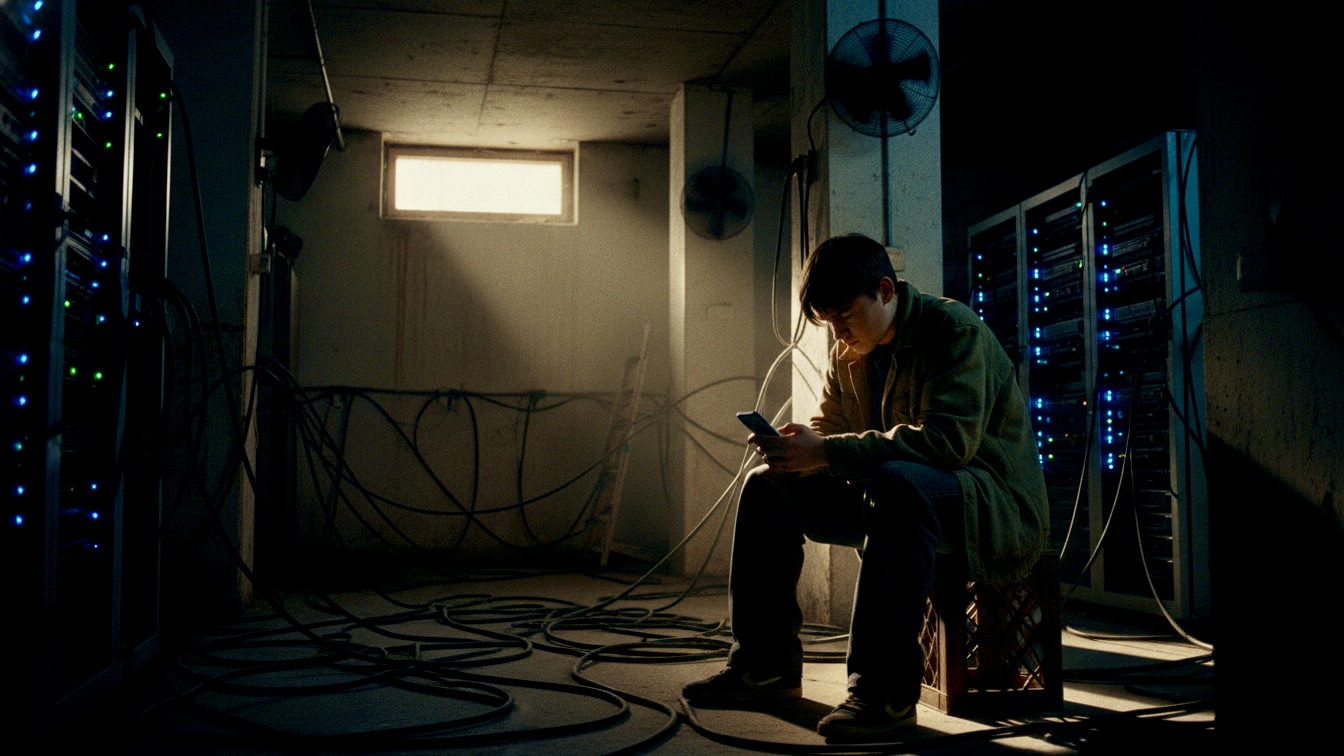
Instead, it held a server farm.
Rows and rows of metal shelving units stretched across the massive concrete room. Stacked on the shelves were hundreds of rectangular metal boxes, each one glowing with LED lights and fitted with multiple spinning fans. Tangled masses of thick black cables poured out of the machines, snaking across the floor like a nest of rubber vipers. The cables all fed into massive, heavy-duty extension cords that were plugged directly into the building's main industrial electrical panels, the doors of which had been ripped off their hinges.
The heat in the room was suffocating. Industrial floor fans were set up at the end of each row, blowing the hot air around uselessly. The noise was deafening. Thousands of tiny cooling fans spinning at maximum RPM, screaming in the dusty air.
I knew what this was. I had watched enough tech videos on my feed. These were ASIC miners. Cryptocurrency rigs. Someone was mining Bitcoin in the basement of the community centre.
I walked slowly down the first aisle. The machines were covered in a fine layer of dust, but they were running hard. The green lights blinked furiously, processing algorithms, solving math problems, minting invisible money.
I looked at the thick black cables running into the main electrical panel. The sheer amount of electricity this operation was pulling had to be staggering. No wonder the ice upstairs was melting. All the power, all the budget meant to keep the compressors running and the building cool, was being sucked down here to power this digital sweatshop.
"You should not be down here, Tyler."
I spun around. My heart hammered against my ribs.
Standing at the end of the aisle, blocking the doorway, was Mayor Mac.
He did not look like the smiling man on the re-election posters plastered all over Main Street. He looked terrible. He was wearing a cheap gray suit, but the jacket was off, slung over his arm. His white dress shirt was unbuttoned at the collar, and massive sweat stains bloomed under his armpits. His tie was loosened. His comb-over was failing, strands of damp gray hair plastered to his forehead. He was holding a lukewarm coffee cup from the gas station, the cardboard sleeve stained with brown drips.
"Mayor Mac," I said. My voice was barely audible over the screaming fans. I had to speak up. "What is this?"
He sighed, a long, heavy sound that seemed to deflate his entire chest. He walked toward me, his leather shoes scuffing against the concrete floor. He stopped a few feet away, looking at the glowing racks of machines.
"This," Mac said, waving his coffee cup at the servers, "is the future of Ojiway Falls."
I looked at the blinking lights. "This is a crypto mine. You are mining Bitcoin in the basement of the arena."
"It is an alternative revenue stream for the municipality," Mac said. He took a sip of his coffee and grimaced. "The town is broke, Tyler. You know that. Your parents know that. The mill closed down five years ago. The provincial government cut our infrastructure grants. We cannot afford to pave the roads, let alone keep this dinosaur of a building running."
"So you stole the heating and power budget to buy graphics cards?" I asked. "The ice upstairs is literally melting into slush. The peewee tournament is supposed to be this weekend."
"The peewee tournament brings in maybe two thousand dollars in concession sales," Mac snapped. The political veneer cracked, revealing the desperate, exhausted man underneath. "These machines? They are generating ten times that a week. I am saving the town, kid. I am building a lifeboat."
I stared at him. The heat was making me dizzy. The noise was a physical weight pressing against my skull.
"You are not saving the town," I said, my voice deadpan. "You are burning it down. You are using the town's electricity, which the taxpayers pay for, to mine fake internet money that goes directly into a wallet you control. That is not a lifeboat. That is embezzlement."
Mac's face flushed red beneath the sweat. He took a step closer to me. His breath smelled like old coffee and sour anxiety.
"You think you understand how the world works because you watch videos on that phone all day?" Mac sneered, pointing at the dead black rectangle in my hand. "You do not know anything. You do not know what it is like to sit in a council meeting and tell people there is no money for the snowplows. You do not know what it is like to watch a town die slowly. It is over, Tyler. Ojiway Falls is dead. It has been dead for a decade. We are just the ghosts haunting the corpse."
He gestured wildly at the servers.
"This is the only thing generating actual value!" he yelled over the noise. "I am converting dead infrastructure into digital assets. I am adapting."
"You are stealing," I repeated.
I didn't actually care about the town. That was the funny part. I hated Ojiway Falls. I hated the potholed roads, the empty storefronts, the depressing, gray winters that lasted seven months. I hated the people who pretended things would get better. I agreed with him. The town was dead. But I also hated him. I hated his sweaty face, his cheap suit, the way he thought he was smarter than everyone else while hiding in a damp basement.
"You are going to report me, I suppose?" Mac asked. He sounded tired now. The anger had burned out quickly. "You are going to go to the local paper? The one that prints four pages a week? You think anyone will care? You think the police Chief, whose pension I am trying to save with this money, is going to arrest me?"
I looked down at my dead phone. My thumb twitched, a phantom muscle memory of scrolling.
"I do not care about the paper," I said. "I do not care about the town. I just came down here looking for a wall outlet."
Mac paused. He blinked, sweat dripping from his eyelash. "What?"
"My phone died," I said. I held it up. "I was upstairs. The outlets in the hallway are broken. I followed the heat down here looking for power."
Mac stared at me for a long, silent moment. The industrial fans screamed around us. He looked at my face, searching for a lie, searching for a shred of civic duty or moral outrage. He found nothing. I was an empty vessel, drained by twelve hours of algorithm-fed dopamine, standing in a puddle of water in a crumbling basement.
He started to laugh. It was a dry, hacking sound that turned into a cough.
"You just want to charge your phone," he said, shaking his head. "God. Your entire generation. The world is burning, the ice is melting, the town is bankrupt, and you just want to plug in your screen."
"Yes," I said. "Do you have an outlet or not?"
Mac reached into his pocket and pulled out a handkerchief. He wiped his face, smearing the sweat across his forehead. He looked at the servers, then back at me. A new calculation was happening behind his eyes. The desperation was replaced by a slippery, transactional coldness.
"There is a power strip behind that third rack," Mac said, pointing. "Plug it in."
I walked past him. I found the power strip, nestled among a tangle of ethernet cables and dust bunnies. I plugged my white charging block into the black plastic strip. I plugged the cord into my phone.
I waited. Ten seconds later, the white Apple logo appeared on the black screen. A wave of relief washed over me. The anxiety in my chest loosened. I was back online.
I stood up. Mac was right behind me.
"So," Mac said, his voice low, conspiratorial. "You are a smart kid, Tyler. You understand that some things are better left unsaid. You understand that the optics of this... project... might confuse the older folks in town."
"You want to bribe me," I said.
"I want to offer you a grant," Mac corrected smoothly. "A digital dividend. For your silence."
I looked at my phone. The lock screen lit up. Three percent battery. Notifications flooded in. A text from Lucy asking where I was. A notification from the mobile game I played, Neon Protocol.
NEW MYTHIC SKIN BUNDLE AVAILABLE NOW. LIMITED TIME ONLY.
I clicked the notification. The game loaded, filling the screen with bright, flashing neon graphics. The new skin was a sleek, black-and-gold armor set for my main character. It was completely useless. It offered no tactical advantage. It was purely cosmetic. It cost fifty dollars.
I looked up at Mac.
"How much?" I asked.
Mac did not blink. "I will transfer point-zero-one Bitcoin to your wallet right now. That is roughly six hundred dollars. You walk out of here, you go home, and you forget you ever saw this basement."
Six hundred dollars. To keep my mouth shut about the mayor destroying the last piece of public infrastructure in a dying town so he could line his own pockets.
I looked at the game on my screen. The golden armor rotated slowly, catching the digital light. I thought about the peewee hockey players who would arrive on Saturday to find a swimming pool instead of an ice rink. I thought about the taxpayers whose bills were going to skyrocket to cover the electricity stolen by these machines.
I realized I felt absolutely nothing for any of them.
Mac was right. The town was a corpse. If I didn't take the money, someone else would. The servers would keep running. The ice would keep melting. Nothing I did here would change the trajectory of Ojiway Falls. The only difference was whether I walked away with a mythic skin or not.
"Do you have a wallet set up?" Mac asked, pulling his own phone out of his pocket.
"Yes," I said.
I closed the game and opened my crypto app. I generated a receive QR code. I held the bright screen up in the dim, hot basement.
Mac scanned the code with his phone camera. His thumb tapped the screen a few times.
"Sent," he said.
I looked at my screen. A few seconds later, the balance updated. Point-zero-one BTC. It was done. The transaction was recorded on the blockchain, permanent and immutable, cementing my complicity in the decay of my own hometown.
"Pleasure doing business with you, Tyler," Mac said. He put his phone back in his pocket. He looked relieved. He looked like a man who had just bought another week of survival.
"Whatever," I said.
I unplugged my phone from the wall. I wrapped the cord around the charging block and shoved it into my pocket. My phone was at six percent. Enough to make the purchase and get home.
I turned and walked away from him. I walked past the screaming machines, past the blinking green lights, past the stolen electricity. I did not look back. I pushed through the heavy basement door and started climbing the concrete stairs. The air grew cooler as I ascended, but it still smelled like wet mold and defeat.
I reached the main floor hallway. The darkness was complete now, save for the red exit signs. I opened the Neon Protocol app as I walked. I navigated to the store. I clicked purchase. The transaction went through instantly, converting a fraction of the bribe into a digital cosmetic item that did not exist in the physical world.
The screen flashed green. PURCHASE SUCCESSFUL.
I felt a tiny, hollow spike of dopamine hit my brain. It lasted for exactly two seconds before fading into the familiar, numb static.
I walked out into the main arena. The massive space was pitch black. I could not see the bleachers. I could not see the scoreboard. But I could hear it.
The heavy steel door clicked shut behind me, locking the heat inside, while another massive crack echoed from the melting ice above.
“The heavy steel door clicked shut behind me, locking the heat inside, while another massive crack echoed from the melting ice above.”


