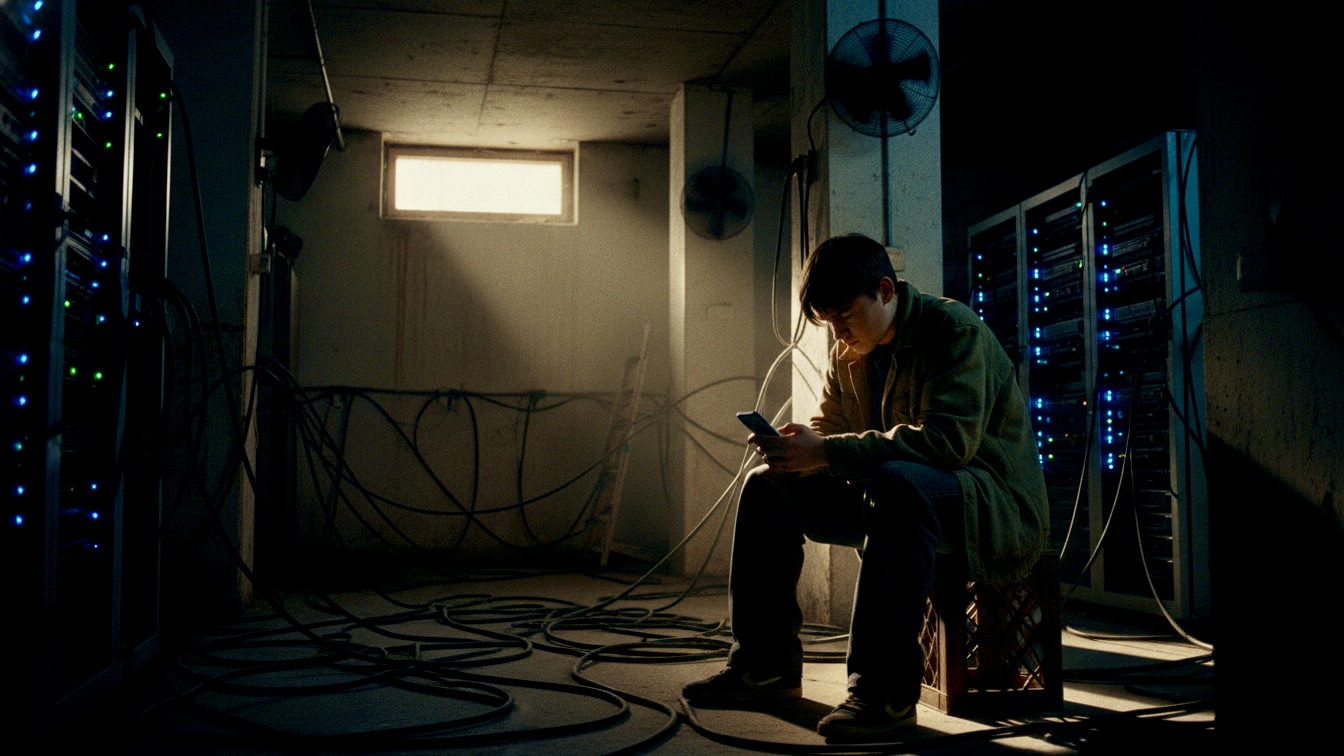
In the decaying community centre of Ojiway Falls, a teenager named Tyler sits absorbed in his smartphone while the physical world literally melts around him. His friends, Lucy and Sam, eventually grow frustrated with his catatonic state and depart to find food, leaving him alone in the humid, leaking arena. As the spring thaw turns the town into a swamp of road salt and garbage, Tyler remains fixated on a stream of mindless digital content. His sanctuary is shattered when his phone battery nears exhaustion, sparking a visceral panic that forces him to search the crumbling building for a functional power outlet.
His search leads him into the sweltering basement of the facility, where he discovers a massive, illegal cryptocurrency mining operation hidden among the machinery. Mayor Mac confronts him, defending the operation as a desperate, secret revenue stream intended to save the bankrupt municipality. Rather than reacting with moral outrage or civic duty, Tyler displays a profound apathy toward the mayor's embezzlement and the destruction of the town's infrastructure. He agrees to accept a bribe in Bitcoin to ensure his silence, immediately using the illicit funds to purchase a cosmetic skin in a mobile game. The story concludes with Tyler retreating further into his digital void while the physical arena continues to rot in the darkness.
The primary theme of the story is the intersection of physical decay and digital escapism within a dying society. Ojiway Falls is depicted as a "corpse" of a town, where the infrastructure is rotting and the natural environment has become a "swamp of brown water." This physical dissolution mirrors the mental state of the protagonist, who prefers the "frictionless void" of his screen to the harsh reality of his surroundings. The melting ice in the arena serves as a potent metaphor for the loss of community and the failure of traditional institutions.
Another central theme is the normalization of corruption in a state of terminal decline. Mayor Mac justifies his criminal behavior as a "lifeboat," suggesting that when the systems of the past fail, morality becomes entirely transactional. Tyler’s acceptance of the bribe reinforces the idea that the younger generation has inherited a world so broken that they no longer feel any obligation to repair it. Instead, they seek small, hollow rewards within digital ecosystems that offer a temporary reprieve from their bleak environment. The "Black Slush" of the title represents the sludge of both the physical landscape and the human spirit.
The narrative also explores the predatory nature of modern technology and its impact on human agency. The algorithm is described as something that "maps" the brain, turning the individual into a "meat sack" designed only to hold a device. This digital anesthetic numbs the characters to the point where they can no longer engage with the world in a meaningful way. The irony of using stolen electricity from a dying town to power a virtual economy highlights the parasitic relationship between technology and the real world. Ultimately, the story suggests that as the physical world becomes more difficult to inhabit, the digital world becomes a more attractive, albeit hollow, prison.
Tyler is a study in modern alienation and profound digital dependency. He views his smartphone not as a tool for communication, but as a "state of being" and a "digital anesthetic" that allows him to ignore his deteriorating surroundings. His psychological state is characterized by intense apathy and a lack of emotional connection to his peers or his community. Even when confronted with a massive criminal conspiracy, his primary concern remains the state of his battery and his ability to reconnect to the internet. He is a passive observer of his own life, content to let the algorithm dictate his focus and his values.
His decision to take the bribe from Mayor Mac reveals a cynical pragmatism that has replaced traditional morality. He does not harbor any illusions about the mayor's character, nor does he believe in the sanctity of the town’s future. He recognizes the decay of Ojiway Falls and chooses to profit from its collapse rather than oppose the corruption. This choice highlights a total lack of agency; he is a character who has been drained of civic duty by years of algorithm-fed dopamine. The purchase of the "Mythic Skin" at the end of the story symbolizes his ultimate commitment to a world that does not exist.
Mayor Mac represents the desperate, moral bankruptcy of a leadership class that has run out of legitimate options. He is a man who has traded his integrity for a "digital dividend," convincing himself that his theft is actually an act of salvation for the town. His physical appearance—sweaty, disheveled, and exhausted—reflects the internal rot of his administration. He views the townspeople not as a community to be served, but as a burden to be managed through deception. He is a ghost haunting a corpse, trying to extract whatever value remains from a dying system.
His interaction with Tyler reveals a slippery, transactional coldness that he uses to navigate his precarious situation. He is quick to identify Tyler’s lack of moral core and exploits it with a bribe, showing how easily he can adapt his political skills to criminal ends. Mac is not a traditional villain, but rather a symptom of a larger systemic failure where survival necessitates the destruction of the very things he is supposed to protect. He believes he is building a lifeboat, but he is actually just accelerating the sinking of the ship. He is a man who has completely lost sight of the difference between value and price.
The narrative utilizes a gritty, visceral style to emphasize the sensory unpleasantness of the setting. Descriptions of "wet dog," "stale fries," and "rotten infrastructure" create an atmosphere of stagnation and disgust. The author effectively contrasts this with the "brightly colored" and "frictionless" nature of the digital world. This sensory divide helps the reader understand why the protagonist is so desperate to retreat into his screen. The rhythmic "plink-plink-plink" of the leaking roof provides a constant, auditory reminder of the inevitable collapse of the physical world.
The pacing of the story mirrors the protagonist's internal experience, moving from the slow, hypnotic rhythm of scrolling to the frantic panic of a dying battery. Once Tyler enters the basement, the prose becomes more intense and claustrophobic, reflecting the heat and the mechanical roar of the server farm. The transition from the cold, damp arena to the baking, neon-lit basement creates a sharp shift in the story's energy. This shift underscores the transition from a dying past to a hollow, high-tech future. The narrative voice remains consistently cynical and detached, reflecting the perspective of a character who has checked out of reality.
The dialogue is flat and deadpan, which serves to emphasize the emotional vacuum in which the characters reside. There is no soaring rhetoric or deep emotional connection; every exchange is functional and often laced with mutual contempt. This stylistic choice reinforces the theme of apathy and the breakdown of social bonds. The ending leaves the reader with a sense of hollow finality, as the physical world continues to crack and melt in the dark while Tyler finds temporary satisfaction in a digital purchase. The author successfully creates a world that feels both uncomfortably realistic and hauntingly prophetic.


