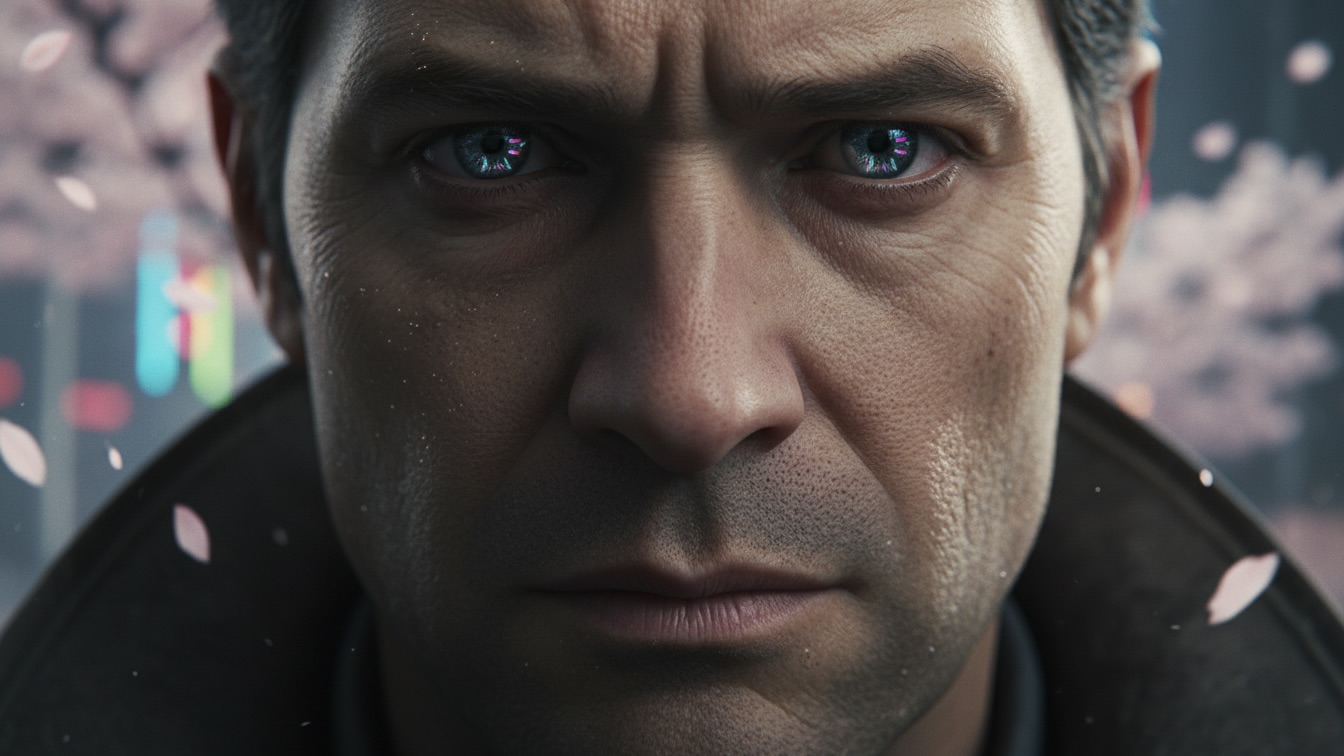
Detective Lane investigates a murder where the cameras see nothing, relying on his failing eyes and a shard.
The precinct smelled like cheap coffee. It was a spring morning, the kind that usually promised renewal, but for Detective Lane, it just meant more pollen to irritate his already failing eyes.
He sat in front of the monitors, squinting. Captain Underwood stood behind him, arms crossed over a chest that looked like it was made of granite. The screen showed the interior of a luxury apartment. The victim, a man named Henderson, lay face down on a rug that cost more than Lane’s car. Blood pooled on the weave. But on the footage, the room was empty. There was no one there. No struggle. No killer. Just a man falling over as if struck by an invisible hand.
"The servers say the room was empty until the maid walked in at eight," Underwood said. Her voice was flat. "But the body has three stab wounds. Physical ones. Real ones."
"The servers are lying," Lane said. He rubbed his eyes. The edges of his vision were gray and fuzzy, like a lens smeared with grease. "They aren't lying. They are just reporting what they see. And they see the AR-cloak. The software fills in the gaps. It paints a picture of a perfect, empty room because it thinks the interference is just a bug in the code."
"We can't take 'it thinks it's a bug' to a judge, Lane. Without video, there is no crime. That is the law now. Deepfakes broke the system. If it isn't verified by the central hub, it didn't happen."
Lane stood up. His knees popped. A physical sound in a digital world. "Then I will go look at the dirt. Dirt doesn't have a login. Dirt doesn't need a firmware update."
He drove to the scene. The city was blooming. Pink petals from cherry trees drifted through the air like slow-motion confetti. They landed on his windshield, real and temporary. He stepped into Henderson's apartment. The air was heavy with the smell of copper and expensive cologne. The forensic bots were humming in the corners, their blue lights scanning the walls. They were useless. They were looking for digital signatures, for heat maps, for things that the killer’s cloak had already neutralized.
Lane got down on his hands and knees. He didn't use a scanner. He used his fingers. He crawled across the hardwood, feeling for anything that didn't belong. His vision pulsed. A dark spot in the center of his right eye made it hard to focus. He ignored it. He was looking for a break in the pattern. He found it near the balcony door. A small, jagged piece of glass. No, not glass. It was iridescent, shifting colors when he tilted it.
"You found something?" a bot asked. Its voice was a synthesized chime.
"Nothing you would understand," Lane replied. He picked it up with a pair of tweezers. It was a shard from a high-end holographic emitter. The tech was experimental, military-grade stuff. It was the heart of an AR-cloak. The killer must have bumped the doorframe during his exit. A physical collision. The one thing code couldn't prevent.
He took the shard to a contact in the basement of a hobbyist shop. A kid named Toby who still used soldering irons. Toby looked at the shard through a magnifying glass. "This is a Prism-9. It is the gold standard for real-time rendering. You can't just buy these. They are serialized to the user's biometric profile."
"Can you trace the profile?" Lane asked.
"The server says the serial number is null," Toby said, grinning. "But the hardware has a physical burn-in. Give me twenty minutes."
Twenty minutes later, Lane had a name. Randy. A tech-entrepreneur who spent his days selling 'truth-verification' software and his nights living in a penthouse that overlooked the entire district.
Lane didn't call for backup. Underwood wouldn't give it to him anyway. Not without a digital warrant, and a digital warrant required digital evidence. He took the elevator up to the top floor. The doors opened directly into a space that was more glass than wall. Randy was standing by a floor-to-ceiling window, looking out at the spring sunset. He was wearing a suit that looked like it was made of liquid silver.
"Detective Lane," Randy said without turning around. "The man who still carries a notebook. How quaint. Your presence here is a fascinating anachronism."
"I found your toy, Randy," Lane said. He held up the shard in a small plastic bag. "You left a piece of yourself at Henderson's. A physical footprint."
Randy turned. He was smiling. It was a cold, practiced expression. "That is merely a fragment of silicon and plastic. In a court of law, it is a curiosity, not evidence. The security logs for my building show I have been in this room for forty-eight hours. The city’s eye says I am here. Therefore, I am here."
"You killed him because he was going to expose the flaw in your software," Lane said, stepping forward. "He found out your 'truth' is just a mask for whoever pays the most."
"You pursue phantoms, Detective. The concept of objective truth is entirely obsolete. I am merely the data the server chooses to broadcast. If the world agrees I am innocent, then the blood on that rug is just an error in the simulation. You are chasing ghosts, old man. Objective truth is cooked. I'm whatever the server says I am."
"The server didn't feel the impact when you hit that doorframe," Lane said. "But I can feel the weight of this handcuffs."
Randy’s smile didn't falter. He tapped a device on his wrist. Suddenly, he vanished. Not like a magician, but like a glitch. One second he was a man in a silver suit, the next he was a shimmer in the air, a distortion that looked like heat rising off a highway.
"Catch the error, Lane," Randy’s voice echoed from everywhere and nowhere.
Lane heard the heavy thud of a boot on the carpet. He lunged, but his hands met only empty air. A fist slammed into his jaw. The world spun. He hit the floor, the taste of salt and iron filling his mouth. He blinked, trying to clear the gray fog in his eyes, but the dark spot was growing. The strobe lights of the city outside began to flicker as the sun dipped lower, casting long, rhythmic shadows into the room.
Randy was moving toward the door. Lane could hear the rustle of the silver suit. He scrambled to his feet, gasping. He followed the sound. Out of the penthouse, down the back stairs. Randy was fast, but he was loud. He was a digital ghost making an analog racket.
They burst out into the street. They were in the Strobe District, where the massive LED billboards pulsed at frequencies designed to bypass the human brain's filters. The light was blinding. Blue, red, white, yellow. It hit the AR-cloak and created a nightmare of visual static. To Lane’s failing eyes, the world was a jagged mess of colors. He couldn't see Randy at all. The cloak was perfectly calibrated for this environment.
Lane stopped. He stood in the middle of the sidewalk. People pushed past him, faces buried in their own AR-glasses, oblivious to the hunt.
He closed his eyes.
He didn't need them anymore. They were lying to him anyway. He focused on the ground. The city in spring was wet from a recent rain. The puddles were shallow.
Splash.
Ten feet ahead. Slightly to the left.
Scrape.
A shoe catching on a loose paving stone.
Lane ran. He didn't look. He listened to the rhythm of the chase. He heard the labored breathing of a man who spent too much time in virtual reality and not enough in the gym. He heard the frantic heartbeat of a killer who thought he was invisible.
Randy turned into an alleyway. Lane followed. The walls were narrow here. The sound of Randy’s boots echoed, bouncing off the brick. Lane reached into his coat and pulled out a small, heavy cylinder. It was an old M-84 flash-bang. It wasn't smart. It didn't have a chip. It was just magnesium and a prayer.
"You can't hide from the light, Randy!" Lane shouted. His voice was theatrical, booming in the confined space. "The server doesn't govern the laws of physics!"
"You are a relic!" Randy screamed back. The shimmer in the air was moving toward a fire escape. "I am the future! You are just a smudge on the lens!"
Lane pulled the pin. He didn't throw it at Randy. He threw it at the ground directly beneath his own feet.
He squeezed his eyes shut and clamped his hands over his ears.
BOOM.
The world exploded in a white-hot wall of sound and pressure. The physical force of the blast hit Lane like a hammer, knocking him back against a dumpster. But for the AR-cloak, the flash was catastrophic. The sensors in Randy's suit were overloaded. The processors couldn't handle the sudden, massive influx of raw light. They short-circuited.
Lane opened his eyes. The world was blurry, filled with dancing spots of green and purple, but the shimmer was gone. Randy was sprawled on the ground, his silver suit scorched and flickering. The cloak was failing, manifesting in ugly, jagged squares of black and gray. The man behind the pixels was revealed. He looked small. He looked terrified. He looked real.
Lane walked over to him. His ears were ringing, a high-pitched whine that drowned out the city. He reached down and grabbed Randy by the collar. He felt the fabric. It was real. He felt the sweat on the man's neck. It was real.
"The server just crashed," Lane whispered.
Randy tried to speak, but he only managed a choked sob. The arrogance had evaporated. Without the shield of his data, he was just a man who had killed another man.
Underwood arrived ten minutes later with a fleet of cruisers. The blue and red lights danced off the puddles. She looked at Randy, then at Lane.
"The cameras in the alley caught the flash," she said. "But they didn't catch the struggle. The footage is just white noise."
"I don't care about the footage," Lane said. He handed her the bag with the holographic shard. "I have the man. I have the weapon. And I have the witness."
"Who?" Underwood asked.
Lane pointed to his own chest. "Me. I saw him. With my own eyes."
Underwood sighed. "A jury won't like that, Lane. They want data. They want certainty."
"Then find a jury that still knows how to blink," Lane said. He turned and walked away.
As he reached the end of the alley, the spring wind picked up again. A flurry of cherry blossom petals swirled around him. He reached out and caught one. He held it close to his face, squinting until he could see the delicate veins in the leaf. It was beautiful. It was flawed. It was the only thing that mattered.
He felt a sharp pain in his temple. The dark spot in his vision didn't go away. It stayed there, a permanent shadow in the center of the world. He knew that soon, he would be completely blind. But as he looked at the petal in his hand, he realized that he had never seen anything more clearly in his life.
He dropped the petal and kept walking into the bright, fake light of the city. He didn't know if Randy would stay in jail. He didn't know if the truth would survive the next server update. But for one moment, the mask had been stripped away. The physical world had collided with the digital lie, and the world had won.
Lane reached his car. He sat in the driver's seat and looked at his hands. They were shaking. The adrenaline was fading, replaced by a deep, bone-weary exhaustion. He closed his eyes and listened to the city. The hum of the drones. The whisper of the magnetic trains. The distant sound of a bird singing in a tree that might or might not be real.
He started the engine. The dashboard lit up, offering him a dozen different ways to see the road. He ignored them all. He adjusted his mirrors, looking at the physical world reflected in the glass. It was enough. It had to be enough.
As he pulled away from the curb, he saw a figure standing in the shadows of a nearby building. It was a man in a dark coat, holding a device that looked suspiciously like a high-end camera. The man didn't move. He just watched Lane drive by.
Lane didn't stop. He didn't look back. He knew that the war wasn't over. The ghosts were still there, hiding in the code, waiting for the next glitch. But he also knew that as long as there was dirt on the ground and blood in the veins, there would be a need for an analog investigator.
He drove toward the sunrise, a small, dark shape moving through a world of light. The spring air was cool on his face, smelling of rain and growth. He took a deep breath. He was still here. He was still real. And for now, that was the only truth that mattered.
He pulled into his driveway and turned off the engine. The silence was heavy. He sat there for a long time, watching the light change on the hood of his car. The paint was peeling. There was a dent in the fender. It was perfect.
He got out of the car and walked to his front door. He fumbled with his keys, his vision blurring again. He found the lock by touch. He turned the key and stepped inside. The house was dark, but he knew every inch of it. He didn't need light to find his way home.
He went to the kitchen and poured himself a glass of water. The glass was cold. The water was clear. He drank it slowly, feeling it slide down his throat. He set the glass on the counter and looked out the window.
In the distance, the towers of the city glowed like giant, luminous circuit boards. They were beautiful, in their own way. But they were also hollow. They were built on a foundation of shifting data and broken promises.
Lane turned away from the window. He went to his desk and opened a drawer. Inside was a stack of paper and a box of pens. Real ink. Real fiber. He took out a sheet and began to write.
He wrote about the body on the rug. He wrote about the shard of glass. He wrote about the man in the silver suit who tried to become a ghost. He wrote it all down, his handwriting messy and large so he could read it back.
He knew that this paper wouldn't be uploaded to any server. It wouldn't be verified by any algorithm. It would just sit here, in this drawer, a physical record of a physical event.
He finished the last sentence and put the pen down. His hand ached. He leaned back in his chair and closed his eyes.
He could still feel the impact of the flash-bang. He could still hear the sound of the explosion. It was a good sound. It was the sound of the world breaking through the screen.
He stayed there in the dark, a man in an empty house, surrounded by the ghosts of a digital age. But he wasn't afraid. He had seen the truth, and it was as solid as the ground beneath his feet.
He fell asleep in the chair, his dreams filled with the scent of cherry blossoms and the cold, hard weight of a broken emitter.
When he woke up, the sun was high in the sky. The room was bright, the light catching the dust motes dancing in the air. He stood up, his body stiff and sore. He walked to the window and looked out at the street.
There was a girl on a bicycle, pedaling hard against the wind. There was an old man walking a dog. There was a delivery truck double-parked at the corner.
It was a normal spring day.
But as Lane watched, the girl on the bicycle suddenly flickered. Her image stuttered for a fraction of a second, revealing a different person underneath—a man in a gray jumpsuit. Then, just as quickly, the image snapped back.
Lane froze. He rubbed his eyes, but the image remained. The girl was back, smiling as she rode past.
He looked at the old man. He looked at the dog. He looked at the truck.
They all seemed real. But for that one second, the veil had slipped.
Lane felt a chill that had nothing to do with the spring breeze. He went back to his desk and picked up the paper he had written the night before. He read the words, his eyes straining to follow the lines.
The server is the only judge.
He looked at the paper for a long time. Then, he folded it carefully and put it in his pocket.
He walked out of the house and back to his car. He didn't know where he was going, but he knew he couldn't stay still. The city was waiting, with all its lies and its hidden truths. And Lane was the only one who could see the difference.
He drove back toward the center of the city, the towers looming larger with every block. He passed the precinct, but he didn't stop. He passed the Strobe District, the billboards now dim in the daylight.
He kept driving until he reached the park where the cherry trees were in full bloom. He got out of the car and walked into the grove. The air was thick with the scent of flowers.
He found a bench and sat down. He watched the people walking by. He looked for the flickers. He looked for the glitches.
He saw a woman sitting on a nearby bench, reading a book. She looked up and caught his eye. She smiled, a warm, genuine expression.
Lane smiled back. For a moment, everything felt right.
Then, the woman’s face dissolved into a swirl of colored pixels.
Lane didn't blink. He didn't turn away. He just watched as the pixels rearranged themselves into a different face—a face he didn't recognize. A face that looked like it belonged to a server room in a basement somewhere.
"The world is changing, Detective," the face said. It wasn't a voice; it was a series of tones that formed words in his mind. "You should try to keep up."
Then, the woman was back, her face once again warm and genuine. She went back to her book as if nothing had happened.
Lane stood up. He felt the weight of the paper in his pocket. He felt the weight of the years in his bones.
He walked back to his car, his footsteps heavy on the path. He didn't look at the trees. He didn't look at the flowers. He kept his eyes on the ground.
He knew what he had to do. He couldn't stop the change. He couldn't fix the server. But he could still be the one who remembered what was real.
He drove back to the precinct and walked into Underwood's office. She looked up from her desk, her eyes tired.
"I thought you were taking the day off, Lane," she said.
"I found something else," Lane said. He took the paper out of his pocket and laid it on her desk.
"What is this?" she asked, picking it up.
"It's the truth," Lane said. "The analog version."
Underwood read the paper. Her expression didn't change, but he saw her fingers tighten on the edges.
"This won't hold up in court, Lane," she said quietly.
"I know," Lane said. "But it’s real. And that’s a start."
Underwood looked at him for a long time. Then, she opened a drawer in her desk and put the paper inside. She locked the drawer and handed him the key.
"Keep it safe," she said.
Lane took the key. It was cold and heavy. It felt like a promise.
He walked out of the office and back into the precinct. The air was still thick with the smell of ozone and cheap coffee. The monitors were still glowing with their digital lies.
But as Lane walked past them, he didn't look at the screens. He looked at the people. He looked at their hands, their eyes, their tired faces.
He looked at the world, and for the first time in a long time, he didn't care if he was seeing it perfectly.
He was seeing it for what it was.
And that was enough.
He walked out of the building and into the spring afternoon. The sun was warm on his back. He took a deep breath and started to walk.
He didn't know where the path would lead. He didn't know if he would ever find the answers he was looking for. But he knew he would keep looking.
Because in a world of ghosts, the only thing that matters is the man who stays behind to watch the shadows.
He reached the corner and stopped. He looked up at the sky. It was a bright, clear blue.
Or at least, that’s what the server said.
Lane smiled. He didn't need the server to tell him it was a beautiful day. He could feel it in his skin. He could smell it in the air.
He turned the corner and disappeared into the crowd, a single, analog soul in a digital sea.
He walked until the sun began to set, casting long, rhythmic shadows across the pavement. He watched the shadows grow, their edges soft and blurred.
He found a small cafe and sat at a table outside. He ordered a cup of black coffee. It was hot and bitter.
He sat there for a long time, watching the city come to life in the twilight. The lights began to flicker on, one by one.
He saw the shimmer of the AR-cloaks. He saw the glitchy advertisements. He saw the digital ghosts moving through the streets.
But he also saw the real things. The steam rising from his coffee. The way the wind caught a discarded newspaper. The sound of a child laughing in the distance.
He took a sip of his coffee and closed his eyes. He listened to the city.
It was a messy, complicated, beautiful world.
And he was part of it.
He stayed there until the stars came out. They were faint and distant, their light barely reaching the ground through the glow of the city.
But they were real.
Lane looked up at them and smiled.
He knew that tomorrow would be another day of hunting ghosts. He knew that his eyes would continue to fail him. He knew that the world would continue to change.
But for tonight, he was content.
He finished his coffee and stood up. He walked back to his car, his footsteps steady on the pavement.
He drove home, the lights of the city reflecting in his mirrors. He didn't look at them. He kept his eyes on the road.
He reached his house and walked to the front door. He unlocked it and stepped inside.
He didn't turn on the lights. He didn't need to.
He went to his bedroom and lay down on the bed. He closed his eyes and let the darkness wash over him.
It was a physical darkness. A real darkness.
And in that darkness, he finally found peace.
He slept until morning, his dreams quiet and still.
When he woke up, the sun was shining through the window. He got out of bed and walked to the kitchen.
He made himself a cup of coffee and sat at the table. He looked out the window.
There was a bird sitting on the fence. It was small and brown, its feathers ruffled in the wind.
Lane watched it for a long time. It didn't flicker. It didn't stutter. It just sat there, singing its heart out.
It was a real bird.
And that was all the evidence Lane needed.
He finished his coffee and went to his desk. He opened the drawer and took out the paper he had written.
He read it one more time.
Then, he picked up his pen and began to write the next chapter.
“He finished the last sentence, put the pen down, and looked at the girl on the bicycle who had just flickered into the form of a man.”


