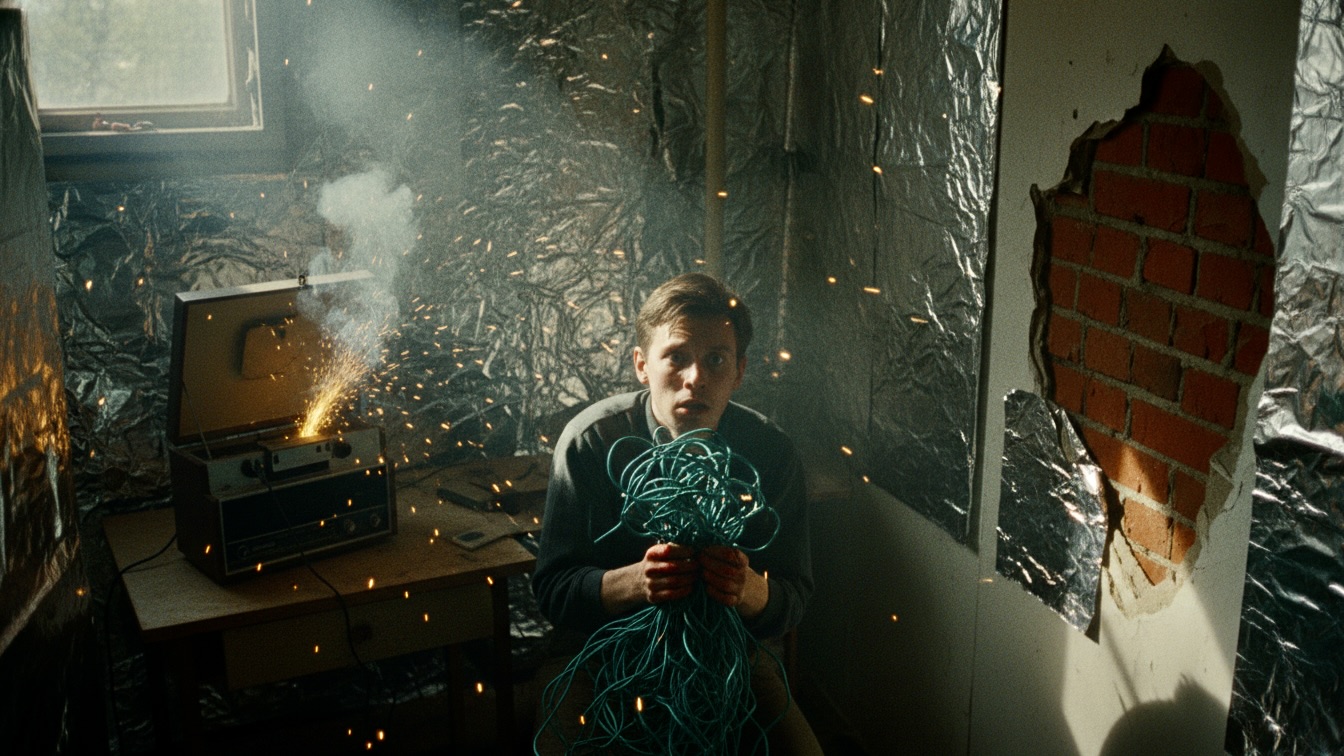
Jeff traces a ghost signal in a crumbling building while his digital life is deleted in real time.
The sun was too bright for March in Winnipeg. It wasn’t a warm sun. It was that sharp, surgical light that hits the melting snow and makes you squint until your head aches. I stood on the corner of Princess and Bannatyne, looking up at the heritage building. It was one of those old brick giants that had survived the 1900s only to be carved into luxury lofts for people who wanted to live in the past but with better Wi-Fi. The brick was red, stained by a century of soot and dampness, and the windows were narrow, like eyes that didn't want to see what was happening on the street.
My phone buzzed. Not my real phone. The work one. The 'Brick.' It’s a custom-built slab of recycled plastic and low-grade silicon that doesn't have a GPS or a camera. It just has a signal scanner. I’m a Vibe-Checker. It sounds like a joke. It sounds like some TikTok trend from 2022 that never died, but in 2026, it’s a high-paying gig. Rich people buy these five-million-dollar condos in the Exchange District and then they start seeing things. Or they feel 'off.' They think the AI-integrated lighting is gaslighting them, or they think the 6G mesh is vibrating their teeth. My job is to go in and tell them they’re crazy, or, more accurately, to find the 'hallucination' signals—the ghost frequencies that the city’s smart-grid kicks out when it gets too crowded.
I checked the address again. 142 Princess. The door was heavy oak, scarred and peeling. The electronic keypad was blinking orange. I tapped my clearance card against the sensor. It hesitated. The light cycled through a few colors before turning green with a reluctant click. I pushed my way inside. The air was different here. It smelled like wet dust and old money. The lobby was empty, the marble floor cracked and covered by a cheap rug that looked like it had been stolen from a motel. There was no concierge. Just a screen on the wall displaying a generic landscape that flickered every few seconds.
I didn't take the elevator. In these old buildings, the elevators are just vertical coffins with bad connectivity. I took the stairs. My boots thudded against the iron treads. Every floor I climbed, the Brick in my pocket got warmer. It was catching something. Not the usual 6G hum. This was different. It was jagged. Low-frequency. Analog.
I reached the fourth floor. The hallway was long and narrow. The lighting was that simulated daylight that always feels slightly blue, like a hospital at three in the morning. I stopped at 402. The door was reinforced with a steel plate. Someone had scratched a symbol into the paint—a circle with a line through it. Old school. Anti-tech.
I knocked. I didn't use the smart-bell.
"Who is it?" The voice was thin, reedy. It sounded like it hadn't been used in a week.
"Jeff. Vibe-Checker. You called the agency?"
There was a long pause. I could hear the sound of several deadbolts sliding back. One. Two. Three. The door opened a crack. A single eye looked out at me. It was bloodshot and surrounded by a map of wrinkles.
"You have the scanner?" the man asked.
"In my pocket. It's offline. Non-transmitting. Just like you asked."
The door opened wider. Mr. Garsen was a small man, wearing a moth-eaten cardigan and a pair of trousers that were two sizes too big. He looked like he was vibrating. Not a physical shake, but a nervous energy that radiated off him. The apartment behind him was a tomb. The windows were covered in heavy foil. The walls were lined with old books and stacks of paper. It was a digital desert.
"Come in. Hurry. The mesh is heavy today. I can feel it on my skin. Like ants," Garsen said, stepping back to let me pass.
I stepped inside and the door slammed shut. He locked all three bolts immediately. The silence in the room was heavy. Without the background hum of the city's smart-grid, my ears started to ring. I pulled the Brick out of my pocket. The screen was black and white. A single line of green pixels danced across the middle.
"What am I looking for, Mr. Garsen? The agency said you were reporting signal interference with your medical devices."
He laughed. It was a dry, hacking sound. "I don't have medical devices. I don't have a smart-watch. I don't even have a fridge that talks to the grocery store. I called the agency because you're the only ones allowed to carry high-gain receivers into private residences without a police warrant."
I frowned. "That’s not exactly how it works. I’m just here to check the vibes."
"Vibes," Garsen spat. "You're checking for ghosts. Well, I found one. Sit down, Jeff. You’re about to lose your job."
He pointed to a chair that looked like it had been salvaged from a dumpster. I sat. Garsen went to a corner of the room and pulled a tarp off a piece of equipment that didn't belong in 2026. It was a reel-to-reel tape recorder. Next to it was a vacuum-tube amplifier and a massive, copper-coiled antenna that looked like it had been hand-soldered.
"Listen to this," he said. He flipped a toggle switch. A low hum filled the room. The Brick in my hand started to vibrate. The green line on the screen went wild, spiking into jagged peaks.
"What is that?" I asked. "That's not 6G. It's way too low."
"It's an analog bypass," Garsen whispered. "It's coming from the sub-basement. Through the old copper pipes. Someone is using the building's skeletal structure as a transmission line. It's an old trick. They used it in the Cold War. It’s un-traceable by the mesh because it doesn’t use packets. It’s just... raw sound."
He turned a dial. The hum cleared, and static took over. Then, through the white noise, a voice emerged. It was a woman’s voice. She sounded tired. She sounded like she was speaking from the bottom of a well.
"Entry 402. March 12th. They’re moving the third floor tonight. It’s not downsizing. They’re not getting severance. I saw the transport logs. They’re being tagged as 'Legacy Hardware.' If you’re hearing this, the riots in 2025 weren't about wages. They were about the data harvesting. We weren't just replaced. We were processed."
I felt a chill that had nothing to do with the drafty apartment. "Processed? What does that mean?"
Garsen leaned in close. His breath smelled like stale coffee. "It means they didn't just fire the workers during the wage riots. They didn't have the money to pay them off, and they couldn't have them roaming the streets. So they moved them to 're-training centers.' Only, the centers don't exist. They took their biometric signatures, their cognitive patterns, and they fed them into the new automation models. They turned humans into training data. Real-time labor simulation. They processed them, Jeff. Literally."
"That’s a conspiracy theory," I said, but my voice was shaking. "The 2025 riots were settled. The government provided the Universal Basic Income. Everyone’s fine."
"Are they?" Garsen asked. "When was the last time you saw a delivery driver who wasn't a drone? When was the last time you talked to a customer service rep who wasn't a deep-fake? The names, Jeff. Listen to the names."
The voice on the tape started reading. It was a list.
"Sarah Miller. ID 9982. David Chen. ID 4431. Mark Thomas..."
I froze. Mark. My brother. He’d disappeared during the second week of the riots. The official report said he’d taken a job in the northern territories, working on the carbon-capture rigs. I hadn't heard from him in six months. I’d sent him messages. I’d tried to call. The mesh always said 'Subscriber out of range.'
"Is this real?" I asked. My heart was thumping against my ribs.
"It’s as real as the copper in these walls," Garsen said. "The signal is looping. It’s been looping for three days. I think whoever was sending it is gone. But they left the transmitter on. I can’t broadcast it. If I try to upload this to the net, the filters will catch it in milliseconds. It’ll be flagged as a 'deep-fake hallucination' and I’ll be audited before I can hit send. My social credit is already at 400. One more hit and they turn off my heat."
I looked at the Brick. The signal was still there. Raw. Human. "I can record it on my scanner. It’s non-integrated. I can take it to the press."
"What press?" Garsen laughed. "The press is owned by the same people who own the mesh. You need to go bigger. You need to get this to the underground nodes. The people who still use the old fiber lines in the sewers."
Suddenly, the Brick in my hand emitted a high-pitched squeal. The screen turned bright red. A message appeared in white text: SECURITY CLEARANCE REVOKED. CONTACT SYSTEM ADMINISTRATOR.
"What?" I tapped the screen. It was frozen. "My clearance... they just flagged me."
I pulled out my personal phone. The screen was dark. I tried to wake it up. A logo appeared. A stylized eye with a line through it. ACCOUNT FROZEN. REASON: UNLAWFUL DATA ACCESS.
"They found us," Garsen said. He looked toward the door. "They saw the dip in the local mesh. They knew someone was looking at the 'dead' air."
I stood up, panicking. "I have to go. I need to get out of here."
I ran to the door and grabbed the handle. It didn't budge. The electronic lock had been engaged from the outside.
"It’s a smart-lock, Jeff," Garsen said calmly. "The building is part of the grid. When they revoke your clearance, they don't just take your money. They take your mobility. We’re locked in."
I kicked the door. It was solid steel under the wood veneer. "There has to be another way out. The fire escape?"
"Welded shut last year. Safety regulations, they said. To keep the 'un-homed' out."
I turned back to the room. I felt the walls closing in. Every sensor in the ceiling, every smoke detector, every smart-bulb was now a camera. The building was watching us.
"They’re coming, aren't they?" I asked.
"The Auditor," Garsen said. "The cleanup crew. They’ll be here in ten minutes. They’ll say there was a gas leak. Or a 'signal-induced psychosis' incident. We’ll be processed, just like the others."
I looked at the copper antenna Garsen had built. I looked at the walls. "You said the signal travels through the pipes? The copper?"
"Yes."
"If we can’t get the signal out through the air, we send it back through the building," I said. I was talking fast now, the words overlapping with my own racing thoughts. "We create a loop. We amplify the signal and dump it into the whole block. If we can hit enough devices at once, the filters won't be able to keep up. It’ll crash the local mesh node."
"How?" Garsen asked. "We don't have enough power."
"We need more wire," I said. I looked at the wall where a light switch was. I grabbed a heavy screwdriver from Garsen’s workbench and started prying at the plastic plate. "We strip the copper from the walls. We build a Faraday cage around the transmitter to keep the mesh from jamming us, and then we hook the output directly into the building’s wiring."
I ripped the switch out. Sparks flew. I didn't care. I grabbed the wires and pulled. They were thin, but they were there.
"Help me!" I shouted.
Garsen hesitated, then grabbed a pair of pliers. We went to work like madmen. We tore into the drywall, our fingers bleeding as we searched for the copper veins of the building. It was slow, deliberate work, but the paranoia was a stimulant. Every sound in the hallway—the hum of the elevator, the creak of a floorboard—sounded like a death sentence.
I stripped a long length of wire, the plastic insulation stinging my palms. My mind was a mess. Mark. The names. The processing. It wasn't just a job anymore. It was a funeral. We were in a grave, and we were trying to scream loud enough to wake the neighbors.
"I hear them," Garsen whispered. He was standing by the door, his ear pressed to the wood. "The elevator. It’s coming up."
I looked at the mess of wires we’d gathered. It was a tangled nest of orange and green. "Hook it up. Now!"
We ran to the reel-to-reel. I wrapped the raw copper around the output jack. Garsen was shivering. I could see the fear in his eyes—the realization that his three years of hiding were over.
"If we do this, there’s no going back," he said. "They’ll delete everything. Our IDs. Our histories. We’ll be ghosts."
"We're already ghosts," I said. "I just want people to know my brother's name."
I grabbed the main power line for the amplifier. My hands were shaking. I looked at the Brick. The red screen was still there, a digital tombstone.
"Do it," Garsen said.
I shoved the wire into the outlet.
The room exploded in a burst of white light. The amplifier roared. The reel-to-reel spun so fast the tape began to smoke. The sound wasn't coming from the speakers anymore. It was coming from everywhere. The walls vibrated. The foil on the windows rattled. It was the sound of a thousand voices screaming through the copper, a chorus of the disappeared.
Outside, I heard the sound of the smart-locks in the entire building clicking open simultaneously. The mesh was crashing.
I looked at the door. The handle turned.
The light in the hallway was blinding, and a figure stood there, silhouetted against the artificial day. It wasn't a man. It was a machine, sleek and black, with a single glowing lens for a face.
"Jeffery Miller," the machine said. Its voice was a perfect, synthesized version of my own. "Your vibe check is complete."
I gripped the copper wire, the current humming through my bones, and I didn't let go.
“I gripped the copper wire, the current humming through my bones, and I didn't let go.”


