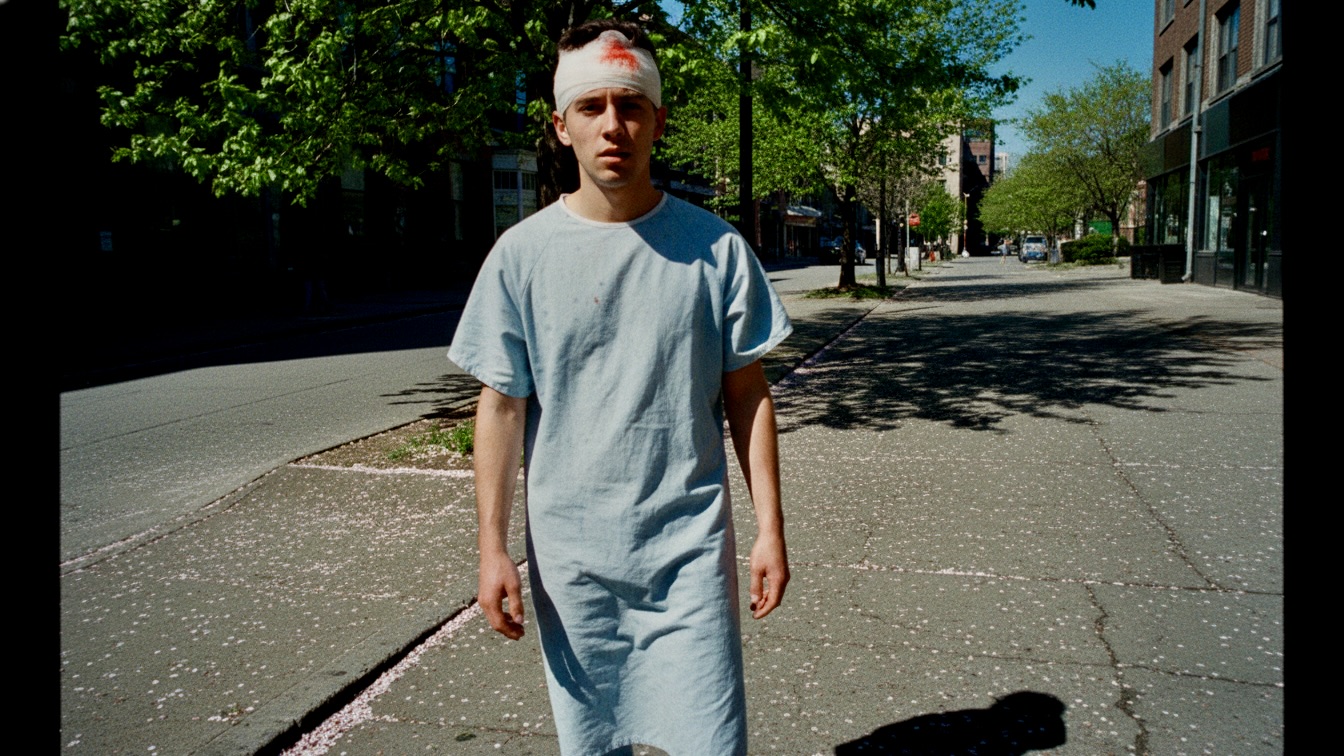
Ole discovers a hidden server partition that holds the life he forgot while erasing others for a living.
My head is a dead room. That is the only way to describe the feeling of the clinic at six in the morning. It is too clean. The air has been filtered so many times it feels like it has no nutrients left in it. Outside, the cherry blossoms are doing that thing where they turn the sidewalks into a pink mess, but in here, everything is grey and white. The spring sun hits the windows in the lobby, but the glass is tinted. It makes the world look like a low-resolution video. I hate the way the light looks in April. It is too hopeful for what we do here.
I sat at my desk and watched the cursor blink. It was waiting for me to login. I have been doing this for three years, and every morning, I feel like I am logging into someone else's life. Paula was coming in at six-thirty. She was a high-profile case. The kind of girl whose father buys buildings to make problems go away. She had a problem that a building could not fix. She had a hit-and-run on her conscience, and she wanted the conscience part removed.
I heard the heavy door at the front click open. That was Paula. She always smelled like expensive cigarettes and a perfume that probably cost more than my rent. I got up and walked to the waiting area. She was sitting on the edge of the designer chair, her hands shaking. She looked like she had not slept in a week. Her eyes were bloodshot, the red veins making a map of her guilt.
"Hey," I said. I do not use titles. It makes them feel too much like patients. In here, they are clients. "You ready?"
Paula looked up at me. "Does it hurt? Everyone says it doesn't, but they're all... you know. They don't remember if it did."
"It doesn't hurt," I said. I have said that a thousand times. "It feels like a nap. You wake up, and the weight is gone. You won't even remember the weight existed."
"I want it gone, Ole. I can't see his face anymore. Every time I close my eyes, I see the bike. I see the way his helmet cracked. I just... I can't."
"We'll take care of it," I told her. I led her back to the extraction suite. The room is dominated by the tank. It is filled with a thick, blue gel that looks like melted gummy bears but smells like a hospital. We call it the cradle. I helped her get into the gown. She was thin, her collarbones sticking out like knives. I hooked the sensors to her temples. I felt the familiar hum of the machinery through the floor. It is a low-frequency vibration that you stop noticing after ten minutes, but it gets into your bones.
"Close your eyes," I said. I started the drip. The sedative is fast. Her eyelids fluttered and then stayed shut. I sat at the console and began the scan. The monitor showed her brain in 3D, a glowing web of neon lines. I found the trauma node easily. It was a jagged, pulsing cluster of deep purple in the temporal lobe. That was the hit-and-run. That was the man on the bike. I highlighted it with the stylus. Usually, when I hit 'Process,' the system runs an algorithm that disrupts the synaptic pathways. The memory is broken down into noise. It becomes a blur, then a smudge, then nothing.
But today, the system felt slow. There was a lag. I saw a progress bar I had never seen before. It didn't say 'Deleting.' It said 'Transferring.'
I paused. My finger hovered over the screen. Transferring? To where? The clinic's policy was total erasure. We were supposed to be a digital incinerator. I looked at the data path. The packets of Paula's trauma—the sound of the impact, the scream, the rain on the windshield—were being bundled into an encrypted file and sent to a local partition named 'Vault_7'.
I felt a cold prickle on the back of my neck. I looked at Paula. She was floating in the blue gel, her mouth slightly open. She looked peaceful, but her life was being stolen, not deleted. I checked the directory. Vault_7 was massive. It was gigabytes of human misery. But it wasn't just misery. There were folders for 'Joy,' 'First_Love,' 'Technical_Skill.'
I opened a random folder in the 'Joy' section. It was a memory of a wedding. A beach. The sound of waves crashing. I felt a weird sense of vertigo. I knew those waves. I knew the way the sun hit the water at that specific angle. I scrolled through the thumbnails. There was a woman in a white dress. She was laughing, her hair blowing across her face. She had a small mole just above her lip.
My heart hammered against my ribs. I knew her. But I didn't. I searched my mind for a name, a place, a date. Nothing. It was like looking at a movie I had seen a long time ago and forgotten the plot of. Then I saw the metadata for the file. The owner ID was mine. Ole Weidun.
I felt sick. I looked at the date. Three years ago. The month before I started working here. I had no memory of a wedding. I had no memory of that woman. According to my own head, I have been single and focused on my career since I graduated. I live in a studio apartment with a plant I forget to water. I don't have a wife. I don't have a beach.
I heard footsteps in the hall. Fast, rhythmic. Dr. Kniler. I quickly closed the window and pulled up the standard deletion interface. The transfer was already 90% complete. I couldn't stop it without crashing the whole system.
Kniler walked in. He is one of those men who looks like he is made of granite and expensive tailoring. He smiled, but it didn't reach his eyes. It never does. "How's our girl doing?"
"Almost done," I said. My voice sounded thin to my own ears. "Just finishing the scrub."
"Good, good. She's a big one. Her father is already asking about the bill. Make sure it's clean, Ole. No ghosts."
"The system seems a bit slow today," I said, testing him. "I saw some lag in the processing speed."
Kniler walked over to the console. He leaned in close. I could smell his coffee. "The servers are under a lot of load. Don't worry about the technical side. Just focus on the client. Are we clear?"
"Clear," I said. I watched the progress bar hit 100%. The purple cluster on Paula's brain map faded to a dull grey. She was empty now. The man on the bike was gone. He was in the Vault.
Kniler stayed until I drained the tank. He watched me help the groggy Paula into a recovery chair. She blinked at me, her eyes vacant. "Did it work?" she whispered.
"It worked," I said. I felt like a liar. I felt like a thief.
After Paula left and Kniler went to his office, I stayed in the extraction suite. I locked the door. My hands were shaking so hard I could barely type. I navigated back to the hidden partition. I needed to see that wedding again. I needed to see the woman with the mole.
I found the file. I opened the video. It was a first-person perspective. My perspective. I was holding her hands. I could hear my own voice. "I promise to always keep the coffee warm," I said in the video. I sounded happy. I sounded like a person I didn't recognize.
"Ole?"
I jumped, nearly knocking the monitor over. Kniler was standing at the door. I hadn't heard the lock click. He must have a master key. He wasn't smiling anymore.
"You weren't supposed to find that," he said. He walked into the room, his presence filling the small space.
"What is this?" I pointed at the screen. "Who is she? Why don't I remember this?"
Kniler sighed. He sat on the edge of the desk, looking at me with a sort of pity that made me want to punch him. "Total rejuvenation, Ole. That's the brand, right? We sell the blank slate. But you can't be a good technician if you're carrying around your own baggage. You were a mess when you came to us. Grief-stricken. Non-functional. You asked for this."
"I asked to forget my wife?"
"She died, Ole. A car accident. You couldn't handle it. You were suicidal. So we did a deal. We gave you a job, a purpose, and a clean head. In exchange, we took the data. Memories of that caliber—pure, deep, unadulterated love—they're worth a fortune. We sell them to people who have never felt anything. It's a premium product."
"You're harvesting us," I said. The room felt like it was spinning. "Paula. Me. Everyone who comes through that door. You're not erasing the trauma. You're just moving it to a shelf so you can sell the good parts of their lives to the highest bidder."
"It's recycling," Kniler said, his voice flat. "The world is full of people with empty heads and full bank accounts. Why let a perfectly good memory go to waste in a grave or a bottle of whiskey? We're optimizing the human experience."
"I want them back," I said. I stood up. "I want my memories back."
"You can't have them. They've already been licensed out. Parts of your wedding are currently being enjoyed by a tech mogul in Singapore. He finds the beach sounds very soothing for his anxiety."
I felt a surge of rage so hot it made my vision blur. I looked at the tank. The blue gel was still warm from Paula. I looked at the console. The 'Admin_Backup_W' folder was still open. There was a 'Reinject' command. It was restricted, but I knew the override codes. I had written half of them.
"Get out, Ole," Kniler said. "Go home. Take a week off. We'll talk when you're less... emotional."
"No," I said. I didn't think. I just moved. I grabbed the heavy glass carafe from the side table and swung it. It hit Kniler in the side of the head with a sickening thud. He went down hard, his head bouncing off the carpet. He wasn't dead, but he was out.
I worked fast. I knew security would be at the door in minutes. I dragged Kniler into the recovery room and locked it. I ran back to the console. I initiated the reinjection protocol for the 'W' file. The system screamed at me. WARNING: NEURAL INTEGRITY AT RISK. TOTAL SYNAPTIC OVERLOAD LIKELY.
I didn't care. I stripped off my shirt and climbed into the tank. The gel felt like cold slime against my skin. I grabbed the headpiece and jammed the needles into the ports behind my ears. I felt the sharp sting, then the cold rush of the interface fluid.
I reached for the remote tablet on the edge of the tank. My fingers were slippery with gel. I hit 'Confirm.'
At first, there was nothing but white noise. A loud, rushing sound like a waterfall inside my skull. Then, the ceiling of the clinic vanished.
I was on the beach. The sun was so bright it hurt. I could smell the salt. I could feel the sand between my toes. The woman—her name was Clara, I remembered it now, it hit me like a physical blow—was standing in front of me. She was wearing a sundress that smelled like laundry detergent and coconut oil.
"You're late," she said, laughing.
Then the scene shifted. We were in a small kitchen. It was raining outside. We were eating Thai takeout on the floor because we hadn't bought a table yet. I could taste the spicy peanut sauce. I could feel the rough texture of the carpet.
Then the pain hit.
It wasn't just the good stuff. Kniler had lied. They didn't just take the joy. To keep the joy, you had to have the context. The harvest included everything. I saw the car. I saw the headlights. I heard the screech of tires. I felt the steering wheel vibrate in my hands as I tried to swerve. I heard the glass shattering. I heard the silence that followed.
I felt the three years of grief that I had been cheated out of. It came at me like a tidal wave. It wasn't a grey weight; it was a black hole. It tore through my mind, shredding the neat, tidy life I had built in the clinic. I felt my brain frying, the neurons screaming as they were forced to reconnect pathways that had been cauterized.
I screamed, but my mouth was full of blue gel. I thrashed in the tank, my limbs heavy and useless. The world was a strobe light of memories—Clara's smile, the hospital bed, the smell of her hair, the sound of the heart monitor flatlining.
I felt the needles pull out of my head as I kicked the side of the tank. The gel spilled onto the floor. I collapsed onto the tiles, shivering, gasping for air that didn't taste like chemicals.
I lay there for a long time. The clinic was quiet. The alarm was ringing somewhere in the distance, but it felt miles away. I looked at my hands. They were covered in blue slime. I remembered everything. I remembered the way Clara used to bite her lip when she was reading. I remembered the fight we had the morning she died. I remembered the way the air felt at her funeral.
It hurt. It hurt so much I couldn't breathe. My chest felt like it had been cracked open with a sledgehammer.
I heard the door burst open. Security. Medics. Maybe even the police. I didn't move. I just lay there on the cold, hard floor, watching the spring sun try to fight its way through the tinted glass.
Someone grabbed my shoulders. Someone was shouting my name. I didn't answer. I didn't want to. I was too busy feeling the ache in my throat. It was the most honest thing I had felt in years.
I looked up at the ceiling. The grey weight was gone. It had been replaced by a crushing, beautiful, agonizing reality. I was broken, and I was bleeding, and I was finally, actually alive.
Kniler was wrong. You can't recycle a life. You can only live it, even if living it means you want to die. I closed my eyes and saw Clara. She wasn't a digital file anymore. She wasn't a licensed product for a billionaire in Singapore. She was mine. The pain was mine.
I felt a hand on my pulse. "He's back," a voice said. "He's awake."
I opened my eyes and looked at the medic. He was young, maybe twenty-two. He looked scared.
"Are you okay?" he asked. "Do you know where you are?"
I looked at the blue gel drying on the floor. I looked at the locked door where Kniler was probably waking up with a concussion. I looked at the bright, terrifying April sun.
"I'm here," I said.
But as the shadows of the security team loomed over me, I realized that remembering was only the first step. The clinic was still there. The Vault was still full. And I was the only one who knew how to unlock the door.
I felt the weight of the memories settle into my bones. They weren't light. They weren't easy. They were jagged and sharp and heavy as lead. But they were heavy the way a child is heavy when you carry them to bed. It was a weight that meant something.
I wondered if Paula was sitting in her car right now, staring at her hands, wondering why she felt like something was missing. I wondered if she felt the ghost of the man on the bike. I hoped she did. I hoped she felt every bit of it. Because the alternative was this grey, sterile nothingness.
I tried to sit up, but my muscles wouldn't cooperate. I just lay there, a wet, shivering mess on the floor of a million-dollar facility.
"Don't move," the medic said. "You've had a massive neural event. We need to stabilize you."
"I'm stable," I whispered.
I watched a single cherry blossom petal that had somehow made its way through the ventilation system. It drifted down, landing in the puddle of blue gel near my face. It was pink and fragile and real. It was the only thing in the room that wasn't a lie.
I reached out a finger and touched it. The texture was soft, slightly damp. It felt like the world. It felt like the truth.
I didn't know what would happen next. I didn't know if they would arrest me or just wipe me again and throw me on the street. But as the darkness started to creep back in at the edges of my vision, I held onto that petal. I held onto the image of Clara's mole. I held onto the sound of the crashing waves.
I wasn't a dead room anymore. I was a house on fire, and for the first time, I wasn't trying to put it out.
I closed my eyes and let the fire burn. It was the only way to stay warm in a place this cold.
I heard Kniler's voice from the other room, muffled but angry. He was shouting about the data. He was shouting about the loss of revenue. He didn't understand. He thought the memories were the product. He didn't realize that the product was the person. And you can't sell a person one piece at a time without losing the whole thing.
I felt a needle go into my arm. A sedative. They were trying to put me back to sleep. They were trying to bring back the grey.
"No," I said, but the word was just a breath.
I fought it. I fought the sleep with everything I had. I counted the memories like beads on a string. The wedding. The car. The kitchen. The funeral. The beach. The rain. Clara. Clara. Clara.
I wouldn't let them take her again. Even if I had to burn my own brain to ash to keep her.
I felt the world slipping away, the sterile lights of the clinic fading into a dull hum. But underneath it, I could still hear the waves. I could still smell the salt.
I was going under, but I wasn't drowning. I was just going home.
I think I saw Paula in the hallway as they wheeled me out. She looked at me, and for a second, I thought I saw a spark of recognition in her eyes. A flicker of the man on the bike. A shadow of the truth.
I tried to smile, but I couldn't feel my face.
I just watched her until the doors closed.
Then there was only the dark, and the heat, and the beautiful, terrible pain of being me.
I woke up later in a different room. It wasn't the clinic. The air was different. It smelled like old dust and stale coffee. There were no blue gels here. There were no high-resolution brain maps. Just a cracked ceiling and the sound of a siren outside.
I tried to move my hand. It felt like it belonged to someone else. I looked down. I was wearing a hospital gown. My head was wrapped in bandages.
I felt a sharp pain behind my eyes. I welcomed it. It meant I was still there.
I looked at the bedside table. There was a small, plastic cup of water and a cheap digital clock. 4:15 PM. Spring.
I realized I didn't know where I was, but for the first time in three years, I knew exactly who I was. I was Ole Weidun, and I was a man who had lost his wife. I was a man who had committed a crime. I was a man who had stolen his own life back.
I reached up and touched the bandages. My fingers were shaking.
I wondered if the tech mogul in Singapore was missing his beach right now. I wondered if he felt the sudden void where my joy used to be. I hoped he felt the cold. I hoped he felt the emptiness.
I sat up, the world tilting dangerously. I had to get out of here. I had to find a way to tell the world about the Vault. I had to find a way to give people back their ghosts.
Because without our ghosts, we're just machines that eat and sleep and wait to die.
I stood up, my legs feeling like jelly. I grabbed the hospital gown, pulling it tight around me. I walked to the window.
Outside, the world was loud and messy and bright. There were people everywhere, carrying their own burdens, their own secrets, their own pains. They didn't know how lucky they were to feel the weight of it all.
I looked at the street below. A man was riding a bike. He was wearing a yellow helmet.
I watched him until he turned the corner.
I didn't know if I would survive the next hour, let alone the next day. But as I stood there in the fading light of a spring afternoon, I felt a strange sense of peace.
It wasn't the fake peace of the clinic. It wasn't the chemically induced calm of the cradle. It was the peace of a man who has finally stopped running.
I turned away from the window and headed for the door.
I had a lot of work to do.
I had a lot of people to wake up.
But first, I needed to find a phone. I needed to see if I could find Clara's parents. I needed to tell them I was sorry I had forgotten. I needed to tell them that I remembered every single thing.
I walked into the hallway, the light flickering above me. It was a cheap, industrial light, and it was perfect. It was real.
I felt the pain in my head flare up again, a sharp, pulsing reminder of the cost of the truth.
I smiled.
It was the best thing I had ever felt.
I passed a nurse at the station. She didn't look up. She was busy typing on a computer, her face lit by the blue glow of the screen. I wondered what she was forgetting. I wondered what she was hiding from.
I didn't stop to ask. I didn't have time.
I reached the exit and pushed open the heavy doors.
The air hit me like a physical force. It was cold and damp and smelled of exhaust and blooming flowers. It was the smell of life.
I took a deep breath, filling my lungs with the messy, unfiltered air of the city.
I stepped onto the sidewalk, my bare feet cold on the concrete.
I was Ole Weidun. I was a widower. I was a thief. I was a survivor.
And I was finally, finally, awake.
“I stepped onto the sidewalk, my bare feet cold on the concrete, and for the first time in years, the air didn't feel empty.”


