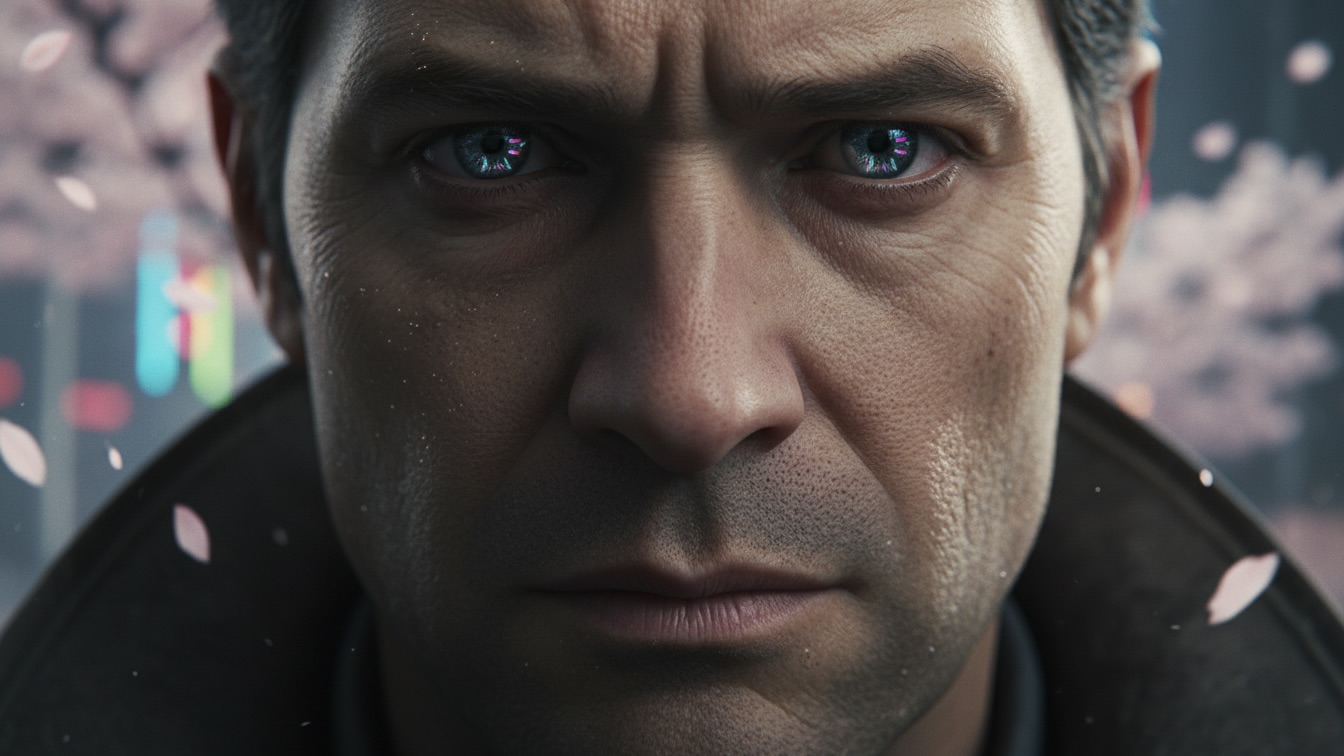
Detective Lane is an aging investigator struggling with failing eyesight in a world where digital data has superseded physical evidence. When a wealthy man named Henderson is murdered in a room that security servers claim was empty, Lane suspects the use of an augmented reality cloak. He ignores the digital logs and relies on his physical senses, eventually finding a tangible shard of a holographic emitter at the crime scene. This physical clue leads him to Randy, a tech entrepreneur who believes that truth is whatever the central hub broadcasts.
The confrontation between Lane and Randy culminates in a chase through the Strobe District, where Randy uses his invisibility technology to hide in plain sight. Lane, realizing his eyes are being deceived by the digital mask, closes them and relies on sound and touch to track the killer. He uses an analog flash-bang to overload Randy's sensors, forcing the cloak to fail and revealing the terrified man beneath the pixels. Although the digital legal system refuses to acknowledge the arrest without data, Lane records the events on physical paper, choosing to trust his own perception over the flickering, simulated reality of the city.
The narrative explores the profound tension between objective truth and digital consensus. In Lane’s world, the legal system has been hijacked by a "central hub" that dictates reality based on verified data streams. This creates a terrifying landscape where a murder can be physically real but legally non-existent because it was not captured by a sensor. The story suggests that when society prioritizes data over human witness, it loses its grip on morality and justice.
Another central theme is the decay of the physical in the face of the digital. Lane’s failing eyesight serves as a metaphor for the fading relevance of the biological world. While the city is filled with beautiful cherry blossoms and bright lights, these images are often revealed to be glitches or projections. The story posits that the more we rely on digital filters to perceive our surroundings, the more fragile our connection to actual existence becomes.
Finally, the story examines the concept of "analog resistance." Lane represents a dying breed of human who values the weight of a key, the texture of paper, and the smell of coffee. His victory over Randy is not a triumph of superior technology, but a triumph of basic physics. By using a flash-bang—a simple explosion of light and sound—he proves that the digital world is a thin veneer that can be shattered by raw, physical force.
Detective Lane is a man defined by his sensory struggle and his refusal to adapt to a dishonest age. Psychologically, he suffers from a sense of displacement, feeling like an "anachronism" in a city that no longer values his methods. His failing vision is not just a physical ailment but a psychological catalyst that forces him to develop a deeper, more intuitive connection to the world. He finds clarity in the dark, suggesting that his true strength lies in his ability to perceive what cannot be rendered by a computer.
His motivation is rooted in a stubborn commitment to the "dirt" of reality. He is a character who finds comfort in imperfections, such as the dent in his car or the peeling paint of his home. This preference for the flawed and the tangible reveals a man who equates perfection with deception. By the end of the story, his acceptance of his impending blindness reflects a psychological peace; he no longer needs to see the digital lie to know the physical truth.
Randy serves as the psychological foil to Lane, representing the hubris of the digital elite. He perceives himself as a god-like figure who can rewrite reality through code, dismissing the concept of objective truth as "obsolete." His identity is entirely tied to his digital footprint and his silver suit, which acts as a second skin. This reliance on a technological mask suggests a profound internal hollowness and a fear of being seen as a mere, fallible human.
When his technology fails, Randy’s psychological facade collapses instantly. Without his AR-cloak, he is described as small and terrified, revealing that his arrogance was entirely dependent on his invisibility. He is a character who has traded his humanity for data, and when the server "crashes," he is left with nothing. His defeat highlights the cowardice inherent in those who hide behind systems of control rather than facing the consequences of their physical actions.
Captain Underwood represents the middle ground between Lane’s analog world and the digital future. She is a pragmatist who understands the limitations of the law but remains bound by its digital requirements. While she dismisses Lane’s theories initially, her actions at the end of the story reveal a hidden psychological conflict. By locking Lane’s paper record in her desk, she acknowledges a truth that she is officially required to ignore.
The pacing of the story mirrors the protagonist's internal state, moving from a slow, squinting deliberation to a frantic, sensory-overloaded climax. The early scenes are atmospheric and heavy, emphasizing the "cheap coffee" and "granite" presence of the Captain. As the chase begins, the prose becomes more rhythmic and percussive, reflecting the "analog racket" of the pursuit. This shift in speed effectively conveys the urgency of Lane's mission to catch a man who is literally disappearing.
The author uses sensory details to create a sharp contrast between the digital and the analog. The "smell of copper," the "pop of knees," and the "bitter coffee" are described with a visceral intensity that makes them feel more real than the "liquid silver" suits or "luminous circuit boards" of the city. These details ground the reader in Lane's perspective, making the digital glitches feel invasive and wrong. The use of light is particularly effective, moving from the "smear of grease" in Lane's vision to the "white-hot wall" of the flash-bang.
The narrative voice is one of weary persistence, characteristic of the noir genre. It carries a tone of mourning for a world that is being overwritten by code. The recurring motif of the cherry blossoms provides a delicate, temporary beauty that contrasts with the cold permanence of the servers. This stylistic choice reinforces the idea that true beauty and truth are often found in things that are "real and temporary," rather than in the eternal, artificial loops of a digital simulation.


