Format: Short Film / Anthology Episode | Est. Length: 10-12 minutes
Imagine a near-future anthology series titled The Analog Ledger, where every episode explores the friction between a hyper-digitized society and the gritty, decaying remains of physical reality. In this world, the "Central Hub" dictates what is true based on server logs, leaving justice in the hands of those who still remember how to look beneath the pixels. "Dead Pixel Ghost" serves as a pilot or standalone entry that establishes the series' core conflict: the battle to preserve objective truth in an era of programmable perception.
Detective Lane stares at a high-definition security feed of a brutal murder where the victim falls dead from invisible wounds in a perfectly empty room. "The servers say the room was empty," Captain Underwood states, while Lane looks at the very real blood pooling on a very real rug.
A detective with failing eyesight must hunt a killer who uses military-grade AR-cloaking to remain invisible to the city’s digital surveillance. To catch a ghost the servers refuse to acknowledge, he must abandon his screens and rely on his fading physical senses.
The primary theme explores the death of objective truth in favor of consensus reality, where data is treated as more "real" than physical evidence. It questions whether a crime truly happened if the system is programmed to ignore it, highlighting the dangerous power held by those who control the "truth-verification" software.
Secondary themes include the obsolescence of the human body and the value of the "analog" experience. Lane’s failing eyes serve as a metaphor for a society losing its ability to perceive the world without a digital filter, ultimately suggesting that truth is found in the flawed, the physical, and the permanent rather than the polished digital lie.
For Detective Lane, the stakes are both professional and existential; if he cannot prove Randy’s guilt, the legal precedent will be set that digital logs supersede physical reality, effectively granting immunity to anyone with the right code. For the city, the stakes involve the total erosion of justice, as the "Central Hub" becomes a tool for the elite to mask their crimes behind a veil of "verified" data.
The primary external conflict is the technological gap between Lane’s traditional investigative methods and Randy’s high-end AR-cloaking tech, which makes the killer literally invisible to both cameras and Lane’s failing eyes. Internally, Lane battles his own degenerative vision and a bureaucratic system, embodied by Captain Underwood, that refuses to issue warrants without "digital certainty." Randy serves as the personification of digital arrogance, believing himself a god because he can manipulate the data that the world accepts as gospel.
Detective Lane investigates the murder of a man named Henderson, who was stabbed to death in a room that digital surveillance claims was empty. While the department's forensic bots fail to find digital signatures, Lane’s manual search uncovers a physical shard of a holographic emitter, proving the killer used an AR-cloak to "edit" himself out of the reality captured by the servers. Tracing the hardware to tech-mogul Randy, Lane realizes the murder was committed to suppress a flaw in Randy’s "truth-verification" software.
Despite having no digital warrant, Lane confronts Randy in his penthouse, leading to a high-stakes chase through the "Strobe District," where the killer’s cloak makes him a shimmering ghost amidst the neon lights. Lane, realizing his eyes are lying to him, closes them and uses his ears and feet to track the killer’s physical impact on the environment. He detonates an analog flash-bang to overload Randy’s sensors, stripping away the digital mask and revealing the terrified man beneath. Though the system may never fully record the truth, Lane begins a physical ledger to ensure the facts remain in a world of ghosts.
Detective Lane (The Relic): A veteran investigator suffering from macular degeneration, Lane is a man out of time who values "dirt" over "data." His psychological arc begins with a sense of uselessness in a world that no longer needs his eyes, but ends with a renewed sense of purpose as he realizes his fading vision forces him to perceive the world more honestly than those blinded by AR.
Randy (The Architect of Lies): A charismatic but cold tech-entrepreneur who believes that objective truth is an obsolete concept. He starts the episode as an untouchable "ghost" protected by his own software, but his arc ends in total psychological collapse when his digital shield is stripped away, leaving him a small, vulnerable man in a physical alley.
Captain Underwood (The Pragmatist): A high-ranking officer who has surrendered her intuition to the requirements of the "Central Hub." She represents the system's shift toward data-dependency, moving from a position of skeptical obstruction to one of quiet, unofficial support for Lane’s analog methods.
The episode opens with Lane and Underwood viewing the "empty" murder footage, establishing the impossible crime and Lane's frustration with the "lying" servers. Lane ignores the humming forensic bots to crawl across the crime scene, eventually finding a physical holographic shard that the digital scanners were programmed to overlook. He visits Toby, an underground hobbyist, who identifies the shard as military-grade tech and provides the physical "burn-in" serial number that links the hardware directly to Randy.
Lane confronts Randy in a glass penthouse, where the villain explains that "truth" is merely whatever the server chooses to broadcast before vanishing into a digital shimmer. The chase moves into the Strobe District, where Lane is battered by an invisible Randy until he closes his eyes to track the killer by the sound of his footsteps and the splash of puddles. In the climax, Lane detonates an old-fashioned flash-bang, the raw physical light short-circuiting Randy’s AR-suit and revealing the killer to the physical world for the first time.
In the aftermath, Underwood admits the digital footage of the arrest is white noise, but Lane presents his own testimony and the physical shard as the only evidence that matters. Lane returns home and witnesses a "glitch" in a passerby, realizing the entire world is becoming a digital facade. He sits at his desk and begins writing a physical record of the case in a paper notebook, choosing to be the man who watches the shadows in a world of fake light.
The episode begins with a cold, clinical atmosphere of frustration as Lane struggles against a system that denies his senses. The mood shifts into a gritty, tactile investigation as Lane finds the shard, creating a sense of grounded determination. The climax is a sensory-overload nightmare of flickering lights and disorienting sounds, which resolves into a quiet, melancholic clarity as Lane accepts his role as the world's analog witness.
If expanded, the season would follow Lane as he uncovers a systemic "Great Glitch"—a deliberate effort by the Central Hub to overwrite historical records and current events to suit corporate interests. Each episode would feature a different "ghost" crime that requires Lane’s analog intervention, slowly building a network of "Analog Investigators" who operate outside the digital grid.
The season-long character evolution would see Lane losing his sight entirely, forcing him to train a younger, tech-dependent protégé in the art of "seeing" without eyes. The thematic escalation would move from individual murders to the manipulation of city-wide events, culminating in a finale where the digital veil is momentarily lifted for the entire population, forcing a choice between the comfortable lie and the painful truth.
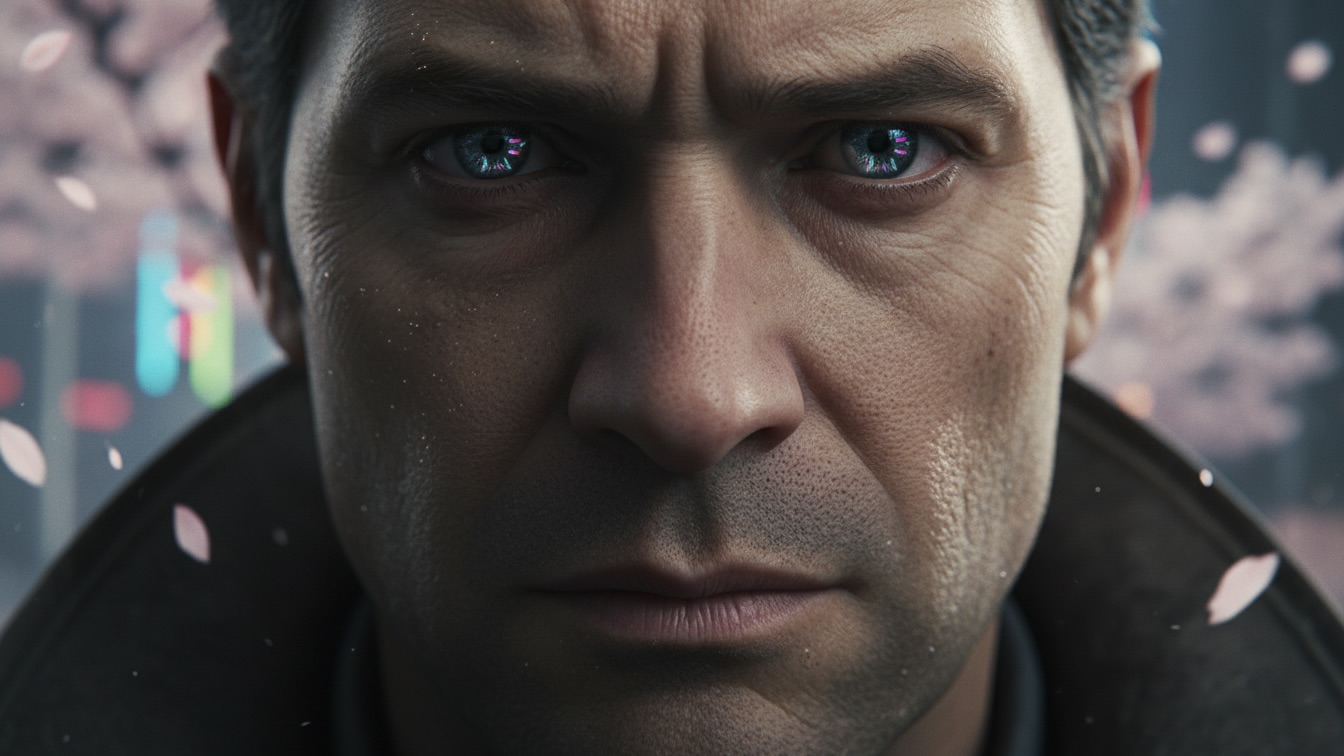
The visual style is "Tactile Cyberpunk," contrasting the sterile, blue-tinted glow of digital interfaces with the warm, messy textures of the physical world—peeling paint, cherry blossoms, and copper-scented blood. The camera work should utilize shallow depth of field and occasional "digital artifacts" to mimic Lane’s failing vision, making the audience feel his disorientation.
The tone is a blend of Neo-Noir and Psychological Thriller, comparable to the investigative grit of Se7en mixed with the high-tech existentialism of Ghost in the Shell. It maintains a somber, grounded atmosphere that emphasizes the weight of physical objects in a world that feels increasingly hollow.
The target audience includes fans of cerebral science fiction and procedural dramas, specifically those aged 18-45 who enjoy "Black Mirror"-style social commentary. It appeals to viewers interested in the ethics of AI and data privacy, as well as those who appreciate the aesthetic of "lo-fi" technology and classic detective tropes.
The 10-12 minute runtime necessitates a brisk, three-act structure: Act I (The Discovery) takes 3 minutes, Act II (The Hunt) takes 5 minutes, and Act III (The Revelation and Aftermath) takes 3-4 minutes. The pacing should feel deliberate and slow during the investigation scenes to emphasize Lane’s focus, then accelerate into a frantic, high-tempo rhythm during the Strobe District chase.
The AR-cloak effect should be handled through a mix of "heat shimmer" post-production effects and practical lighting to ensure the killer feels like a physical presence that is being digitally erased. The Strobe District sequence will require high-intensity LED panels and precise synchronization to create the "visual static" effect without causing actual viewer distress.
The "glitch" scenes, where people’s faces momentarily shift, should be subtle and brief to maintain the sense of unease rather than becoming a full horror element. Practical sets for the penthouse and the alleyway are essential to maintain the "analog" feel of the story, emphasizing the contrast between the silver liquid-suit and the gritty brick-and-mortar environment.


