Format: Short Film / Anthology Episode | Est. Length: 10-12 minutes
This story serves as a foundational entry in a political thriller anthology series titled State of Decay, which examines the fragility of democratic institutions under the pressure of modern geopolitical volatility. Each episode focuses on a different regional crisis, exploring how clandestine intelligence operations, radicalized bureaucracy, and the erosion of public trust converge to destabilize sovereign nations from within.
The silence in the National Assembly boardroom is broken only by the discovery of a sophisticated, non-commercial transmitter hidden behind a radiator. Sebastien Leclair, a mid-level political aide, realizes he has stumbled upon a federal espionage operation just as the city outside erupts into violent, anti-government protests.
A low-level political aide discovers a federal plot to frame his province for terrorism and must navigate a web of double-agents to expose the truth. With the government on the brink of collapse, he realizes that the conspiracy is far deeper—and more dangerous—than he ever imagined.
The episode explores the theme of institutional rot, specifically focusing on how state actors weaponize civil unrest to achieve political ends. It highlights the tension between personal integrity and the cold, calculated necessities of statecraft, questioning whether the truth can survive in a landscape defined by false-flag operations and systemic deception.
Beyond the political, the narrative touches on the theme of betrayal, as the protagonist learns that his allies are as much a threat as his enemies. The emotional undercurrent is one of profound isolation, where the protagonist is forced to abandon his belief in the system and confront the reality that he is a pawn in a much larger, lethal game.
Sebastien’s life is at immediate risk, as he possesses evidence that could dismantle the careers of high-ranking federal and provincial officials. For the province, the stakes involve the potential for martial law and the total loss of autonomy, while for Chloe, the cost of her defection is near-certain death at the hands of her former employers.
The external conflict pits Sebastien against a shadow network of intelligence directors and corrupt security officials who are willing to incite civil war to consolidate power. Internally, Sebastien struggles with the collapse of his worldview, moving from a loyal civil servant to a fugitive who must decide if the truth is worth the cost of the province’s stability.
After discovering a transmitter in the National Assembly, Sebastien contacts his clandestine lover, Chloe, a federal intelligence analyst, to uncover the truth behind the device. They learn that the federal government—or a rogue faction within it—intends to plant fabricated evidence on a provincial tablet to justify a military takeover, effectively weaponizing the ongoing separatist riots.
As they race to expose the conspiracy, they are betrayed by the head of provincial security, Moreau, who reveals that he is actively facilitating the federal plot to trigger a full-scale secession. Following a violent breach of the Citadel by protesters, Sebastien and Chloe escape into the tunnels, only to discover a final, cryptic message on a recovered phone that suggests the conspiracy reaches even higher than they feared.
Sebastien Leclair begins as a naive, rule-following bureaucrat who believes in the sanctity of his office. His arc forces him to shed his professional detachment and embrace the role of an insurgent, ending the episode as a hardened, cynical survivor who no longer trusts the institutions he once served.
Chloe is a disillusioned intelligence analyst who has spent her career compromising her ethics for the sake of the "country." Her journey is one of redemption; she risks everything to expose the rot within her agency, ultimately finding herself a pariah on both sides of the political divide.
Moreau is the pragmatic antagonist, a high-ranking security chief who views the chaos as a necessary tool for liberation. He is cold, calculated, and entirely devoid of remorse, serving as the bridge between the federalists and the separatists who both seek to exploit the crisis for their own gain.
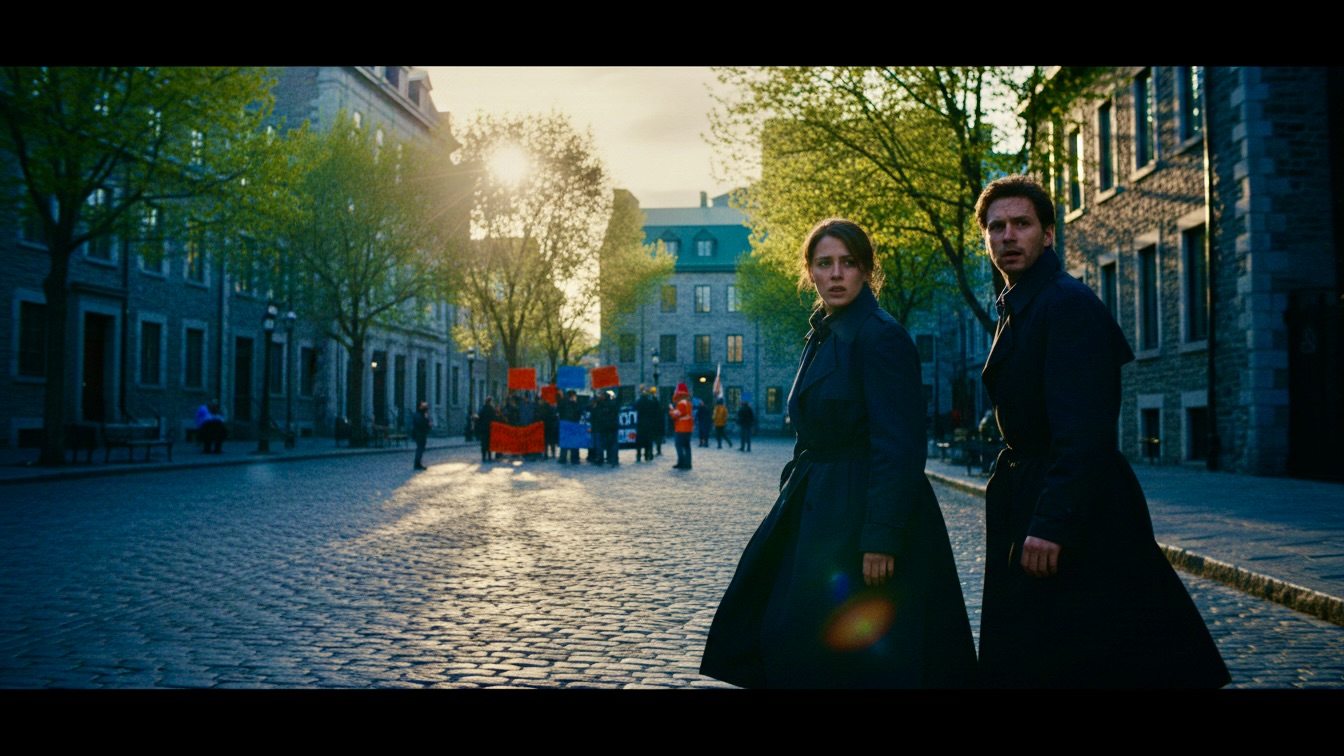
The discovery of the transmitter in the boardroom serves as the inciting incident, establishing the atmosphere of unease and the physical weight of the conspiracy. The meeting at Place Royale acts as the midpoint, where the scope of the threat is revealed and the personal stakes are solidified through Chloe’s confession. The climax occurs at the Citadel, where the betrayal by Moreau and the subsequent breach of the fortress force Sebastien into a desperate, high-stakes flight for survival.
The mood begins with a suffocating, stagnant tension that slowly escalates into a frantic, paranoid pace as the protagonists realize they are being hunted. By the end, the tone shifts to one of grim, cold realization, leaving the audience with an overwhelming sense of dread as the conspiracy expands beyond the initial scope.
If expanded, the season would follow Sebastien and Chloe as they attempt to dismantle the shadow network, uncovering a series of similar "false-flag" operations across the country. Each episode would peel back a layer of the conspiracy, revealing that the federal government is not a monolith, but a collection of warring factions competing for control in a post-democratic landscape.
The overarching narrative would track the gradual breakdown of order, with the protagonists becoming the primary targets of an increasingly desperate state. As they move from city to city, they would build a small, underground network of whistleblowers, leading to a final confrontation that forces them to choose between saving the country they once knew or letting it burn to start anew.
The visual style is characterized by "cold-war noir," utilizing a desaturated color palette of slate grays, deep blues, and the harsh, clinical orange of streetlights. The camera work is handheld and intimate, emphasizing the claustrophobia of the stone-walled buildings and the chaotic, blurred energy of the protests outside.
Influences include the paranoid thrillers of the 1970s, such as The Conversation and Three Days of the Condor, combined with the gritty, modern aesthetic of Children of Men. The tone is relentlessly serious, prioritizing tension and atmosphere over action-movie spectacle, ensuring the audience feels the weight of every decision.
The intended audience is adults aged 25-50 who enjoy high-concept political thrillers, investigative dramas, and narratives that challenge the viewer’s perception of authority. It is designed for streaming platforms that cater to viewers who appreciate complex, serialized storytelling and morally ambiguous protagonists.
The pacing is designed to mirror the protagonist's descent into the conspiracy, starting with a slow, deliberate build-up that allows the audience to absorb the setting. Once the threat is identified at the midpoint, the tempo accelerates significantly, utilizing quick cuts and shorter scenes to convey the urgency of the final act.
The production should prioritize practical, on-location shooting in Quebec City to capture the authentic, imposing architecture of the National Assembly and the Citadel. The use of natural light and practical weather effects—such as the slushy, melting snow—will be vital in grounding the political conspiracy in a tangible, decaying reality.
Special attention should be paid to the sound design, particularly the contrast between the muffled, oppressive silence of the interior rooms and the overwhelming, visceral roar of the protest crowds. This sonic dichotomy will serve as a constant reminder of the chaos looming just outside the characters' reach.


