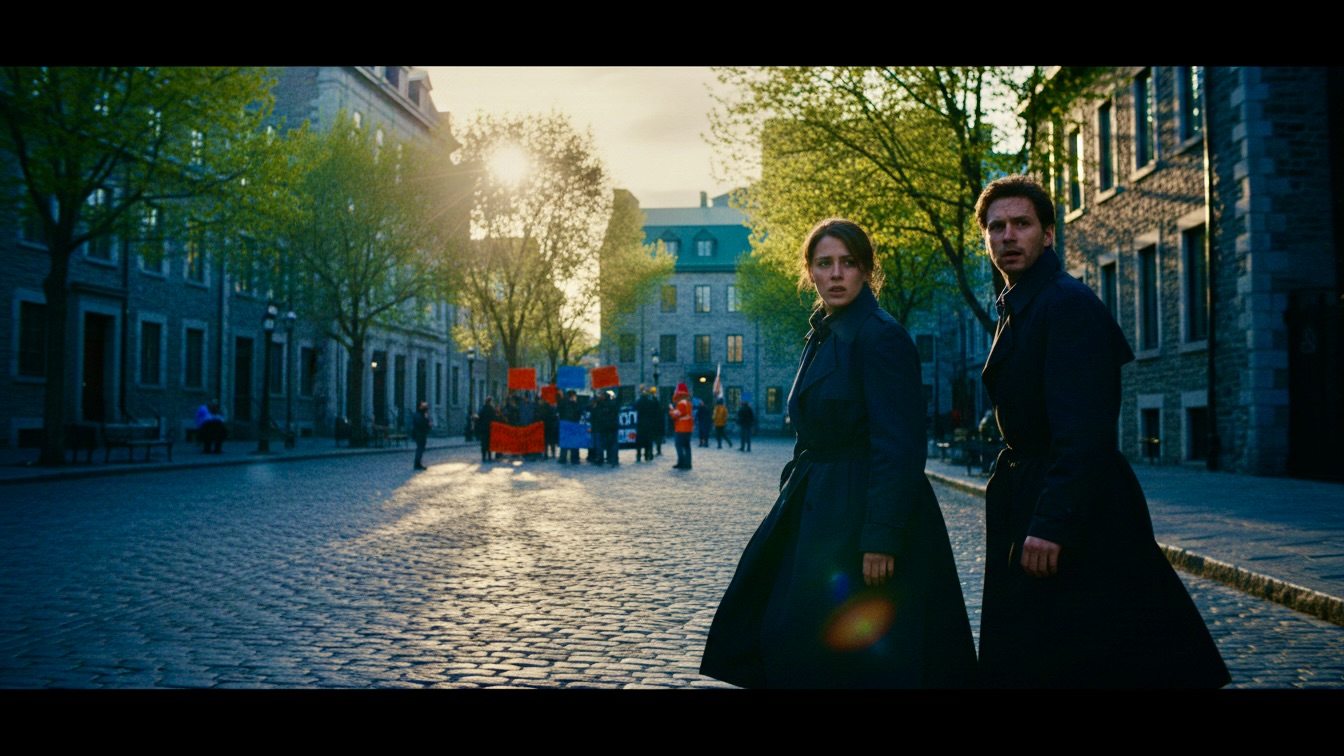
A hidden drive in a quiet room unravels the federation, turning the spring thaw into a political warzone.
The silence in the boardroom was wrong.
It wasn't the natural quiet of an empty room. It was a heavy, stagnant pause, like a held breath. The kind of silence that presses against your eardrums. I stood alone by the massive oak table, staring at the dust motes hanging suspended in the shafts of late afternoon light. The light itself felt off. It was spring in Quebec City, the first real day of the thaw, and the sun cutting through the tall, arched windows of the National Assembly building should have felt warm. Instead, it cast long, hard shadows across the carpet. The shadows seemed to pool in the corners, a thick mass of dark that made the room feel smaller than it was.
My stomach turned over. A slow, grinding ache started in my lower gut.
I rubbed the back of my neck. My collar was damp with sweat. The meeting had ended twenty minutes ago. The Premier's people had filed out, followed by the federal delegates, everyone shaking hands and smiling with their teeth while their eyes stayed entirely dead. National unity negotiations. That was the official title on the agenda. In reality, it was a knife fight in a phone booth over resource revenue sharing and provincial autonomy clashes. Ottawa wanted control over the new lithium deposits up north. Quebec wanted them to go to hell.
I walked over to the window. The wood floor creaked under my left shoe. I needed to get the sole fixed. Down below, Grande Allée was a mess of melting snow, gray slush, and hundreds of people. The protests had started three days ago. The crowd looked like a bruised sea of heavy coats and brightly colored placards. I couldn't hear their voices through the thick glass, but I knew the chants. Autonomy now. Ottawa out. The separatist movement revival wasn't just a fringe thing anymore; it was mainstream, loud, and angry.
The glass was cold against my forehead. I closed my eyes for a second.
When I opened them, I saw the reflection of the room behind me. The long table. The empty leather chairs. The radiator against the far wall.
Something was tucked behind the radiator.
I wouldn't have noticed it if the light hadn't hit it exactly right. A tiny, dull glint. I turned around. The room was still dead quiet. I walked over to the radiator, my shoes making too much noise on the hardwood perimeter. I crouched down. The heat radiating from the metal pipes smelled like burning dust and old iron.
I reached behind the painted metal grating. My fingers brushed against something hard. Plastic. I pulled it out.
It was a small, black USB drive, no larger than my thumb, affixed to a flat, magnetic transmitter. Not a commercial bug. Not something you buy online to spy on a cheating spouse. The casing was matte, entirely devoid of serial numbers or brand names. It was heavy for its size.
My jaw clamped shut. I felt a spike of adrenaline shoot down my arms, making my fingers tingle.
Federal overreach accusations were one thing. Finding physical proof of federal espionage in the provincial parliament during a closed-door summit was another. It was treason. Or an act of war, depending on who you asked.
I dropped the device into my trench coat pocket. It felt like a stone against my hip.
I needed to leave.
I walked out of the boardroom and down the grand hallway. The marble floors echoed. A lone security guard, a guy named Lapointe, nodded at me as I passed the rotunda. I didn't nod back. I just kept walking, pushing through the heavy brass doors and out into the biting spring air.
The smell hit me instantly. Quebec City in the spring is a specific violent collision of scents. The sharp, metallic odor of melting ice, the exhaust from idling news vans, and the heavy, greasy smell of frying potatoes and gravy from the poutine stalls set up near the plaza. It was overwhelming.
I pulled my phone from my inner pocket. The screen was spiderwebbed in the top right corner from where I'd dropped it in a cab last week. I dialed a number I knew by heart.
It rang twice.
"Yeah," Chloe answered. Her voice was flat.
"I'm out," I said, keeping my head down as I walked past a group of tourists taking photos of the parliament building.
"And?"
"We need to talk. Not on this line."
There was a pause on the other end. I could hear the background noise of wherever she was—the clinking of cups, a low hum of voices.
"Place Royale," she said. "Twenty minutes."
She hung up.
I shoved the phone back into my pocket. Chloe was a senior analyst for the Privy Council Office. The feds. We had met eight months ago at a boring policy retreat in Ottawa. It started as a hookup, evolved into a mistake, and was currently functioning as a massive liability for both of us. If my boss, the Minister of Intergovernmental Affairs, knew I was sleeping with federal intelligence, I'd be fired. If her bosses knew, she'd be investigated for treason.
I walked down the steep, winding streets of Old Quebec. The stone buildings loomed on either side, their roofs still capped with stubborn patches of dirty snow. The maples lining the streets were just beginning to show life, their tiny green buds looking like raw nerves exposed to the wind. The air was getting colder as the sun dipped lower, the shadows lengthening, creeping across the cobblestones.
I kept checking my reflection in the dark windows of the boutiques I passed. I was looking for a tail. I didn't see anyone obvious, but that didn't mean much. My chest felt tight. The drive in my pocket seemed to burn through the fabric of my coat.
Place Royale was crowded. The plaza was a trap of tourists, locals, and students enjoying the break in the weather. I spotted Chloe sitting at a small, wrought-iron table outside a café. She was wearing a dark gray wool coat, her shoulders hunched against the chill. She was looking down at a paper cup, rotating it slowly between her hands.
I pulled out the chair across from her and sat down. The metal scraped loudly against the stone.
She didn't look up. "You're late."
"Traffic. The protests are blocking Honoré-Mercier."
"I told you to avoid the upper city," she said, finally looking at me. She looked exhausted. There were dark bags under her eyes, and her skin was pale.
"Chloe, stop. Don't start managing me today."
"I'm not managing you, Seb. I'm trying to keep you from doing something incredibly stupid."
"Like what?"
She leaned in, her voice dropping. "Did you find it?"
My stomach dropped again. A cold sweat broke out along my hairline. She knew. Of course she knew.
"Find what?"
"Don't play stupid. It doesn't suit you."
"Tell me what you think I found."
"Sebastien, please." She reached across the table, but I pulled my hands back. "If you found the transmitter, you need to put it back. Or destroy it. Do not bring it to your boss."
"You bugged the room. The federal government bugged a provincial negotiation. Do you have any idea what this means? If this gets out, the unity negotiations are dead. The sovereignty movement will tear the province apart."
"It's not what you think," she said quickly. Her eyes darted around the plaza. "It's not Ottawa. Not the PMO."
"Then who?"
"There are factions, Seb. People who think the PM is being too soft on Quebec. They want to force a crisis. If they can prove your Minister is funding the separatist protests, they can invoke emergency measures. They can take over the resource fields by force."
"We aren't funding the protests!"
"Keep your voice down." She looked at a man walking past with a dog. She waited until he was out of earshot. "It doesn't matter if you are. They just need it to look like you are. The drive you found... it wasn't just recording. It was a local network broadcast point. It was meant to plant fabricated files onto your Minister's secure tablet during the meeting."
I stared at her. The noise of the plaza faded out. The chatter, the clinking of coffee cups, the distant honking of cars. All of it became a low, muddy hum.
"You're telling me this now?" I asked. My throat felt dry. "Why didn't you warn me before the meeting?"
"I didn't know until an hour ago. I saw the authorization order cross a desk it shouldn't have been on. I came straight here."
I looked at her face. The tight lines around her mouth. The slight tremor in her hands. She was terrified.
"I have to decrypt it," I said. "I have to see what they tried to plant."
"No." She shook her head aggressively. "If you plug that into any machine with an internet connection, it will beacon. They'll know you have it. They'll know where you are."
"I have an air-gapped laptop at the office. An old piece of junk we use for archiving."
"Sebastien, listen to me. If you look at those files, you are a target. They will not let you walk away with proof of a false-flag operation. They will kill you."
I stood up. The chair scraped again. "I'm going to the office. Are you coming or not?"
She looked up at me. She looked like she wanted to cry, but she just clamped her jaw shut, stood up, and left her coffee on the table.
We didn't speak on the walk to my office. We took the back alleys, avoiding the main roads and the growing noise of the protests. The sky was turning a dark, bruised purple. The streetlights flickered on, casting long, orange streaks across the wet asphalt.
My office was in a secondary building, a few blocks from the Assembly. It was an old stone structure, drafty and poorly lit. We took the stairs to the third floor. My legs burned by the time we reached the top.
I unlocked the door to the archive room. It smelled like decaying paper and stale coffee. I turned on the overhead fluorescent light. It buzzed loudly, flickering for a few seconds before settling into a harsh, clinical glare.
I walked over to a metal desk in the corner. Sitting on it was an old, thick laptop. The casing was scratched, the keyboard coated in a fine layer of dust. I hit the power button. The fan whined to life, sounding like a dying aircraft engine.
Chloe stood by the door, her arms crossed over her chest. She was watching the window.
"Close the blinds," I said.
She pulled the cord. The heavy plastic slats snapped shut, cutting off the view of the street below.
I pulled the drive from my pocket. It felt heavier now. I stared at the USB port on the side of the laptop. I took a breath, my chest tight, and jammed it in.
The screen flickered. A prompt appeared. I bypassed the standard security protocols, using a backdoor command I'd learned from our IT guy months ago. The file directory opened.
There were dozens of folders. None of them had names. Just strings of alphanumeric code.
I clicked on the first one. A PDF opened.
I leaned closer to the screen. The text was dense, but the letterhead was clear. It was a forged document, bearing the provincial seal. It was a drafted memo from my Minister, authorizing the transfer of three million dollars from a discretionary infrastructure fund to a shell corporation linked to the radical wing of the separatist movement.
"Jesus," I muttered.
I clicked another file. A list of coordinates. Locations of federal buildings in Quebec, Montreal, and Gatineau. Attached were schematics for homemade explosives.
"They were going to frame us for terrorism," I said, my voice sounding hollow. "They were going to make it look like the provincial government was actively planning to bomb federal infrastructure."
Chloe walked over and stood behind me. I could smell her perfume, a faint scent of vanilla and sandalwood, mixed with the cold smell of the street.
"I told you," she said quietly. "It's a pretext. If these files were found on your Minister's device, Ottawa would have legal grounds to suspend the provincial government. Martial law. Total federal control over the resource sectors."
"Who is 'they', Chloe? Who authorized this?"
She hesitated. "The director of domestic intelligence. A man named Corriveau. He's an ultra-nationalist. Thinks federalism is dead and needs to be replaced with a unitary state."
"And you work for him."
"I work for the country," she snapped. "I didn't sign up for this."
I dragged the entire file directory to a secure, encrypted partition on the laptop's hard drive. Then I pulled the physical drive out of the port.
"What are you doing?" she asked.
"We need to get this to the Premier. Tonight. The summit reconvenes at the Citadel in two hours for the formal dinner. Everyone will be there. The feds, the media. If we drop this on them publicly, Corriveau can't hide it."
"You're out of your mind," Chloe said, grabbing my arm. Her grip was surprisingly strong. "If you walk into the Citadel with that, you won't walk out. Corriveau's people are running security for the federal delegation."
"Then we bypass them. I give it to Moreau. He's the head of the provincial security detail. He answers directly to the Premier."
"You trust Moreau?"
"I trust that he hates the feds more than he hates me."
I shoved the laptop into a worn leather satchel. "Are you with me, or are you going back to Ottawa?"
She looked at the satchel, then at me. Her expression hardened. "If I go back now, I'm dead anyway. They'll know I accessed the files. I'm already a traitor."
"Then let's go."
The walk to the Citadel was a nightmare. The protests had swelled. Thousands of people were in the streets now. The chants were a physical wall of noise. Flags snapped in the wind. The police had formed barricades along the perimeter of the old fort, their riot gear reflecting the flashing red and blue lights of the cruisers.
We pushed our way through the crowd. I kept my head down, my hand gripping the strap of the satchel so hard my knuckles ached. The air was thick with the smell of sweat, wet wool, and the faint, acrid sting of tear gas hanging in the distance.
We reached the VIP checkpoint at the base of the Citadel walls. A line of provincial police stood behind steel barriers. I pulled out my credentials.
"Sebastien Leclair," I shouted over the noise of the crowd. "Chief of Staff to the Minister of Intergovernmental Affairs."
The cop checked my badge, shined a flashlight in my face, and nodded. He pulled the barrier back just enough for me to slip through. Chloe followed.
"She's with me," I said.
The cop didn't care. He shoved the barrier back into place.
Inside the perimeter, the noise dropped significantly. The thick stone walls of the fortress absorbed the sound of the riot. The courtyard was lit by harsh floodlights. Black SUVs were parked in a neat line. Federal and provincial security personnel milled around, trying to look relaxed but failing.
I scanned the courtyard. I saw Moreau standing near the entrance to the main dining hall. He was a big man, built like a brick wall, wearing a suit that looked uncomfortably tight across his shoulders.
I walked toward him, Chloe trailing a few steps behind.
"Moreau," I said as I got close.
He turned. His eyes narrowed. "Leclair. You're late. The Minister was asking for you."
"I need to speak to the Premier. Right now."
"The Premier is inside with the Prime Minister. No interruptions."
"It's a matter of national security," I said, stepping closer, dropping my voice. "I have proof of a federal black op. They're trying to frame the provincial government for the riots."
Moreau didn't blink. He didn't look surprised. He just stared at me, his face a blank mask.
"Show me," he said.
"Not out here. We need a secure room."
Moreau nodded slowly. "Follow me."
He turned and walked toward a side entrance. I followed him, my heart hammering against my ribs. Chloe walked beside me. Our shoulders brushed. She was tense.
We entered a narrow stone corridor. It was poorly lit, the air cold and damp. Moreau stopped in front of a heavy wooden door. He pushed it open and stepped inside.
I walked in after him. It was a small, empty room. No windows. Just a table and two chairs.
"Put it on the table," Moreau said.
I unbuckled the satchel and pulled out the laptop. I set it down.
Moreau didn't look at the computer. He looked at Chloe.
"Who is she?" he asked.
"She's the one who tipped me off. She's federal intelligence, but she defected."
Moreau reached under his jacket.
My brain didn't process the movement fast enough. By the time I realized what he was doing, the gun was already out.
It was a black, suppressed pistol. He pointed it directly at Chloe's chest.
"Moreau!" I yelled, stepping between them.
"Move, Leclair," Moreau said. His voice was completely calm. "She's a spy. She's feeding you garbage."
"She's telling the truth! The files are on the drive!"
"I know what's on the drive," Moreau said.
The room went perfectly still. The silence returned. That same heavy, suffocating silence I had felt in the boardroom hours ago.
The shadow mass.
It wasn't just federal overreach.
"You?" I whispered. My mind struggled to connect the pieces. "You're working with Corriveau?"
"Corriveau is an idiot," Moreau sneered. "He thinks he can use this to crush the province. But we're going to use it to break the federation. When the public finds out Ottawa tried to frame us, the anger will be uncontrollable. We won't just protest. We will secede. Tomorrow. The referendum will pass with eighty percent. Corriveau handed us the match to burn the country down, and he doesn't even know it."
"You're going to let them enact martial law?" I asked, my voice cracking.
"We want them to try. Let the federal troops march into Quebec. Let them see what happens."
Moreau shifted his aim, pointing the gun at my face.
"I'm sorry, Sebastien. But martyrs are required for the cause. The media will report that federal agents assassinated the Minister's Chief of Staff to cover up their espionage. It's a perfect narrative."
He pulled the hammer back.
The click was the loudest sound I had ever heard.
Then, the wall exploded.
It wasn't a bomb. It was a vehicle. A massive, concussive crash shook the entire building. The stone floor heaved. The heavy wooden door was ripped off its hinges, thrown across the room. Dust and debris filled the air instantly. The single lightbulb shattered, plunging us into darkness.
I threw myself to the floor. The sound was deafening—screams, the grinding of metal, the sharp cracks of gunfire from the courtyard. The riots had breached the gates.
I scrambled blindly in the dark. My hands found the leather satchel. I pulled it to my chest.
Someone grabbed my collar. I thrashed, throwing an elbow backward. It connected with something soft.
"Seb! It's me!" Chloe yelled over the noise.
She pulled me up. I couldn't see anything through the thick cloud of pulverized stone. I smelled sulfur, brick dust, and copper.
"Where's Moreau?" I choked out, coughing.
"Down. I don't know. Move!"
We stumbled out of the room, climbing over the splintered remains of the door. The corridor was a warzone. Provincial police were running past us, weapons drawn, ignoring us in the chaos. The main courtyard was entirely engulfed in smoke. A black SUV had rammed through the secondary gate and was on fire. People were running in every direction.
We didn't go toward the exit. We went deeper into the Citadel.
I knew the layout of the fort. We ran down a flight of stone stairs, into the old armory tunnels. The air down here was freezing. The noise from above was muffled, reduced to a heavy, rhythmic thudding that felt like a heartbeat in the stone.
We ran until my lungs felt like they were bleeding. We stopped in a dark alcove beneath the eastern bastion. I dropped the satchel and leaned against the cold wall, gasping for air. My knees shook.
Chloe leaned next to me. She was bleeding from a cut on her forehead. The blood looked black in the dim emergency lighting.
"Moreau is one of them," she panted. "He's working with the separatists to let the false flag happen."
"He's letting Corriveau win the battle so he can win the war," I said, wiping sweat and stone dust from my eyes. "He wants the federal crackdown. He wants the violence."
"We have the laptop," she said. "We still have the proof."
"Who do we give it to? The feds are trying to frame us, and our own security is trying to let them. There's no one left to trust."
I looked down at the floor. My hands were shaking. I reached into my coat pocket. I had grabbed something in the dark when I fell.
It was a phone. It wasn't mine. I must have snatched it off the floor when the wall caved in. It had a cracked screen, much worse than mine.
I hit the power button. The lock screen lit up.
There was a single notification. A text message.
I stared at the screen, the pale light reflecting off the stone walls, the cold reality of the situation finally settling into the pit of my stomach as I read the sender's name and the two words that changed everything.
“I stared at the screen, the pale light reflecting off the stone walls, the cold reality of the situation finally settling into the pit of my stomach as I read the sender's name and the two words that changed everything.”


