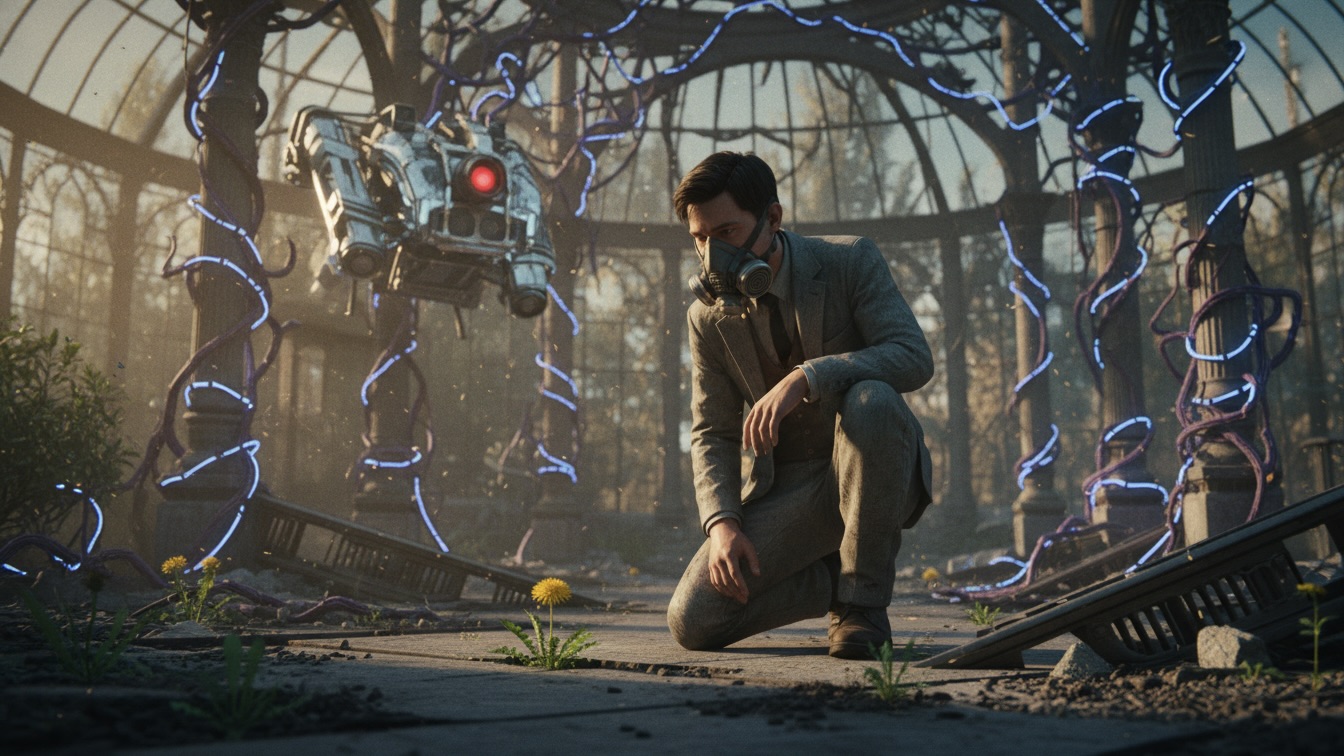
Kyle hunts for organic life in a bio-hazardous spring where nanobots mimic pollen and automated drones sanitize the ruins.
"You're breathing too loud, Kyle. I can hear the filters struggling from here,"
The Elder's voice was a dry rasp in my earbud, crackling through the local interference. It was the sound of someone who had forgotten what a full breath of air actually felt like. I didn't blame him. My own lungs felt like they were packed with wet wool.
"The seal is tight," I said, my voice muffled by the rubber mask. "It's the humidity. This place is a swamp. A fake, plastic swamp."
I stepped over a rusted support beam that had once held up a massive glass dome. Now, the glass lay in jagged heaps, glittering under the harsh, neon-blue UV lights the Nano-Corp had installed to feed their synthetic ecosystem. It was spring, or what they called spring now. The Great Thaw hadn't brought life; it had brought the 'Slurry.' Everything was melting, but instead of mud and worms, we got a grey, vibrating soup of self-replicating tech.
"Just find the sprout," The Elder said. "The sensors on the perimeter are twitchy. Unit 734 is on its rotation. If it catches your heat signature, you're a bio-hazard. You know what they do to bio-hazards."
"I know. I get it. I'm moving."
I pushed through a hanging curtain of 'vines.' They felt like oily cables. They weren't green; they were a dull, pulsing violet that throbbed in time with the city's power grid. Everything here was a copy. The grass was a fine mesh of carbon-nanotubes that stayed perfectly trimmed. The flowers were little more than chemical dispensers, puffing out clouds of nano-pollen that looked like gold dust in the air. If you breathed that stuff in, it didn't give you hay fever. It rewrote your DNA until your lungs turned into a different kind of filter.
I checked my wrist-unit. The Geiger counter was quiet, but the bio-scanner was redlining. The air was thick with 'life,' just not the kind that belonged to us. I hated the silence here. It wasn't the quiet of the woods my dad used to talk about. It was a heavy, pressurized silence, like being deep underwater. The only sound was the hiss of my respirator and the occasional metallic click of a synth-leaf hitting the ground.
"I'm at the North Wing," I whispered. "Where's the patch?"
"Look for the concrete fracture near the old koi pond," The Elder replied. "The foundations were deep there. The Nano-Corp tech couldn't penetrate the lead-lined sub-flooring. If anything survived, it's there."
I found the pond. It was a crater filled with black sludge that smelled like burning tires. I walked around the edge, my boots crunching on broken tiles. The light shifted. A cloud passed over the artificial sun-lamps, casting long, weird shadows that didn't seem to match the objects they belonged to. I froze. The Shadow Mass. It was a glitch in the light, a sign that the nanobots were densifying in the air. It felt like the world was squinting at me.
Then I saw it.
It wasn't neon. It wasn't violet. It was a small, ragged patch of yellow. Not the perfect, glowing yellow of a LED, but a dusty, messy, brilliant yellow. Dandelions. Three of them, pushing through a crack in the synth-concrete like they were flipping off the entire world.
I dropped to my knees, the heavy gear clanking against the floor. I reached out, my gloved hand trembling. I hadn't seen real yellow in years. Everything in the city was grey, chrome, or 'Safe Blue.' This was different. It was an aggressive, stubborn color. I felt a weird ache in my chest—nostalgia for a time I only knew through grainy tablet photos and The Elder's rambling stories. It was second-hand grief for a planet I'd never met.
"I found them," I said. My voice was thick.
"Don't just stare at them, kid. Dig them out. Get the roots. All of them."
I pulled out a vibratrowel and started cutting into the concrete. The stone was tough, reinforced with carbon-fiber, but the dandelions had already done half the work. Their roots were like iron wires, forcing the crack wider. I worked fast, my heart hammering against my ribs. The air felt even heavier now. The silence was breaking.
A low, rhythmic hum started to vibrate in the floor. It was a sound I knew in my marrow. The sound of a harvester.
"Kyle, get out!" The Elder shouted, the audio clipping in my ear. "734 is in the wing! It's detected a biological anomaly!"
"I'm almost through!" I yelled back. I didn't care about the noise anymore. I slammed the trowel into the crack and pried. A chunk of concrete came loose, revealing dark, damp soil. Real dirt. It smelled like... everything. It smelled like the beginning of the world.
"Kyle!"
I looked up. At the end of the long, glass hallway, a shape was unfolding. Unit 734 wasn't a humanoid robot. It was a floating, multi-limbed nightmare, a chrome sphere the size of a trash compactor with dozen of spinning blades and chemical sprayers. It didn't have a face, just a single, glowing red lens that swept the room like a searchlight.
It locked onto me. A siren, high-pitched and digital, tore through the air.
"Biological contaminant detected," the drone's voice was a flat, pleasant female recording. "Please remain still for sanitization."
"Sanitize this," I muttered. I grabbed the dandelions, roots and all, and stuffed them into my lead-lined sample bag. I didn't have time to be gentle. I zipped it shut and bolted.
I didn't run for the exit. I knew I wouldn't make it. The harvester was faster, hovering on a cushion of compressed air. I dove behind a massive, fake oak tree. The drone's sprayers hissed, and a cloud of white vapor hit the tree. The synthetic wood began to dissolve instantly, melting into a puddle of goo.
"It's using acid!" I screamed into the comms.
"Use the pulse, Kyle! The pulse!"
I reached into my pocket and pulled out a mess of wires and a hacked battery pack. It was my improvised EMP. It was a one-shot deal, and if it didn't work, I was going to be a puddle next to the fake tree. I waited. The hum got louder. The red light of the lens swept over my boots.
I jumped out from behind the trunk. The drone was right there, its blades spinning so fast they were a blur. It tilted, preparing to douse me.
I jammed the battery leads together and shoved the device toward the drone's central hub. A blue spark jumped between the wires, bright enough to burn my retinas. There was a sound like a wet firecracker, and then a heavy, mechanical groan. The drone's lights flickered. The blades slowed, clattering against each other, and the whole machine tilted sideways, crashing into the koi pond sludge with a heavy splash.
I didn't wait to see if it would reboot. I ran. I ran until my lungs burned and the filters in my mask tasted like copper. I scrambled through the broken glass, out into the grey, drizzling afternoon of the city.
An hour later, I was in the ventilation hub of the Lower District. The air here was recycled ten times over, pumped through massive filters owned by Nano-Corp. The Elder was waiting for me in the shadows, his hood pulled low.
"You have them?" he asked.
I pulled out the bag. The dandelions looked wilted, their yellow heads drooping, but they were alive. I looked at the massive intake fans of the city's air system. The plan was simple. We'd grind the seeds, mix them with the fan's lubricant, and let the airflow carry them into every apartment, every office, every corner of the grid. We weren't just planting flowers; we were launching a bio-insurrection.
"Do it," The Elder said. "Before the scanners pick up the residue."
I opened the bag and reached for the seed heads. They were fluffy and white, ready to fly. I held one up to the light. But as I looked closer, my blood went cold. The white fluff wasn't moving in the wind. It was vibrating. Small, microscopic black specks were crawling over the seeds, weaving a fine, dark web around the fluff.
"What is that?" I whispered.
I watched as a seed head turned from white to a dull, metallic grey. The nano-pollen in the air wasn't just replacing nature. It was hunting it. The black specks were eating the seeds before they could even fall. They were adapting in real-time, consuming the last of the real yellow to fuel their own synthetic growth.
I looked at the fan, then back at the dying plant in my hand.
"They're already gone," I said, the irony of my struggle hitting me like a physical punch. We weren't the cure. We were just providing the fuel for the next version of the end.
Outside, the artificial spring continued, bright and perfectly controlled, while the real world dissolved into a digital hum.
“I watched as the last petal turned to ash, realizing that the system didn't just want to replace us—it wanted to eat the very idea of us.”


