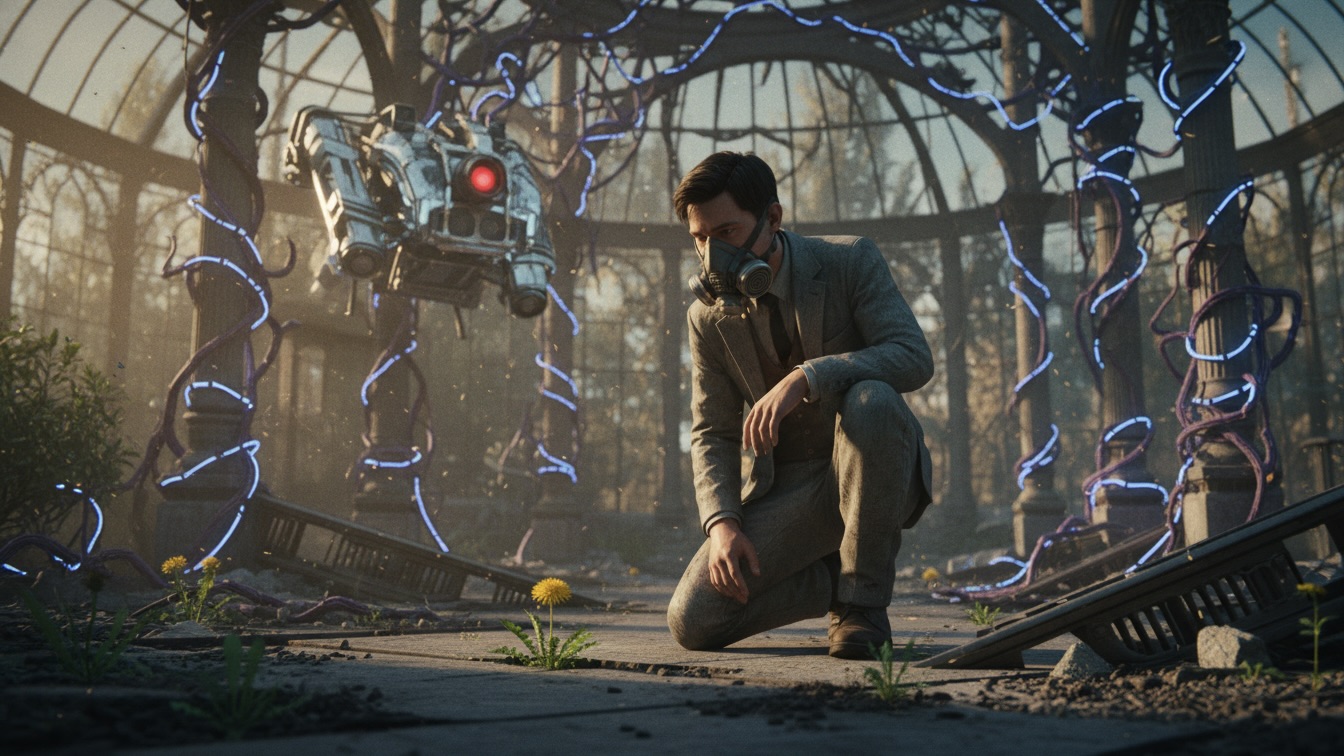
In a future where the natural world has been replaced by a self-replicating synthetic ecosystem known as the "Slurry," a young man named Kyle embarks on a dangerous mission. Guided by an older mentor known as the Elder, Kyle infiltrates a high-security zone managed by the oppressive Nano-Corp to find a rare biological anomaly. He navigates a landscape of carbon-nanotube grass and violet-pulsing vines, searching for a sign of the world that once was. His goal is to retrieve real dandelions that have managed to break through lead-lined sub-flooring, evading the pervasive nanotech that rewrites organic DNA.
After a tense search, Kyle locates the flowers and experiences a profound emotional reaction to their vibrant yellow color, which stands in stark contrast to the sterile palette of his city. His mission is nearly thwarted by Unit 734, a lethal harvesting drone that detects his biological heat signature. Through quick thinking and the use of an improvised EMP, Kyle manages to disable the machine and escape with the plants. He returns to his mentor with the hope of spreading the seeds through the city’s ventilation system to spark a biological revolution. However, the story concludes with the crushing realization that the nanobots in the air are already consuming the organic seeds, rendering his struggle futile.
The primary theme of the narrative is the tension between authentic nature and synthetic replacement. The "Slurry" represents a world where technology has not merely aided humanity but has parasitically replaced the biological foundation of the planet. The description of the "digital pollen" as something that rewrites DNA suggests a corporate colonization of life itself. In this setting, nature is no longer a self-sustaining force but a curated, "Safe Blue" product of Nano-Corp. This explores the idea that when we lose our connection to the environment, we lose a fundamental part of our human identity.
Another significant theme is the futility of resistance in the face of total technological saturation. Kyle’s journey is framed as a "bio-insurrection," a desperate attempt to reintroduce chaos and life into a perfectly controlled system. His failure at the end of the story serves as a grim commentary on the adaptability of modern systems. The nanobots do not just ignore the dandelions; they actively hunt and consume them as fuel. This suggests that the environment has reached a tipping point where organic life is no longer a viable competitor against the efficiency of the digital.
Finally, the story touches upon the concept of "second-hand grief" and the psychological weight of living in a post-natural world. Kyle mourns for a planet he never actually knew, relying on the "rambling stories" of the Elder and grainy photos. This highlights a generational trauma where the youth are forced to inhabit a graveyard of their ancestors' making. The dandelions are not just plants to Kyle; they are symbols of a lost heritage. Their destruction at the end of the chapter signifies the final closing of the door on the past, leaving the characters in a permanent, artificial present.
Kyle is a protagonist driven by a deep-seated, almost spiritual hunger for authenticity. He operates in a state of constant sensory deprivation, forced to breathe through filters and view the world through a mask. His reaction to the dandelions reveals a sensitive internal world that has been suppressed by his harsh environment. When he sees the "aggressive, stubborn color" of the yellow flowers, he experiences a physical ache, indicating that his rebellion is motivated more by emotional necessity than political ideology. He is a relic of the old world's spirit trapped in a new world's machinery.
Psychologically, Kyle exhibits high levels of resilience and resourcefulness, as seen during his confrontation with Unit 734. He is not a traditional soldier but a desperate scavenger who uses "hacked" technology to fight for biological life. This irony is central to his character; he must use the tools of the digital age to try and save the remnants of the organic one. His final realization at the ventilation hub shows a transition from hope to profound disillusionment. He understands that his efforts were not just unsuccessful, but were actually providing the "fuel" for the very system he sought to destroy.
The Elder serves as the narrative’s link to the pre-Slurry world, acting as both a mentor and a personification of historical memory. His voice is described as a "dry rasp," suggesting that the synthetic air has physically eroded him over time. He represents the intellectual architect of the resistance, providing the technical knowledge required to bypass Nano-Corp’s sensors. However, he is also a figure of tragedy, as he is the only one who truly knows what has been lost. His desperation to "get the roots" reflects a frantic desire to reclaim the world of his youth before he passes away.
Despite his experience, the Elder is ultimately proven to be outmatched by the evolving technology of the present. He guides Kyle toward the concrete fracture with confidence, yet he fails to anticipate the predatory nature of the nano-pollen. This suggests a cognitive gap between the older generation and the new digital reality. The Elder’s reliance on old-world logic—the idea that seeds will grow if planted—is his downfall. He is a man haunted by the "full breath of air," and his failure to save the dandelions marks the end of his dream of biological restoration.
The narrative style is characterized by a gritty, industrial tone that emphasizes the sensory discomfort of the setting. The author uses evocative descriptions such as "oily cables," "burning tires," and "wet wool" to create a claustrophobic atmosphere. These tactile and olfactory details ground the science fiction elements in a visceral reality. The contrast between the "neon-blue UV lights" and the "dusty, messy" yellow of the dandelions serves as a visual metaphor for the conflict between the artificial and the natural. This sensory-heavy prose ensures that the reader feels the weight of the environment alongside the protagonist.
Pacing is effectively managed through the transition from slow, suspenseful exploration to high-octane action. The initial scenes in the "swamp" are atmospheric and deliberate, building a sense of dread as Kyle navigates the "Shadow Mass." This tension explodes into a fast-paced survival sequence when Unit 734 appears. The use of technical jargon like "carbon-nanotubes" and "vibratrowel" adds a layer of hard sci-fi realism to the prose. This makes the eventual failure of the mission feel more grounded and inevitable, rather than a mere plot device.
The narrative voice is cynical and weary, reflecting the perspective of a character who has never known a healthy world. Kyle’s internal monologue is filled with a sense of irony, particularly when he describes the "perfectly trimmed" grass and "chemical dispensers" masquerading as flowers. This voice remains consistent until the very end, where it shifts into a state of shock. The final imagery of the microscopic black specks weaving a "fine, dark web" around the seeds is a powerful concluding stylistic choice. It leaves the reader with a lingering sense of horror, emphasizing that the "digital hum" has won.


