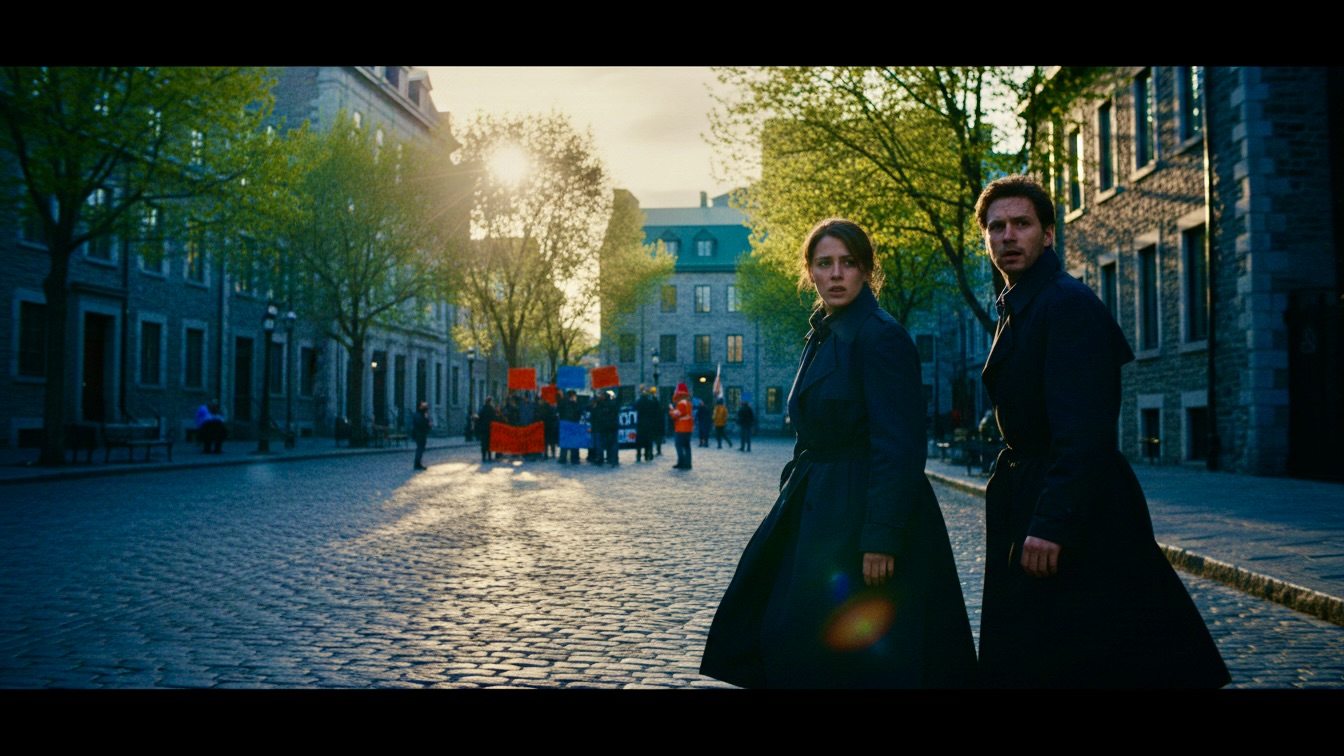
The story follows Sebastien Leclair, a Chief of Staff for a provincial government minister in Quebec City, during a volatile national unity summit. While alone in a boardroom, Sebastien discovers a hidden transmitter, which he realizes is a tool for federal espionage designed to frame his government for funding separatist riots. He contacts Chloe, a federal analyst with whom he shares a clandestine and illicit relationship, to discuss the discovery. As they navigate the city, they uncover a deeper conspiracy involving fabricated evidence meant to justify a federal takeover of the province.
The tension culminates at the Citadel, where Sebastien attempts to hand the evidence to Moreau, the head of provincial security. He quickly realizes that Moreau is a double agent who intends to use the federal frame-up as a catalyst to trigger a full-scale secession movement. The meeting descends into violence as a vehicle crashes into the building, allowing Sebastien and Chloe to narrowly escape into the tunnels. The chapter ends on a cliffhanger as Sebastien discovers a mysterious phone that promises to upend his understanding of the conspiracy.
The primary theme of the narrative is the corrosive nature of political polarization. The story illustrates how extreme ideological factions on both sides of the federal-provincial divide are willing to sacrifice truth and human life to achieve their respective ends. By framing the conflict as a struggle between federal overreach and provincial radicalization, the author highlights the fragility of democratic institutions when they are hijacked by actors who view crises as opportunities rather than disasters.
Trust and betrayal serve as secondary themes that permeate every interaction. Sebastien finds himself in a position where he cannot rely on his government, his federal contact, or his own security detail. The narrative suggests that in high-stakes political environments, personal relationships are often reduced to liabilities or tactical assets. The physical setting of the thawing Quebec winter mirrors this internal coldness, where old structures of governance are melting away, leaving behind a chaotic and dangerous landscape.
Sebastien functions as the audience’s anchor, providing a perspective that is grounded in confusion and growing moral clarity. He begins the chapter as a man concerned with protocol and his own career, but he is forced to evolve into a desperate whistleblower. His internal conflict stems from the realization that the system he serves is not merely flawed, but fundamentally compromised by actors who operate in the shadows. He is driven by a sense of duty, yet he remains vulnerable, constantly checking for tails and reacting with visceral, physiological responses to the stress of his situation.
Chloe represents the duality of the state apparatus, acting as both an instrument of federal power and a disillusioned insider. She is characterized by her exhaustion and her pragmatic, albeit fearful, approach to the unfolding catastrophe. Her motivation is complex; she attempts to protect Sebastien, yet her previous actions as a federal analyst suggest she has lived in a world of moral gray areas for a long time. She is a woman who has finally reached her limit, choosing to defect because she cannot reconcile her personal morality with the dangerous agenda of her superiors.
Moreau acts as the cold, calculating antagonist who embodies the accelerationist philosophy. He is a man of singular purpose who views the democratic process with utter contempt. His betrayal of Sebastien is not fueled by simple greed, but by a twisted sense of patriotism that demands a violent rupture in the status quo. He is the most dangerous character because he understands that the chaos orchestrated by the federal government can be weaponized to achieve his own separatist goals, proving that he is more radical than the very people he pretends to oppose.
The narrative voice is immediate and claustrophobic, utilizing first-person perspective to trap the reader within Sebastien’s escalating anxiety. The author makes effective use of sensory details to heighten the tension, focusing on cold glass, the smell of burning dust, and the oppressive silence of the boardroom. These physical sensations anchor the political abstractions of the plot in a tangible, decaying reality.
The pacing is deliberate, mimicking the slow build of a pressure cooker before exploding into the chaotic action of the Citadel sequence. The author transitions seamlessly from the quiet, internal monologue of the beginning to the frantic, external movement of the final scenes. By maintaining a sharp, concise sentence structure, the prose mirrors the protagonist’s erratic heart rate and the urgent, high-stakes nature of his mission.


