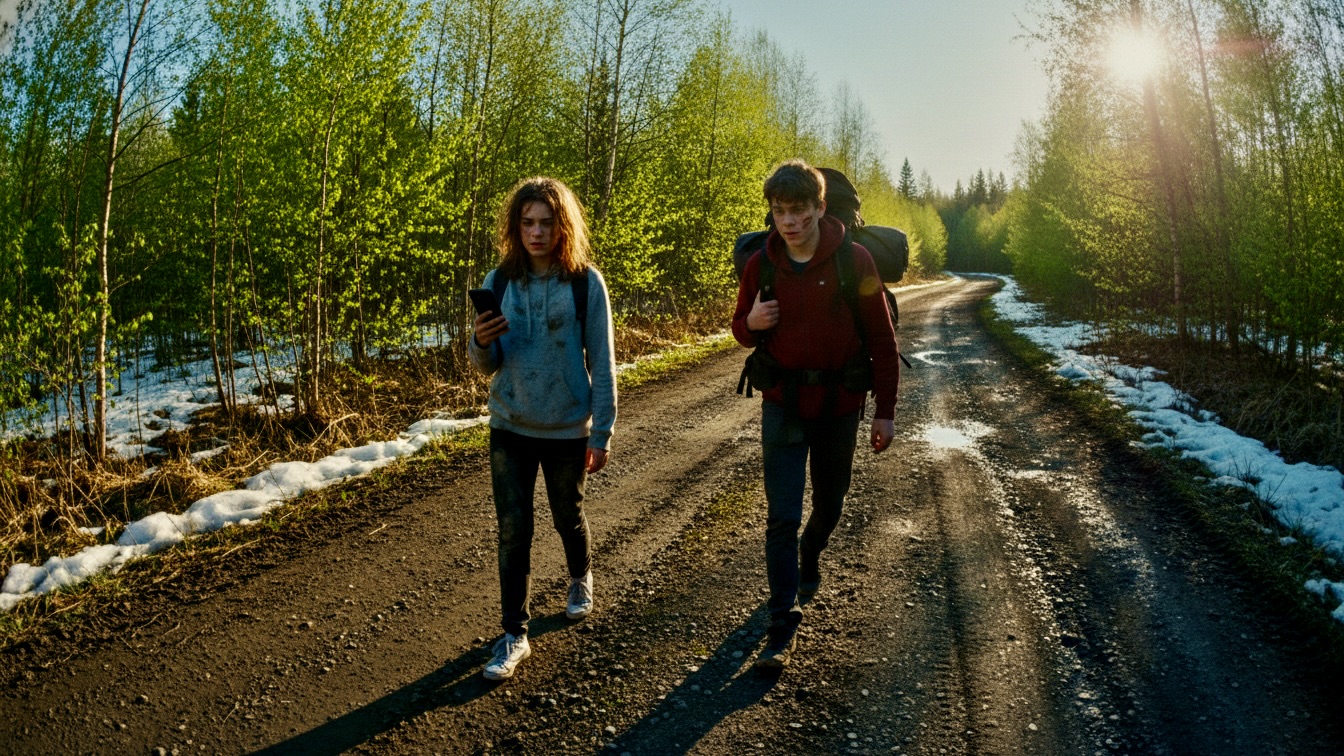
Two teens struggle against a mud-trapped ATV and a total lack of cell service in the spring woods.
"We are literally cooked," Jenni said. She didn't look up from her phone, which she was holding high in the air as if trying to catch a stray bit of 5G drifting off a cloud. Her boots, once a pristine white that probably cost more than my entire wardrobe, were currently disappearing into a grey, bubbling slurry that smelled like ancient rot and failed dreams.
"It’s not cooked. It’s just... anchored," I said. I was standing on the seat of the Polaris, which was tilted at a thirty-degree angle into the frost boil. The mud here wasn't normal dirt. It was a seasonal conspiracy. In the winter, this path was a highway of frozen solid ground. In the summer, it was dust. But in April, it turned into a sentient, hungry soup that specialized in swallowing mid-sized utility vehicles.
"Anchored implies we can pull it up," Jenni said, finally dropping her arm. Her screen stayed dark. "This is a burial. We should say some words. I’ll start. Goodbye, my dignity. Goodbye, my chance of being home for the DoorDash delivery."
I jumped off the seat, landing with a wet, heavy thwack that sent spray up my shins. The mud gripped my ankles immediately. It felt like the earth was trying to pull my socks off through my skin. I grabbed the winch cable, which was already submerged in the muck. It was cold. Not just cold, but that deep, biting spring cold that reminds you the ice only melted five minutes ago. I pulled, and the cable didn't budge. The motor had made a sad, clicking sound before giving up entirely five minutes ago.
"The battery is dead, Jenni."
"I know the battery is dead, Phil. I heard the click. It was the sound of my soul leaving my body."
"We have to walk."
Jenni looked at the woods. The trees were just starting to bud, little nubs of neon green poking out of grey bark, looking like something from a low-budget sci-fi movie. Everything was too bright. The sun was hitting the remaining patches of snow in the deep shadows, creating a glare that made my eyes ache. It was a beautiful day, objectively. Subjectively, it was a disaster. We were six miles from the trailhead. My phone was at twelve percent. Hers was at four. We were out of range of the nearest tower by about three miles.
"Walk?" she asked, her voice reaching a pitch only dogs could hear. "In these?"
She pointed at her feet. The mud had reached the laces. "They’re just shoes, Jenni. They’re material goods. They don’t have feelings."
"They have a price tag, Phil. A price tag that requires a payment plan. You said this trail was 'mostly dry.' You used the word 'mostly' like it was doing a lot of heavy lifting. It wasn't. It was lying. You were lying."
"I wasn't lying. I was being optimistic. It’s a personality trait. You should try it."
I grabbed the backpack from the rear rack, nearly slipping and face-planting into the grill. I managed to stabilize myself by grabbing the roll bar, which was coated in a fine grit of dried spray. I slung the pack over my shoulder. It felt heavier than it had this morning. The water bottle inside was half-empty, and the only food we had left was a single, squashed protein bar that tasted like chalk and regret.
"Fine," Jenni said, stepping out of the mud with a sound like a giant suction cup being ripped off a bathtub. "But if I get trench foot, I’m suing you. I’ll find a lawyer who specializes in 'Friends Who Are Idiots.'"
"Good luck with the signal," I muttered, starting to trek up the incline toward the firmer ground.
The first mile was the worst. It’s the mile where you still think you can save your shoes. You try to hop from dry patch to dry patch. You balance on half-buried rocks and rotting logs. You treat the ground like it’s lava. But the ground isn't lava; it's a strategist. It waits until you’re confident, and then a rock shifts.
Jenni went down first. It wasn't a hard fall, just a slow-motion descent onto one knee. She stayed there for a second, staring at the brown stain spreading across her leggings.
"Character arc?" I asked, offering a hand.
"This isn't a character arc, Phil. This is the villain origin story. In twenty years, I’m going to buy this forest and pave it with gold just out of spite."
She took my hand and pulled herself up. She didn't bother wiping the mud off. The seal was broken. From that point on, we stopped trying to be clean. We just marched. The rhythm of the walk took over—the heavy squelch of boots, the heavy breathing, the sound of a distant woodpecker hitting a tree with the mechanical precision of a jackhammer.
"Why do we even do this?" Jenni asked after ten minutes of silence. "Like, why is 'outdoors' a thing people want? There are bugs. There is gravity. There is a complete lack of climate control. It’s incredibly mid."
"It’s for the aesthetic," I said, wiping sweat from my forehead with the back of a muddy hand. "Think of the photos you didn't take because your phone is dead."
"I could have faked this in a park with a green screen and a humidifier. I didn't need to actually suffer. Suffering is so 2010. We’re supposed to be post-suffering."
"You’re very dramatic when you’re hungry."
"I’m dramatic because I’m a realist trapped in a romantic’s fever dream. You saw a YouTube video of a guy on a quad and thought, 'Yeah, that’s my vibe.' You forgot that the guy in the video has a support crew and a trailer and probably isn't a nineteen-year-old with a bank account balance of twelve dollars."
"I have fourteen dollars, actually. Interest hit yesterday."
"Oh, wow. Big spender. Buy us a helicopter."
We hit a stretch where the trail opened up into a clearing. The sun was direct here, and the heat was starting to bake the mud on our clothes into a stiff crust. The air smelled like pine and wet earth and something sweet—the smell of things actually growing. It was that specific spring scent that feels like a physical weight in your lungs. It was aggressive.
I looked at Jenni. Her hair was a mess, she had a smear of dirt on her cheek, and she was limping slightly because a pebble had made its way into her boot. She looked more real than I’d seen her in months. No filters, no carefully curated bored expression. Just a girl who was very annoyed by the planet Earth.
"You okay?" I asked.
"My feet hurt. My phone is a paperweight. I’m pretty sure I saw a bear back there, but it might have just been a very large, very ugly bush. Other than that, I’m thriving. Truly."
"It wasn't a bear. It’s too early for bears."
"Is it? Did you check the bear’s calendar? Did you send him a Google invite? 'Hey Mr. Bear, please don't eat Jenni until May. She’s currently busy being mad at Phil.'"
I laughed. It felt good, even if my calves were burning. "If a bear eats you, I’ll make sure to post a very moving tribute. Lots of black and white photos. A slow-reverb version of a pop song. People will be devastated."
"You better. Use the one from New Year's. I looked snatched in that one."
We kept walking. The silence of the woods was weirdly loud. When you’re used to a constant stream of notifications and background noise, the sound of wind moving through bare branches feels like someone is whispering right in your ear. It makes you paranoid. You keep looking back, thinking you heard a footstep, but it’s just the world existing without you.
"Do you think anyone knows we’re out here?" Jenni asked. Her voice was smaller now, the irony thinning out.
"My mom knows I took the ATV. She’ll start worrying when I’m not back for dinner. So, in about three hours."
"Three hours. Cool. That’s enough time for the 'large bush' to find us."
"We’ll be back before then. The road is just over that ridge."
I pointed to a line of trees that looked exactly like every other line of trees we’d passed. I didn't actually know if the road was over that ridge. I was guessing based on the direction of the sun and a vague memory of a map I’d glanced at for three seconds before we left the house.
"You’re doing that thing again," she said.
"What thing?"
"The 'I’m the man, I have a compass in my brain' thing. You don’t. You’re lost. Just admit we’re lost."
"We aren't lost. We are on a trail. A trail leads to a place. By definition, we are found."
"That is the most pseudo-intellectual garbage I have ever heard. You should be a life coach for people who want to die in the woods."
We started the climb. The ridge was steep, and the ground was a mix of loose shale and slick pine needles. Every step forward involved a half-step back. I reached back to pull Jenni up a particularly nasty ledge. Her hand was cold and gritty. For a second, as our eyes met, the banter died. We were just two kids in the middle of nowhere, covered in filth, realizing that the world was very big and we were very small.
She didn't let go of my hand immediately after she reached the top. We stood there for a beat, breathing hard, the spring wind whipping past us. It was chilly now that we weren't in the direct sun of the clearing.
"If we die," she whispered, "I’m ghost-ghosting you. Like, I won't even haunt your house. I’ll haunt a Starbucks near your house so you can see me being happy without you."
"Fair," I said.
We reached the top of the ridge. Below us, the trail wound down into a valley where a thin grey ribbon of gravel was visible. It was the logging road. It looked like the most beautiful thing I had ever seen. It looked like civilization. It looked like a place where cars with heaters existed.
"See?" I said, waving a hand at the view. "The road. I am a literal human GPS."
Jenni squinted. "It’s like two miles away, Phil. My legs are currently made of jelly. This isn't a victory; it’s a deferred defeat."
"Just walk, Jenni."
As we descended, the landscape changed. The tight, claustrophobic trees gave way to more open space. We crossed a small stream that was swollen with snowmelt. The water was crystal clear and looked inviting until I dipped a finger in and realized it was essentially liquid ice. I splashed some on my face anyway, trying to wash off the salt and dirt.
Jenni sat on a rock by the stream, looking at her boots. She looked defeated. Not the 'I’m making a joke about it' defeated, but the 'I’m actually done' defeated.
"Hey," I said, sitting down next to her. "We’re almost there. Seriously. Look at the road. It’s right there."
"I know," she said. She didn't look at me. "It’s just... everything is so much work, isn't it? Even a stupid Saturday. You try to do something fun, and the earth literally tries to swallow you. It’s like we aren't supposed to be here."
"Maybe we aren't. We’re just tourists."
"I’m a bad tourist. I want to go back to the hotel."
I reached into my pocket and pulled out the squashed protein bar. I broke it in half and handed her the bigger piece.
"It’s chocolate chip," I said. "Or at least, the wrapper says it is. It mostly tastes like brown."
She took it and chewed slowly. "It’s terrible. Thank you."
"You’re welcome."
We sat there for a few minutes, watching the water rush over the stones. It was peaceful, in a way that made you feel slightly uneasy. The sheer indifference of the nature around us was staggering. The birds didn't care that our ATV was stuck. The stream didn't care that Jenni’s shoes were ruined. It was all just... happening.
"You think the Polaris will be there tomorrow?" she asked.
"Unless the mud finishes the job and digests it. We’ll come back with my dad’s truck and a real winch. It’ll be fine."
"Your dad is going to kill you."
"Oh, absolutely. It’s going to be a bloodbath. He loves that rig more than he loves me. He gave it a name. You don't name things unless you’re prepared to mourn them."
"What’s its name?"
"Barnaby."
Jenni snorted, a bit of protein bar nearly flying out of her nose. "Barnaby? That’s the most 'dad' thing I’ve ever heard. Rest in peace, Barnaby. You were a real one."
We stood up and started the final leg of the journey. The gravel road was a relief under our feet. It was solid. It was predictable. We walked side by side, our shadows stretching out long and distorted in the late afternoon light. The sky was turning a pale, bruised purple at the edges, the kind of color that only happens in spring when the air is still thin and cold.
"My phone vibrated," Jenni said suddenly.
She pulled it out. A single bar of service was flickering like a dying candle.
"Did you get a text?" I asked.
"No. It’s a notification from Instagram. Someone I haven't talked to in three years liked a photo of my cat. The world is back, Phil. We’re saved."
"Is that it? No emergency alerts? No 'where are you' from your mom?"
"Nothing. Just a bot liking a picture of a tabby. It’s poetic, really. The first sign of life is a digital ghost."
I checked mine. Still nothing. "I’m still in the dark ages. Tell the bot I say hi."
We reached the trailhead parking lot just as the sun dipped behind the mountains. My old, beat-up sedan was sitting there, looking like a luxury limo in the fading light. I fumbled for my keys, my fingers stiff and clumsy.
When the locks clicked open, the sound was like a choir of angels. We climbed in, and for a long moment, we just sat there in the dark. The smell of the car—old french fries and stale air freshener—was the most comforting thing in the world.
I turned the key. The engine turned over, a solid, mechanical roar that meant we weren't walking anymore. I blasted the heater.
"Don't look at the floor mats," I said. "They’re going to be a crime scene."
"I’m not looking at anything except the road to the nearest Taco Bell," Jenni said, leaning her head back against the seat and closing her eyes. "If they don't have the Cravings Box, I’m walking back into the woods and letting the bush-bear have me."
"I think we’ve had enough adventure for one day."
"Speak for yourself. I’m thinking of starting a vlog. 'How to Lose Your Mind and Your Footwear in Six Easy Miles.' It’ll go viral."
I put the car in gear and started the drive down the winding mountain road. The headlights cut through the gathering gloom, reflecting off the damp pavement. We were quiet for a while, the hum of the heater filling the space.
I looked over at Jenni. She was staring out the window at the dark shapes of the trees passing by. She looked exhausted, but the tension in her shoulders had finally dropped.
"Hey," I said.
"Yeah?"
"Next time, we’ll just go to the movies."
She didn't look at me, but I saw a small, tired smile tug at the corner of her mouth.
"Next time," she said, "we’re staying in a basement with no windows and a very strong Wi-Fi signal."
"Deal."
As we hit the main highway, the lights of the town appeared in the distance—a flickering grid of orange and white. It looked fake, like a circuit board. I thought about the Polaris, sitting alone in the dark, sinking an inch deeper into the earth every hour. I thought about the way the mud felt, how it didn't care about our plans or our shoes.
I gripped the steering wheel, my knuckles still stained with grease and grit. We were back, but the silence of the woods was still ringing in my ears, a low-frequency hum that made the town feel too loud, too bright, and entirely too temporary.
Jenni’s phone chimed. A real text this time.
"It’s my mom," she said, her voice flat. "She wants to know if I remembered to take the chicken out of the freezer."
I looked at the mud-caked dashboard and the two of us, looking like refugees from a swamp war.
"Did you?" I asked.
Jenni sighed, a long, weary sound that seemed to sum up the entire day.
"No, Phil. I definitely didn't."
We drove on, the heater working overtime to kill the chill of the spring night, leaving the quiet, hungry mud behind us in the dark.
“As we pulled into her driveway, I noticed a dark, oily smudge on my palm that wouldn't scrub off, a permanent souvenir of the ground that almost took us.”


