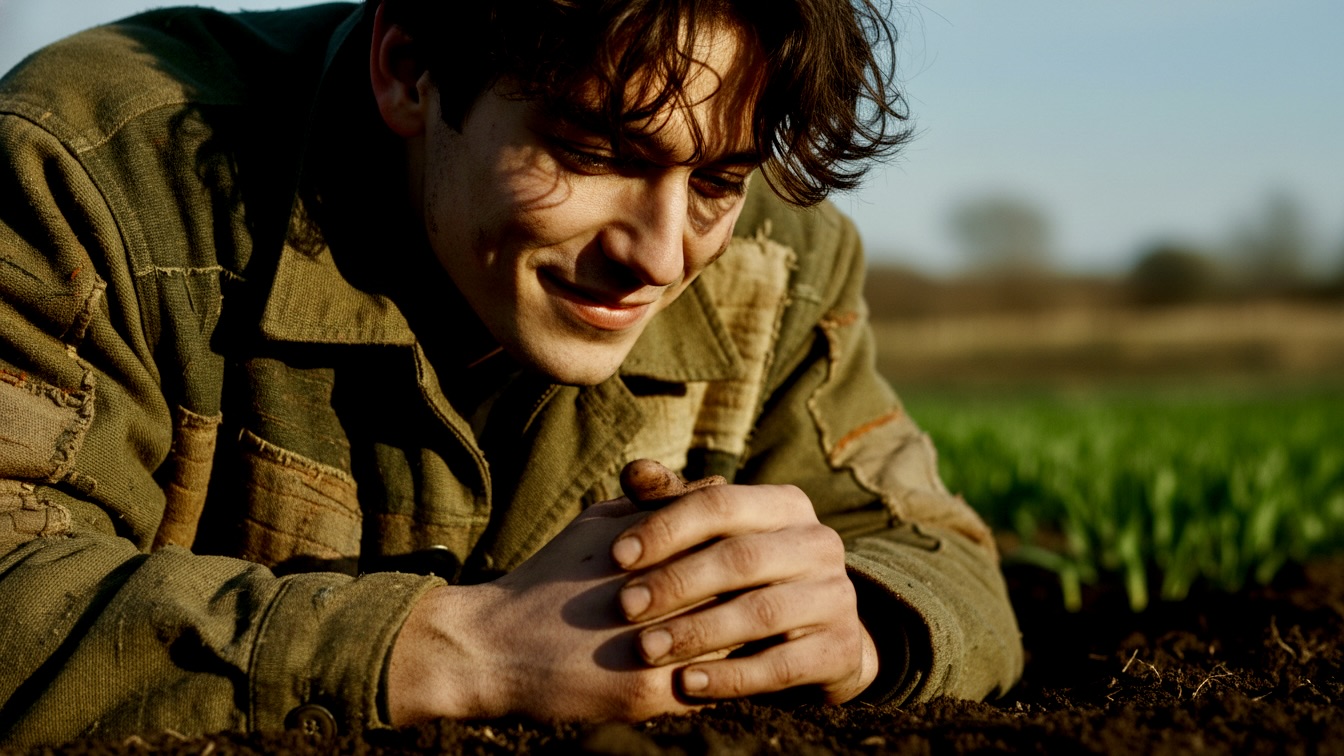
The tarp was slashed, the compost was gone, and I was going to kill him with a trowel.
The blue tarp was slashed down the middle. I stood in the mud, staring at the empty space where forty pounds of premium, grade-A nitrogen compost should have been sitting.
The smell of the garden was overwhelming. After ten years of breathing nothing but recycled bunker air and the sharp, sterile scent of frozen dust, the sudden arrival of spring felt like an assault. The air was thick, wet, and smelled heavily of rotting vegetation and thawing soil. It was disgusting. It was the best thing I had ever smelled in my life.
But the compost was gone.
"I am looking at a crime scene," I said out loud to nobody.
"It is a tragedy," a voice replied from the doorway of the rusted greenhouse.
I did not have to turn around to know it was Nate. He had a habit of appearing exactly when I was already at the edge of losing my mind.
"A true Shakespearean loss," Nate continued, stepping out into the pale morning light. He was wearing a dark jacket that had been patched in four different places with duct tape, and his boots were already caked in fresh mud. He leaned against the aluminum frame of the greenhouse, crossing his arms and putting on a look of deep, theatrical mourning.
"You stole it," I said, tightening my grip on the small metal trowel in my right hand.
"I am falsely accused by a tyrant," Nate said, pressing a hand to his chest. "I am but a humble scavenger. A victim of the spring."
"Nate, I swear to God. I tracked the inventory last night. We had three bags of the high-yield nitrogen mix left. Now we have two. And you are the only person in this entire useless settlement who thinks he can grow mutated tomatoes in the south quadrant."
"I am a visionary," he said. "History will absolve me."
"History is going to watch me bury you under the radish beds," I told him, turning to fully face him.
He smiled. It was a terrible smile, entirely too bright for the bleak reality of our situation. The sun was hitting the side of his face, illuminating the sharp line of his jaw and the tangled mess of dark hair that he absolutely refused to cut. I hated that smile. I hated that it made my stomach do a weird, unhelpful flip.
"You are lowkey unhinged today, Jay," he said, pushing off the greenhouse frame and walking toward me. "It is just dirt."
"It is not just dirt," I argued, pointing the trowel at him like a weapon. "It is the literal foundation of our survival. The winter lasted a decade. Ten years of eating paste and vitamin pills. The soil is finally thawed. The radiation levels are actually manageable. If we do not get these seeds in the ground with the right nutrient balance today, we miss the planting window. And if we miss the window, we starve in October."
"We are not going to starve," he said, his tone shifting just slightly, dropping the theatrical act for a fraction of a second. He stopped a few feet away from me, looking down at the empty spot where the bag had been. "I took it. I admit it. I plead guilty before the court."
"Why?"
"Because my sector has absolutely zero drainage, and the soil acidity is a joke. I needed the buffer."
"You could have asked."
"You would have said no."
"I would have said no because tomatoes are a luxury and radishes are a staple," I said, stepping closer. I had to crane my neck slightly to look him in the eye. "You are compromising the primary food supply for a side project."
"A life without tomatoes is not a life worth living," Nate said solemnly. "It is mere existence. We must strive for flavor, Jay. We must reach for the stars."
"You are an absolute parasite," I muttered, dropping my arm. The energy was draining out of me. The anger was just a cover anyway. I was exhausted. My boots were wet, my back ached from sleeping on a military cot for half my life, and standing this close to Nate was making me acutely aware of how long it had been since I had washed my hair.
"I am a parasite who is going to help you plant these radishes," he offered, gesturing to the flat wooden crates of seeds stacked by the water barrel.
"You do not know how to plant radishes."
"I know that the green part goes up and the dirty part goes down," he said. "I am a quick learner. Put me to work, boss. Let me work off my debt to society."
I stared at him. He looked entirely too pleased with himself. The problem was, I actually needed the help. The designated farming plot was roughly fifty feet by thirty feet of raw, unforgiving mud. Tilling it alone would take until sundown, and my shoulders were already burning just thinking about it.
"Fine," I snapped. "Grab the other trowel. And the bucket. We are doing the trench method."
Nate saluted me. An actual, terrible salute. "Yes, commander."
We moved out into the open plot. The sky above was a pale, washed-out blue, streaked with thin white clouds. It felt enormous. For ten years, the sky had been nothing but a ceiling of gray ash and heavy snow. Being out here, completely exposed to the open air, still triggered a low-level panic response in my brain. Every time a shadow crossed the dirt, my instinct was to run for the bunker doors.
I dropped to my knees in the mud. The wet cold soaked through the fabric of my jeans instantly.
"Disgusting," Nate observed, dropping down next to me. He held his trowel loosely, looking at the dirt as if it had personally offended him.
"Start digging," I told him. "A straight line. Two inches deep. Do not make it crooked."
We worked in silence for the first twenty minutes. The physical labor was brutal. The soil was heavy and dense, thick with rocks and chunks of old concrete from whatever buildings used to stand here before the collapse. Every thrust of the trowel sent a shock up my wrist.
I focused on the rhythm. Dig, scoop, toss. Dig, scoop, toss.
Nate was working beside me, mirroring my movements. He was surprisingly efficient when he actually shut his mouth and focused. I watched him out of the corner of my eye. The muscles in his forearm flexed as he pulled a large, jagged piece of brick out of the trench and tossed it aside.
"You are staring at me," he said, not looking up from the dirt.
I felt my face get hot. "I am supervising. You are making the trench too shallow."
"The trench is perfect. It is a masterpiece of modern engineering."
"It is a ditch, Nate."
"It is a home for the future generation of root vegetables," he corrected, sitting back on his heels and wiping a streak of mud across his forehead with the back of his hand. It made him look ridiculous. It made him look highly attractive. I hated my brain.
"Are we really doing this?" he asked suddenly. The theatrical tone was gone.
I stopped digging and looked at him. "Doing what?"
"This," he said, gesturing vaguely at the mud, the sky, the distant, broken skyline of the old city. "Rebuilding. Planting seeds. Pretending like we are going to start over and get it right this time."
I sat back on my heels, letting the trowel rest in the dirt. The damp cold of the wind hit my neck. "What is the alternative? We just lay down and die?"
"I am just saying," Nate said, leaning forward and resting his elbows on his knees. "Look at the track record. Humanity is a virus. We had a perfectly good planet, and we burned it to the ground because people wanted faster shipping on cheap plastic garbage. Then the bombs fell, the sky froze, and we spent ten years eating each other in the dark. Now the ice melts, and what is our first move? We start fighting over fertilizer. We are the exact same people."
"We are not the exact same people," I argued.
"We are," he insisted. "We are just doing a side quest right now. The main plot is over. We lost the game. We are just wandering around the ruined map, planting radishes and pretending it matters."
I looked down at my hands. They were coated in thick, black mud. My fingernails were broken. I had a scar across my left thumb from a knife fight over a can of peaches five years ago. He was not entirely wrong. The existential dread was always there, hovering just behind my eyes, a constant buzzing static that told me none of this meant anything.
"If it does not matter," I said quietly, "then why did you steal the nitrogen for your tomatoes?"
Nate looked at me. The silence stretched out between us, broken only by the sound of the wind rattling the loose metal sheets on the greenhouse roof.
"Because I wanted to see something red," he said finally. His voice was low. "I have not seen a bright color in ten years, Jay. Everything is gray. The bunker is gray. The sky was gray. The food is gray. I just wanted to grow something that looked alive. I wanted to prove that something could still be beautiful."
My chest tightened. I swallowed hard, looking away from him. It was too much honesty. We did not do honesty. We did sarcasm. We did defensive deflection.
"Take a break," I muttered, reaching into my jacket pocket. "My hands are cramping."
I pulled out a foil-wrapped ration bar. It was the standard issue garbage from the bunker reserves. Compressed oats, synthetic protein, and a chemical binding agent that tasted vaguely like cardboard. I unwrapped it and broke it in half.
I held out one of the halves to Nate.
He took it, our fingers brushing briefly. His skin was warm despite the chill in the air.
"A feast," Nate declared, holding up the gray square of synthetic food. "A culinary triumph."
"Just eat it," I said, taking a bite of my half. It was dry and chalky. It coated the roof of my mouth like dust.
We sat there in the mud, chewing in silence. The wind picked up, cutting through my jacket. I shivered slightly.
Nate noticed. He shifted closer to me. Not touching, but close enough that his body blocked the wind. It was a subtle movement, but the intention was loud.
"We are not going to repeat the same mistakes," I said, staring out at the empty fields. "The people who ruined the world are dead. They burned in the fire they started. We are the ones left. And we know better."
"Do we?" Nate asked softly.
"We have to," I said. "Otherwise, I am going to murder you for stealing my compost, and then the cycle continues."
Nate laughed. It was a real laugh this time, sharp and bright. "I accept those terms. If I start hoarding resources and building a capitalist empire, you have my full permission to hit me with a shovel."
"A trowel," I corrected. "I only have a trowel."
"It will take longer, but the message will be clear," he agreed.
He finished his ration bar and dusted his hands off on his jeans, which accomplished nothing except making his jeans dirtier. "Alright. Let us finish this. Hand me the seeds."
I reached for the packet of radish seeds. They were tiny, hard little spheres. I poured half of them into Nate's open palm.
"Drop them in the trench," I instructed. "About an inch apart. Do not clump them, or they will choke each other out."
We went back to work. This time, there was no hostility. There was just the shared rhythm of the task. We crawled slowly along the trench, dropping the tiny seeds into the dark earth.
It was tedious work. My knees were completely numb. The mud was seeping through my jeans, chilling my skin. But the sun was climbing higher, and the air was slowly warming up.
We reached the end of the first row at the same time.
"Now we cover them," I said.
I reached out to push the loose dirt back over the trench. Nate reached out at the exact same moment.
Our hands collided in the mud.
I froze. My hand was resting on top of his. The wet dirt was squeezed between our fingers. I stopped breathing for a second. The rational part of my brain screamed at me to pull away, to make a sarcastic comment, to deflect. But I did not move.
Nate did not move either. He turned his head to look at me. His face was inches from mine. I could see the exact shade of his eyes—a dark, muddy brown that caught the sunlight and looked almost gold. I could see the faint pulse beating in his neck.
"You missed a spot," he whispered, his voice catching slightly.
"Where?" I asked. My voice did not sound like my own. It sounded thin and fragile.
He turned his hand over under mine, lacing his muddy fingers through mine. The grip was firm. The heat of his skin was a stark contrast to the freezing mud.
"Right here," he said, looking down at our joined hands, and then back up to my face.
My heart was hammering against my ribs. It felt like a trapped bird. All the exhaustion, all the anger, all the cynical armor I wore every single day just dissolved. We were sitting in the ruins of the world, covered in dirt, eating trash, and I had never felt more alive.
I squeezed his hand back.
Nate smiled. A small, genuine, quiet smile. He leaned in, closing the distance between us. I closed my eyes, feeling the warmth of his breath on my cheek.
And then my knee hit the trowel.
The metal tool slid off the edge of the dirt mound and struck the bottom of the trench we had just dug. It did not hit a rock. It did not hit a piece of brick.
It hit metal.
A hollow, resonant clink echoed up from the mud.
I snapped my eyes open, pulling my hand away from Nate's. The moment shattered instantly.
"What was that?" Nate asked, his posture straightening, his survival instincts immediately kicking in.
"I do not know," I said, grabbing the trowel.
I scraped the dirt away from the bottom of the trench. About four inches down, buried beneath the topsoil, my blade scraped against something smooth and silver.
I dug faster, using my hands to clear the mud.
It was a cylinder. About the size of my forearm. It was perfectly smooth, made of a dark, brushed metal that looked entirely untouched by the ten-year winter. There was no rust. There was no decay.
Nate leaned over my shoulder, staring at it. "Is that an unexploded ordnance?"
"I do not think so," I said, my voice tight with sudden panic. "It does not look military. It looks... new."
I reached out and brushed the last layer of dirt off the center of the cylinder.
My thumb swept over a small, glass-like panel.
The metal cylinder under the soil began to emit a high, thin scream, and a red light blinked to life in the mud.
“The metal cylinder under the soil began to emit a high, thin scream, and a red light blinked to life in the mud.”


