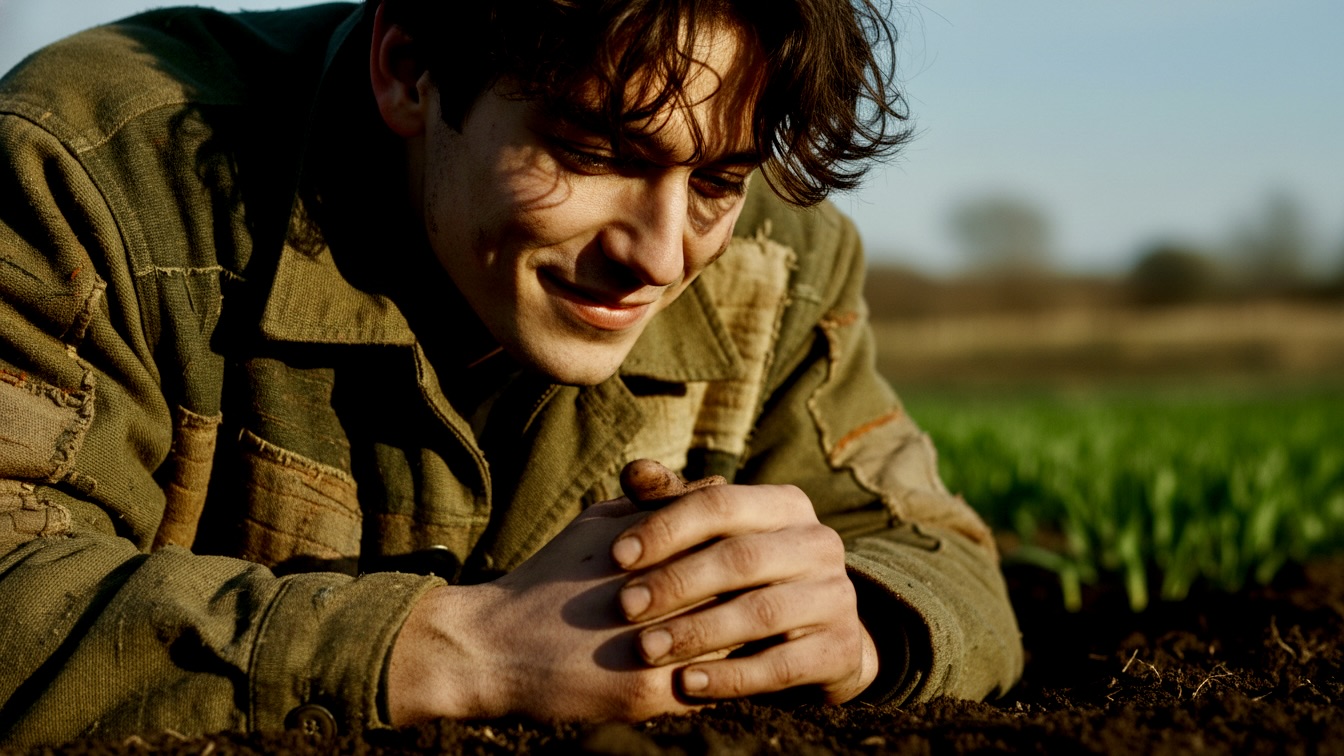
Format: Short Film / Anthology Episode | Est. Length: 10-12 minutes
Imagine a world emerging from a decade of suffocating gray ash, where the first signs of green are as terrifying as they are hopeful. The Thaw is an anthology series that explores the fragile reconstruction of humanity in the immediate aftermath of a ten-year nuclear winter. Each episode focuses on a different micro-conflict within isolated settlements, tracking the psychological transition from bunker-dwelling survival to surface-level cultivation. While the characters struggle with the scarcity of the present, an overarching mystery suggests that the "Old World" left behind automated protocols designed to monitor—or terminate—the resurgence of civilization.
Jay stands in the freezing mud of a post-apocalyptic spring, staring at a slashed blue tarp where forty pounds of life-saving nitrogen compost used to be. The smell of thawing rot is the best thing she has ever smelled, but without that dirt, the settlement will starve by October.
In a world finally thawing after a decade of nuclear winter, two rival survivors must set aside their grievances to plant the crops that will determine their settlement's survival. Their labor unearths a buried remnant of the past that suggests their new beginning is actually a monitored experiment.
The primary theme is the conflict between "Survival" and "Living," represented by the choice between planting radishes for calories or tomatoes for beauty and flavor. It explores whether humanity is doomed to repeat the same cycles of resource hoarding and conflict, or if the shared trauma of the "Ten-Year Winter" has fundamentally changed the species.
The episode also leans into the "Eco-Thriller" genre, highlighting the visceral, disgusting, and beautiful reality of a world reclaiming itself from the ice. It questions the cost of hope in a landscape that has spent a decade being hostile to life, framing every seed planted as an act of defiance against a dead history.
For Jay, the stakes are literal survival; as the settlement’s primary farmer, a failed planting window means a return to the starvation and "paste-eating" of the bunker years. For Nate, the stakes are emotional and spiritual, as he risks his standing in the community to prove that life after the collapse should be defined by more than just caloric intake. If they fail to work together, the settlement loses its only chance at a self-sustaining food supply before the next winter cycle begins.
The external conflict is driven by the scarcity of resources and the unforgiving environment, specifically the heavy, rock-filled mud and the ticking clock of the planting window. Internally, Jay struggles with a cynical defense mechanism that views any hope or beauty as a dangerous distraction from survival. The primary antagonistic force is the "Old World" itself—not just the radiation and ruin it left behind, but the mysterious, high-tech remnants buried beneath the soil that do not want the earth to be disturbed.
Jay discovers that Nate, a "visionary" scavenger, has stolen the settlement's last bag of premium nitrogen compost to fuel his private project of growing mutated tomatoes. After a heated confrontation in a rusted greenhouse, Jay realizes she cannot till the frozen, rocky soil alone and reluctantly accepts Nate’s help to plant a staple crop of radishes. As they labor together in the mud, the initial hostility between them softens into a shared vulnerability, revealing the deep psychological scars left by ten years of living in a gray, sterile bunker.
During a break, Nate confesses that his theft wasn't about greed, but a desperate need to see a color other than gray—the bright red of a tomato. This moment of honesty leads to a tentative romantic connection, which is abruptly shattered when Jay’s trowel strikes a buried object. They uncover a pristine, high-tech cylinder that clearly post-dates the collapse, and as Jay clears the dirt, she accidentally triggers a proximity alarm. The episode ends on a cliffhanger as the device emits a piercing scream and a red light, signaling that they are being watched.
Jay: A rigid, trauma-hardened survivor who has spent her entire adult life in a military-style bunker. Her psychological arc moves from a state of hyper-vigilant cynicism and emotional isolation to a brief, terrifying moment of openness and hope. By the end of the episode, her hard-won sense of security is destroyed not by the environment, but by the realization that the world is still being manipulated by external forces.
Nate: A performative, theatrical scavenger who uses humor and sarcasm to mask his profound grief for the lost world. He begins the episode as a perceived "parasite" and thief, but his arc reveals a sincere, idealistic core that values the quality of life over mere existence. He moves from a state of playful defiance to genuine sincerity, only to be thrust back into survival mode when the buried technology is activated.
Jay discovers the theft of the compost and confronts Nate at the greenhouse, where their ideological clash over "staples vs. luxury" establishes the high stakes of the planting window. Realizing the physical impossibility of tilling the plot alone, Jay forces Nate into manual labor, leading to a grueling sequence of them fighting the rocky, unforgiving earth. During a shared meal of synthetic ration bars, the two characters drop their guards, discussing the "gray" existence of the bunker and the terrifying vastness of the open sky.
As they finish the first row of seeds, a moment of physical contact in the mud leads to a near-kiss, representing the first genuine human connection either has felt in a decade. The romantic tension is instantly broken when Jay’s tool hits a metallic object, shifting the tone from a character drama to a high-stakes sci-fi mystery. They unearth a dark, brushed-metal cylinder that is far too advanced for the current world, and Jay’s touch activates a high-pitched alarm and a blinking red light that illuminates the mud.
The episode begins with a sharp, cold feeling of anger and frustration, mirroring the "wet cold" of the thawing mud. As the characters work, the mood shifts into a rhythmic, meditative exhaustion, allowing for a slow build of warmth and tentative intimacy. The climax provides a brief peak of emotional vulnerability before a violent tonal shift into dread and panic, leaving the audience with a sense of profound unease as the "New Spring" is revealed to be a potential trap.
If expanded, the season would follow Jay and Nate as they realize the cylinder is one of hundreds of "Soil Monitors" buried across the continent by a shadow-government faction still living in high-tech orbital or sub-oceanic stations. The thematic escalation would focus on the "Second Colonization," where the surface survivors must defend their fledgling farms against the very people who destroyed the world and are now returning to "reclaim" it.
Character evolution would see Jay becoming a reluctant leader of the settlement's defense, while Nate’s idealism is tested as he has to choose between his desire for beauty and the violent reality of protecting their home. The season would culminate in the settlement discovering that the "Thaw" was not a natural occurrence, but a terraforming event triggered by the orbital faction to prepare the surface for their own return.
The visual style is characterized by a "Gritty Naturalism" with a desaturated color palette—lots of deep browns, slate grays, and pale blues—to emphasize the bleakness of the post-winter world. Handheld camera work should be used during the labor sequences to create a sense of physical intimacy and struggle, while wide shots of the empty, broken skyline emphasize the characters' isolation. The lighting should transition from the flat, harsh light of a cloudy morning to the warm, golden "magic hour" during their moment of connection, before being invaded by the artificial, rhythmic red strobe of the cylinder.
The tone is a blend of the grounded survivalism seen in Children of Men and the quiet, character-driven tension of A Quiet Place. It avoids "junk-punk" aesthetics in favor of a more realistic, weathered look, where every piece of duct tape on a jacket tells a story of a decade of repair. The sound design is crucial, contrasting the wet, squelching sounds of the mud and the whistling wind with the sudden, jarringly clean electronic scream of the buried device.
The target audience is adult viewers (ages 25-45) who enjoy "prestige" science fiction and post-apocalyptic dramas that prioritize character psychology over spectacle. It appeals to fans of anthology series like Black Mirror or Tales from the Loop, as well as viewers interested in environmental themes and the "solarpunk-adjacent" struggle of rebuilding society from scratch.
The pacing is deliberate and "heavy," mirroring the physical act of digging through mud, with a 12-minute runtime allowing for three distinct acts. Act One (0-4m) establishes the theft and the conflict; Act Two (4-9m) focuses on the labor and the emotional thaw between Jay and Nate; Act Three (9-12m) introduces the sci-fi twist and the cliffhanger. The tempo should feel slow and grounded until the final two minutes, where the editing accelerates to match the characters' rising panic.
The primary production challenge is the creation of the "South Quadrant" set, which requires a large-scale mud pit that is safe for actors to kneel in for extended periods while maintaining a realistic, visceral texture. Practical mud and water effects are essential to ground the story; the "disgusting" nature of the environment must be felt by the audience to make the character's struggle believable.
The buried cylinder should be a high-quality practical prop with integrated LED lighting to ensure the red glow interacts naturally with the mud and the actors' faces. The greenhouse should be a practical location or a highly detailed set piece featuring aged aluminum and "clouded" plastic or glass to create interesting light diffusion during the opening confrontation.


