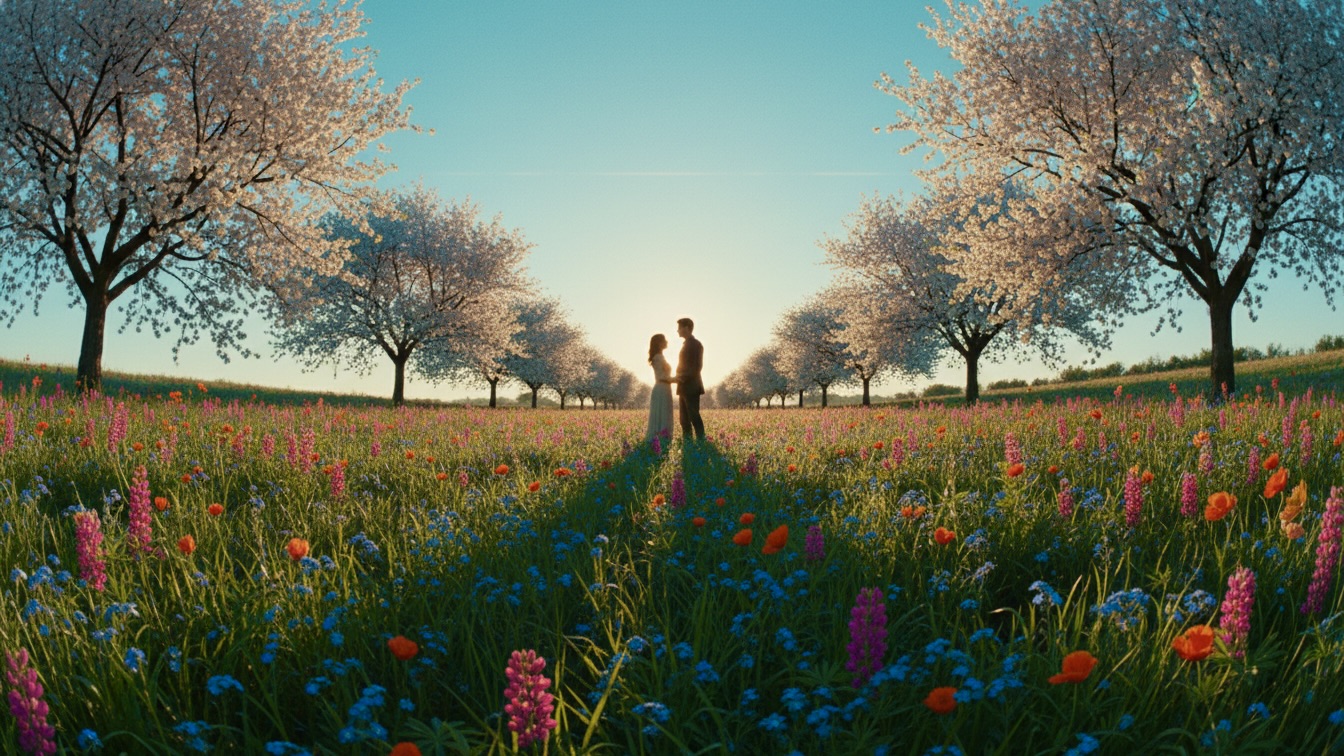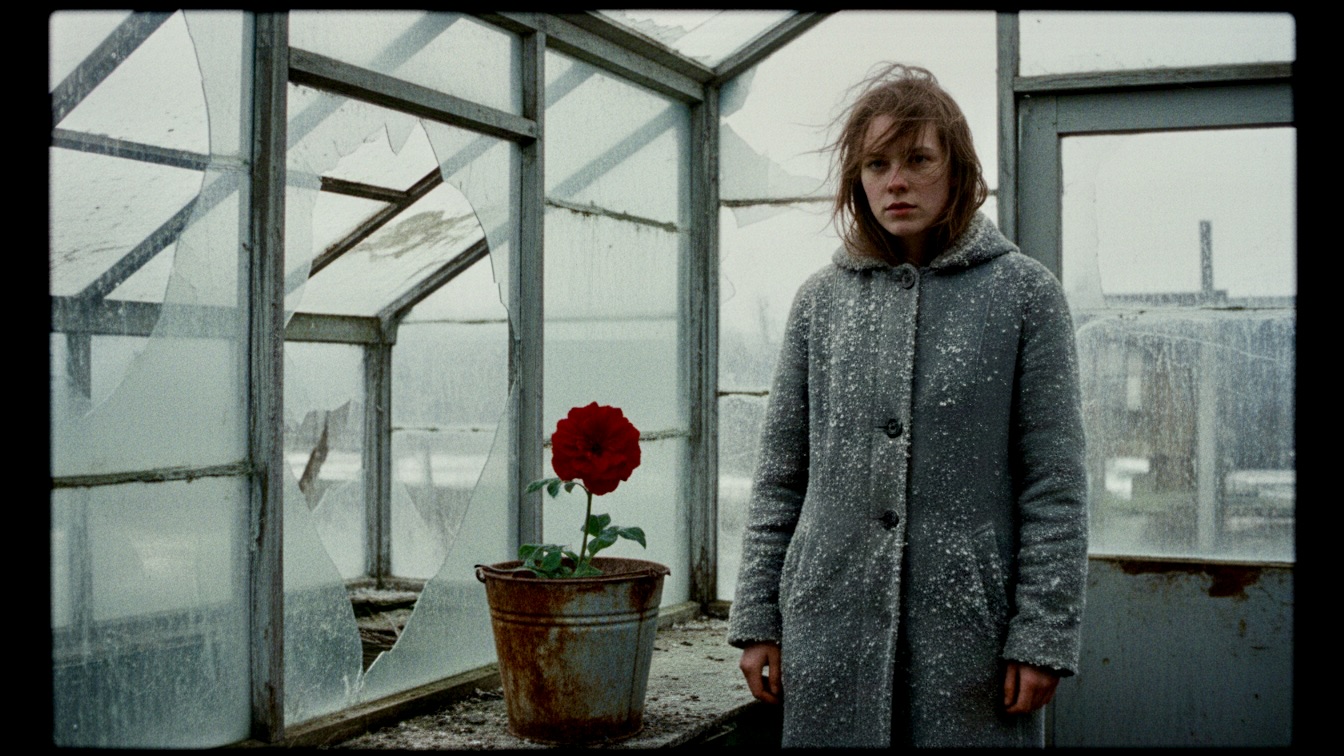
Mia finds a red flower in a frozen greenhouse, sparking a dream of a life she cannot afford.
The wind did not howl. It hissed. It pushed through the gaps in the cracked glass with the sound of a slow leak. Mia stood in the center of the derelict greenhouse, her breath coming out in thin, gray clouds that vanished before they could reach the ceiling. The sky outside was the color of a wet sidewalk, heavy and flat. It was January. Nothing should have been alive here. The dirt in the long-abandoned planters was hard as concrete, frozen solid by a week of sub-zero nights. Everything was gray. Everything was dead. Then she saw the red.
It was a flower. It sat in a rusted metal bucket near the back wall. The petals were a deep, wet red—not the color of a rose, but the color of a fresh cut. It looked out of place, like a high-definition image pasted onto a low-res background. Mia walked toward it. Her boots crunched on shards of glass and frozen moss. The sound was too loud. It felt like the greenhouse was holding its breath, and her footsteps were an insult to the silence.
She stopped a foot away. The light in the room shifted. It didn't get darker because of a cloud; the shadows just changed their weight. In the corner of her eye, a mass of darkness seemed to detach itself from the wall. It didn't move like a person or an animal. It just drifted, a blur of black that felt heavier than the air around it. Mia didn't look at it directly. She knew that if she looked, it would disappear, and the silence would get even heavier. She focused on the flower.
Her fingers were numb, the tips a dull blue. She reached out. Her hand shook. She expected the flower to be cold, to be made of plastic or wax. When her skin touched the petal, it was hot. It was unnervingly warm, like touching a person with a fever. The heat traveled up her arm, through her elbow, and settled in her chest.
Then the world blurred.
The gray sky vanished. The smell of damp rot and frozen dirt was replaced by the scent of clean laundry and expensive coffee. She wasn't in a ruin anymore. She was in a kitchen. It was bright. The light was golden, the kind of light you only see in movies or in your best memories. She felt full. Not just her stomach, but her head. The constant, low-level buzz of anxiety—the bills, the dead-end job, the feeling that the world was ending in slow motion—was gone.
She saw a man. He was standing by a window, looking out at a garden that wasn't frozen. He turned to her. It was Julian. He looked younger, or maybe just less tired. He held a ceramic mug, and the steam curled into the air in a way that felt deliberate and peaceful.
'The coffee is ready, Mia,' he said. His voice wasn't clipped or stressed. It was smooth. It was the voice of a man who had never looked at his bank account and felt sick. 'We have nothing to do today. The schedule is clear. We can just exist.'
Mia felt a sob catch in her throat. It was a physical weight. The dream felt more real than the greenhouse. She could feel the texture of the wooden floor under her feet. She wasn't wearing boots; she was barefoot. She felt the grain of the wood, the warmth of the rug. It was a future that felt like a lie, but she wanted to live in it. She wanted to stay in the kitchen until the sun went down. She wanted the version of Julian who didn't look like he was carrying the weight of a failing city on his shoulders.
But the shadow mass was there, too. In the corner of the bright kitchen, a patch of the wall was flickering. It was a hole in the dream. It was the gray of the January sky trying to leak back in. The silence of the greenhouse started to bleed through the sound of the coffee machine.
'Mia.'
Julian’s voice changed. It became sharper. The golden light flickered.
'Mia, you are touching a ghost. Release it.'
She blinked. The kitchen shattered like a dropped plate. The heat in her arm turned to a stinging burn. She pulled her hand back from the red flower. She was back in the greenhouse. The cold hit her like a physical blow, knocking the air out of her lungs. Her lungs burned. Her feet were back in her salt-stained boots.
Julian was standing five feet away. He wasn't the man from the dream. He was wearing a heavy black coat that looked like it weighed fifty pounds. His face was pale, his eyes rimmed with the red of someone who hadn't slept in forty-eight hours. He didn't look peaceful. He looked like a man standing on the edge of a cliff.
'Your presence in this ruin is an intrusion I did not authorize,' Julian said. His voice was formal, pitched for a theater he wasn't in. It was a defense mechanism. He spoke like he was reciting lines from a play because the real world was too loud to handle.
Mia wrapped her arms around herself, trying to keep the ghost of the dream’s warmth inside. 'The door was open, Julian. Or what's left of the door. I saw the red from the street. I thought it was a fire.'
'It is a fire,' Julian replied. He took a step closer. The shadow mass behind him grew, stretching up the glass wall like ink in water. 'It is a metabolic fire. That plant is consuming the heat of this room to maintain the illusion of life. It is a biological thief. Why were you touching it?'
'I wanted to see if it was real,' Mia said. She felt small. Her voice sounded thin against the vast, empty space of the greenhouse. 'I saw things, Julian. I saw us. In a house. With a kitchen that wasn't falling apart. We were happy. It felt like... like we weren't waiting for something bad to happen.'
Julian’s expression didn't soften. If anything, his face became more like a mask. 'The optics of your hope are catastrophic, Mia. You are dreaming of a future that the budget of reality cannot afford. Look at where we are. The glass is broken. The soil is dead. The city is a corpse under a blanket of snow. To dream of a kitchen is to invite a madness that will eat you from the inside out.'
'It felt better than this,' she snapped. The irony of her own desperation hit her. She was arguing for a hallucination. 'It felt better than standing here in the dark, watching you pretend that you don't care about anything. Why do you talk like that? We aren't on a stage.'
'We are always on a stage,' Julian said. He reached into his pocket and pulled out a pair of heavy leather gloves. He began to put them on, his movements slow and deliberate. 'The world is a performance of decay. If I speak with gravity, it is because gravity is the only thing holding me to the floor. This flower... it is a glitch. A beautiful, dangerous error. It shows you what you want so it can take what you have.'
'And what do I have?' Mia asked. She gestured to the ruins around them. 'I have a cracked phone screen and a job that pays me in stress. I have a room where the heater broke three days ago. If this flower wants to take my misery in exchange for a dream of a warm kitchen, let it.'
Julian stepped into her space. He was taller than her, and he smelled like cold metal and old paper. He looked down at her, and for a second, the theatrical mask slipped. His eyes were wide, full of a frantic kind of fear.
'It doesn't take your misery, Mia. It takes your will. You will sit here in the cold, staring at those red petals, until your heart stops. You will die with a smile on your face because you think you're drinking coffee in the sun. Is that the end you want? A comfortable lie in a frozen grave?'
'Maybe,' she whispered.
The shadow mass moved. It slid across the floor, passing between them. The temperature dropped another ten degrees. Mia shivered so hard her teeth clicked together. The silence in the greenhouse became a roar in her ears. It was a physical pressure, pushing against her eardrums.
Julian grabbed her shoulders. His gloves were rough against her coat. 'Leave this place. Now. The shadow is hungry, and you have made yourself soft with your dreaming.'
'I can't just go back out there,' she said, her voice breaking. 'It’s so gray, Julian. Everything is so gray.'
'Then be gray,' he commanded. His voice was a whip. 'Be cold. Be hard. Survive the winter so you can see the spring, even if the spring is just more mud and rain. The kitchen is a trap. The man in the window is a ghost. I am here. I am cold, and I am real. Choose the reality that hurts.'
Mia looked at the flower. It seemed to glow brighter as the light in the greenhouse failed. It was the only beautiful thing in a five-mile radius. It was a promise. It was a lie. She looked at Julian. He was a mess. He was a collection of sharp angles and bitter words. He was difficult. He was there.
She looked back at the corner. The shadow mass was no longer a blur. It was taking a shape. It looked like a door that led nowhere. It looked like the end of the story.
'I hate it here,' Mia said.
'Good,' Julian replied. 'Hatred is a fuel. It lasts longer than hope.'
He let go of her shoulders and turned toward the flower. He reached out with his gloved hand.
'What are you doing?' she asked.
'I am closing the theater,' Julian said.
He closed his fist around the red flower. He didn't pluck it. He crushed it. The petals didn't tear; they burst. A thick, dark liquid—too dark to be sap—leaked through his fingers. The heat in the room vanished instantly. The red glow died.
Mia felt a sharp pain in her chest, as if something had been ripped out of her. The memory of the kitchen flickered and turned to ash. She couldn't remember the color of the rug anymore. She couldn't remember the smell of the coffee. It was gone.
Julian stood over the bucket, his hand dripping with the dark fluid. He looked older than he had five minutes ago. The shadow mass behind him settled, merging back into the darkness of the walls. The silence was no longer unnatural. It was just the quiet of an empty building.
'It's done,' Julian said. He didn't look at her. 'The illusion has been liquidated.'
'You didn't have to do that,' Mia said, though she knew he did.
'The cost of keeping it was too high,' he said. He wiped his hand on his coat. 'Go home, Mia. Lock your door. Turn on your broken heater. Feel the cold. It is the only thing telling you that you are still alive.'
He turned and walked toward the exit, his heavy coat swaying. He didn't look back. He moved like a man who had won a battle he never wanted to fight.
Mia stood alone in the center of the greenhouse. The red was gone. The world was gray again. She looked down at the floor, at the crushed remains of the flower. A single petal remained, stuck to the side of the rusted bucket. It wasn't red anymore. In the dying light, it looked black.
She reached out to touch it, one last time, just to see if the heat was truly gone.
Before her finger could make contact, the shadow in the corner moved again, not toward the wall, but toward her feet, stretching out like a hand reaching for a gift.
“Before her finger could make contact, the shadow in the corner moved again, stretching toward her like a hand reaching for a gift.”