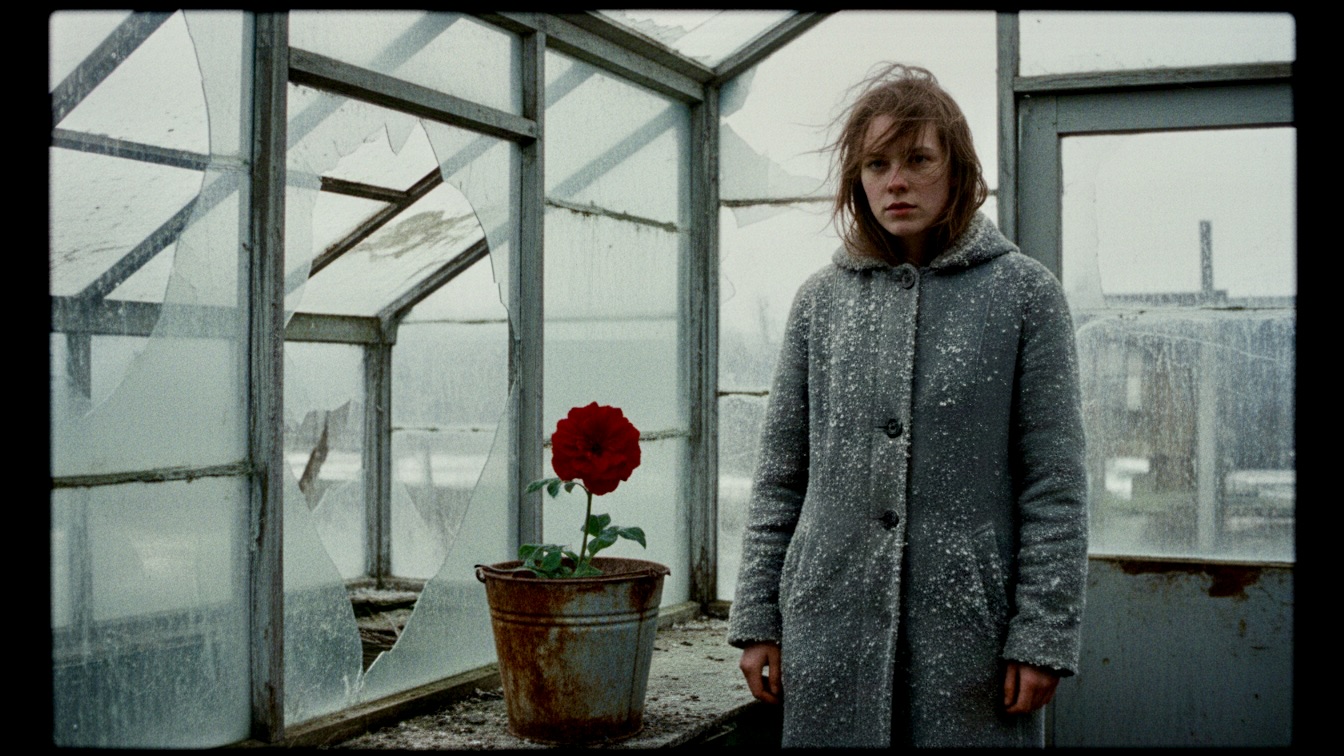
The story follows Mia as she enters a derelict, freezing greenhouse in the dead of January, a place defined by its gray decay and oppressive silence. Within this ruin, she discovers a vibrant, unnervingly warm red flower that acts as a sensory portal, transporting her to a vivid, idealized domestic reality where she is reunited with a peaceful version of Julian. This hallucination offers a respite from her bleak, anxiety-ridden life, but it is shadowed by a dark, amorphous entity that threatens to consume her. Julian appears and forces her to confront the danger of the illusion, ultimately destroying the flower to break the spell. The chapter ends with the return of the harsh, cold reality, leaving Mia with a lingering, ominous connection to the shadow that once haunted the room.
The central theme of the narrative is the tension between the seductive nature of escapism and the brutal necessity of objective reality. The red flower serves as a metaphor for a narcotic hope, a beautiful anomaly that promises comfort at the cost of one's agency and life force. By framing this hope as a "budget of reality" that cannot be afforded, the text suggests that the human capacity for dreaming is a dangerous luxury in a world defined by systemic decay. The struggle is not merely against the cold, but against the temptation to surrender one's consciousness to a painless, artificial existence.
Furthermore, the story explores the concept of performance as a psychological defense mechanism. Julian views the world as a stage where he must maintain a rigid, performative gravity to prevent his own psychological collapse. This indicates that identity is often a fragile construct maintained by externalizing one's pain and treating one's own life as a role to be played. The shadow mass represents the inevitable consequence of this suppression, suggesting that when individuals refuse to acknowledge their internal darkness, it manifests as an external, predatory force that waits to claim them.
Mia is a character defined by a profound sense of existential exhaustion and a desperate longing for stability. Her internal state is characterized by a "low-level buzz of anxiety," which makes her susceptible to the siren call of the flower. She is not merely looking for a better life; she is seeking an escape from the burden of her own consciousness. Her willingness to trade her life for a "comfortable lie" highlights the depth of her despair and her rejection of a reality that offers nothing but coldness and struggle.
Despite her vulnerability, Mia possesses a latent defiance that manifests when she argues with Julian. She recognizes the irony of her own desperation, acknowledging that she is clinging to a hallucination precisely because the alternative is so unbearable. Her final act, reaching toward the shadow at the end of the chapter, suggests a complex relationship with her own destruction. She is not a passive victim, but a woman who is actively curious about the void because it feels more honest than the gray, empty life she is forced to endure.
Julian is a man who survives through extreme emotional compartmentalization and the adoption of a theatrical persona. He perceives the world as a site of total collapse, leading him to adopt a tone of formal, rhythmic detachment. His fear is not of death, but of losing the ability to maintain his mask, which is why he reacts to the flower with such visceral, violent rejection. He is a protector, yet his protection is cold and punishing, rooted in the belief that only suffering can prove one's existence.
Beneath his rigid exterior, Julian is terrified of the same emptiness that threatens Mia. His insistence that "hatred is a fuel" reveals his own reliance on negative emotions to anchor himself to the world. He forces the reality of the cold upon Mia because he cannot bear the thought of her succumbing to a dream he knows he could never participate in. He is a tragic figure, a man who has traded his warmth and his humanity for a grim, functional survival.
The narrative utilizes sharp, sensory-driven prose to ground the reader in the hostile environment of the greenhouse. The contrast between the "hissing" wind and the "clean laundry" scent of the hallucination creates a jarring, effective juxtaposition that mirrors Mia’s internal disorientation. The author employs a cold, precise vocabulary that emphasizes the metallic and structural decay of the setting, which effectively translates the external environment into a reflection of the characters' internal states.
The pacing is deliberate, slowing down during the moments of hallucination to allow the reader to feel the weight of the golden light, before abruptly shattering the dream with the harsh, stinging reality of the cold. This sudden shift in tone—from the cinematic warmth of the kitchen to the stark, biting reality of the greenhouse—mirrors the psychological trauma of waking from a dream. The use of the shadow as a recurring, shifting motif adds a layer of gothic dread, ensuring that the reader remains unsettled even during the most peaceful moments of the narrative.


