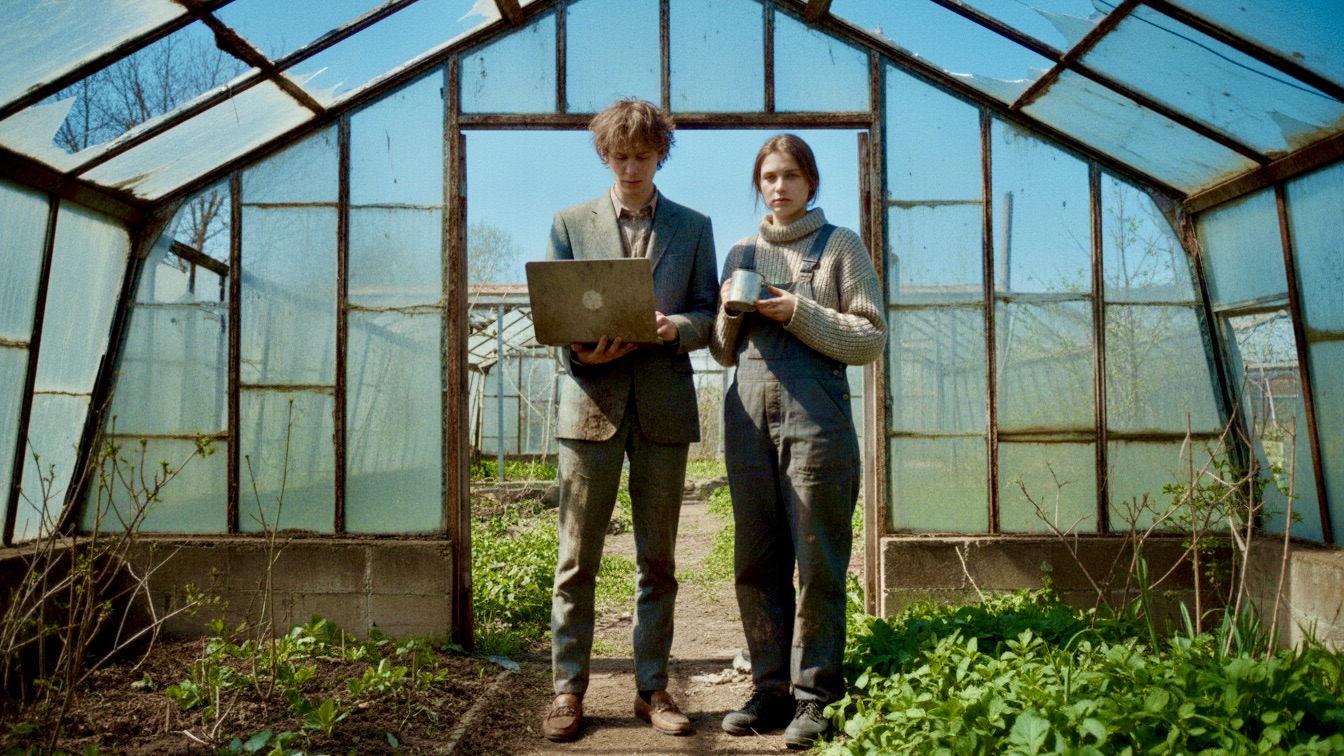
Paul stepped into the freezing spring mud, his corporate life dissolving inside a broken greenhouse.
The GPS on Paul's phone lost its signal three miles ago. He was navigating blindly down a dirt road that was currently losing a battle against the spring thaw. April in the northeast was a scam. It looked like spring on the calendar, but out here in the rural fringe, it was just wet winter. The snow banks on the side of the road were melting into piles of dirty slush, bleeding gray water into the deep ruts of the road. His sedan hit a pothole. The suspension groaned. Paul's head snapped forward, his jaw clenching as his teeth clicked together.
He parked the car near a rusted mailbox that hung off a rotting wooden post. The engine ticked as it cooled. Paul sat in the driver's seat for a long moment. He stared at the steering wheel. He felt a dull, rhythmic thud behind his eyes. He had not slept a full night in four months. His suit, purchased a year ago when he actually cared about his job at the bank's commercial appraisal division, hung loosely on his frame. He was twenty-four. He felt fifty. He grabbed his clipboard from the passenger seat. The metal clip was freezing.
He opened the car door. The wind hit him immediately. It was a sharp, biting cold that smelled like wet pine needles and ozone. He swung his legs out. His right foot found the ground. Or rather, it found a deep puddle of freezing mud hidden beneath a thin layer of ice. The ice cracked. His foot plunged down. The cold brown water instantly topped the edge of his shoe, soaking his sock and instantly freezing his ankle.
"Perfect," Paul said to the empty road.
He dragged his foot out of the mud. He looked down at his ruined leather loafers. They were expensive. Or they used to be. Now they were just two wet sacks of regret. He slammed the car door shut. He began the walk up the long, winding driveway toward the property.
This was supposed to be a standard foreclosure finalization. The bank owned the debt. The owner defaulted. Paul took pictures, signed the forms, and the bulldozers came next week to pave it over for a regional distribution center. It was simple. It was brutal. Paul used to feel bad about it, but the burnout had calcified his empathy into a hard, protective shell of absolute apathy. He just wanted to go back to his city apartment, eat cold takeout, and stare at the ceiling until his alarm went off.
He crested the hill. The property came into view. It was a massive, sprawling commercial greenhouse complex. Or at least, it had been. Most of the glass panes were cracked or missing entirely. The steel frames were rusted brown and orange. It looked like the skeleton of a dead whale washed up on a hill. But there was something strange. Deep inside the central structure, a weird, erratic purple light was flashing. It did not look like an electrical short. It looked deliberate. It blinked in a bizarre, unpredictable rhythm. A glitch in the dead landscape.
Paul frowned. He walked toward the main entrance. The mud sucked at his ruined shoes with every step. He reached the heavy metal door of the central greenhouse. The handle was cold iron. He pulled it open.
He stepped inside.
The sensory shock was immediate. The air was heavy. It smelled intensely of wet earth, rotting vegetation, and something sharp, like crushed mint. The temperature dropped. Outside, the sun was trying to shine, but inside, the shadows were thick. He took three steps down the center aisle. The floor was covered in spilled potting soil and dead vines.
"I am requesting that you halt your advance immediately," a voice rang out.
Paul stopped. He blinked, his eyes adjusting to the gloom.
Standing at the far end of the aisle was a woman. She was holding a heavy steel wrench. She wore thick, mud-stained coveralls over a heavy wool sweater. Her hair was a dark mess pulled back with a piece of twine. She looked twenty-three, but her eyes held the frantic, wired energy of someone who had survived on black coffee and spite for a week straight. This was Mabel. The owner on the file.
"Mabel Thomas?" Paul asked, reading from his clipboard. He hated how his voice echoed.
"I am the sole proprietor of this facility, yes," Mabel said. Her voice was sharp. Theatrical. She did not sound like someone losing her family business. She sounded like a general directing a siege.
"I am Paul from the regional appraisal office. I am here to finalize the property assessment for the foreclosure. You were sent three notices."
"I received three pieces of corporate fiction," Mabel replied. She stepped sideways. She moved toward a heavy, rusted lever mounted on the wall near the frame of the door Paul had just walked through.
"It is not fiction," Paul said, his patience instantly evaporating. His foot was freezing. His head hurt. "It is a legal mandate. I just need to take five pictures of the structural damage and I will leave. You have until Tuesday to vacate the premises."
"I have until Tuesday to save a century of botanical history," Mabel countered. She grabbed the rusted lever. "And you are going to help me."
"I am absolutely not doing that," Paul said.
"We will see," Mabel said. She pulled the lever down with all her weight.
A loud mechanical screech echoed through the greenhouse. A heavy iron crossbar slammed down over the main door behind Paul. The sound of a massive industrial padlock clicking into place echoed off the glass walls.
Paul spun around. He stared at the barred door. He walked back to it. He grabbed the handle and pulled. It did not move. He pushed against it with his shoulder. It was solid steel. He turned back to face Mabel.
"What are you doing?" Paul demanded. His stomach turned over.
"Securing an audience," Mabel said. She dropped the wrench onto a wooden potting table.
"I am going to call the police," Paul said. He reached into his coat pocket and pulled out his phone. He stared at the screen. The signal bar was completely empty.
"There is no signal in here," Mabel said, crossing her arms. "The glass is reinforced with a lead-mesh wire from a 1970s agricultural experiment. It blocks all cellular transmission. Welcome to my presentation."
Paul stared at her. He felt a spike of genuine panic, quickly followed by a massive wave of exhausted anger. "This is a kidnapping."
"This is a mandatory seminar on ecological preservation. You are the sole attendee," Mabel said. She gestured to the rows of dead and dying plants around them. "And we have a lot of material to cover."
"I am requesting, formally, that you unlatch this door before I am forced to shatter your vintage glass," Paul stated. His voice shook slightly. The cold was seeping through his wet sock, traveling up his leg.
"You are welcome to try, Paul," Mabel said. She gestured to the wall. "But that is industrial wire-mesh glass. You will simply shatter your collarbone. I suggest you sit down. I have a thermos of tea."
Paul did not sit down. He walked over to the nearest pane of glass. He looked at it. He could see the thick wire grid embedded inside the thick pane. He grabbed a heavy clay pot from a nearby table. He swung it hard against the glass. The pot shattered into dust. The glass did not even scratch.
Paul dropped the remaining piece of clay. He turned around. He looked at Mabel. She was watching him with a look of mild amusement.
"Are you finished?" she asked.
"You are insane," Paul said.
"I am desperate," Mabel corrected. She walked over to a small camping stove set up on a metal workbench. She struck a match. A small blue flame hissed to life. She placed a battered tin kettle over the fire. "Do you genuinely believe a piece of paper signed by a mid-level manager dictates the worth of a century of root systems?"
"I believe the sheriff with the eviction notice thinks so," Paul replied. He walked down the aisle toward her. He needed to stay near the stove. The temperature in the greenhouse was dropping as the sun dipped behind the clouds outside.
"The bank wants to pave this over for a distribution center," Mabel said, ignoring his sarcasm. "Do you know what is growing in the back quadrant?"
"Weeds," Paul guessed.
"A highly localized strain of perennial ryegrass that has adapted to hyper-polluted soil," Mabel said, her eyes wide. "It can literally eat industrial runoff. If I can isolate the genetic marker, I can patent it. I just need six more months. The bank will not give me six days."
"The bank does not care about grass," Paul said. He crossed his arms, trying to trap his body heat. He shivered. His wet foot was completely numb now. "The bank cares about the three hundred thousand dollars your father borrowed against this land before he died. The bank cares about the missed payments."
"My father was a visionary, not an accountant," Mabel said. She poured hot water into two dented tin cups. She handed one to Paul.
He did not want to take it. He wanted to maintain his authority. But his fingers were stiff and white. He took the cup. The heat burned his palms. It felt incredible.
"Drink," Mabel ordered. "You are shivering so hard your suit is vibrating."
Paul took a sip. It was an aggressively bitter herbal tea. It tasted like dirt and mint. He drank half of it immediately.
"You cannot keep me here," Paul said, his voice quieter now. The fight was draining out of him. He was just so tired.
"I will let you out when you agree to help me," Mabel said. She leaned against the workbench. The strange purple light from the back of the greenhouse blinked again, casting long, weird shadows across her face.
"Help you do what?"
"Stop the foreclosure."
"I cannot do that. I am an appraiser. I am literally the bottom of the corporate ladder. I just take pictures."
"You have access to the county portal," Mabel said. Her tone shifted. It became calculating. "You have the administrative login to file the final assessment."
Paul stopped drinking. He stared at her over the rim of the tin cup. "How do you know that?"
"I read the technical manuals for the county appraisal software," Mabel said, waving a hand dismissively. "It is boring, but informative. I know how the system works. If a property is flagged as a heritage site before the final appraisal is logged, it freezes all commercial development for an automatic eighteen months pending review."
Paul felt his jaw lock. "You want me to commit a federal offense."
"I want you to file a digital form," Mabel corrected. "It is a heritage site. This greenhouse was built in 1922."
"It needs proper documentation. It needs historical society approval. I cannot just check a box."
"You can if you attach the preliminary approval forms," Mabel said.
"Which you do not have."
"Which we are going to forge," Mabel said.
Paul stared at her. The silence stretched. The only sound was the hiss of the camping stove and the wind rattling the heavy glass panes. Paul felt a strange sensation in his chest. It was absurd. The whole situation was completely unhinged. He was standing in a freezing greenhouse with a ruined shoe, holding a cup of dirt tea, listening to a madwoman propose a felony.
And yet, for the first time in four months, he did not feel numb. He felt entirely, terrifyingly awake.
"No," Paul said. He set the cup down on the bench. "Absolutely not. Open the door."
Mabel did not move. She looked at him. She really looked at him. Her eyes scanned his face, tracking the dark circles under his eyes, the hollow look in his cheeks, the rigid, unnatural way he held his shoulders.
"You are dying," Mabel said quietly.
"I am twenty-four," Paul snapped.
"You look forty. Your soul is a gray cubicle. You do not even care about this foreclosure. You do not care about the bank. You just want to go back to your apartment and stare at the wall because it is the only thing that does not ask anything of you."
Paul felt a sharp pain in his throat. He swallowed hard. "You do not know me."
"I know the look," Mabel said. She stepped closer to him. The theatricality dropped from her voice. She sounded grounded. Real. "I saw it in my father at the end. The absolute exhaustion of trying to play by rules that are designed to crush you. You are wearing a suit that does not fit, working a job you hate, to pay for an apartment you never spend time in. You are completely empty, Paul."
Paul backed up a step. His heel hit a wooden crate. He stopped. His heart was hammering against his ribs. She was right. It was the absolute truth. He hated the bank. He hated the spreadsheets. He hated the fake emails and the fake meetings and the fake life he was living.
"If I forge the documents, I will lose my job," Paul said. His voice was a whisper.
"Good," Mabel said. "It is a terrible job."
"I could go to jail."
"The county historical society is run by three people over the age of eighty. They check their email once a month. By the time they realize the preliminary approval is fake, the eighteen-month freeze will be legally binding. I will have my patent. I will pay off the bank. The fraud will become irrelevant."
Paul looked around the greenhouse. He looked at the dead plants. He looked at the weird purple light flashing in the back. It was a UV growth lamp, he realized. It was struggling to stay on, fighting a bad electrical connection. It was trying to keep something alive.
He looked back at Mabel. She was standing there, covered in dirt, completely defiant against a system that was about to erase her. She was chaotic, illegal, and entirely alive.
Paul pulled his phone out of his pocket. He looked at the blank signal bar. He looked at the battery. Forty percent.
"My laptop is in my bag," Paul said. "I have the county templates downloaded locally. If we draft the documents offline, I can upload them the second I get a signal."
Mabel smiled. It was a bright, dangerous smile. It completely changed her face.
"You are making a very poor career choice, Paul," she said.
"My career is already dead," Paul said. He reached into his coat and pulled out his laptop. He set it on the metal workbench next to the camping stove. He opened the lid. The screen glowed to life, casting a harsh white light over the dirt and rust.
"Okay," Mabel said, stepping next to him. She leaned in close. He could smell the mint and the damp earth on her clothes. "We need to backdate the initial petition to October."
Paul opened the appraisal software. He bypassed the network warning and opened the local file cache. He found the heritage template. His fingers hovered over the keyboard. His hands were shaking. It was not from the cold anymore.
"If we backdate it to October, we need a fake signature from the regional director," Paul said, his mind shifting into problem-solving mode.
"I have his signature from the eviction notice," Mabel said. She grabbed a crumpled piece of paper from her pocket and slammed it onto the table. "Copy it."
Paul looked at the signature. He looked at the digital document. He started typing. They worked in silence for twenty minutes. The cold continued to creep into the greenhouse, but Paul barely felt it. He was hyper-focused. He drafted a completely fabricated historical assessment of the property. He cited the 1922 architectural style of the steel beams. He cited the unique soil composition. He used all the empty, meaningless corporate jargon he had learned at the bank and weaponized it against them.
"Add a section about the cultural significance of the rural agricultural sector," Mabel instructed, pointing at the screen.
"That is too broad. It will trigger an automatic review by the state board," Paul said, deleting her suggestion. "We keep it hyper-local. We claim the site is necessary for municipal drainage studies."
"You are surprisingly good at lying," Mabel noted.
"I write commercial real estate appraisals," Paul said without looking up. "Lying is the entire industry."
He finished typing. He attached the forged signature. He compiled the file into a secured PDF. He attached it to his final appraisal report. He checked the box marked 'HERITAGE FREEZE PENDING'.
He stared at the screen. The button to finalize the report was glowing blue. Once he hit it, the file would queue up. The second his laptop connected to the internet, it would send. The foreclosure would halt. The bank would lose millions in delayed development. He would be an accomplice to fraud.
Paul looked at his ruined leather loafers. He looked at the mud on his trousers. He looked at Mabel.
"Are you ready?" she asked quietly.
Paul did not hesitate. He pressed the enter key. The software chimed. The file was queued.
"It is done," Paul said. He closed the laptop.
Mabel let out a long breath. She reached out and grabbed his shoulder. Her grip was strong. "Thank you."
Paul looked at her hand on his shoulder. He felt a sudden, sharp jolt of electricity that had nothing to do with the cold. He looked up at her face. The irony and the sarcasm were completely gone from her expression. She looked incredibly relieved.
"Open the door," Paul said. His voice was softer now.
Mabel nodded. She walked over to the rusted lever. She pushed it up. The heavy iron crossbar groaned and lifted. The padlock clicked open. Mabel grabbed the handle and pulled the heavy metal door open.
The bright, clear spring sunlight poured into the greenhouse. It cut through the gloom, lighting up the dust motes in the air. The smell of the melting snow and the pine trees rushed back in.
Paul picked up his laptop bag. He walked toward the door. He stepped out into the sunlight. The cold wind hit him, but he did not care. He turned back to look at Mabel.
"You have to come to the city," Paul said.
"Why?"
"Because we need to file the hard copies at the county clerk's office before Tuesday, or the digital freeze will void out."
Mabel leaned against the doorframe. She smiled again. "Are you asking me on a felony date, Paul?"
"I am instructing you on the proper execution of municipal fraud," Paul said. He adjusted the strap of his bag. "I will pick you up on Monday morning. Wear something that does not smell like compost."
"I make no promises," Mabel called out.
Paul turned and walked down the muddy driveway. His right shoe squelched with every step. His suit was ruined. His career was over. His chest felt lighter than it had in years. He hit send on the forged document as his phone caught a signal, the digital seal locking them into a felony and a future.
“He hit send on the forged document as his phone caught a signal, the digital seal locking them into a felony and a future.”


