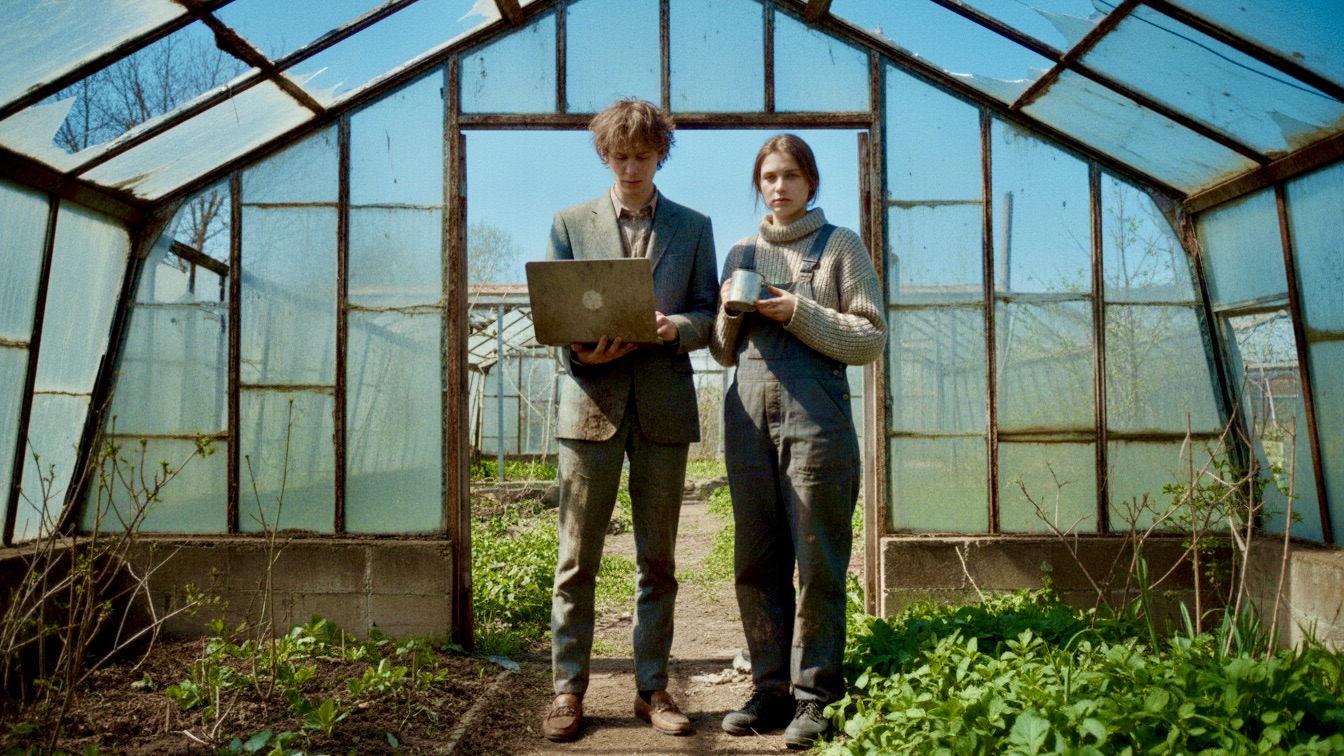
Format: Short Film / Anthology Episode | Est. Length: 10-12 minutes
This story serves as a standout episode in an anthology series titled The Paper Trail, which explores the lives of low-level bureaucrats who encounter radical acts of defiance within the mundane machinery of corporate law. Each episode centers on a different professional—appraisers, clerks, or auditors—who find their sterile, data-driven worlds colliding with the messy, vibrant realities of the people they are tasked with displacing. The series maintains a consistent focus on the friction between cold institutional power and the desperate, often illegal, creativity of the individuals fighting to survive on the rural and urban fringes.
A burnt-out bank appraiser ruins his expensive shoes in a freezing mud puddle only to find himself locked inside a decaying, signal-dead greenhouse by a woman wielding a heavy steel wrench.
A cynical bank appraiser is taken hostage in a crumbling greenhouse by a desperate botanist fighting a brutal foreclosure. To regain his freedom, he must choose between his dying career and a daring act of municipal fraud that could save a century of history.
The primary theme explores the soul-killing nature of modern corporate life and the "gray cubicle" existence that strips individuals of their empathy and agency. It contrasts the rigid, calculated world of finance with the chaotic, life-affirming struggle of ecological preservation, suggesting that true living often requires a radical break from societal expectations.
Secondary themes include the value of legacy versus profit and the concept of weaponized bureaucracy. The story posits that the same meaningless corporate jargon used to displace people can be repurposed as a tool for rebellion, turning the system’s own complexity against itself.
For Paul, the stakes are both professional and existential: he risks a prison sentence for federal fraud and the loss of his livelihood, but the alternative is continuing a slow emotional death in a job he loathes. For Mabel, the stakes are absolute, as she faces the imminent destruction of her family’s century-long botanical legacy and the loss of a potentially world-changing scientific discovery. If Paul fails to act, the greenhouse will be bulldozed for a distribution center, erasing her father’s work and her only means of survival.
The external conflict is a high-stakes "chamber piece" struggle between Paul’s need to escape and Mabel’s physical containment of him within a lead-mesh structure that blocks all communication. The primary antagonistic force is the faceless bank and the legal timeline of the foreclosure, which acts as a ticking clock throughout the episode. Internally, Paul battles his own calcified apathy and the fear of consequences, while Mabel fights the crushing weight of debt and the exhaustion of her solitary crusade.
Paul, a twenty-four-year-old bank appraiser who feels fifty, arrives at a derelict greenhouse complex in the freezing Northeast thaw to finalize a foreclosure. His expensive loafers are ruined by mud, and his spirit is equally dampened by months of corporate burnout and lack of sleep. Upon entering the skeletal glass structure, he is confronted by Mabel, the property owner, who uses a mechanical lever to lock him inside a signal-dead zone, forcing him to listen to her plea for the survival of her botanical research.
Mabel reveals she has developed a strain of ryegrass capable of cleaning industrial runoff, but she needs eighteen more months to secure a patent that the bank refuses to grant. After a tense confrontation where Mabel strips away Paul's professional mask and exposes his inner emptiness, Paul decides to help her. Using his administrative access and knowledge of corporate loopholes, he forges a heritage site application that triggers an automatic legal freeze on the foreclosure, choosing a life of meaningful crime over a life of hollow obedience.
Paul (The Apathetic Agent): Paul begins the story as a hollowed-out shell of a man, defined by his ill-fitting suit and a "hard, protective shell of absolute apathy" brought on by his role in the bank’s commercial appraisal division. By the end of the episode, his psychological arc moves from cold detachment to a terrifyingly awake state of rebellion, as he regains his agency through a deliberate act of fraud.
Mabel (The Desperate Visionary): Mabel is a high-energy, caffeine-fueled survivor who has spent a week straight on "black coffee and spite" to protect her father’s legacy. She starts as a theatrical, almost manic antagonist, but reveals a grounded, deeply perceptive core when she identifies Paul’s internal rot. Her arc is one of successful recruitment, moving from a position of solitary desperation to finding an unlikely ally in the very system trying to crush her.
Paul navigates a muddy, pothole-ridden road in the rural Northeast, ruining his expensive leather loafers in a freezing puddle before reaching the skeletal remains of a massive greenhouse. The physical discomfort of his wet feet and the biting cold mirror his internal state of exhaustion and corporate burnout as he prepares for a routine foreclosure. He enters the central structure, which is filled with the scent of rotting mint and the erratic flashing of a purple UV light, signaling that this is not a standard abandoned property.
Mabel emerges from the shadows with a wrench and pulls a rusted lever, slamming an iron crossbar over the door and trapping Paul in a cellular dead zone. Paul’s initial panic turns into exhausted anger as he realizes he is being held for a "mandatory seminar" on ecological preservation. He attempts to shatter the industrial wire-mesh glass with a clay pot, but the glass holds, forcing him to accept Mabel’s offer of bitter tea and listen to her ultimatum.
Mabel reveals her secret research into pollution-eating ryegrass and accurately diagnoses Paul’s "gray cubicle" soul, forcing him to confront the misery of his own life. She proposes a plan to forge a heritage site freeze using Paul’s administrative login, weaponizing the bank’s own bureaucratic complexity to buy her eighteen months of time. Paul initially resists the idea of a federal offense, but the realization that his career is already a "terrible job" leads him to open his laptop and begin the forgery.
Working together by the light of a camping stove, Paul and Mabel draft a fabricated historical assessment, using corporate jargon to justify a "Heritage Freeze Pending" status. Paul backdates the documents and forges the regional director’s signature, feeling a surge of focus and adrenaline that replaces his long-standing numbness. He hits the enter key to queue the file for upload, effectively ending his career and beginning his life as a co-conspirator.
Mabel opens the iron door to let the spring sunlight flood the greenhouse, and the two share a moment of mutual respect and relief. Paul instructs Mabel to meet him in the city to file the hard copies, framing their upcoming legal battle as a "felony date." He walks away down the muddy driveway, his phone catching a signal and sending the forged document, his chest finally feeling light despite his ruined suit and squelching shoes.
The episode begins with a cold, desaturated mood of "wet winter" misery and physical discomfort, establishing a tone of heavy, rhythmic exhaustion. As the trap is sprung, the mood shifts into a sharp, claustrophobic tension characterized by shadows and the eerie purple pulse of the UV lamp. The emotional core of the story warms during the central dialogue, moving from hostility to a shared, conspiratorial heat, ending on a note of bright, defiant hope as the characters step out into the spring sunlight.
If expanded, the season would follow Paul and Mabel as they navigate the eighteen-month freeze, constantly staying one step ahead of bank investigators and the county historical society. Paul would use his position within the bank to sabotage other predatory foreclosures, while Mabel works to prove the scientific validity of her ryegrass to secure the patent that will save the property legally.
The thematic escalation would involve the duo building an underground network of "bureaucratic insurgents" who use their low-level access to protect vulnerable sites. Each episode would introduce a new challenge—a suspicious auditor, a physical threat from developers, or the internal strain of their secret life—leading to a climax where they must choose between total anonymity or a public stand against the financial institution.
The visual style is defined by "Rural Noir" aesthetics: high-contrast lighting, deep shadows, and a color palette that shifts from the muddy grays and browns of the exterior to the vibrant, sickly purples and deep greens inside the greenhouse. The camera work should be handheld and intimate during the confrontation, emphasizing the characters' claustrophobia, before opening up into wide, stable shots when the door is finally unlatched.
The tone is a blend of cynical corporate satire and high-stakes thriller, comparable to the dry, procedural tension of Better Call Saul mixed with the atmospheric isolation of 10 Cloverfield Lane. It maintains a grounded, realistic feel while allowing the "mad scientist" energy of Mabel’s greenhouse to provide a touch of heightened, botanical surrealism.
The target audience consists of adults aged 25-45 who are familiar with the pressures of modern professional life and the feeling of being a "cog in the machine." This demographic resonates with themes of burnout, the desire for a radical life change, and "David vs. Goliath" stories where the underdog wins through wit rather than brawn. It appeals to viewers who enjoy smart, dialogue-driven dramas with a strong sense of place and a rebellious streak.
The episode is paced as a rapid-fire chamber piece, with the first three minutes establishing the atmosphere and the "trap," followed by a six-minute central dialogue that serves as the emotional and narrative engine. The final three minutes focus on the "heist" element of the forgery and the resolution, maintaining a brisk tempo that mirrors Paul’s transition from lethargy to hyper-focus. The 10-12 minute runtime ensures that the tension remains taut without the need for unnecessary subplots.
The primary production requirement is a weathered, industrial-style greenhouse set that feels both massive and claustrophobic, featuring practical "wire-mesh" glass and a heavy iron door mechanism. The "purple light" mentioned in the text should be achieved through flickering, high-intensity UV LED panels to create a rhythmic visual motif that underscores the "glitch in the landscape" feel of the setting.
Special attention must be paid to the sound design, particularly the "mechanical screech" of the iron crossbar and the "muddy squelch" of Paul’s shoes, which serve as auditory anchors for his discomfort. The transition from the muffled, heavy atmosphere of the locked greenhouse to the crisp, airy soundscape of the outdoors in the final scene is crucial for conveying the protagonist's emotional release.


