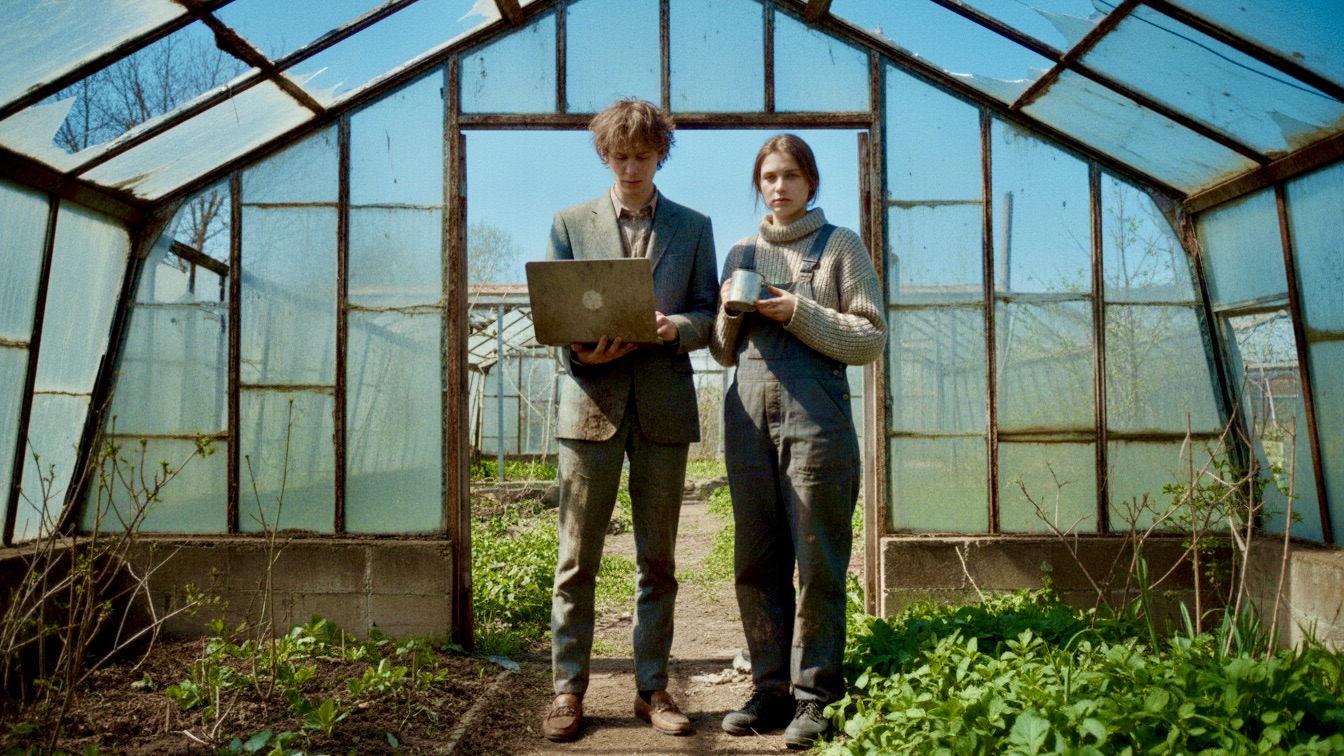
The narrative follows Paul, a twenty-four-year-old commercial appraiser for a bank, as he travels to a remote, decaying greenhouse to finalize a foreclosure. Burnt out and emotionally numb, Paul’s day begins with the symbolic ruin of his expensive leather loafers in a freezing mud puddle. Upon entering the skeletal remains of the greenhouse, he is confronted by the owner, Mabel Thomas, who refuses to yield her family’s legacy to corporate interests. Mabel traps Paul inside the signal-blocking structure, forcing him to listen to her plea for a stay of execution based on a unique, pollution-eating strain of ryegrass she has developed.
As the interaction progresses, Mabel strips away Paul’s professional facade, diagnosing his profound existential exhaustion. She proposes a desperate plan to forge a digital "Heritage Freeze" that would stall the foreclosure for eighteen months. Recognizing the hollowness of his current life and the vitality of Mabel’s cause, Paul chooses to sabotage his own career. He uses his technical knowledge to fabricate the necessary documents, effectively committing a felony to save the greenhouse. The story concludes with the two characters forming an unlikely alliance, as Paul finds a renewed sense of purpose through their shared criminal act.
The central theme of the story is the conflict between corporate sterility and the messy, vital reality of human passion. Paul represents the "gray cubicle" existence, where life is measured in spreadsheets, missed payments, and legal mandates. His world is one of "calcified empathy," where the human cost of a foreclosure is hidden behind administrative jargon. In contrast, Mabel and her greenhouse represent a decaying but living history that refuses to be paved over. The story suggests that the modern corporate structure is a predatory force that consumes both the land and the souls of those who serve it.
Another prominent theme is the concept of rebirth through destruction. Paul’s journey begins with the literal ruin of his shoes, which serve as a metonymy for his professional identity. For his soul to be "reawakened," his career and his adherence to the law must be destroyed. The "ruined" loafers are not a tragedy but a necessary shedding of a false skin. By committing fraud, Paul is not falling into ruin; he is escaping the slow rot of his previous life. The act of forgery becomes a creative endeavor that allows him to feel "entirely, terrifyingly awake" for the first time in months.
The narrative also explores the theme of ecological preservation as a form of resistance. Mabel’s work with the hyper-polluted soil suggests that life can adapt to and even thrive within the messes created by industrialism. This mirrors the human condition portrayed in the story; Paul is a product of a "polluted" corporate environment, yet he finds a way to adapt and find meaning through Mabel’s intervention. The greenhouse, described as the "skeleton of a dead whale," acts as a liminal space where the old world of the bank and the new world of Mabel’s scientific vision collide and transform.
Paul is a character defined by profound psychological burnout and a sense of premature aging. At only twenty-four, he experiences the world with the exhaustion of a man decades older, a physical manifestation of his "calcified empathy." His internal state is mirrored by his physical environment; the "dull, rhythmic thud" behind his eyes and his clenching jaw indicate a man who is constantly braced for a blow that has already landed. He has become a ghost in his own life, moving through a routine of cold takeout and staring at ceilings, suggesting a dissociative response to a career that demands he participate in the destruction of others' livelihoods.
His decision to help Mabel is not a sudden lapse in judgment but a desperate act of self-preservation. When Mabel tells him his soul is a "gray cubicle," she voices the truth he has been suppressing. Paul’s compliance with the forgery is a rebellion against the "rules that are designed to crush you." By weaponizing the very corporate jargon he once used to facilitate foreclosures, he reclaims his agency. The shift in his demeanor—from shivering and numb to hyper-focused and "lighter"—shows that his involvement in the felony is a curative process for his depression.
Mabel serves as the narrative’s catalyst, a "visionary" who operates on a frequency of "black coffee and spite." She is the psychological mirror to Paul; where he is hollow and apathetic, she is overflowing with frantic, wired energy. Her theatricality and the act of trapping Paul highlight her desperation, but her intelligence and calculation reveal a woman who is far from insane. She understands the systems that threaten her and recognizes that the only way to defeat a bureaucratic machine is to jam its gears with its own technicalities.
Psychologically, Mabel possesses a keen ability to read others, likely born from her own experiences with loss and struggle. She bypasses Paul’s professional defenses by targeting his obvious physical and emotional decay. She does not just want to save her plants; she wants to save a century of "root systems," which represents her connection to her father and her heritage. Her "bright, dangerous smile" at the end of the story indicates that she is a person who thrives in high-stakes environments, finding a kindred spirit in Paul’s willingness to burn his old life down.
The author utilizes a stark, sensory-heavy prose style to establish the oppressive atmosphere of the story. The description of April as a "scam" and "wet winter" sets a tone of cynicism and disappointment that reflects Paul’s internal state. Sensory details such as the "smell of wet pine needles and ozone" and the "bitter herbal tea" that tastes like "dirt and mint" ground the narrative in a physical reality that contrasts with the abstract world of banking. These details emphasize the "sensory shock" Paul experiences, pulling him out of his numbness and back into a world where things have texture and consequence.
Pacing in the story moves from a sluggish, heavy opening to a frantic, focused middle section. The initial descriptions of the mud and the "rotting wooden post" mirror Paul’s lethargy and the slow death of his career. However, once the door is locked and the "mandatory seminar" begins, the dialogue becomes sharp and rhythmic. The technical descriptions of the forgery process are handled with a precision that reflects Paul’s "problem-solving mode," creating a sense of momentum that mirrors the characters' rising adrenaline.
The use of light as a motif is particularly effective in signaling the story's shifts in mood. The "erratic purple light" of the UV lamp represents the struggling, glitchy hope of Mabel’s project, cutting through the gloom of the "skeletal" greenhouse. As the story concludes, the "bright, clear spring sunlight" that pours through the opened door symbolizes a moment of clarity and liberation. The final image of the "digital seal" locking the characters into their shared future provides a definitive, satisfying end to the narrative arc, transitioning from the gray water of the opening to the bright light of a new, albeit criminal, beginning.


